The Huntsman’S Son
The Huntsman’S Son: A long, long time ago there lived in a little hut on the borders of a great forest a huntsman and his wife and son. From his earliest
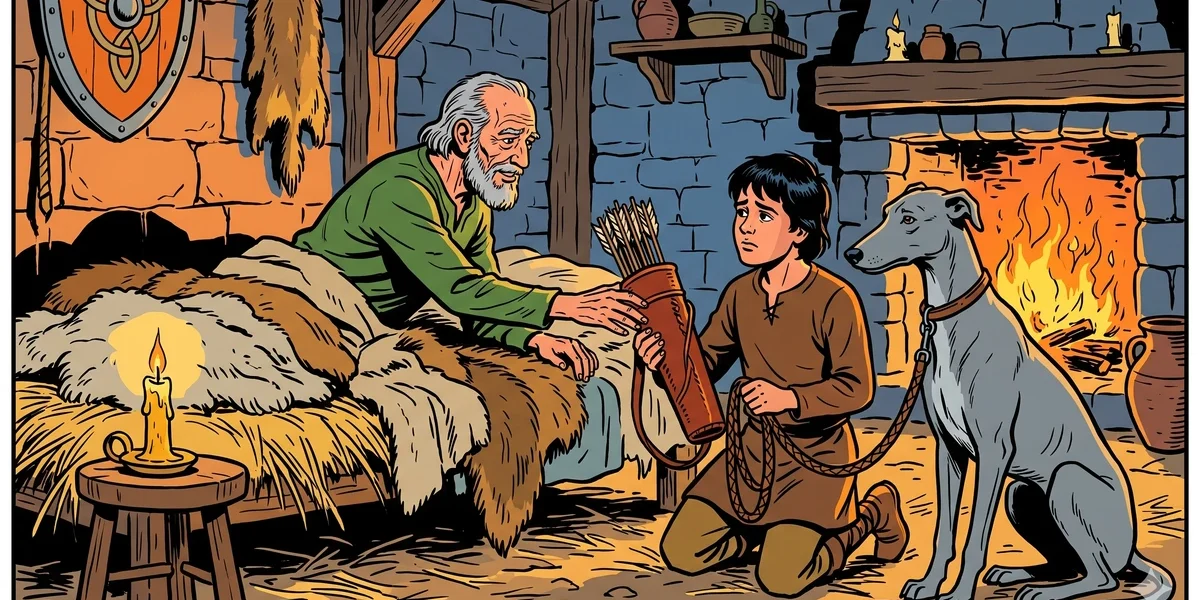
Few narrative traditions in the Celtic world are as richly layered as those revolving around the children of skilled hunters—figures who inherit both practical cunning and a peculiar proximity to the supernatural frontier between the human settlement and the wild forest. “The Huntsman’s Son” is one of the most celebrated of the Irish folktales that explores this liminal inheritance. Preserved in oral tradition across Connacht, Munster, and Ulster, its various tellings share a common skeleton: a young man, orphaned or otherwise deprived of his father’s living guidance, must rely on uncanny gifts—an enchanted hound, a magical weapon, or the counsel of a mysterious stranger—to overcome trials that would destroy any ordinary hero. The tale belongs to the wider pan-Celtic type sometimes catalogued under ATU 300 (The Dragon-Slayer) and ATU 532 (I Don’t Know), yet it carries distinctively Irish colouring in its treatment of fírinne (truth), loyalty between master and animal companion, and the hero’s gradual discovery of his own hidden lineage.
Scholars such as Séamus Ó Duilearga, who compiled vast quantities of West Munster lore in the mid-twentieth century, noted that huntsman narratives occupied a special prestige niche in the Irish storytelling hierarchy. Where a farmer’s son might win a princess by cleverness alone, the huntsman’s son was expected to demonstrate both physical courage and an intimate knowledge of the natural world—a knowledge coded in the tradition as a kind of second sight. This essay examines the tale’s structure, its mythological antecedents in the Fenian and Ulster cycles, its comparative resonances with Welsh, Breton, and Scottish Gaelic parallels, and the cultural values it encodes for its audiences across the centuries.
Synopsis and Structural Analysis
The most widely circulated version of “The Huntsman’s Son” opens with an ageing huntsman who has served a local king or chieftain faithfully for many years. On his deathbed the huntsman bequeaths his son three objects: a worn leather quiver that never empties of arrows, a hound of supernatural speed named Bran or Sceolan (names borrowed consciously from the Fenian cycle), and a single piece of advice—to trust no promise made at a crossroads after dark. The son, whose name varies across tellings but is most commonly given as Ciarán, Diarmaid, or simply “the lad,” sets out to seek his fortune.
The tale divides naturally into three movements. In the first, Ciarán encounters a series of tests that establish his moral character: he shares his food with a starving beggar who is later revealed to be a shape-shifting supernatural helper; he refuses to kill a white deer that speaks in a human voice; and he resists the temptation of a merchant who offers to buy the magical quiver. Each refusal or act of generosity accumulates a form of invisible credit that the story will later cash in.
The second movement introduces the antagonist—most commonly a giant (a fomhóire in older tellings, or simply a monstrous stranger) who has laid waste to a kingdom by demanding a tribute of cattle and young women. The king, desperate, promises his daughter to whoever can slay the monster. Ciarán, armed with his father’s quiver and guided by the supernatural hound, pursues the giant across bogs, mountains, and finally into an underground realm beneath a lake—a geography that immediately evokes the Otherworld topography of the Tuatha Dé Danann’s hollow hills.
In the third movement, Ciarán defeats the giant in a combat that often involves a sympathetic magic element: the giant’s life is stored in an egg hidden inside a succession of nested creatures (a motif known to folklorists as the “external soul” or the Kashchei motif, most familiar from Russian tales but thoroughly naturalized in Irish tradition). The huntsman’s son must locate the egg, crack it, and thus destroy the giant’s animating principle. He then rescues the captive women, returns with proof of his victory, and—crucially—resists a false claimant (a treacherous nobleman or knight who tries to steal credit for the deed) before being publicly vindicated and marrying the princess.
Mythological Roots: The Fenian Cycle and the Hunter-Hero
To understand why a huntsman’s son carries such narrative weight in Irish folklore, it is necessary to trace the archetype back to its mythological origins. The most obvious ancestor is Fionn mac Cumhaill himself, whose father Cumhall was a warrior-chieftain slain before Fionn’s birth, forcing the child to grow up in secret in a forest under the tutelage of the druidess Bodhmall and the warrior woman Liath Luachra. Fionn’s early years are spent learning the arts of the hunt, and his first great exploit—the salmon of knowledge—arises directly from this forest education. The pattern is clear: the father’s violent absence, the forest as school, the acquisition of an extraordinary gift (often involving an animal or food), and the eventual return to claim a rightful place in society.
The hound that accompanies Ciarán in “The Huntsman’s Son” is explicitly Fenian in its associations. Fionn’s hounds Bran and Sceolan were, according to the Dindshenchas and later prose romances, not ordinary animals but his own cousins transformed by a jealous enchantress. Their loyalty to Fionn was therefore doubly charged—simultaneously canine devotion and familial bond. When Irish folktale assigns a supernaturally loyal hound to the huntsman’s son, it is invoking this entire mythological complex and suggesting, without stating directly, that the hero may have a noble or even divine lineage he has yet to discover.
The motif of the never-emptying quiver connects the tale to the Ulster Cycle as well. In the story of Cú Chulainn’s training with Scáthach on the Isle of Skye, the hero receives weapons of supernatural potency that are explicitly linked to his identity—they can only be wielded by him and will destroy any lesser hand that grasps them. The huntsman’s quiver operates by the same logic: it functions perfectly for Ciarán, who is its destined owner, but would become useless in another’s hands. This is the Irish equivalent of the Arthurian sword in the stone—a test of legitimate inheritance expressed through the language of the hunt rather than kingship.
The Otherworld Beneath the Lake
The descent of the huntsman’s son into the realm beneath the lake is the tale’s most cosmologically significant episode. Irish mythology consistently locates the Otherworld—Tír na nÓg, Mag Mell, Tír fo Thuinn (the Land Beneath the Wave)—in liminal geographical zones: beneath islands, inside mountains, beyond the western horizon, and, most relevantly for this tale, under bodies of water. Lakes in particular serve as thresholds. Lough Derg, Lough Ree, and numerous smaller lakes in Connacht and Ulster are each associated in local tradition with the entrances to underground palaces, and many hero tales hinge on a plunge through reflective water into a world that mirrors yet inverts the world above.
In “The Huntsman’s Son,” the giant’s underground palace typically contains architectural details that signal its Otherworldly character: the light comes from gems in the ceiling rather than windows; time moves differently (a night spent below may equal a week above); and the captive women are not merely imprisoned but are in some versions being gradually transformed—forgetting their human language, learning to see in the dark. This transformation motif underscores the urgency of rescue: delay too long and the women become citizens of the Otherworld, no longer repatriable to the human realm.
The giant himself is typically described in terms borrowed from the mythological Fomorians—the ancient, dark, pre-Tuatha races associated with chaos, blight, and the hostile aspects of nature. By defeating this figure, Ciarán does not merely rescue a princess; he re-enacts the primordial victory of order over chaos that structured Irish cosmogony. The tale is thus simultaneously a personal coming-of-age narrative and a ritual re-affirmation of the cosmic order that sustains agricultural and social life.
Notably, the hound plays a crucial role in the underground sequence. In several Ulster variants, it is the hound who first locates the egg containing the giant’s external soul—sniffing it out from its hiding place inside a series of nested animals (fish within a chest, bird within a fish, egg within a bird) with a precision that no human sense could replicate. The dog’s involvement reconnects the hero to his father’s craft: hunting, at its deepest level, is the skill of reading invisible signs, following a trail through darkness, and locating what is hidden. The supernatural hound makes this epistemological claim literally true.
The External Soul Motif: Cross-Cultural Resonances
The motif of a villain whose life force is stored outside his body—in an egg, a jewel, a distant object—is one of the most widely distributed elements in world folklore. The Russian Kashchei the Deathless hides his death in a needle inside an egg inside a duck inside a chest buried beneath an oak on a distant island. The Norse Hrungir’s heart is of stone and located outside his chest. The Egyptian Set conceals his power in a distant location. In Irish tradition, the external soul appears not only in folktales but in mythological texts: the Dagda’s club, which killed and revived at the wielder’s will, functions as an analogous repository of power separated from the body.
The specifically Irish inflection of the motif in “The Huntsman’s Son” is the nested animal sequence. While the Russian and Scandinavian versions tend toward inanimate objects (chests, islands), the Irish version emphasises a chain of living creatures, each containing the next—a structure that has been read by scholars including Alan Bruford as a metaphor for the layers of the natural world that a true hunter must penetrate. The huntsman’s son, trained from birth to track animals, is precisely the right kind of hero to unravel an animal-based puzzle. His father’s skill, passed down through the magical quiver and the loyal hound, gives him the key.
Comparative analysis reveals additional resonances with Welsh and Breton material. The Welsh tale of Lleu Llaw Gyffes in the Mabinogion similarly involves a hero whose death can only be brought about through an elaborate conditional chain—he can be killed neither by day nor night, neither indoors nor outdoors, neither on horseback nor on foot. Lleu’s enemy Gronw must meet every condition simultaneously, and the resolution involves a complex spatial arrangement. Like the nested animals of the Irish tale, this structure encodes a puzzle that only lateral thinking (or supernatural assistance) can solve. The hero’s triumph is as much intellectual as physical.
The False Claimant: Truth, Honour, and Social Order
The episode in which a false claimant tries to usurp Ciarán’s victory is structurally essential and culturally revealing. In most versions, the false claimant is a nobleman of higher social standing—a knight, a lord’s steward, or even a prince—who arrives at the court with the giant’s severed head (which he has obtained from Ciarán while the hero slept, or which he has found abandoned) and declares himself the champion. The king, deceived by the claimant’s rank and bearing, is on the point of giving him the princess when Ciarán returns and presents his proofs: the tongue of the giant (he has cut it out before surrendering the head, a motif found in ATU 300 tale-type variants across Europe), the testimony of the rescued women, or some token known only to the true victor.
This episode resonates deeply with Irish legal and social ideology. Early Irish law (Brehon law) placed enormous emphasis on fírinne—truth as both a moral and a cosmic principle. The king who makes a false judgment was believed to cause natural disasters: cattle diseases, crop failures, storms. The false claimant episode therefore raises stakes beyond mere personal injustice: by nearly rewarding a liar, the king risks destabilising the entire realm. Ciarán’s vindication is not just his personal triumph; it is the restoration of the cosmic truth-principle that legitimate social order requires.
The detail of the giant’s tongue—often overlooked in retellings aimed at children—is particularly rich. The tongue is the organ of speech, of oath-taking, of story. By retaining it, Ciarán retains the evidence of the true narrative against the false one. He is, in a sense, keeping custody of the real story. This is a profound reflexive gesture within a tale that is itself concerned with preserving a true account against distortion—the huntsman’s son as guardian of narrative truth as well as of political justice.
The Loyal Hound: Animal Companions in Celtic Tradition
No analysis of “The Huntsman’s Son” would be complete without sustained attention to the role of the magical hound. Dogs occupy a position of unusual complexity in Irish mythological and folkloric tradition. On one hand, they are associated with the chthonic and the dangerous: the name of Ulster’s champion Cú Chulainn means “Hound of Culann,” a title he acquires after killing the guard dog of the smith Culann and agreeing to serve in its place—a moment that simultaneously marks his entry into the warrior class and his assumption of a semi-animal identity. On the other hand, dogs are the most loyal of domestic companions, the bridge between the human settlement and the wild, and their acute senses give them access to information unavailable to human perception.
In “The Huntsman’s Son,” the hound embodies both poles of this ambiguity. It is dangerous—in several versions it kills one of the false claimant’s followers who tries to seize it—but its loyalty to Ciarán is absolute. The relationship between boy and dog is the tale’s emotional core. When Ciarán descends into the Otherworld, it is the hound who leads and who returns to guide him out. When Ciarán is falsely accused, the hound refuses to acknowledge the false claimant. The animal’s loyalty is a form of moral testimony—a non-verbal assertion of truth that supplements and eventually enables the verbal proof of the severed tongue.
This doubled testimony—animal and object—reflects a broader pattern in Irish narrative in which the natural world participates in human justice. Trees groan when heroes lie beneath them. Ravens speak. The earth itself can be called as a witness. The enchanted hound of the huntsman’s son is the most intimate instance of this principle: nature, in the form of the hunter’s companion, recognises and upholds the true order of things when human social perception fails.
The hound’s name—Bran in many versions—adds another layer. Bran is also the name of the Irish mythological voyager whose tale (the Imram Brain) is the oldest surviving Irish Otherworld journey narrative, and the name of the Welsh sea god whose severed head continues to speak. By naming the hound Bran, the storyteller connects it to a cluster of mythological associations around wisdom, Otherworldly travel, and the persistence of identity beyond physical death. The hound, like the severed head of Bran in Welsh tradition, continues to guide and protect even in extreme circumstances.
Regional Variants and the Living Tradition
The tale has been recorded in substantively different forms across Ireland’s provinces, and these variations illuminate the local priorities of different storytelling communities. In Connacht versions collected by Lady Gregory and Douglas Hyde at the turn of the twentieth century, the emphasis falls heavily on the hero’s journey to the west—to islands that may or may not be visible from the shore—and the giant is sometimes replaced by an enchanted prince who must be freed from a curse rather than slain. The Connacht tradition, shaped by the Atlantic horizon and its suggestion of the Isles of the Blessed to the west, tends to soften the violence and foreground the theme of transformation and restoration.
Ulster variants, collected by William Carleton and later by the Irish Folklore Commission fieldworkers, are generally darker and more combative. The giant remains unambiguously monstrous; the combat is brutal and extended; and the hero’s victory is more explicitly a matter of superior craft and courage rather than the accidental discovery of a magical solution. These versions reflect the martial ethos of the Ulster Cycle and the tradition of heroic boasting poetry that persisted longer in the north. The huntsman’s son in Ulster tellings is less the lucky innocent of the Connacht versions and more the competent professional warrior-hunter whose skills are equal to any supernatural challenge.
Munster versions, particularly those from the Dingle Peninsula and the Iveragh Peninsula collected by Ó Duilearga and his colleagues, often incorporate a love interest that the other regional variants downplay. Here the princess is not merely a prize but an active participant: she sends a secret message to Ciarán during his imprisonment (in some versions it is he, not she, who is briefly captured), or she recognises him from a dream she has had before they meet. This romantic elaboration connects the Munster tale to the wider tradition of aislinge (vision poetry) in which the sovereignty goddess appears to the predestined king in a dream. The huntsman’s son, by marrying the dream-princess, fulfils a destiny that was written before his birth.
The Tale as Initiation Narrative
Structurally and symbolically, “The Huntsman’s Son” is most coherently understood as an initiation narrative—a ritual journey from boyhood to full adult status. The stages correspond closely to the classic van Gennepian schema of separation, liminality, and reincorporation. Ciarán separates from his father’s house at the tale’s opening; he spends its middle section in a liminal zone characterised by danger, shapeshifting, and the temporary suspension of ordinary social rules (the Otherworld beneath the lake is the liminality made spatial); and he returns at the end to be reincorporated into society at a higher level—as son-in-law of the king, as the realm’s champion, as the inheritor of a lineage now publicly acknowledged.
The father’s three gifts—quiver, hound, advice—function as the ritual equipment for this initiation. In traditional initiation ceremonies worldwide, the initiate is given objects or marks that identify his new status and give him access to powers unavailable to the uninitiated. The quiver never empties because Ciarán is the destined hunter; the hound is loyal because it recognises his identity; the advice about crossroads is the social wisdom that allows him to navigate the adult world of ambiguous promises and dangerous strangers. These are not merely practical tools; they are emblems of a transformed identity.
The combat with the giant is the ritual ordeal at the heart of the initiation. In many traditional initiation rites, the novice undergoes a symbolic death and rebirth—often represented as a descent into darkness or the belly of a monster. Ciarán’s descent beneath the lake, his combat in the darkness of the giant’s hall, and his return to the surface bearing proof of his victory enact this death-and-rebirth structure with unusual literalness. He goes down as a boy, a huntsman’s orphaned son with an uncertain future. He returns as a man who has confronted the worst the world can offer and survived, whose father’s skills have proved adequate and more, and whose identity—social, moral, and perhaps divine—has been publicly confirmed.
Legacy and Continuing Relevance
“The Huntsman’s Son” has not only survived in the living oral tradition but has influenced a range of later literary and artistic productions. W.B. Yeats drew on the imagery of the enchanted hound and the underground hunt in several poems, most notably in his treatment of the Oisín legend. Lady Gregory’s retelling of Fenian material in Gods and Fighting Men (1904) incorporates structural elements clearly derived from the huntsman’s son tale type. In more recent decades, the tale has been adapted for children’s literature, for theatrical performance, and for animated productions, each adaptation making different choices about which elements to preserve and which to transform for contemporary audiences.
The scholarly literature on the tale reflects broader debates in Celtic studies and comparative folklore. Stith Thompson’s motif index provides a useful skeletal framework, but critics including Patricia Lysaght and Bo Almqvist have argued that the truly distinctive features of Irish narrative tradition are lost when tales are reduced to motif strings. The emotional texture of the hound’s loyalty, the cosmological weight of the lake-descent, the juridical complexity of the false claimant episode—these are not separable motifs but an integrated moral and aesthetic vision that requires sustained cultural analysis to appreciate.
For contemporary Irish storytellers and educators, “The Huntsman’s Son” offers a narrative that speaks directly to enduring questions about inheritance and identity. What do we owe our parents? How do we learn to trust gifts we did not ask for? How do we navigate a world in which power and truth do not automatically align? The huntsman’s son answers these questions not through philosophical argument but through action—through the making of choices under pressure, the maintenance of loyalty in darkness, and the patient accumulation of evidence for a truth that the world initially refuses to see. In this it remains, across all its regional variations and all the centuries of its telling, a tale of urgent and practical wisdom.
“The Huntsman’s Son” endures because it understands something fundamental about the relationship between skill, loyalty, and justice. The father’s craft is not lost when the father dies; it lives in the objects he leaves behind, in the animal he has trained, and in the habits of attention he has cultivated in his son. The Otherworld is dangerous but not unconquerable. The false claimant may temporarily succeed, but the truth, like an arrow from a never-emptying quiver, will find its mark in the end. In the long history of Irish storytelling, this has been a consolation worth keeping, worth repeating, worth carrying from firelight to firelight across the centuries.
You May Also Like
 Celtic Folk Tales
Ages 9-12
Celtic Folk Tales
Ages 9-12
The Fate of the Children of Lir
The Fate of the Children of Lir: t happened that the five Kings of Ireland met to determine who should have the head kingship over them, and King Lir of the
 Celtic Folk Tales
Ages 9-12
Celtic Folk Tales
Ages 9-12
The Story Of Deirdre
The Story Of Deirdre: There was a man in Ireland once who was called Malcolm Harper. The man was a right good man, and he had a goodly share of this world’s
 Celtic Folk Tales
Ages 9-12
Celtic Folk Tales
Ages 9-12
The Greek Princess and the Young Gardener
The Greek Princess and the Young Gardener: here was once a king, but I didn’t hear what country he was over, and he had one very beautiful daughter. Well, he