The Children of Lir
The Children of Lir: In the time when magic still dwelt in the lands of Ireland and the boundaries between the mortal world and the realm of the Sidhe were
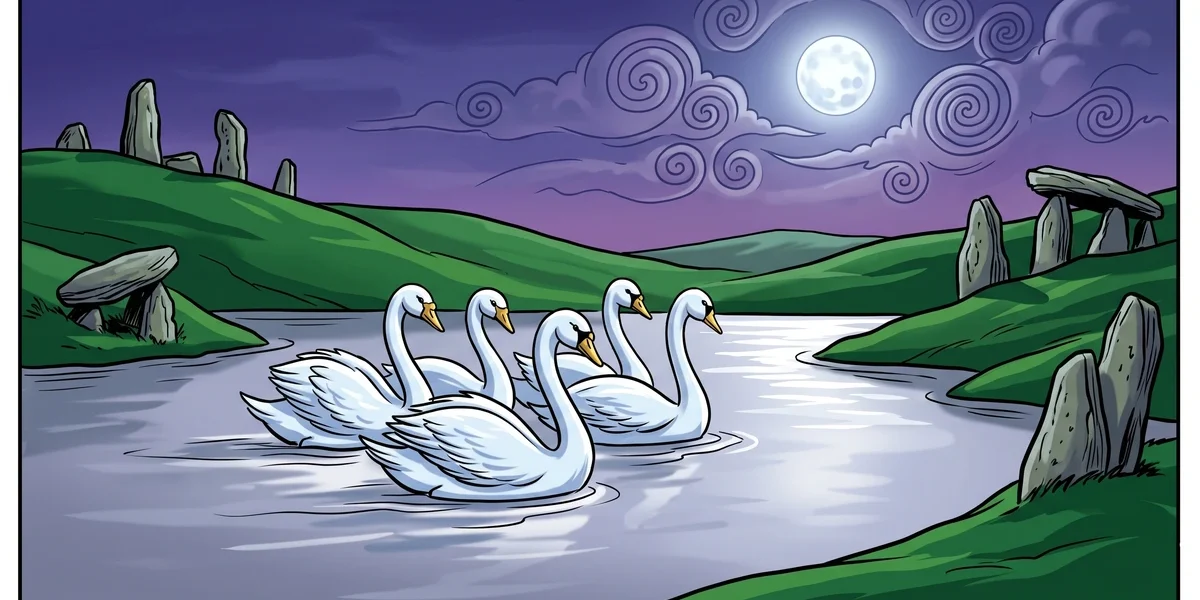
In the years when the Tuatha Dé Danann still held sway over Ireland — the bright, magical people who had won the land in battle and who lived in the green hollow hills and beside the still lakes — there ruled among them a lord named Lir. He was a chieftain of dignity and great feeling, and his name has come down to us joined forever to the saddest tale the old storytellers ever set their tongues to. For of all the legends Ireland has carried out of its pre-Christian past, none has been wept over so long or so willingly as the story of how Lir’s four children were turned into white swans and made to wander the cold waters of the island for nine hundred years.
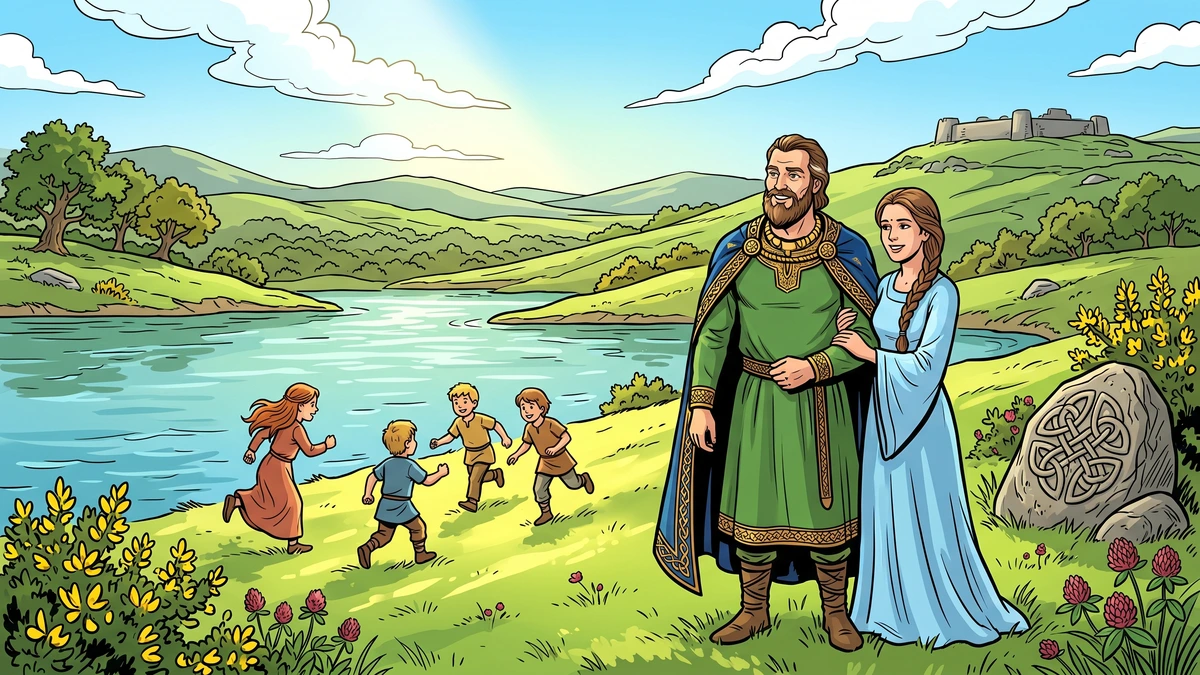
Lir had married a gentle woman named Aobh, a foster-daughter of Bodb Dearg, the king the Tuatha Dé Danann had chosen to rule over them. Aobh bore Lir four children whose beauty became famous throughout the land. The eldest was a girl, Fionnuala, whose grace and steadiness of heart would carry the whole story upon her shoulders. After her came a son, Aodh, and last of all the twin boys, Fiachra and Conn. The household of Lir was, for a brief shining while, as happy a place as Ireland held. Then Aobh fell ill after the birth of the twins and died, and the light went out of Lir’s home.
A King’s Grief and a Second Marriage
Lir’s grief was so deep that those who loved him feared for his life. It was Bodb Dearg who offered the remedy that custom and kindness both suggested: he would send Lir another of his foster-daughters, Aoife, the sister of the wife he had lost, so that the four motherless children might be raised by one of their own blood. Lir accepted, and Aoife came to his house as its new mistress. For a time all seemed well. Aoife was beautiful and clever, and she appeared to love the children as the dead Aobh had loved them.
But love and resentment can wear the same face, and Aoife’s heart slowly turned. She saw how Lir doted on the four children, how he could scarcely bear to let them out of his sight, how even Bodb Dearg, when the family visited his great house by the lake, showed the children more open tenderness than he showed her. A cold thought took root in her and grew: that she was loved only as a substitute, that the children stood between her and every affection she desired. She fell into a long sickness of jealousy, keeping to her bed for the better part of a year while the poison in her mind hardened into a plan.
When at last she rose, she rose with a purpose. She ordered her chariot prepared and announced that she would take the four children to visit their grandfather Bodb Dearg. Fionnuala, who had the gift of unease that often visits those about to be wronged, did not want to go; she had dreamed ill dreams. But a child cannot refuse a parent’s command, and so the four of them set out with their stepmother along the road that led toward the lake.
The Wand Above the Water
On the journey Aoife tried first to have the deed done by other hands. She turned to her servants and offered them their hearts’ desire if they would kill the four children where they rode. The servants recoiled in horror and refused, and — to their lasting honour in the tale — they would not be moved, no matter what she promised or threatened. Aoife was shamed by their refusal but not turned from her path. She had thought herself capable of murder; she found she could not lift her own hand against the children either, for some last thread of conscience or fear held her. So she chose a crueller thing than a clean killing. She chose enchantment.
They came to the shore of Loch Dairbhreach, the Lake of the Oaks — Lough Derravaragh in the modern county of Westmeath. Aoife bade the children bathe in the lake. As they played in the water, innocent and unsuspecting, she drew out a druid’s wand of power, a rod of the old magic, and struck the air above them. A spell of her own shaping fell upon the four, and where four children had splashed and laughed there now floated four white swans.

But the children’s minds and voices were left to them — that was the heart of Aoife’s cruelty. They would keep the memory of who they were, the love of their father, the knowledge of all they had lost; they would simply be unable to return to it. Fionnuala, finding her sister-voice still her own, asked the question that the listener always dreads: how long would the enchantment hold? Aoife, perhaps already half-appalled at herself, gave the sentence its terrible length. The children would be swans for nine hundred years: three hundred years upon Lough Derravaragh, three hundred years upon the Sea of Moyle between Ireland and Scotland, and three hundred years upon the wild western waters of Erris and the island of Inishglora. The spell would not break, she said, until a king of the north wed a queen of the south, until the old gods had given way, and until they heard the ringing of a bell of a new faith in the land.
Even Aoife could not leave the curse wholly without mercy. She granted the children one mercy that she perhaps meant as torment: they would keep their human reason and their human speech, and they would keep, too, the gift of song — a music so sweet that all who heard it would be soothed of every sorrow. With that, she left them on the water and drove on to the house of Bodb Dearg.
The Long Sentence on Three Waters
When Aoife arrived without the children, Bodb Dearg’s questions soon broke her false answers. The truth came out, and the king’s judgement upon her was swift. He demanded to know what shape in all the world she most dreaded and most hated; and when at last her own dread named itself — a demon of the air — he struck her with his own wand of power and made her that thing forever, a creature of the cold winds with no place to land. So Aoife passes out of the story, scattered upon the very air, and is heard of no more. The tale does not gloat over her. It simply turns away from her, back to the four swans upon the lake, where its true heart lies.
Word spread through Ireland of the four singing swans of Derravaragh, and Lir came to the shore, and Bodb Dearg came, and the Tuatha Dé Danann gathered, and they could speak with the children and hear them but could not free them. So the people of Ireland made a kind of peace with the wonder: for three hundred years the Men of Dea camped about the lake to be near the children, and every evening the swans sang the company to sleep, and those years, for all their strangeness, held a sweetness.
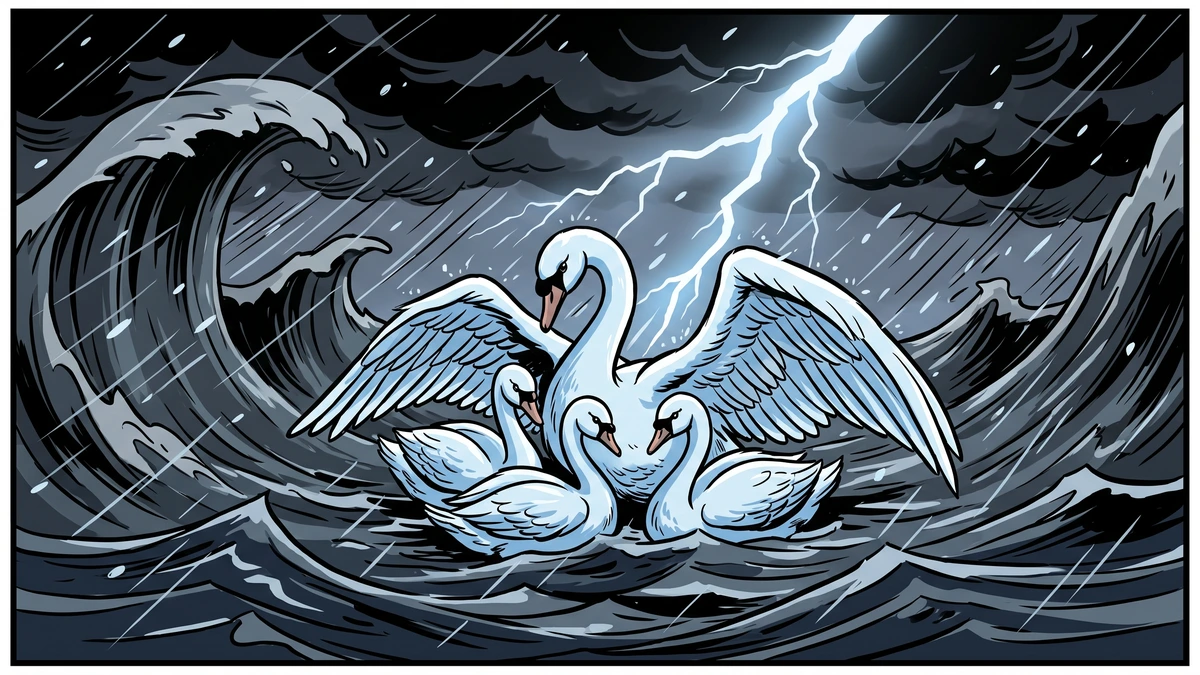
Then the first three hundred years ended, and the enchantment lifted the children from the friendly lake and carried them to the Sea of Moyle, the bitter strait of grey water that runs between the north of Ireland and Scotland. Here the gentleness ended. The Moyle was a place of storms, of black nights and freezing spray, of rocks that tore and currents that dragged the four apart in the dark. It was here that Fionnuala became wholly the mother of the family. On the worst night of all, when a storm scattered the brothers across the sea and she feared she had lost them, she gathered them at last upon the Rock of the Seals and sheltered them through the night beneath her wings — Conn under her right wing, Fiachra under her left, and Aodh under the feathers of her breast. Three hundred years she kept that watch, and the tale gives those centuries to her endurance.
The last three hundred years carried them west, to the open Atlantic off Erris in County Mayo and the lonely island of Inishglora. The waters there were no kinder than the Moyle, but the children were old now in spirit, worn smooth by suffering, and they bore it. And all the while, unknown to them, Ireland itself was changing beneath them. The age of the Tuatha Dé Danann was passing. The bright old gods were withdrawing into the hills. A new faith was coming westward across the sea, carried by quiet men with bells.
The Bell of the New Faith
At the close of the nine hundred years there came to the western shore a holy man — the tale most often names him Mochaomhóg, a follower of the new Christian way — and he built a small church near the water where the swans now lived. One morning the children of Lir heard a sound they had never heard in all their long enchantment: the clear, strange ringing of a chapel bell across the dawn water. It frightened them at first, this voice of the new age. But Fionnuala knew it for what it was. This was the sign Aoife had named. The bell of the new faith was ringing in the land. The nine hundred years were over.
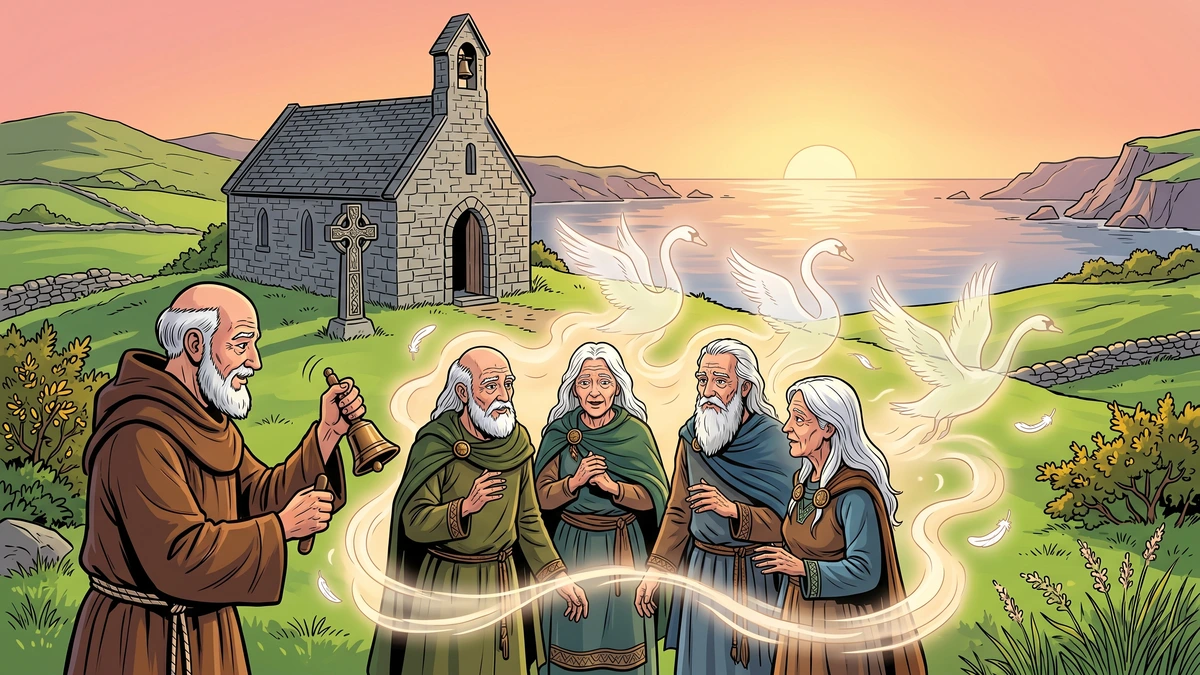
The swans came to the holy man and spoke with him, and he welcomed them and kept them, and joined them with a silver chain, two and two, and they lived beside his church in peace and were happy as they had not been happy since the lake of the oaks. But the breaking of an enchantment is not always the gift it seems. When the spell finally fell away, it did not return four children to the shore. Nine hundred years had passed, and the years claimed what they were owed. The swan-feathers dropped away and revealed not children but four ancient, withered people, older than any living thing should be, frail as dust.
Fionnuala, mother to the last, asked the holy man for one thing: that he baptise them into the new faith before they died, and that he bury the four of them together — Conn at her right side, Fiachra at her left, and Aodh before her face — in the same way she had sheltered them through three hundred nights upon the Sea of Moyle. The holy man baptised them, and in that same hour the four children of Lir died, and he buried them as Fionnuala had asked. And it is said that he wept for them, and raised a stone above them, and that the long sorrow was over at last.
The Moral of the Tale
The story of the children of Lir is not a tale of a problem solved. No hero rides to the lake; no riddle is answered; the curse is never broken by cleverness or courage. What the tale honours instead is the quieter and harder thing — the capacity to endure a sorrow that cannot be fixed, and to endure it without becoming cruel. Aoife’s jealousy is the engine of the tragedy, and the tale’s first warning is plain: resentment left to grow in the dark will, in the end, destroy what the resentful person most wanted to keep. Aoife wished to be loved best, and her crime ensured she would be remembered only as a monster of the air.
But the deeper teaching belongs to Fionnuala. Through nine centuries of cold and loss she keeps two things alive: her tenderness toward her brothers and her hope. She shelters Conn and Fiachra and Aodh under her wings; she keeps watch; she does not let the bitterness of the curse turn her bitter. The tale’s truest line is the one the old people in Ireland still say of any family weathering hardship together:
Ar scáth a chéile a mhaireann na daoine.
“It is in one another’s shelter that people survive.”
Fionnuala lives that proverb across nine hundred years. The children survive not because the curse is gentle — it is not — but because they have each other, and because the eldest will not let go. That is the moral the tale leaves in the listener’s hands: that love does not always rescue, but it can shelter; and that to keep faith and tenderness alive through a long darkness is itself a kind of victory, even when no rescue ever comes.
Origins, Sources, and Attribution
“The Children of Lir” is one of the central stories of the Irish Mythological Cycle, the body of medieval Irish prose and verse that tells of the Tuatha Dé Danann and the supernatural early peoples of Ireland. Its Irish title is Oidheadh Chlainne Lir, usually translated “The Tragic Death of the Children of Lir” or “The Violent Death of the Children of Lir.” The tale belongs to a famous trio. Together with Oidheadh Chlainne Uisnigh (the death of the sons of Uisneach, the story of Deirdre) and Oidheadh Chlainne Tuireann (the fate of the children of Tuireann), it forms the group the Irish tradition calls the Trí Truagha na Scéalaíochta — “the Three Sorrows of Storytelling.” These were understood as the three tales whose grief was deepest, the stories a master storyteller kept for the moments when sorrow itself was the thing to be told.
While the Lir of this tale is rooted in genuinely ancient mythology — Lir is a sea-associated figure of the Tuatha Dé Danann, and his name survives in his more famous son Manannán mac Lir, the great sea-god — the polished version of the story that readers know today is not, in fact, drawn from the earliest strata of Irish manuscript literature. Oidheadh Chlainne Lir survives in late medieval and early modern Irish manuscripts, with the earliest known copies dating only to around 1500. One important early witness is the manuscript catalogued as Gaelic LVI (Advocates MS 72.2.6), now held in the National Library of Scotland in Edinburgh. The scholar and folklorist Robin Flower argued that the three “Sorrows” share a common shaping hand, and proposed that they may have been given their classic form by an author of the fourteenth century working in the learned circle of the Mac Fhirbhisigh family in north-west Connacht, a region long famous for its hereditary scholars and historians.
This is part of what makes the tale unusual and moving as a document. Its ending — the breaking of the curse by the ringing of a Christian bell, the baptism of the children, their burial as Christians — is not a clumsy addition but the very hinge of the story. The tale was composed or reshaped in a Christian Ireland looking back at its own pagan past, and it dramatises that exact passage: the old enchanted world of the Tuatha Dé Danann does not survive into the new age, but it is not simply condemned either. It is given dignity, sorrow, song, and at the last a Christian burial. The children of Lir are the old Ireland, enduring just long enough to be received gently by the new. In folklore scholarship the central motif — humans transformed into birds and held in that shape for a fixed term — is a widespread one, related to the international “swan maiden” and enchanted-transformation traditions, but the specific architecture of this tale, its nine hundred years and its three waters, is distinctively Irish.
The story moved from manuscript into the modern imagination through the work of nineteenth- and twentieth-century collectors and writers. It became a favourite of the Irish Literary Revival, retold by, among others, the writers around Lady Gregory and W. B. Yeats, and Eugene O’Curry and other antiquarians made the medieval text accessible to scholars. In the twentieth century the four swan-children became one of the recognised emblems of Ireland itself: Oisín Kelly’s bronze sculpture of the children of Lir, transforming from human to swan, stands at the heart of the Garden of Remembrance in Dublin, dedicated to those who died for Irish freedom — a public choice that reads the tale as a parable of suffering, endurance, and release.
Why the Tale Has Lasted
Most enchantment stories promise their listeners a release: the spell will break, the true shape will return, the ending will undo the wrong. “The Children of Lir” withholds that comfort and is loved all the more for the withholding. When the nine hundred years end, the curse lifts — and the children die, because no magic can give back the centuries that the magic took. That is an unusually honest thing for a story to say to a child, and generations of Irish listeners have felt its truth. Grief, the tale admits, is sometimes simply long. Some sorrows are not solved; they are only outlived, and outliving them is itself the whole of the heroism on offer.
And yet the tale is not despairing, and that is the second reason it has lasted. Against the long cold of the Moyle it sets Fionnuala’s wings, and against the silence of the abandoned children it sets their song, sweet enough to soothe every grief that hears it — including, across the centuries, our own. The story tells us that a family holding to one another in the dark is not defeated by the dark, even when it cannot escape it. That is why the four swans still stand in bronze in Dublin, why the tale is still the first myth told to Irish children, and why, fifteen hundred years and more after a poet first shaped its sorrow, “The Children of Lir” can still bring a quiet to a room. It has carried, faithfully and beautifully, the oldest comfort there is: that we survive in one another’s shelter.
You May Also Like
 Celtic Folk Tales
Ages 9-12
Celtic Folk Tales
Ages 9-12
The Story-Teller At Fault
The Story-Teller At Fault: At the time when the Tuatha De Dannan held the sovereignty of Ireland, there reigned in Leinster a king, who was remarkably fond of
 Celtic Folk Tales
Ages 9-12
Celtic Folk Tales
Ages 9-12
Notes And References
Notes And References: It may be as well to give the reader some account of the enormous extent of the Celtic folk-tales in existence. I reckon these to extend
 Celtic Folk Tales
Ages 9-12
Celtic Folk Tales
Ages 9-12
Guleesh
Guleesh: There was once a boy in the County Mayo; Guleesh was his name. There was the finest rath a little way off from the gable of the house, and he was