Morraha
Morraha: orraha rose in the morning and washed his hands and face, and said his prayers, and ate his food; and he asked God to prosper the day for him. ’s
Morraha; Brian More, son of the high-king of Erin is one of the most layered survivals of the Gaelic “Sword of Light” (Claíomh Solais) cycle, a story-stream that drifted across western Donegal and the Atlantic seaboard for centuries before any pen reached it. The version printed by William Larminie in West Irish Folk-Tales and Romances (London: Elliot Stock, 1893) was taken from the seanchaí Patrick Minahan of Glencolumbkille, County Donegal, sometime between 1884 and 1892. Larminie set down Minahan’s words verbatim, preserving the rhythm of the Irish-speaking storyteller even as he rendered the tale in English. A year later, Joseph Jacobs reprinted it in More Celtic Fairy Tales (London: David Nutt, 1894), where his note calls Larminie’s collection “the chief addition to the Celtic store” since his earlier volume. From that single chain — Minahan, Larminie, Jacobs — the tale entered the children’s bookshelves of the English-speaking world.
The Frame Within the Frame: A Story That Saves a Life
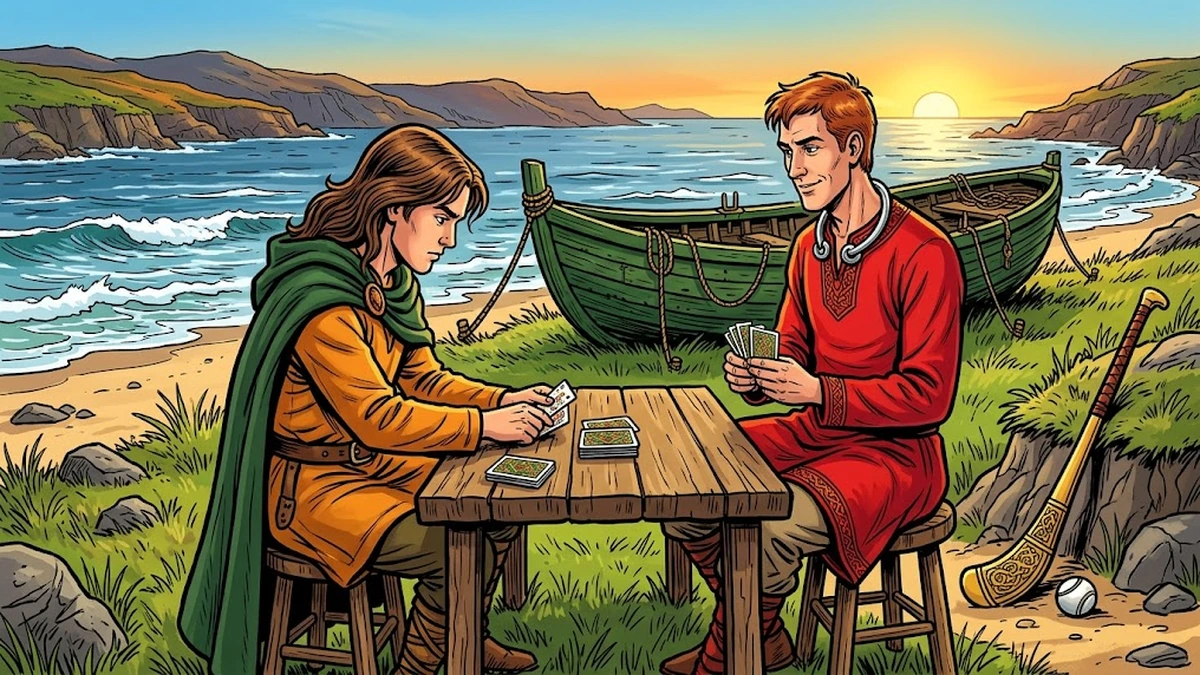
What makes Morraha unusual among Irish wonder-tales is its architecture. The opening is a bridal-quest in miniature: a young man wins a beautiful wife and a magnificent castle by gambling at cards on the seashore against a stranger called the Slender Red Champion (in the Irish, the Gruagach, a wizard-champion of the otherworld). When Morraha at last loses, the Gruagach lays an unbreakable druidic geis upon him — “not to sleep two nights in one house, nor finish a second meal at one table, until thou bring me the Sword of Light and tidings of the death of Anshgayliacht.” That commission launches the second half of the tale, which is a quest narrative; and inside the quest sits a third, embedded layer — the long story of Niall’s Five Burnings, told to Morraha by the woodland giant who possesses the Sword of Light. That inner tale, which folklorists recognise as a Gaelic redaction of the medieval werewolf legend (a cousin of Marie de France’s twelfth-century Bisclavret), is the only thing that, when repeated faithfully to the Slender Red Champion, can save Morraha’s head.
The pattern of three concentric narratives — the gambler’s wager, the impossible quest, the rescuing tale — has been studied by George Lyman Kittredge (Harvard, 1903) in Arthur and Gorlagon, where he argues that the Irish versions preserve an older shape of the werewolf legend than any continental witness. The motif index assigns the Sword of Light proper the symbol H1337 in Stith Thompson’s catalogue (Motif-Index of Folk-Literature, 1932-36); the gambling-with-the-otherworld opening sits within the Aarne-Thompson-Uther family of bridal-quest types associated with ATU 313 (“The Magic Flight”), while the embedded werewolf frame draws kinship with ATU 449 (“The Tsar’s Dog” / “Sidi Numan”).
Beat One: The Currach on the Green Strand
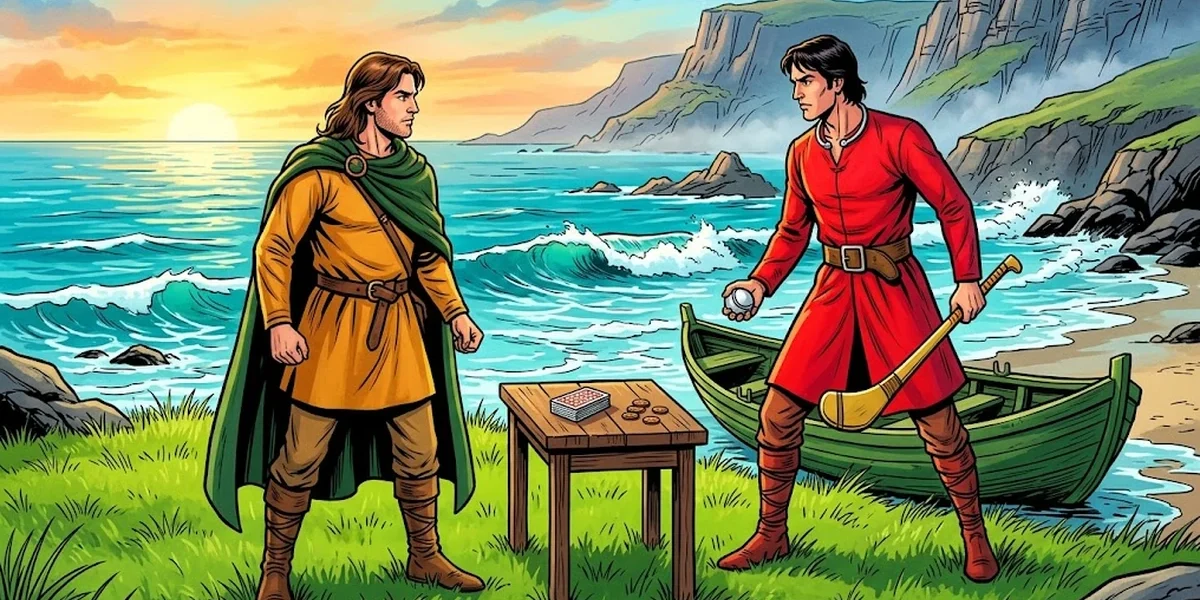
The story opens on the shore of the western sea, on a morning that promises nothing in particular. Morraha rises, washes, says his prayers, and goes down to the brink of the waves. Out of the haze comes a small green currach — the slender hide-and-lath boat of the Atlantic coast — and in it stands a single youthful champion, hurling a silver ball with a golden hurl from prow to stern. He runs the boat up onto the green grass, ties her with cords for “a year and a day,” and asks Morraha for a game of cards. The opening is doing quiet folkloric work. The currach belongs to the otherworld; the year-and-a-day binding is the magical contract; the silver-and-gold hurley signals a being who comes from the people of the sídhe (the fairy mounds). The Irish listener, hearing this in 1890s Donegal, knew exactly what kind of stranger had landed.
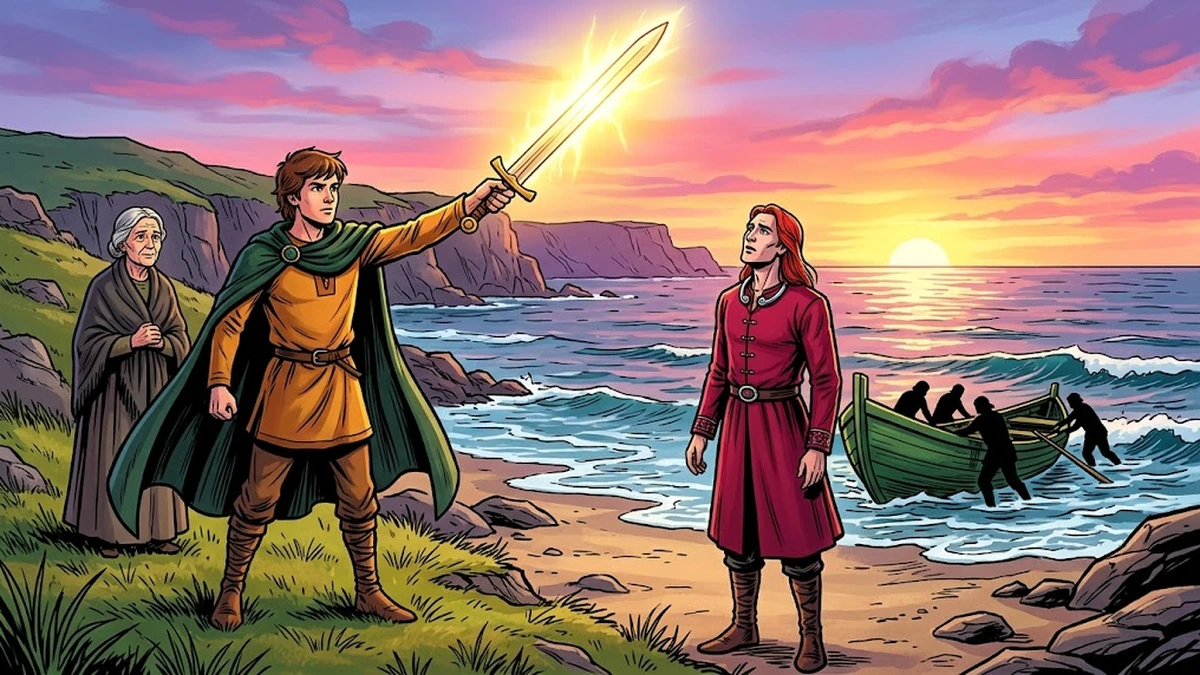
Three games are played, each on a separate day. The first two Morraha wins, and on the strength of his stake he asks for a hillside full of sheep, then a stout stone castle filled with the loveliest of women. Both gifts arrive overnight. On the third morning he ignores the warning of his old wife — who tells him plainly, “You may play this day, but lose you will” — and the third game goes against him. The Slender Red Champion lays the geis upon him at once, and the otherworld currach disappears into the blue water as suddenly as it arrived. Morraha is now a man under bonds, and bonds in Irish narrative are not metaphors; they are the ritual obligations whose breaking brings death.
Beat Two: The Brown Mare and the Helpful Beast
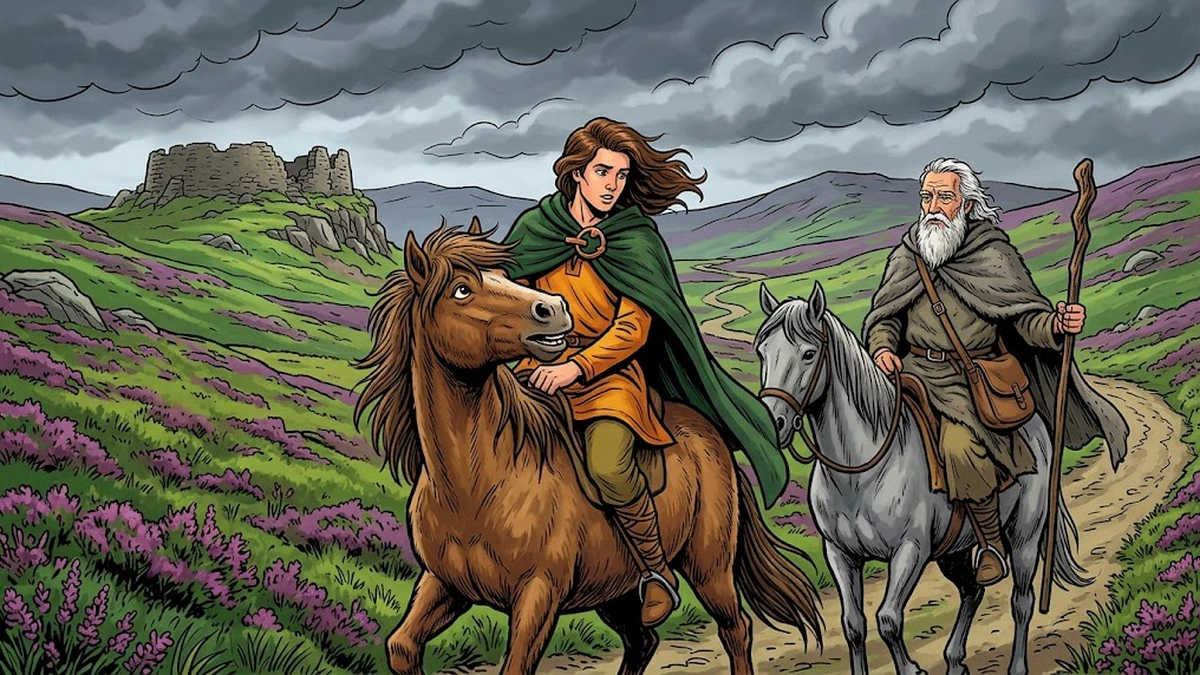
Riding out into a featureless country, Morraha despairs of finding either the Sword of Light or anyone who has heard of Anshgayliacht. At his lowest moment he is overtaken by an old man called Niall, riding a small shaggy brown mare; and the brown mare proves to be the engine of the tale. She is one of the great helpful animals of Gaelic tradition — a creature kin to the cú sídhe dogs and the wonder-horses of the Fenian cycle — and she speaks. She tells Morraha to do exactly as she says, no more, no less, and she will bring him alive to the Sword of Light. The motif of the speaking horse who out-thinks her rider is one of the oldest in Indo-European tradition; we meet her in the Welsh Mabinogion as Rhiannon’s white mare, in the Norse Eddas as Sleipnir, and in the Sanskrit Mahābhārata as Uchchaihshravas. In the Donegal version, the brown mare is plain and hard-bitten and entirely practical, which is the great Irish gift to the type.
Under her instruction Morraha confronts the giant of the wood, who is the keeper of the Sword. The fight is described with the formal repetitions of the seanchaí: blow for blow, fall for fall, reaching at last to “the small bones of the giant’s neck were like the broken hazels in the sound of the wind.” When the giant is overcome, he begs for his life, and offers, in payment, both the Sword of Light and the long story of his own ruin — the story of Niall and the five burnings of his castle.
Beat Three: Niall’s Five Burnings — the Tale Inside the Tale
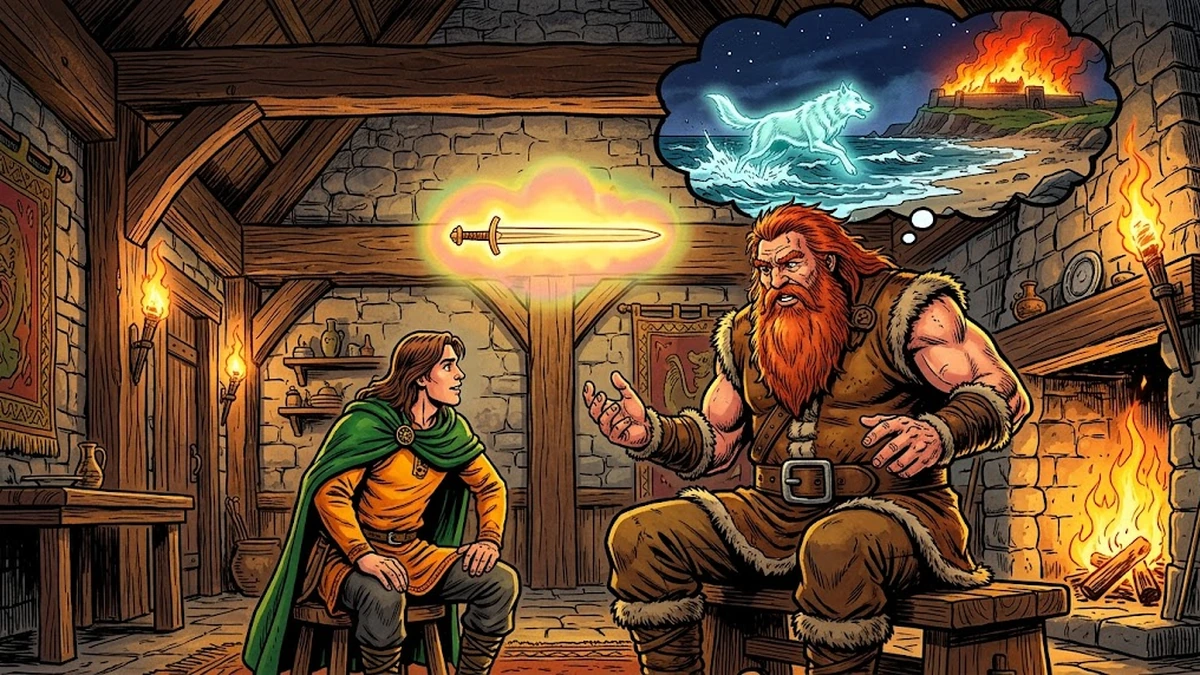
The giant, who is in fact the brother of the old horse-rider, tells how five times in his youth a wolf came up out of the sea and burned his rath to the ground while he was away hunting; how at last he caught and bound the wolf, only to learn at sunrise that the wolf was a young man under enchantment — and that the young man was his own brother Niall, sentenced by druidic curse to roam the western tides in the form of a hound. The brother’s curse is broken by recognition: the moment the giant calls him by name and refuses to kill him, the wolf-skin falls away and the human shape returns.
This is the kernel of the medieval werewolf legend in its Gaelic dress, and its placement here is no accident. By the time Morraha hears it from the giant’s own mouth, he has been listening for so long that he has memorised every detail. That is the point. The story is not ornament; it is the weapon. When at last he returns to the strand, the Slender Red Champion will demand from him not the Sword alone but “the news,” and “the news” must be told without slip, without abridgement, in the very order the giant told it. To repeat a tale faithfully, the Irish tradition holds, is to honour the people inside the tale; to leave anything out is to betray them.
Beat Four: The Return to the Strand
Morraha rides home with the Sword of Light tied to his saddle and the long story rehearsed in his head. The brown mare carries him in a single night across mountains it had taken weeks to cross outward — for in the Irish wonder-tale the homeward road, when the geis is fulfilled, has been quietly straightened by the otherworld itself. He finds his old wife waiting where he left her, and on the next morning the green currach comes again over the bay. Morraha lays the Sword on the turf and begins to speak. He tells the entire story of Niall and the five burnings, exactly as he heard it; and as he speaks the Slender Red Champion’s face changes, for the listener is himself a kinsman of the wolf in the tale. By the time the last sentence is spoken, the bonds dissolve, the castle of women is restored, and the Champion takes the Sword and rows away forever.
“Ní beag liom mar sgéal é, agus do scaoileas thú ó na geasaibh.”
(I count it not little as a tale, and I release thee from thy bonds.) — the Slender Red Champion’s parting words, as preserved by Patrick Minahan to William Larminie, 1893.
Moral: The Tale Itself Is the Treasure
The deepest moral of Morraha is one that very few children’s stories reach for. The treasure that saves the hero’s life is not the Sword of Light. It is the story of Niall and the five burnings — the act of remembering and re-telling, faithfully, what another person has lived through. In a culture that for a thousand years carried its history, its law, its genealogy and its theology in unwritten verse, the moral was practical as well as poetic. A man who could not listen and repeat was a man who could not be trusted with anything that mattered. Morraha survives because he becomes, for one long night in the giant’s hall, a true seanchaí.
The secondary moral concerns the limits of cleverness. Morraha plays cards three times against a being smarter than himself. Twice he wins by luck, and the winnings make him over-confident; the third time the universe corrects him. The tale does not punish him for his pride exactly — it sends him on a journey that turns the proud man into the patient one. He returns from the giant’s hall a different sort of person: humbler, slower of speech, and far more attentive to other people’s stories. That, the seanchaí of Donegal would have said, is what a man is supposed to look like when his geasa are fulfilled.
Why This Tale Has Lasted
For all its strangeness, Morraha survives in the modern imagination for a very particular reason: it is one of the small handful of Irish tales that names the act of storytelling itself as a heroic deed. Most folk-tales reward courage, kindness, or cunning. This one rewards memory. In an age in which children are taught to scroll past stories rather than sit inside them, the lesson Patrick Minahan whispered to William Larminie on a Donegal hillside has not lost any of its edge: the people who shape your life are the people whose stories you are willing to carry.
The Sword of Light itself, the Claíomh Solais, has gone on travelling. It is the weapon of Nuada in the Cath Maige Tuired, of Cú Roí Mac Dáire in the Ulster Cycle, and (under a slightly different name) of King Arthur as Excalibur in the British matter. It has reappeared in the twentieth century as the lightsaber in the Star Wars films, whose creator George Lucas drew openly on Joseph Campbell’s reading of Celtic and Indo-European myth. When a child today watches a glowing blade swing through a darkened cinema, the great-great-great-grandfather of that blade is the sword Morraha brought home from the giant’s wood — and the great-great-grandmother of every “wise old mentor figure” in modern fantasy is the small brown mare who told him, on a windy morning in nineteenth-century Donegal, exactly what to do.
Note on the Text and Pronunciation
The hero’s name is given in Larminie’s transcription as Morraha, an Anglicised form of the Irish Murchadh (pronounced roughly MUR-uh-khoo), a personal name attested in the Annals of the Four Masters and meaning, by older etymologies, “sea-warrior.” His patronymic in the long form of the title — Brian More, son of the high-king of Erin — is a courtesy lineage attached by the storyteller; the same hero appears under several names in the Donegal repertoire. The antagonist’s title Anshgayliacht (Larminie’s spelling) is now generally read as An Sgéaluidheacht, “the Storytelling,” a personification — which, if accurate, makes the Slender Red Champion’s commission deliciously self-referential: bring me the Sword of Light, and tidings of the death of Storytelling itself. Morraha succeeds because he refuses, in the only way a folk-hero can refuse, to let storytelling die.
For the Family Reader
This tale rewards patience. Younger children may need help with the Donegal flavour of Larminie’s English — the sentences are long and the cadence is the cadence of an Irish-speaker thinking in Irish — but the story rewards the labour. Read the gambling scene at one sitting; read the giant’s tale at the next; let the child see how the story comes back round to where it began. That circular shape is the oldest shape a story can wear. It was old when Patrick Minahan learned it from his grandfather; it is older still by every year we keep telling it.
Patrick Minahan and the Donegal Seanchaí Tradition
The storyteller from whom Larminie heard Morraha deserves more than a footnote. Patrick Minahan was an Irish-speaking labourer, born around the late 1820s in the small upland parish of Glencolumbkille, on the western seaboard of County Donegal — one of the last and most resilient of the Atlantic Gaeltachtaí. He never read English with any fluency, but he carried, in his unaided memory, an entire repertoire: long heroic tales of the Fenian Cycle, shorter nuala or “tales of the household,” local saint-legends, and at least three full-length wonder-tales of which Morraha was the longest. The collector noted that Minahan had learned every story from his grandfather and that the older man had, in turn, learned them from his grandfather, putting the chain of transmission back into the late eighteenth century at the latest. This is the slow pulse of oral literature: three lifetimes, one fireside, and the tale arrives almost unaltered. Larminie’s preface speaks of Minahan with real respect, calling his version of Morraha “as good a piece of sgéaluidheacht [storytelling] as the present compiler has ever recovered.”
To understand what a seanchaí was, one has to imagine a world in which the longest novel anyone in the village had ever encountered was the one that lived inside the storyteller’s head. Long winter evenings, the turf fire, no electric light, no print: in those conditions, memory was furniture. A good seanchaí could begin a tale at sunset and finish it after midnight, without losing his place, without contradicting himself, and with the rhythm of the verse-passages — those formal “runs” that punctuate the action — falling into the same metrical pattern they had worn for a hundred years. Morraha contains several such runs: the description of the warrior’s outfitting, the catalogue of the giant’s wound, the boast of the Slender Red Champion. The runs were the hooks on which memory hung. When the seanchaí reached one, the listeners’ faces relaxed; they had heard those exact words from the same lips a year before, and would hear them again the year after.
Sword, Mare, and Wolf: The Three Symbols at the Heart of the Tale
If Morraha can be reduced to a kind of compressed iconography, the three figures that survive the compression are the Sword, the Mare, and the Wolf. Each one is doing precise narrative work, and each one connects the Donegal version to a much wider Indo-European inheritance.
The Sword of Light is the trophy, but it is not the meaning. In the older Tuatha Dé Danann literature, the Claíomh Solais is one of the four sacred treasures brought from the Otherworld cities — the others being the Lia Fáil, the Spear of Lugh, and the Cauldron of the Dagda. Its property is that it cannot be unsheathed without the holder’s enemies fleeing. In the Donegal tale the Sword is reduced to a single luminous object that can be carried back across the sea, but its mythological history rides with it: when Morraha lays the blade on the strand, the listener (in 1890 as in 2026) is meant to feel that the entire weight of the older mythology is being briefly grounded.
The brown mare is the helper, but she is also the moral instructor. In Indo-European folklore the helpful animal is almost always smarter than the hero, and almost always more patient. The mare’s repeated counsel — do exactly as I tell you, no more, no less — is an exact paraphrase of the mantra given to Arjuna by Krishna in the Bhagavad Gītā and to Odysseus by Athena in the Odyssey. The seanchaí could not have read either text. He did not need to. The form of the wise companion — the still, small voice that knows the road — is older than the literatures that record it.
The wolf is the buried memory. In the inner story of Niall, the wolf-skin that the cursed brother wears is shed not by violence but by recognition. Marie de France’s Bisclavret ends the same way; so does the still-older Greek tale of King Lykaon. The wolf, in the European folkloric imagination, stands for the part of a human being that has been driven out of the village by shame or sentence — and the cure is always the same: someone calls him by his old name and refuses to kill him. That, distilled to its essence, is the moral the giant gives to Morraha and Morraha gives to the Slender Red Champion. It is an extraordinary moral for a children’s tale to carry.
Reading the Tale With Younger Listeners
A few practical notes for parents and teachers. The vocabulary in Larminie’s transcription includes Anglicised Irish forms — currach, geis, seanchaí, Anshgayliacht — that will reward a quick gloss before reading aloud. The fight with the giant is not graphic by modern standards but does include the formal “small bones like broken hazels” run, which younger children may find arresting; we recommend reading the run in a deliberately rhythmic voice, since the rhythm itself is the point. The card-playing scenes are entirely safe and rather funny. The werewolf scene at the heart of the giant’s tale is unsettling in the way good ghost stories are unsettling, but it ends in reconciliation, and the reconciliation is what children remember.
Finally, the tale offers an unusually clean opportunity to talk with a child about the difference between winning and finishing. Morraha wins twice and loses once. The losing is the beginning of the real story. By the end he has not “won” anything new at all — the wife and castle he had at the opening are simply restored to him — and yet he is, by every measure that counts, a different person. That is one of the deepest lessons folk-tales offer, and it does not require any didactic prompting from the grown-up reading. The story, as the Slender Red Champion himself says at the end, is enough.
You May Also Like
 Celtic Folk Tales
Ages 9-12
Celtic Folk Tales
Ages 9-12
Dream of Owen O’Mulready
Dream of Owen O'Mulready: here was a man long ago living near Ballaghadereen named Owen O’Mulready, who was a workman for the gentleman of the place, and was a
 Celtic Folk Tales
Ages 9-12
Celtic Folk Tales
Ages 9-12
Hudden And Dudden And Donald O’Neary
Hudden And Dudden And Donald O'Neary: There was once upon a time two farmers, and their names were Hudden and Dudden. They had poultry in their yards, sheep on
 Celtic Folk Tales
Ages 9-12
Celtic Folk Tales
Ages 9-12
The Battle Of The Birds
The Battle Of The Birds: I will tell you a story about the wren. There was once a farmer who was seeking a servant, and the wren met him and said: “What are