The Voyage of Bran
The Voyage of Bran: In the ancient days of Irish mythology, when the line between the mortal world and the realm of magic was gossamer-thin and easily crossed

Among all the strange and shining stories the old Irish kept, there is a particular kind they called the immram — a “rowing about,” a voyage tale — in which a hero takes to a small boat and is carried beyond the edge of the known world to islands no map could hold. The oldest and most beautiful of these is the tale of Bran mac Febail, a chieftain who heard music in an empty hall, followed it onto the sea, and sailed so far into wonder that he could never quite find his way back. It is a story about longing: about the ache for something brighter than ordinary life, and about the terrible, quiet price of being granted exactly what you longed for.
The Irish told it without raised voices. There are no battles in the Voyage of Bran, no monsters slain, no villain to be punished. There is only a branch of silver blossom, a sea that turns out to be a meadow, an island where time forgets to move, and a homecoming that arrives a few centuries too late. For more than a thousand years the tale has kept its hold precisely because it refuses to comfort us. It promises that the Otherworld is real and radiant and reachable — and then it shows, gently and without cruelty, that the door which opens to let you in does not always open the same way to let you home.

The Branch of Silver and White Blossom
The story opens in stillness. Bran mac Febail, a lord of good name and settled fortune, was walking one day near his stronghold when he heard music behind him — sweet beyond any harp he knew, and so gentle that it carried him into sleep where he stood. When he woke he found beside him a branch of silver, white with blossom, so finely made that the silver and the bloom could scarcely be told apart. He carried it back into his royal house, and there, with all his company gathered around him, a woman appeared in the middle of the floor in strange clothing. No one had seen the doors open. The house was closed, and yet she stood among them.
She began to sing, and her song was a long catalogue of marvels. She sang of a distant island held up by four pillars, around which the white sea-horses of the waves forever glistened; of Emain, the gentle land where no grief or sickness or death was known; of a plain called Mag Mell, the Plain of Delight, where silver-clouded chariots raced and the trees dropped fruit in every season at once. She sang of a country without lying and without hardness, where music fell from the rocks and the only argument anyone could imagine was a contest of beautiful games. And she told Bran plainly that the branch in his hand had come from the apple-tree of Emain, and that her song was an invitation: he was to rise and sail and find these islands for himself.
When she had finished, the woman went out of the hall as silently as she had come — and as she went, the silver branch sprang from Bran’s hand into hers, for he had no strength to hold it. With the branch went the choice. The marvels she had named were no longer rumour; they had been promised to him by name, and a man cannot un-hear a promise like that. The next morning Bran gathered his crews — three companies of nine men, with three foster-brothers of his own to lead them — and put out to sea.
The Voyage Across the Bright Sea
For two days and two nights Bran rowed across open water, and on the second day he saw a man driving a chariot toward him over the tops of the waves, as easily as another man might cross a field. It was Manannán mac Lir, the sea-god, the lord of that country beyond the country, and he greeted Bran with a poem that turned the whole world inside out. What Bran saw as a clear sea, Manannán said, was to him a flowering plain; what Bran took for the shining swell of waves were calves and bright-coloured lambs at peace, and salmon leaping were as wandering cattle to him. Bran’s boat, he said, was at that very moment travelling across the crowns of an orchard, and the crests of the sea Bran’s oars dipped into were the blossom of trees.

It is the strangest and most haunting moment in the tale, and the heart of its meaning. Manannán was not correcting Bran; he was showing him that two truths can lie one on top of the other, and that the wonder of the Otherworld is not somewhere else — it is the same place, seen by a being who belongs there. The sea that drowns the unready is, to the one who is home in it, a quiet pasture full of light. Manannán also foretold the birth of a great son, Mongán, who would walk in the shapes of many creatures, and then he turned his chariot away and let Bran sail on. The poem left Bran’s men quieter than before. They had set out chasing a woman’s song; now a god had met them on the water and confirmed every word of it.
For Bran’s crews, the meeting changed the colour of the whole voyage. A sea is a thing to be endured, crossed, survived; an orchard is a thing to be travelled through with delight. Manannán had not moved a single wave, yet he had remade the journey by remaking the way it could be seen. The men rowed on through water that they now half-suspected of being something else entirely — and that suspicion, that sense of a brighter reality pressing against the thin skin of the ordinary one, is the particular magic the immram exists to deliver.
The Island of Laughter and the Land of Women
The first land they reached was the Island of Joy. Its whole shoreline was crowded with people who did nothing but laugh and gape and stare, never pausing, never answering a question, their faces fixed in helpless mirth. Bran called to them and got no reply. At last he sent one of his own crew ashore to learn what manner of place it was — and the moment the man’s feet touched the island, he too began to gape and laugh, and joined the staring crowd, and would not come back into the boat. Bran waited, and called, and at last sailed on without him, leaving one of his company behind on a shore of meaningless joy. It is the tale’s first warning, easy to miss: not every wonder is kind, and some islands keep whatever steps onto them.

Then they came to the Land of Women. The chief of the women stood at the harbour and called a welcome to Bran by his own name, but Bran, remembering the Island of Joy, would not bring his boat in to land. So the woman threw a ball of thread straight to him across the water; it clung fast to his palm, and she drew the coracle gently to the shore by that single thread, and so the choice to land was, in a sense, made for him. Inside, the men found everything the first woman’s song had promised. There were beds enough for every man and a woman for each; there was food on every dish that became, in the eating, exactly the taste each man most wished for; and there was no weariness and no end to the day’s contentment. The Irish word for it was simple: it was the place without sorrow. Bran and his crews stayed, and were happy, and counted the time as a single year.
This was the Irish Otherworld exactly as the old poets imagined it: not a heaven of reward and not an underworld of punishment, but a country running parallel to the mortal one, close enough to be reached by a boat and a following wind, where the things that wear a human life away — age, hunger, grief, the slow grinding of time — simply had no purchase. The woman’s first song had named it truly. Here was the land without lying and without hardness, and to be inside it was to feel, every day, that nothing could ever again go wrong.
But it was not a single year. Time in the Land of Women did not run as time runs in Ireland, and what felt to the crews like twelve bright months was, in the world they had left, many lifetimes of men. They did not know this. They only knew, after a while, that one of them — Nechtán, son of Collbran — had grown sick for the sight of his own country, and that the sickness had begun, quietly, to spread from man to man until the whole company longed to go home.
The Return and the Crumbling of Nechtán
The chief woman did not forbid them. She only warned them, and her warning was exact. They might sail to Ireland, she said, and they might call to the people on the shore, but not one of them was to set his foot upon the land of Ireland, not for any reason; and on their way home they were to take aboard again the man they had left laughing on the Island of Joy. Bran promised. The crews put out, gathered up their lost companion, and rowed at last toward the green coast of home.
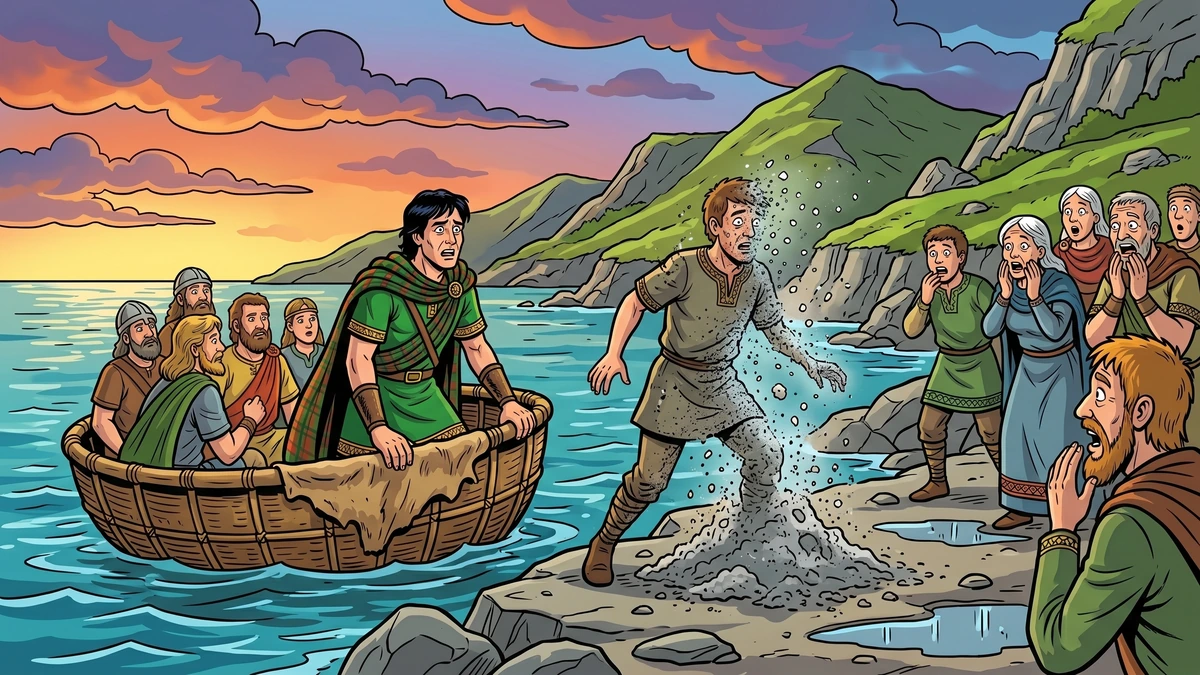
A crowd was waiting on the shore, and the people called out across the water to ask who was in the boat. “I am Bran, son of Febal,” he answered. And the people on the shore said that they did not know any such living man — but that “the Voyage of Bran” was one of their most ancient stories, a tale set down long ago in their oldest records, from a time none of them could remember. Bran’s year had been centuries. Everyone he had ever known was dust, and his own name had passed out of the world of men and into the safe-keeping of legend.
Then Nechtán, son of Collbran — the man whose homesickness had turned the boat around — could not bear it. Against the warning, against Bran’s call, he leaped from the coracle onto the shore of Ireland. And the instant he touched the soil, the years he had outrun came home to him all at once: his body fell away into a heap of ashes, as though he had been dead and buried for hundreds of years, which in truth he had. Bran, from the boat, understood that he could never land. He drew close enough to be heard, and he told the gathered strangers the whole of his wandering from the beginning, and he cut the story into a stave of wood in ogham letters so that it would not be lost. Then he said his farewell to them, and from that hour, the old tale says, his wanderings are not known. The boat turned back toward the bright sea, and Bran was never seen in Ireland again.
It is worth pausing on how little blame the tale assigns. Bran is not foolish, and the women are not cruel; even Nechtán is not wicked, only human and unbearably homesick. The story has no villain because it is not really about a wrong being done — it is about a law of the two worlds that no one in the tale has the power to suspend. That is what gives the Voyage of Bran its strange, level calm. It does not rage at the loss it describes. It simply sets the loss down in front of the listener, plainly, the way the sea sets down a piece of driftwood, and lets the silence afterward do the work.
The Moral of the Tale
The Voyage of Bran is not a tale that scolds, and its lesson is gentler and sadder than a rule. It is a story about the cost of a granted wish. Bran longed for a brightness beyond ordinary life, and he was given it, fully and freely — and the price, which no one hid from him and no one could have changed, was that the ordinary life he left behind would not wait. The Otherworld did not punish Bran. It simply could not be visited and kept at the same time; to step fully into wonder is to let the clock of home run on without you. That is the ache the immram was built to hold.
Within that large sorrow sits one sharp, practical truth, and it belongs to Nechtán. He was given a warning so plain it could not be misunderstood: do not set foot on the land. His longing for home was good and human and shared by everyone in the boat — but longing did not change the danger, and the others mastered theirs while he, in one unguarded leap, did not. The old text frames the Otherworld in Manannán’s words as a thing of pure delight:
“Is mag meld” — “it is a plain of delight.” The sea that would drown an unready man was, to the god who belonged to it, a meadow full of light and blossom. The wonder was always real; what it asked was only that you understand which world you were standing in.
Nechtán forgot which world he stood in, and the warning he had been given became the measure of his loss. The tale’s quiet counsel is this: when you are carried somewhere marvellous, listen carefully to the terms of it, and keep them — for the boundary between a blessing and a ruin can be as thin as the difference between the deck of a boat and the shore a single stride away.
Origins, Sources, and Attribution
The Voyage of Bran is known in Old Irish as Immram Brain, or more fully Immram Brain meic Febail — “The Voyage of Bran son of Febal.” It is the earliest surviving example of the immram, the distinctively Irish genre of the marvellous sea-voyage, a form that would later shape the Christian Voyage of Saint Brendan and influence the wider European literature of the otherworldly journey. Scholars place its composition in the late seventh or early eighth century, which makes it one of the oldest pieces of vernacular literature in any language of north-western Europe.
The tale is believed to have stood originally in the Cín Dromma Snechtai, a now-lost manuscript of the eighth century whose contents are known only because later scribes copied from it. Immram Brain itself survives in several medieval codices dating from roughly the eleventh to the sixteenth centuries, among them the great compilations of early Irish learning. Its text carries the marks of its age and its makers: it weaves frankly pagan material — Manannán mac Lir, the deathless islands, the apple-branch of Emain — together with passages of Christian reflection, the natural blend of a story written down by monastic scholars who valued the old learning even as they reframed it.
The genre Bran’s tale founded proved remarkably long-lived. Later immrama — among them the Voyage of Máel Dúin, the Voyage of the Uí Chorra, and the Voyage of Snédgus and Mac Riagla — took the same shape of an island-by-island sea-journey and turned it, increasingly, toward Christian pilgrimage and moral testing. The most famous descendant of all, the Latin Navigatio Sancti Brendani, the Voyage of Saint Brendan, carried the Irish voyage tale across medieval Europe in dozens of translations. Behind every one of them stands the small silver-branched boat of Bran, the first hero in the tradition to be sung out onto the open sea by a woman from beyond the world.
The tale entered the modern world chiefly through the work of the German Celticist Kuno Meyer, whose edition The Voyage of Bran Son of Febal to the Land of the Living was published in London in 1895 by David Nutt, with two long accompanying essays by Alfred Nutt on the Irish vision of the happy Otherworld and the doctrine of rebirth. Meyer’s parallel Old Irish text and English translation made the story available to readers and writers far beyond the small circle of manuscript specialists, and it has remained the foundation of every later retelling and study.
Why the Tale Has Lasted
One reason the Voyage of Bran has outlived the language it was first written in is the sheer originality of its central image. Manannán’s poem — the sea that is also an orchard, the waves that are also lambs and blossom — is one of the oldest expressions in European literature of an idea that never stops feeling new: that the marvellous is not a far-off country but the ordinary world seen by eyes that belong to it. A reader who meets that image once does not forget it, and every generation finds in it something its own poets have been reaching for.
The other reason is the tale’s refusal to lie about the cost of wonder. It would have been easy for the old storytellers to send Bran home in triumph, his year of bliss a clean reward. Instead they let him return to find his name already worn smooth by centuries of telling, his companion crumbling to dust on the beach, his own homecoming forever one stride out of reach. That honesty is what keeps the story adult and alive. It speaks to anyone who has chased a brighter life and discovered that the choosing of it was also a leaving; anyone who has learned that some doors open generously inward and only narrowly back. Fifteen hundred years on, the little boat is still out there on Manannán’s flowering sea, and the Voyage of Bran still tells us, kindly and without flinching, that the price of touching the Otherworld is that the world you knew will not be waiting when you turn around.