Guleesh
Guleesh: There was once a boy in the County Mayo; Guleesh was his name. There was the finest rath a little way off from the gable of the house, and he was
Guleesh is a Connacht Irish folk tale of a Mayo lad who joins the Sídhe (the fairy host) on a moon-bright Hallow E’en ride, is carried with them through the night air to France, and there ‑ on a borrowed white horse and with one shouted Irish word ‑ saves a French king’s daughter from being married to a man she does not love. The version below follows the canonical text recorded by Dr. Douglas Hyde from Shamus O’Hart, a gamekeeper of Frenchpark, County Roscommon, and printed in Beside the Fire (London, 1890, pp. 104–128). Joseph Jacobs reprinted an abridgment in Celtic Fairy Tales (1892); the closest parallel is Letitia Maclintock’s Donegal tale “Jamie Freel and the Young Lady,” collected by W.B. Yeats in Fairy and Folk Tales of the Irish Peasantry (1888).
Origin, Source & Scholarly Attribution
“Guleesh” — in Irish Giolla na nGiollaí, sometimes given as Guleesh na guss dhu, “Guleesh of the black feet,” because the boy never washed them — was first set in print by Dr. Douglas Hyde (Dubhghlas de hÍde, 1860–1949), the founder of Conradh na Gaeilge and later first President of Ireland. Hyde took the tale down in Connacht Irish from a single tradition-bearer, the gamekeeper Shamus O’Hart of Frenchpark in County Roscommon, and published it first in the Irish-language collection Leabhar Sgeulaigheachta (Dublin: Gill, 1889) and then bilingually, with English on the recto and Irish on the verso, in Beside the Fire: A Collection of Irish Gaelic Folk Stories (London: David Nutt, 1890), where it occupies pages 104–128. Alfred Nutt’s appended notes set the tale in comparative European context.
Three years later Joseph Jacobs, working in London for the Folk-Lore Society, condensed Hyde’s translation for a younger audience in Celtic Fairy Tales (London: David Nutt, 1892), no. 17, pp. 168–186, with notes at pp. 251–253. Jacobs flagged two important parallels: Letitia Maclintock’s Donegal tale “Jamie Freel and the Young Lady” (printed in W.B. Yeats, Fairy and Folk Tales of the Irish Peasantry, London: Walter Scott, 1888) and the fairy-rade abductions in Lady Wilde’s Ancient Legends, Mystic Charms and Superstitions of Ireland (London: Ward & Downey, 1887).
Folklorists assign the tale to the international type-cluster ATU 400 (“The Man on a Quest for His Lost Wife”) with strong contamination from the Northern European migratory legend ML 5085 (“Carried by the Fairies to a Far Land”), to which “Jamie Freel” is the closest Irish analogue. The motif of the changeling stick left in the bride’s place is F321.1 in Stith Thompson’s Motif-Index of Folk-Literature (1955–58). Within the Hyde tradition the story is one of the earliest Connacht fairy narratives recorded directly from a named Irish-speaking informant, and as such it is a touchstone for the Gaelic Revival: Hyde’s preface argues for the Irish text as “the speech of the Connacht peasant,” and the tale is set today as an exemplar of Connacht idiom in Irish-language readers.
Cultural Context: Oíche Shamhna, the Sídhe and the Fairy Rade
To understand “Guleesh” the modern reader needs three stones from the older Irish countryside. The first is the rath, the round earthen ringfort that pocks the green fields of Ireland in their tens of thousands. To the antiquarian these are early-medieval enclosed farmsteads; to the country folk who lived among them they were the lios, the dwellings of the Sídhe, and to disturb their banks or cut their thorns was to court a year of bad luck. Hyde’s narrator places Guleesh’s hovel “a little way off from the gable of the house” of one such rath; the proximity is not decorative — it is the geographical preposition of the entire tale.
The second stone is Oíche Shamhna, the night of Samhain, what English calls Hallow E’en. Samhain is the older feast and was understood, in the seasonal cosmology of Gaelic Ireland, as a hinge night when the door between the world of the living and the world of the dead and the Sídhe stood ajar. The Druidic year began at sunset of Samhain. The fairy host could move; the dead could come home; cattle were herded down off the summer pastures; bonfires were lit on every hill. The plot of “Guleesh” rests on this calendar: the boy joins the host on Samhain, the curse runs for the closed year between Samhain and Samhain, and is broken on the very next opening of the door. Hyde flagged this carefully in his note (Beside the Fire, p. 188): “The Hallowtide is a calendar of which the entire story is a single tick.”
The third stone is the marcra-shee, the fairy rade, the cavalcade of mounted Good People riding the night air on errands of mischief and love. Lady Wilde devotes a whole chapter of Ancient Legends (1887) to the rade; Yeats put one at the centre of “The Stolen Child”; Walter Scott found it in Border Scotland and called it the same name. Hyde’s account in “Guleesh” is the fullest in printed Irish folklore: the cry for horse and bridle, the shout of “Hubbabboo!”, the rise into the air, the long flight overseas, the slipping through closed doors, the laying of the changeling stick. Each of these is a discrete folk motif; “Guleesh” assembles them all in a single sequence, which is one reason the tale is so often quoted in folkloristic surveys of the rade.
The Story
The Boy at the Rath
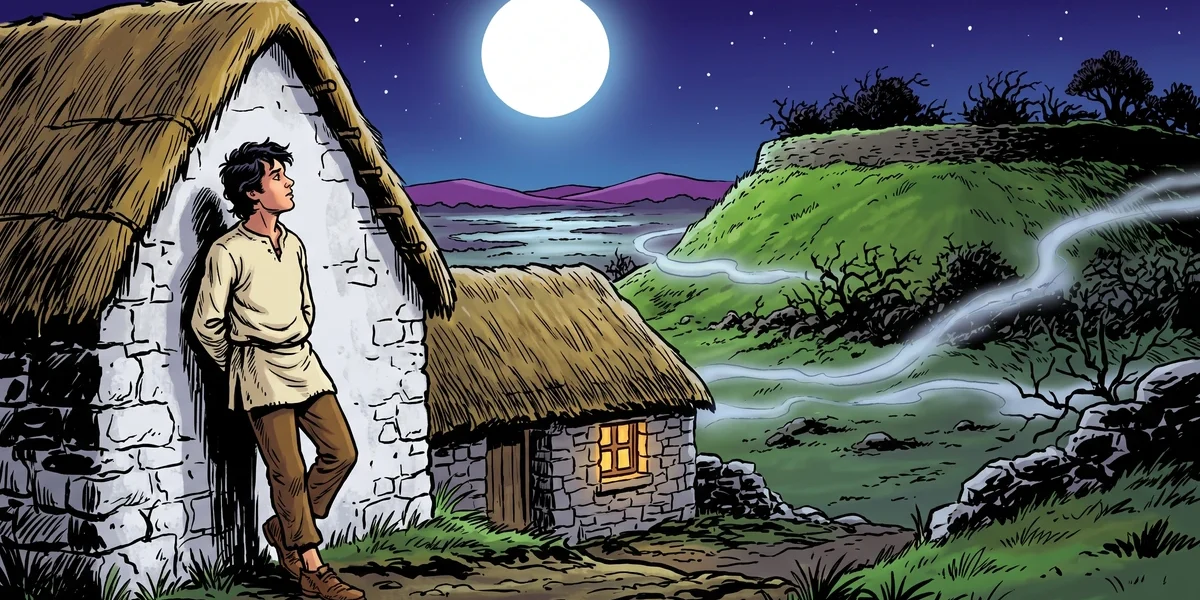
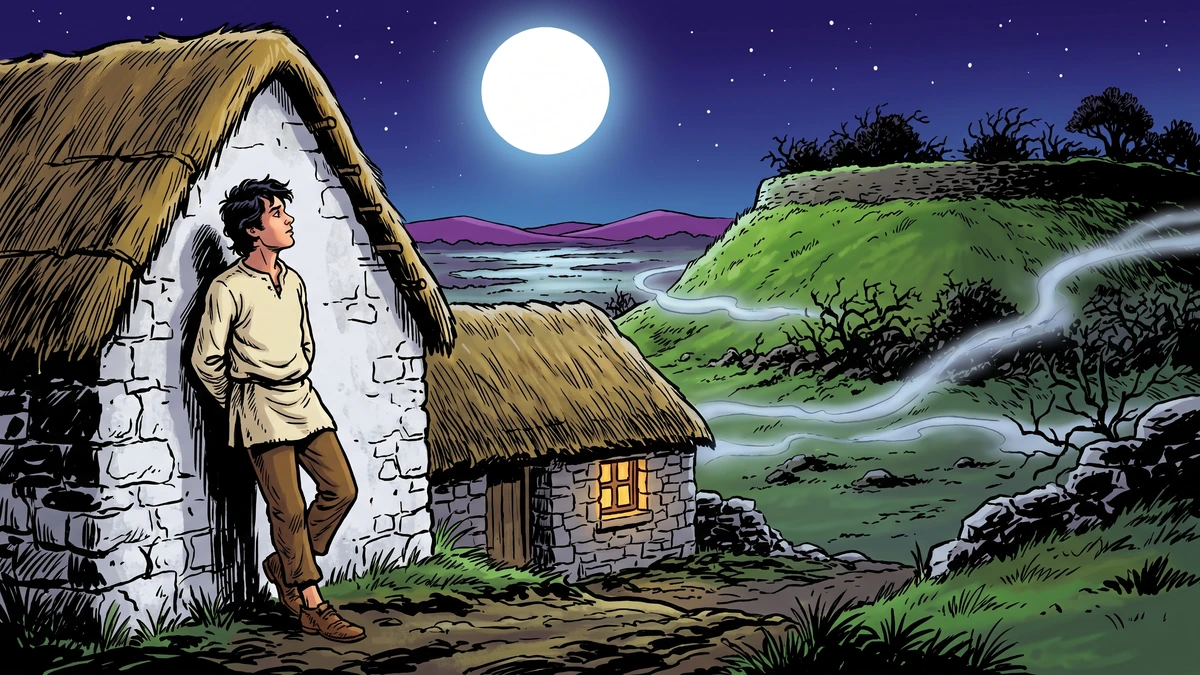
In the County Mayo, hard by Knock-an-Air, there lived a lad called Guleesh, the son of a small farmer. A short walk from the gable of his father’s cabin stood a fine grass-covered rath — one of the green ringforts that the country people knew were the doors and meeting-places of the Sídhe, the Good People. The grass that grew on the bank of the rath was the sweetest Guleesh ever lay on, and on bright nights he would lean against the gable for hours and watch the moon turning over the world. He was a dreamy boy, restless, easily bored with the slow work of the farm, and he was forever wishing himself somewhere else.
It was Hallow E’en — Oíche Shamhna, the night when the fíor-saoghal (the true world) and the sídhe-saoghal (the world of the fairy hosts) come close enough to brush against each other. Guleesh stood in his father’s haggard, looking up at the white moon, and he sighed and said aloud, “Mo léan géar nach im’ aice í — my bitter grief that I am not gone away out of this place altogether. I’d sooner be any place in the world than here. Och, it’s well for you, white moon, that’s turning round, turning round, as you please yourself, and no man can put you back. I wish I was the same as you.”
Hardly was the word out of his mouth when he heard a great noise coming, like the sound of many people running together and laughing and making sport, and the noise went past him like a whirl of wind, straight into the rath. Musha, by my soul, says Guleesh to himself, but ye’re merry enough — and I’ll follow ye.
The Ride of the Sídhe
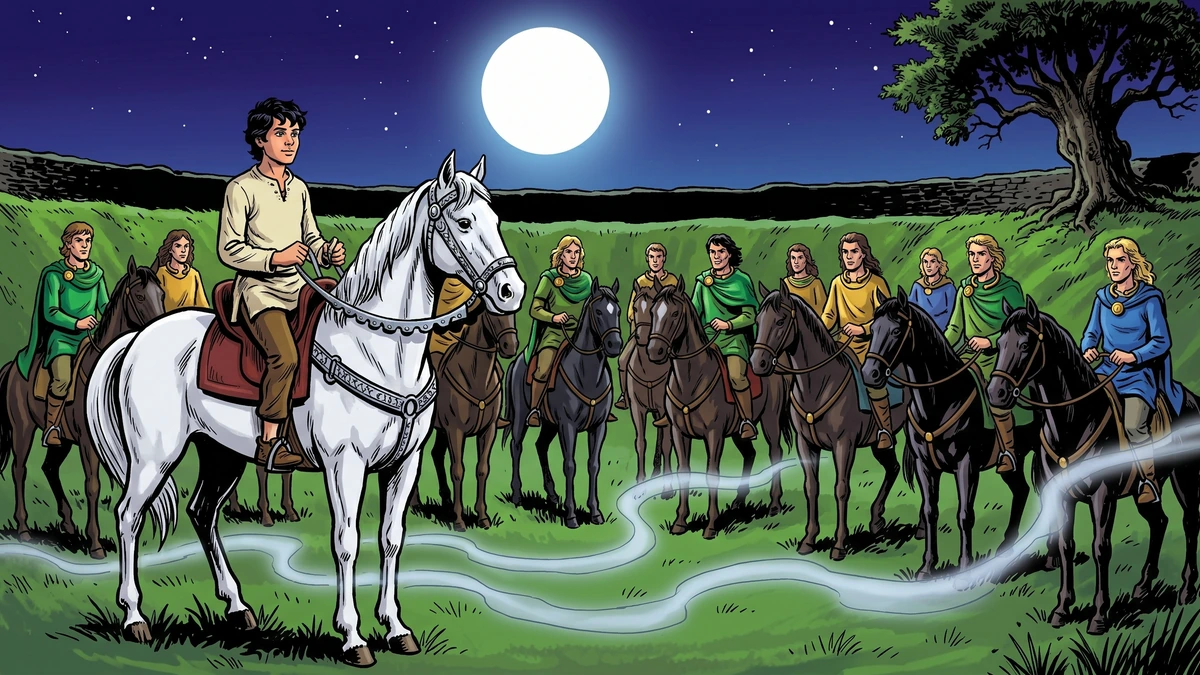
Inside the green ring he heard the fulparnee and the folpornee, the rap-lay-hoota and the roolya-boolya — the rich noise of the fairy revel — and then a great voice cried: “My horse, and bridle, and saddle! My horse, and bridle, and saddle!” and another and another took up the cry, until each of the host had called for a mount and a brown thoroughbred stood ready before him. Guleesh, hidden in the shadow of a thorn, called the same words boldly: “My horse, and bridle, and saddle! My horse, and bridle, and saddle!” — and on the instant a noble white steed was at his side, with a silver bridle and a saddle of red leather. He flung himself upon its back.
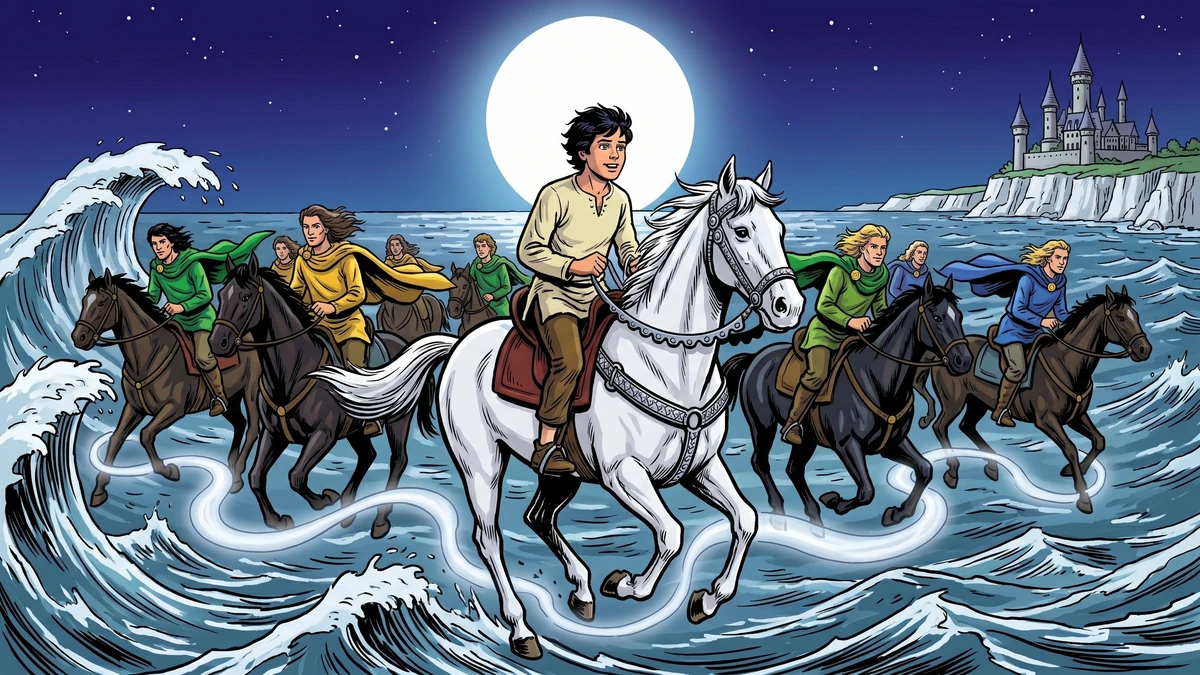
“Where shall we go to-night?” cried the leader. “We shall ride to-night to the King of France’s palace, to bring away the daughter of the King!” — for the King’s daughter was that night to be wedded against her will to the son of the King of a far country, and the Good People had a fancy for stealing her away. The whole host rose into the air with a shout — Hubbabboo! By my hand it’s a fine night for travelling — and Guleesh’s white horse rose with them, the wind sharp in the boy’s eyes, the moon racing behind a flying rag of cloud.
They rode over the dark sea, over the fields of England, over the white cliffs and the foaming Channel, and at last over the rooftops of Paris and into the great courtyard of the King’s palace, where the windows were lit and the music of harp and fiddle was pouring out into the night.
The French King’s Daughter
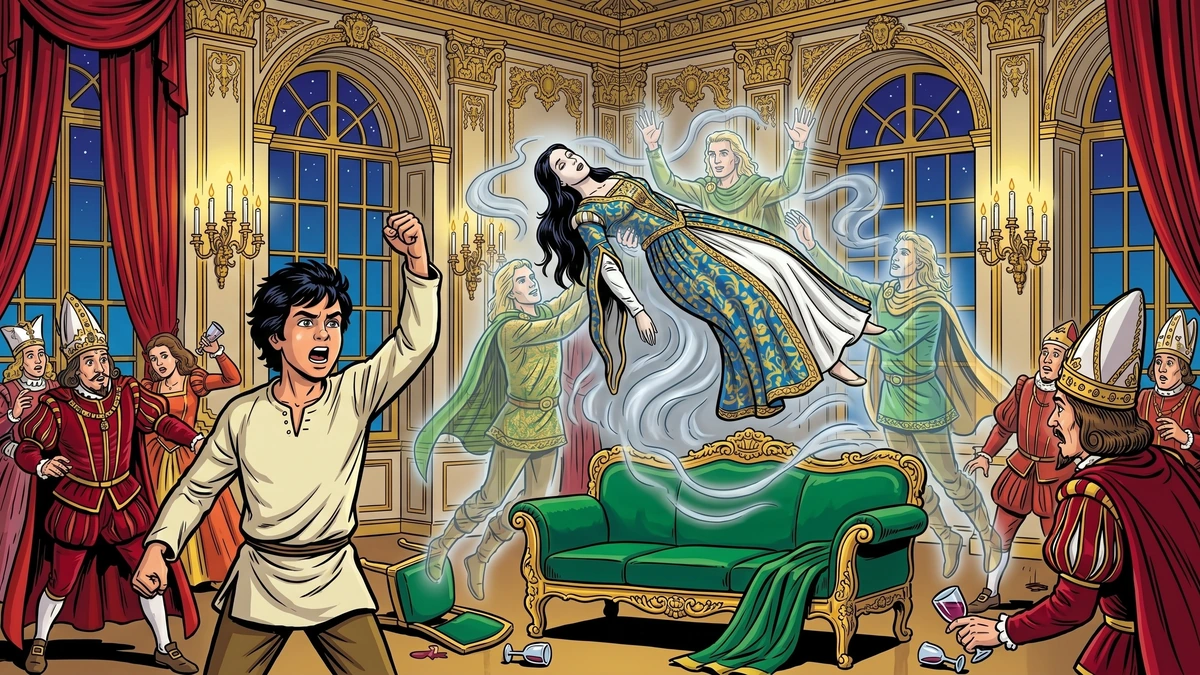
The fairy host slipped through every closed door as if doors were no more than mist, and Guleesh slipped after them. He saw a great hall full of nobles and serving-people, and on a couch in the middle of it a young woman, the most beautiful he had ever seen, white-faced and silent as a stone — for the bridegroom she was being married to was a man old enough to be her grandfather, and her heart was breaking inside her. The leader of the Sídhe whispered a charm over her, and she rose like a sleepwalker, and they carried her away upon one of their horses, and laid an ash stick where she had been so that her people would think she had died of the wedding-grief.
Now Guleesh, riding behind, looked at her face and a great pity rose in him. He had heard often that no fairy work can stand against a true word of Irish spoken aloud, for the speech of the Gael was on Adam’s tongue before iron was forged. Just as the host began to soar back into the sky he leaned forward, struck the white horse on the flank, and shouted with all his voice: “I will not let her go! Ag baile liom féin í, in ainm Dé! — Home with me she goes, in the name of God!”
At that one word — the holy name in Irish — the fairy company was struck powerless. They could not hold her. Their horses began to drop slowly to earth. The leader, in a fury, flung after Guleesh a parting curse: “May she be dumb! From this hour she shall not speak a word to any living creature, until the day twelvemonth that you took her from us!” — and the host vanished with a sound like rooks rising from a wood at evening, leaving Guleesh and the white-faced princess alone on the road, with the white horse standing by them.
The Year of Silence
Guleesh wrapped his coat about her and brought her back to his father’s cabin. The neighbours were astonished and frightened — a French king’s daughter in a Mayo kitchen — but his mother washed her face with spring water, blessed her with the sign of the cross, and made her up a bed in the inner room. There the princess lay, well and safe, and ate and drank, but never a syllable came from her lips, no matter what was said to her, kind or cruel. The neighbours began to whisper that Guleesh had brought a changeling into the house, but his mother stood firm, for she had seen the gentleness in the girl’s face.
The boy stayed close to her all that year. He brought her wildflowers from the bog, the white bog-cotton and the yellow flag-iris and the purple loosestrife, and the heather when it bloomed. He told her, in a slow careful Irish she half understood, the names of the hills and the rivers and the people of the townland. She listened, and her grey eyes followed him, but she never spoke. Once, on a stormy evening when the rain beat against the half-door, he came in soaked from foddering the cow and found her at the hearth, and saw a single tear on her cheek, and he was nearly heart-broken; but still she did not speak.
And so the year went round — Bealtaine to Lúnasa to Samhain — and the night came on at last when twelve months and a day were gone since the ride of the Sídhe, the second Hallow E’en, when the door between the worlds would open again. Guleesh knew, for he had been counting, that this was his only chance to undo the curse upon her tongue.
Hallow E’en Again, and the Word Found
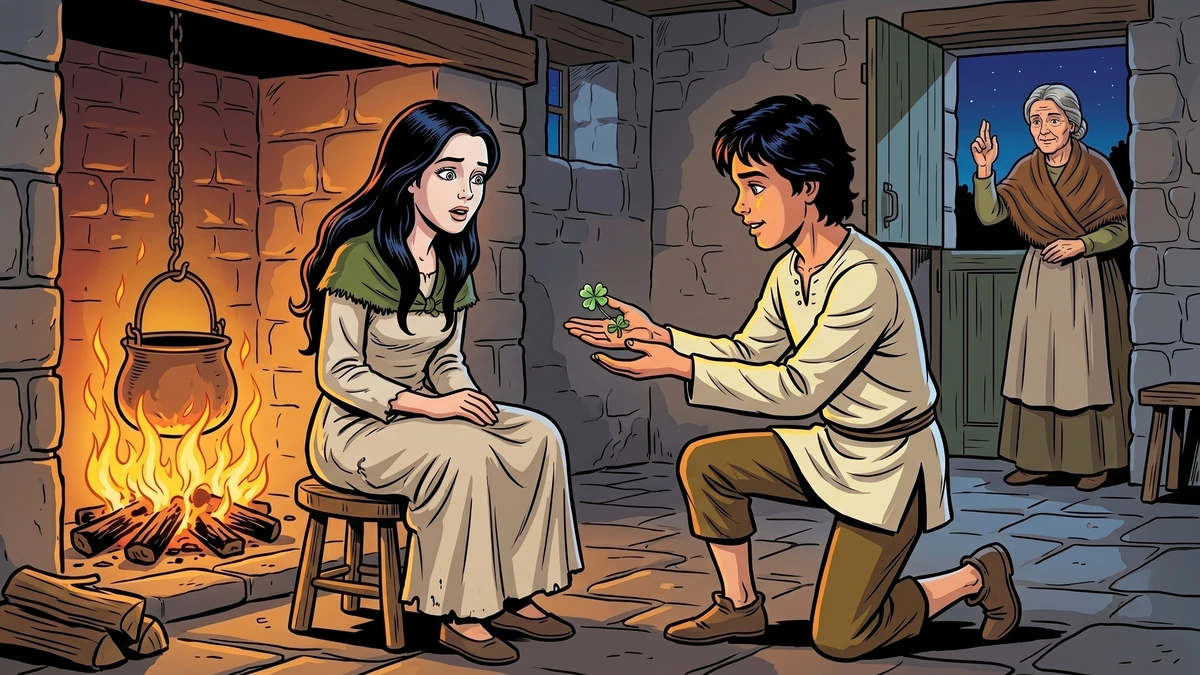
That second Hallow E’en he stood at the rath as he had stood the first, and the white moon was bright again, and again the great host came riding over the bog. This time Guleesh hid in a furze-bush at the edge of the green ring and listened. He heard one of the fairies say to another, in a low chuckling voice: “Foolish indeed is the boy that took the King of France’s daughter from us, and never knew that the herb that grows under the rath of Cnoc-a’-Chéaltais — the four-leaved seamair Mhuire, the Mary-shamrock — would loose the curse off her tongue if she chewed it.” And the other fairy laughed and said, “Foolish entirely — and there it is, three steps from where he is hid this minute.”
The blood leaped in Guleesh. The fairies, not knowing he was listening, rose into the air and were gone. He felt round in the dew, found the small green leaf with the tiny white blossom, and ran home with it pressed to his heart. He gave it to the princess; she chewed it, and the curse fell off her like an old cloak, and she spoke, and her first word was “Guleesh,” and her second was “thank you” — both of them in the Irish he had patiently taught her in the long silent year.
They sent word to the King of France, and great was the joy of that house when she came home alive that had been mourned for dead. The King would have given Guleesh half his kingdom, but Guleesh had grown to love the country girl in the princess and the princess to love the steady kindness of the country boy, and they were married — some say in France with bishops and a great feast, and some say at home in Mayo with a fiddler and a turf fire, and some say in both places, twice, to be sure of it. And Shamus O’Hart, telling the tale to Dr. Hyde a hundred years after, said only: “He never went near the rath again, but he kept the white horse, and he kept his word, and he was a happy man until the day of his death.”
The Moral & Why It Lasted
“Is troime focal ná an chloch is troime ar an domhan” — heavier than the heaviest stone in the world is a true word said aloud.
— Connacht proverb cited by Hyde, Beside the Fire, p. xxv
The moral of “Guleesh” is the moral that runs through all of Hyde’s Connacht material: that the spoken word — and above all the holy name spoken in your own tongue — is stronger than any enchantment. The fairy host is rich, beautiful, and powerful. Their horses outrun the wind, their music opens any door, and the laws of distance and weight do not bind them. But the moment a country boy from Mayo says “in ainm Dé” — “in the name of God” — out loud, in Irish, the whole shining company is brought down and their stolen prize is set free. Hyde, who collected the tale during a movement to save the Irish language from extinction, was making a quiet political point as well as a folkloric one: the Gaelic word still works.
The story has lasted for more than a hundred and thirty-five years on the page (and longer in the mouths of tellers like O’Hart) because it folds three deep folk patterns into one clean shape. It is a fairy-rade tale — the host rides, the boy joins them, ATU 400 in the international index. It is an abduction-and-rescue tale, ML 5085, the sister of “Jamie Freel” and of all the Donegal stories of brides taken off and brought back. And it is a year-of-silence tale, kin to “The Twelve Wild Geese” and to the Grimm “Six Swans,” in which patience and faithfulness break a curse that no sword or spell can touch.
For a child today the lesson is unchanged: be brave enough to follow when something wonderful goes past you, kind enough to refuse to leave another person in the dark, and patient enough to wait through a year of silence for the right word to come. And if you ever need that word, Hyde would say, you can find it in your own grandmother’s Irish, lying under the rath like a four-leaved shamrock for whoever has the wit to look.
It is worth pausing on the herb that breaks the curse, the seamair Mhuire — Mary’s shamrock, the four-leaved clover. Hyde’s note observes that in Connacht tradition the four-leaved seamróg conferred not luck (which is the modern English association) but true sight: the bearer could see the Sídhe as they truly were, and could not be deceived by their glamour. That a princess who has been silenced by fairy magic should be released by chewing exactly the herb that shows truth is the small, beautiful symbolic point on which the whole story turns. The fairies have stolen her name and her speech; the herb gives her back the power to say what is so. In Hyde’s wider project of cultural recovery this is precisely the function of the Irish language itself.
Read also: “Jamie Freel and the Young Lady” (Maclintock / Yeats, 1888); “The Horned Women,” “The Stolen Child” (Yeats); “The Legend of Knockgrafton” (Croker, Fairy Legends of the South of Ireland, 1825); “Connla and the Fairy Maiden” (Jacobs, Celtic Fairy Tales, 1892).
You May Also Like
 Celtic Folk Tales
Ages 9-12
Celtic Folk Tales
Ages 9-12
The Huntsman’S Son
The Huntsman’S Son: A long, long time ago there lived in a little hut on the borders of a great forest a huntsman and his wife and son. From his earliest
 Celtic Folk Tales
Ages 9-12
Celtic Folk Tales
Ages 9-12
A Legend Of Knockmany
A Legend Of Knockmany: What Irish man, woman, or child has not heard of our renowned Hibernian Hercules, the great and glorious Fin M’Coul? Not one, from Cape
 Celtic Folk Tales
Ages 9-12
Celtic Folk Tales
Ages 9-12
The Fate of the Children of Lir
The Fate of the Children of Lir: t happened that the five Kings of Ireland met to determine who should have the head kingship over them, and King Lir of the