The Salmon of Knowledge
The Salmon of Knowledge: In the ancient days of Irish mythology, when magic flowed through the world as freely as water through a stream and the pursuit of

The Irish told many stories about Fionn mac Cumhaill — how he raised the warrior-band of the Fíanna, how he chased the deer across half a kingdom, how he stood between Ireland and every monster that crawled out of the dark. But of all of them, the one they reached for first when they wanted to explain where his wisdom came from was a quiet little tale with almost no fighting in it at all: the story of an old poet, a young runaway, and a fish that had been swimming in the same pool for so long it had eaten the knowledge of the whole world.
It is a story about patience and about its strange, unfair-seeming reward. A man spends seven years of his life waiting for a single prize, and on the very day it finally comes to his hand, it slips past him to a boy who has been with him only a few weeks. What makes the tale Irish — and what makes it last — is not the unfairness. It is what the old poet does in the moment he realises he has lost. That moment, and not the catching of the salmon, is the true heart of the tale.
The Poet by the Boyne
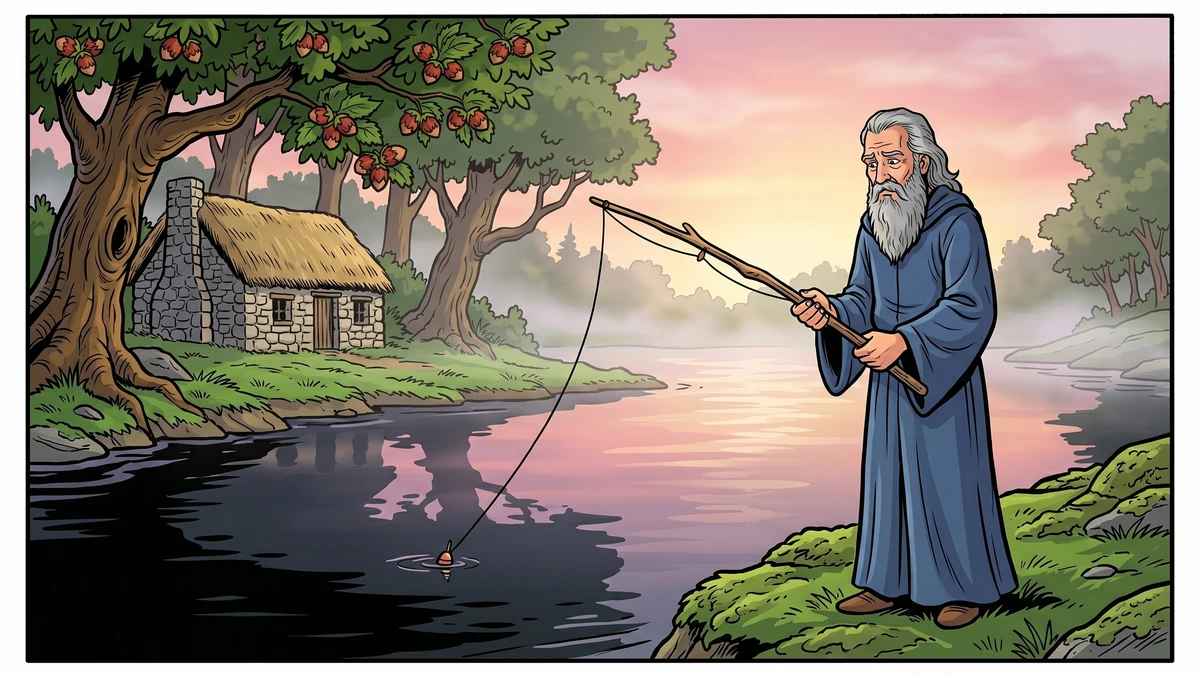
On the green bank of the River Boyne, in a small hut close to a deep dark pool, there lived a poet named Finnéces — Finegas, as the name is often softened in English. He was a fili, one of the learned poets of early Ireland, and that was a far greater thing than the word “poet” suggests to us now. A fili was a keeper of memory: of genealogies and law, of the names of places and the deeds of kings, of the old satires that could raise a blister on a man’s face and the praise-songs that could make a reputation outlast a life. Finegas had spent his years gathering that learning, and he was respected for it. But he wanted one thing more, and he had wanted it for a very long time.
In the pool beside his hut — the Irish called it Linn Féic, the Pool of Féc — swam a salmon, and it was no ordinary fish. Far upriver, at the hidden source of the Boyne, stood a well that the storytellers named the Well of Segais, ringed by nine sacred hazel trees. Each season those hazels dropped their crimson nuts into the water, and in each nut was wrapped a portion of all the wisdom in the world. The salmon of that well ate the nine nuts as they fell, and the knowledge passed into its bright flesh, and it carried that knowledge down the river with it. There was a prophecy fixed to the creature: whoever ate of the Salmon of Knowledge first would know everything — every art, every language, every thing that had happened and every thing that was still to come.
Finegas knew the prophecy, and he had read something else in his learning besides: that the salmon was fated to be caught by a man named Fionn. His own name, by happy chance, carried that sound. And so for seven long years the old poet had fished the dark pool of the Boyne, casting and waiting, casting and waiting, certain that he was the Fionn the prophecy meant and that the wisdom of the world was meant for him. Seven years is a long time to want one thing. It is long enough to build a whole life around the wanting.

The Boy Who Came to Learn
Into that patient, waiting world came a boy. He arrived at Finegas’s hut asking to be taken as a pupil, to learn the craft of poetry and the old learning of Ireland, and he gave his name as Demne. He was a fine, quick, fair-haired boy, and the old poet took him in gladly, for a fili needed students to carry his knowledge forward after him.
But the boy was not only Demne. He was the son of Cumhall, the slain leader of the Fíanna, and he had been raised in secret in the forests of Slieve Bloom by two women warriors because there were men in Ireland who wanted the son of Cumhall dead before he could grow up to claim his father’s place. He had come to Finegas under a half-name, the way a hunted child learns to move quietly through the world. The old poet, watching him, saw a brightness in the boy that made him ask, gently, whether Demne had any other name. And the boy admitted that some called him Fionn — “the fair one,” for his bright hair and bright face.
Finegas heard that and said nothing, but something must have turned cold and uncertain in him. For seven years he had told himself the prophecy pointed at no Fionn but himself. Now here, at his own hearth, fetching his water and tending his fire, was a boy who carried the very name. The old man did not send him away. He did not change his fishing. He went on casting into the pool as he always had, and the boy stayed and learned, and the question hung unspoken in the air of the little hut by the Boyne.
The Salmon Caught at Last
And then, after seven years of empty water, the line went tight. Finegas drew the Salmon of Knowledge out of the dark pool at last — a great fish, shining, the most beautiful thing he had ever pulled from a river, and inside it the wisdom of the whole world that he had wanted for the better part of his life. He carried it up the bank with his heart pounding. Everything he had waited for lay across his two hands.
But the old poet was tired, or perhaps he simply did not want to fumble the cooking of so precious a thing after waiting so long for it. He gave the salmon to the boy. “Cook this fish for me,” he told Fionn, “and take the greatest care. But do not eat the smallest piece of it. Not one bite. Not one taste. When it is ready, bring it to me whole.” The boy promised, and he set the salmon over the fire, and the old man went a little way off to rest, content at last, believing that after seven years the wisdom of the world was finally an hour away from being his.
The boy tended the fire carefully, turning the great fish so it would cook evenly, watching it the way a child watches something he has been trusted with and is afraid to spoil. And as the salmon cooked, a blister rose on its bright skin. Without thinking — the way anyone would — Fionn pressed the blister down with his thumb to smooth it away. The skin was scalding hot. The pain leapt up his arm, and the boy did the most ordinary thing in the world: he put his burned thumb into his mouth to cool it.

The Burned Thumb and the Light of Knowing
It was the smallest accident imaginable. A blister, a burn, a thumb in the mouth — nothing a person would even remember an hour later. But the thumb had touched the cooking flesh of the Salmon of Knowledge, and in that scalding instant Fionn became the first to taste it. The wisdom of the world, gathered over uncounted seasons from the nine hazels of Segais, did not pour into the old poet who had waited seven years for it. It poured into a boy who had only wanted to stop his thumb from hurting.
Fionn carried the cooked salmon to Finegas as he had promised, whole and untouched as a meal. But the old poet looked at the boy and stopped. Something had changed in the young face. There was a new light in his eyes, a depth and a steadiness that had not been there at dawn. Finegas asked him quietly: “Have you eaten any of the salmon?” And the boy answered honestly — no, he had eaten nothing; but when a blister rose on the skin he had burned his thumb pressing it, and he had put the thumb in his mouth to ease the pain.
Here is the hinge of the whole tale, and everything the Irish loved about it lives in this one moment. Finegas had every reason in the world to be bitter. Seven years of his life were standing in front of him wearing a child’s face. He could have raged; he could have grieved; he could have told the boy to leave and never come back. He did none of those things. He looked at Fionn for a long moment, and then he understood — and in understanding, he showed that he truly was a wise man after all. The prophecy had never meant him. It had always meant this Fionn, this boy. And so the old poet picked up the whole salmon and put it into the boy’s hands. “Eat it,” he said. “All of it. The knowledge was never mine to keep. It was always yours.” And Fionn ate the Salmon of Knowledge, and from that day he carried the wisdom of the world.
Ever after, when Fionn mac Cumhaill needed to know a hidden thing — a danger he could not see, a truth someone was keeping from him, the right path at a turning — he had only to put that same thumb between his teeth and bite down on it, and the knowing would come to him. The Irish had a name for it: the dét fis, the “tooth of knowledge,” and it stayed with him to the end of his long life. The gift the salmon carried down the Boyne went on speaking through Fionn for as long as there were storytellers to remember him.

The Moral of the Tale
It is tempting to read this story as a tale about luck — the boy who stumbles into a fortune the old man worked seven years to earn. But the Irish who kept the tale alive did not tell it as a story about luck, and they did not tell it as a story about unfairness either. They told it as a story about two different kinds of wisdom, and about the moment one of them is tested.
There is the wisdom Finegas had spent his life gathering: facts, names, law, craft, the long patient learning of the schools. That is real wisdom and worth having. But the tale sets a second, deeper kind beside it — and it lets us see that second kind not in the boy, but in the old man, at the instant he loses everything. A lesser person, robbed of a seven-year prize by an accident, would have clutched at it, or cursed, or at the very least kept the salmon and tried again with the next one. Finegas did the opposite. He saw the truth, he accepted it without bitterness, and he gave the prize away freely to the one it belonged to. That open hand, in the moment it cost him most, was wisdom — the truest he ever showed. The old Irish put the same idea into a plain proverb that any grandmother might say across a fire:
“Is fearr an t-eolas ná an t-ór.”
— Traditional Irish seanfhocal: “Knowledge is better than gold.”
Knowledge is better than gold — and the proof of it is what Finegas does. He treats the wisdom of the world not as gold to be hoarded but as something with a rightful owner, and he would rather see it go where it belongs than keep it where it does not. The tale teaches, too, that the deepest learning often comes not to the one who chases it hardest but to the one who is ready to receive it, and that it tends to arrive sideways — through an ordinary burned thumb, on an ordinary evening, when no one is reaching for it at all. Wisdom is not seized. It is met. And when it comes to someone else instead of to you, the wise response is the old poet’s: to recognise it, to bless it, and to let it go.
The Tale’s Origins and Canonical Sources
The story of the Salmon of Knowledge belongs to the Fenian Cycle of early Irish literature — also called the Fionn Cycle or, from Fionn’s son Oisin, the Ossianic Cycle — one of the four great story-cycles of medieval Ireland alongside the Mythological, Ulster and Kings cycles. Within that cycle the episode is part of a longer narrative known as Macgnímartha Finn, “The Boyhood Deeds of Fionn,” which gathers the tales of how the hunted son of Cumhall grew up in secret, won back his father’s name, and came into his powers.
Macgnímartha Finn is a Middle Irish text, composed in roughly the twelfth century, though the matter it tells is older still and circulated long before in oral tradition. It survives in a single medieval manuscript, the fifteenth-century Laud Misc. 610, now held in the Bodleian Library at Oxford. The text was edited and translated into English by the great Celtic scholar Kuno Meyer, who published it as “The Boyish Exploits of Finn” in the journal Ériu in 1904 — the version through which most later writers came to know the tale. In the early manuscripts the poet’s name appears as Finnéces or Finn Ecés, the pool is Linn Féic on the Boyne, and the source of the river’s wisdom is the well of Segais, ringed by the nine hazels of knowledge — an image that recurs across Irish tradition, sometimes attached to a parallel well called Connla’s Well.
The tale reached modern readers chiefly through the writers of the Irish Literary Revival, who retold the old cycles for a new audience. Lady Augusta Gregory included the episode in Gods and Fighting Men (1904), her companion volume to Cuchulain of Muirthemne; the poet James Stephens gave it one of its most beloved retellings in Irish Fairy Tales (1920); and P. W. Joyce and others carried it into school readers and children’s collections, where generations of Irish children met it. Because it is heroic and legendary saga rather than a migratory wonder-tale, the episode has no single Aarne–Thompson–Uther tale-type number; folklorists instead index its central idea under the motif of magic knowledge gained from eating a sacred fish. That motif — wisdom carried in the flesh of a salmon, and the salmon itself as a creature of deep knowing — runs all through Celtic myth, and the Salmon of Knowledge is its most famous expression.
Why the Tale Has Lasted
One reason the story has outlived the manuscripts that carried it is that it answers a question every hero-legend has to answer sooner or later: where does the hero’s inner authority come from? Fionn mac Cumhaill spends his adult life leading warriors, judging disputes, seeing through deceptions. An audience needs to believe he has the depth to do all that. The Salmon of Knowledge supplies it in a single childhood scene. Before we ever watch the grown Fionn out-think an enemy, we have watched the gift of knowing pour into him by the Boyne — and so every wise thing he later does is read in the light of that evening and that burned thumb.
The deeper reason, though, is the old poet. Children remember the magic fish and the scalding thumb; adults, coming back to the tale, find that the part that stays with them is Finegas. Almost everyone, at some point, watches a prize they worked years for go to someone else — a younger colleague, a luckier rival, a person who simply happened to be standing in the right place at the right moment. The story does not pretend that does not hurt. What it offers is a model of how to meet it: clearly, without bitterness, with an open hand. Finegas spent seven years fishing for the wisdom of the world, and his single wisest act was to give it away the instant he understood it was not his. That is why the tale has lasted fifteen centuries and is still being told on this page — because it quietly insists that the measure of a wise person is not how much knowledge they can gather and hold, but how gracefully they can let it go to where it truly belongs.
You May Also Like
 Celtic Folk Tales
Ages 9-12
Celtic Folk Tales
Ages 9-12
Princess Finola And The Dwarf
Princess Finola And The Dwarf: A long, long time ago there lived in a little hut in the midst of a bare, brown, lonely moor an old woman and a young girl.
 Celtic Folk Tales
Ages 9-12
Celtic Folk Tales
Ages 9-12
The Black Horse
The Black Horse: nce there was a king and he had three sons, and when the king died, they did not give a shade of anything to the youngest son, but an old
 Celtic Folk Tales
Ages 9-12
Celtic Folk Tales
Ages 9-12
The Greek Princess and the Young Gardener
The Greek Princess and the Young Gardener: here was once a king, but I didn’t hear what country he was over, and he had one very beautiful daughter. Well, he