Elidore
Elidore: the days of Henry Beauclerc of England there was a little lad named Elidore, who was being brought up to be a cleric. Day after day he would trudge


In the days of Henry Beauclerc — Henry I of England, who reigned from 1100 to 1135 — there was a small boy in Pembrokeshire named Eliodorus, whom the English children’s books would later call Elidore. He lived with his widowed mother in a cottage near the cathedral town of St David’s, on the long sea-pointing peninsula that the Welsh call Mynyw and the Latin chroniclers Menevia. By the standards of twelfth-century Wales the boy was meant for a comfortable enough life: his mother had given him to the Black Canons of the cathedral school, where he was being taught his ABC and the elements of Latin, with a view to a vocation in the Church. The trouble was that Eliodorus was, as Giraldus Cambrensis would later record from the man’s own lips, an idle pupil. He hated the desk and the wax-tablet. The monks beat him for his idleness, and at twelve years of age, finding the rod harder to bear than the alphabet, he ran away into the woods. For two days and two nights he hid himself in the great forest by the river, eating nothing but the autumn berries from the hawthorn and the wild rose. On the third morning, half-starving and at the mouth of a low cave at the river’s bank, he was found by two very small men, who told him that if he came with them they would lead him to a country full of games and sports.
The Way Through the Cave: An Otherworld Without a Sun
Eliodorus followed. The two pigmies took him through an underground passage in the dark and brought him at last into a country which Giraldus, writing in his careful clerical Latin, describes with a precision quite unusual for a medieval account of fairyland. It was, the chronicler says, a beautiful land of meadows, rivers and woods, but with one very strange property: the sun never shone in it. There was no day in our sense. The clouds — or what the Welsh fairies in their own tongue would have called niwl — were always over the sky, and there was neither sunlight by day nor moon and stars by night. The little men were small in stature but well-proportioned, with fair hair falling on their shoulders like a woman’s. They rode horses about the size of greyhounds, and they ate no flesh, fish or fowl, but only milk thickened with saffron. They never swore an oath, and they never told a lie. They despised the larger people of the upper world for their lying and their treachery. They worshipped no gods and held no formal religion, but, as Giraldus notes, their reverence was always for veritas, for Truth itself.
This last detail — a fairy people whose only god was Truth — is one of the most striking single notes in all of medieval Celtic literature, and it has fascinated commentators ever since. The early Welsh scholar Sir John Rhys, writing in Celtic Folklore: Welsh and Manx (Oxford: Clarendon Press, 1901), saw in Giraldus’s pigmies a half-remembered echo of an older British belief in an underground race of small people whom medieval Christianity could only categorise as fairies because Christianity had no other slot for them. The folklorist Lewis Spence in The Fairy Tradition in Britain (London: Rider, 1948) connected them to the Welsh Tylwyth Teg, “the Fair Family” — a euphemism, then as now, for the people one did not name out loud. And the philologist J.R.R. Tolkien, who knew the Itinerarium well from his Oxford lectures, took from the tale of Eliodorus the idea — which would later flower in his elves of Lothlórien — that the underground or otherworldly people of Celtic story were neither demons nor diminished men but a separate race, smaller and graver and more truthful than ourselves. The land beneath the cave by the river is the same land, philologically and imaginatively, as Annwn in the Mabinogi, as Tír na nÓg in the Gaelic tradition, and as Avalon in the Arthurian legends Giraldus himself helped to seed.

The Boy at the King’s Court
The two pigmies presented Eliodorus before their king, who asked the lad his name and how he came there. The boy answered him plainly. The king, after a moment’s looking, gave him an office: Filio meo, ait, ministrabis — “Thou shalt attend on my son” — and waved the strange visitor away. So the boy, who in the upper world had run away from monks and beatings, found himself a page at a court of small, fair-haired, vegetarian truth-tellers, riding miniature horses through fields where the sun never rose. He stayed there a long while. He was given the run of the games and sports of the king’s small son, and the games were beautiful and exhausting and entirely unlike the desk-work of the cathedral school. Months passed. The boy grew comfortable, and at last he asked the king for permission to visit his widowed mother in the upper world, promising to return.
The permission was given without difficulty, and the same two pigmies who had first found him led him back through the underground passage, through the wood, and to the door of his mother’s cottage. The reunion was a tearful one: the woman had been a widow long enough to know not to expect children back from the forest, and she had grieved her son for dead. He told her, as Giraldus says he was later to tell Bishop David of St David’s, the whole truth of where he had been. He stayed a few days, and then, at his given hour, he went back to the small fair-haired king. From that time on, Eliodorus lived a double life: partly with his mother in Pembrokeshire, partly with the pigmies underground, going freely between the two countries by the cave-mouth that he now knew well. It was, as Giraldus quietly notes, the happiest period of the man’s whole long life — the years of which, in his old age, he could never speak without weeping.
The Yellow Ball and the Broken Trust
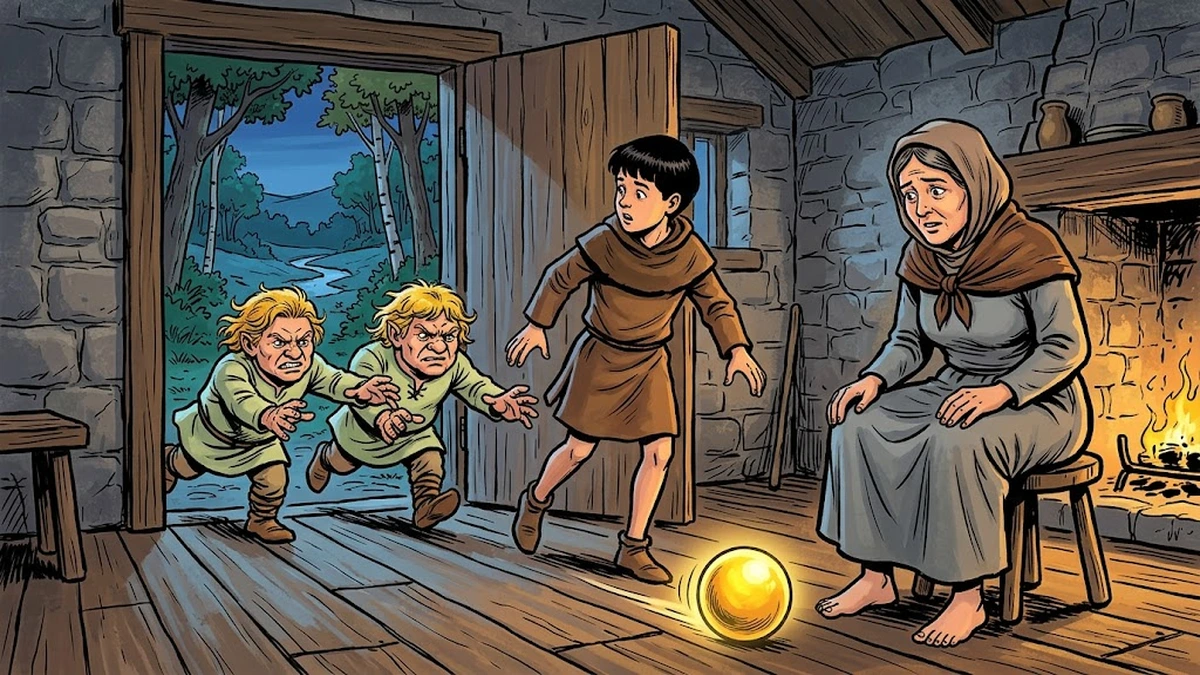
The trouble that ended it was a small one, and very domestic, and very human, and almost certainly the reason the tale has lived eight centuries. Eliodorus, on one of his visits to the upper world, mentioned to his mother in passing that the games of the pigmies were played with little balls of a heavy yellow metal — aureos pilas, golden balls. The widow, whose poverty Giraldus is careful to mention, asked her son if, the next time he came, he would bring her one. The Latin chronicler is too tactful to call her wicked for the asking. He says only that she begged. Eliodorus, on his next return, did what no fairy guest in any folktale has ever done with impunity: he took, without leave, one of the yellow balls from his playmates’ game, and ran for the upper world, no longer waiting to be guided. He came up out of the cave and along the wood-road and to the very threshold of his mother’s cottage, his foot on the stone of the door, when the gold ball slipped from his fingers, rolled across the threshold and stopped at his mother’s feet. In the same instant the two pigmies who had silently followed him sprang from behind, snatched up the ball, spat at the boy, and were gone. He went out next day to the cave by the river to make his apologies. The cave was no longer there. He searched the wood for years. He never found the country of the pigmies again.
The Old Priest and the Greek Words
This is where Giraldus’s account becomes precious to historians, because the chronicler is here writing not from a written source but from oral testimony. In the boy’s middle age, having no other path open to him, Eliodorus went back to the Black Canons at St David’s and took orders. He became, in Giraldus’s careful description, postea sacerdos — “afterwards a priest.” When Bishop David II of St David’s (David Fitzgerald, who held the see from 1148 to 1176) heard the story, he summoned the now elderly priest and questioned him minutely about the manners and customs of the little men. He asked, in particular, what language they had spoken. The old priest gave him two specimens. When the pigmies wanted water, he said, they would say ydor ydorum; when they wanted salt, halgein ydorum. The bishop, a learned man, recognised at once that ydor was the Greek ὕδωρ (water) and halgein was a metathesis of ἅλς (salt). From this slight philological hint Giraldus then leaps, in the manner of his age, to one of the great medieval theories of British origin: that the Britons were the descendants of Brutus son of Aeneas, and that they had carried with them across the Mediterranean the Greek of Trojan ancestors. The pigmies’ Greek, in this reading, is older and purer than that of the upper world; the underground people are an unbroken survival of a buried antiquity.

Modern Celticists are not obliged to believe the Trojan theory — and they don’t. But the philological detail itself is one of the most carefully attested things about Eliodorus’s tale. Giraldus says expressly that he heard the two specimen-words from the old priest’s own mouth (ex ore ipsius), and Bishop David’s identification of the Greek roots is one of the earliest documented attempts at comparative linguistics in Britain. The historian Robert Bartlett, in Gerald of Wales: A Voice of the Middle Ages (Stroud: Tempus, 2006), points out that Giraldus’s whole treatment of Eliodorus carries the marks of careful clerical interview rather than literary embroidery: dates given (the reign of Henry Beauclerc); place named (the wood near St David’s); witnesses listed (Bishop David himself); and the priest’s emotional reaction recorded as a single Latin clause that the children’s-book retellers have never improved upon: quotiens hujus rei mentio fieret, in lacrimas erumpebat — “whenever mention was made of this matter, he would burst into tears.”
The Place of the Tale in European Folklore
The tale of Eliodorus is one of the half-dozen earliest surviving narrative records of fairy abduction in any European language. It precedes by a clear two centuries the great Middle English ballad of Thomas the Rhymer and the related Scots ballad of Tam Lin — both of which have been catalogued by Francis James Child as Child Ballads 37 and 39. It precedes by half a century Walter Map’s similar story, in De Nugis Curialium (c. 1182–1192), of the Welsh nobleman Gwestin Gwestiniog and the lake-women of Brecknock — a tale Map himself notes as belonging to the same family of fata stories. In the international folktale catalogue compiled by Antti Aarne, expanded by Stith Thompson and Hans-Jörg Uther, Eliodorus’s adventures combine a number of ATU types and motifs: the underground passage to the otherworld (Motif F92, “Pit entrance to lower world”); the otherworld where time runs differently (Motif F377); the fairy gift theft (Motif F348.0.1, “Tabu: stealing from fairies”); and most centrally Type 503-related, The Gifts of the Little People, with its insistence that what the fairies give is freely received but what is taken is angrily reclaimed.
What sets Eliodorus apart from the great Scottish and Scandinavian fairy abduction ballads is the gravity of its narrator. Where the ballads delight in the strangeness of fairyland, Giraldus is interested in two specific things: the philological evidence (the Greek words, which prove a doctrine of British origin) and the moral evidence (the old priest’s tears, which prove the truth of the boy’s account). The supernatural is not entertainment here; it is testimony in the strict canonical sense — sworn under the questioning of a bishop, attested by two converging witnesses, and recorded in the careful prose of an archdeacon who was himself a candidate for the see of St David’s. The tears of that old priest, as remembered by a chronicler who had spoken with him or with people who had, are the closest thing the medieval Welsh church possessed to a documented encounter with the Otherworld.
The Welsh Fairy Country and Its Survivals
The country of the small fair-haired people who eat saffron-milk and worship Truth has parallels all through Welsh folk tradition. The lake-maidens of Llyn y Fan Fach in Carmarthenshire come from a country under the water, marry mortal men, and return when the geis (the prohibition) is broken. The plant rhys ddwfn — “the children of Rhys the Deep” — of Cardiganshire are an underground race of fair people who attend the markets of Cardigan invisibly and pay in fairy gold that turns to leaves when their patience is tried. The Tylwyth Teg (“the Fair Family”) of north Wales abduct human midwives, exchange children at the cradle, and live in a country of which only the gateways can be glimpsed by mortals — by the corner of the eye on a particular evening, by the foot stepping into a particular ring of grass on a particular hill. In every case the rules of contact are the same: hospitality may be received but never taken; speech is allowed but never repeated; and the underground time runs at a different pace from our own, so that what feels like an evening below is a year above, or a year below an evening above. Eliodorus’s tale gives us the earliest written specimen of the entire Welsh complex.
The Tale’s Long Afterlife: From Giraldus to Jacobs
The textual history of Eliodorus’s story is one of the cleanest in all of medieval European folklore. The tale survived almost untouched in the manuscripts of Giraldus’s Itinerarium; Sir Richard Colt Hoare gave it its first full English dress in The Itinerary of Archbishop Baldwin Through Wales (1806); Joseph Jacobs took Hoare’s text in 1894 and shortened it for his children’s More Celtic Fairy Tales; Andrew Lang included a sketch of it in The Lilac Fairy Book (1910); and the medievalist Robert Bartlett’s commented translation in Gerald of Wales: The Journey Through Wales and the Description of Wales (Penguin Classics, 1978; rev. 2006) restores to the children’s tale its original gravity as a case-study in twelfth-century clerical ethnography. T. Gwynn Jones in Welsh Folklore and Folk-Custom (London: Methuen, 1930) held the tale up as a paradigm of how a single-source medieval Latin text can be more reliable than a hundred orally-collected variants — few folktales in any European language have travelled so undistorted from their first writing-down to their present form.
Moral
“Quotiens hujus rei mentio fieret, in lacrimas erumpebat.” — “Whenever mention was made of this matter, he would burst into tears.” (Giraldus Cambrensis, Itinerarium Cambriae, I.viii — recording the elderly priest Eliodorus’s invariable response, in old age, to any question about his lost fairy country.)
The hinge of Eliodorus’s life is the moment he takes the yellow ball without being given it. Up to that moment he has been a free guest of the underground country, going freely between two homes, and the trust between him and the small fair people has been complete. When he carries away what was not his to carry, he closes the cave for ever. The story is, in its quiet medieval way, one of the most exact moral parables ever set down about hospitality and theft: the fairy country is not lost because Eliodorus loved his mother — he is praised, in Giraldus’s silent prose, for loving her — but because he could not, on her one weak request, distinguish between what he was free to enjoy and what was not his to take. Every Welsh and Irish fairy tale of stolen gold has the same structure underneath, but Eliodorus’s is the first written. The old priest weeping in his stall at St David’s, fifty years on from the day the cave closed, is the moral made visible: one wrong gesture in a country of generous people had cost him a friendship he could never repair, and a country whose grass and rivers and fair-haired children he had loved without understanding how much.
Why This Story Has Lasted
The reasons that Eliodorus has survived for eight and a half centuries since Giraldus first wrote it down are not very hard to find when one reads the tale aloud, which is the test every folktale must pass. It opens with a perfectly recognisable boy: the schoolboy who can’t memorise his Latin, the child who runs away when the rod becomes more frequent than the page. Its supernatural country is described with that particular Giraldine restraint which makes it both believable and memorable — fair-haired people, no sun, vegetarian diet, miniature horses, a king’s son needing a page, an oath-free truth-loving theology. Its plot turns on the smallest possible action: a boy slipping a yellow ball into his pocket. And its closing image, twice repeated through the chronicle, is the elderly priest of St David’s bursting into tears at any mention of the lost country, fifty years and more after the cave closed against him for ever. The whole thing is twelve hundred Latin words long. It contains in those twelve hundred words a complete theology of fairyland, a philological argument about British origins, a parable about hospitality and theft, and a portrait of a particular old man weeping. A folktale that survives that compressed, that exact, in a clerical Latin chronicle, has earned its place in any company of stories. It earned its place there in the twelfth century, and Joseph Jacobs’s 1894 retelling was simply doing what every fireside and every cathedral school in Wales had done for the seven hundred years before him: keeping faith with a story too good to be allowed to lapse.
Frequently Asked Questions
Who first wrote down the tale of Elidore (Eliodorus)?
Giraldus Cambrensis (Gerald of Wales), c.1191, in his Itinerarium Cambriae Book I, Chapter 8 — composed after his journey through Wales with Archbishop Baldwin in 1188. Giraldus heard the tale from oral testimony in Pembrokeshire: he spoke either with the now-elderly priest Eliodorus himself or with people who had heard the bishop’s interview. The chronicler dates the original adventure to the reign of Henry I (1100-1135), names Bishop David II of St David’s (1148-1176) as the questioner, and notes the priest’s tearful response when asked. The first English-language version is Sir Richard Colt Hoare’s translation in The Itinerary of Archbishop Baldwin Through Wales (1806); Joseph Jacobs gave the tale its now-classic shorter children’s-book form as Tale XXXI of More Celtic Fairy Tales (London: David Nutt, 1894).
What were the Greek words the pigmies spoke?
The old priest gave Bishop David two specimens. For water the pigmies said ydor ydorum; for salt, halgein ydorum. The bishop, a learned man, recognised at once that ydor was the Greek ὕδωρ (water) and halgein was a metathesis of ἅλς (salt). Giraldus, writing it down from the priest’s own lips (ex ore ipsius), then leaps to the medieval theory of British origin from Brutus son of Aeneas. Modern Celticists do not accept the Trojan etymology, but Bishop David’s identification of Greek roots in this clerical interview is one of the earliest documented attempts at comparative linguistics in Britain (see Robert Bartlett, Gerald of Wales: A Voice of the Middle Ages, Stroud: Tempus, 2006).
How does Eliodorus’s story connect to the wider Celtic fairy tradition?
Eliodorus’s tale gives us the earliest written specimen of the Welsh underground-fairy complex. The country of the fair-haired vegetarian truth-tellers parallels the lake-maidens of Llyn y Fan Fach in Carmarthenshire; the plant rhys ddwfn (“children of Rhys the Deep”) of Cardiganshire who attend Cardigan markets invisibly; the Tylwyth Teg (“the Fair Family”) of north Wales who exchange children at the cradle; the Old Irish Tír na nÓg; the Welsh Annwn of the Mabinogi; and the Avalon of the Arthurian legends Giraldus himself helped to seed. The tale precedes by two centuries the Middle English Thomas the Rhymer and the Scots Tam Lin (Child Ballads 37 and 39), and is one of the half-dozen earliest fairy-abduction records in any European language.
What ATU and motif-index types does Eliodorus’s story belong to?
In the international folktale catalogue compiled by Antti Aarne, expanded by Stith Thompson and Hans-Jörg Uther (ATU), Eliodorus’s adventures combine: the underground passage to the otherworld (Stith Thompson Motif F92, “Pit entrance to lower world”); the otherworld where time runs differently (F377); the fairy-gift theft (F348.0.1, “Tabu: stealing from fairies”); and most centrally Type 503-related, The Gifts of the Little People, with its insistence that what the fairies freely give is freely received but what is taken without leave is angrily reclaimed. Tom Peete Cross’s Motif-Index of Early Irish Literature (Indiana UP, 1952) places these motifs in their Celtic context.
Why did J.R.R. Tolkien care about the Eliodorus tale?
Tolkien knew Giraldus’s Itinerarium well from his Oxford lectures on medieval Welsh and English literature. He took from the tale of Eliodorus the idea — which would later flower in his elves of Lothlórien and Rivendell — that the underground or otherworldly people of Celtic story were neither demons nor diminished men but a separate race, smaller and graver and more truthful than ourselves. The pigmies’ fair hair, their reverence for Truth alone, their sunless beautiful country, and their refusal of meat all map directly onto the moral architecture Tolkien built for his Eldar. The land beneath Eliodorus’s cave is, philologically and imaginatively, the same land as Annwn in the Mabinogi, as Tír na nÓg in Gaelic tradition, and as the Undying Lands of The Silmarillion.
You May Also Like
 Celtic Folk Tales
Ages 9-12
Celtic Folk Tales
Ages 9-12
Notes And References
Notes And References: It may be as well to give the reader some account of the enormous extent of the Celtic folk-tales in existence. I reckon these to extend
 Celtic Folk Tales
Ages 9-12
Celtic Folk Tales
Ages 9-12
The Shepherd Of Myddvai
The Shepherd Of Myddvai: Up in the Black Mountains in Caermarthenshire lies the lake known as Lyn y Van Vach. To the margin of this lake the shepherd of
 Celtic Folk Tales
Ages 9-12
Celtic Folk Tales
Ages 9-12
The Story Of Deirdre
The Story Of Deirdre: There was a man in Ireland once who was called Malcolm Harper. The man was a right good man, and he had a goodly share of this world’s