The Little White Cat
Eileen delays a forced marriage with three impossible balls of fairy dew, while the Little White Cat guides a prince through enchanted islands to obtain her rescue.
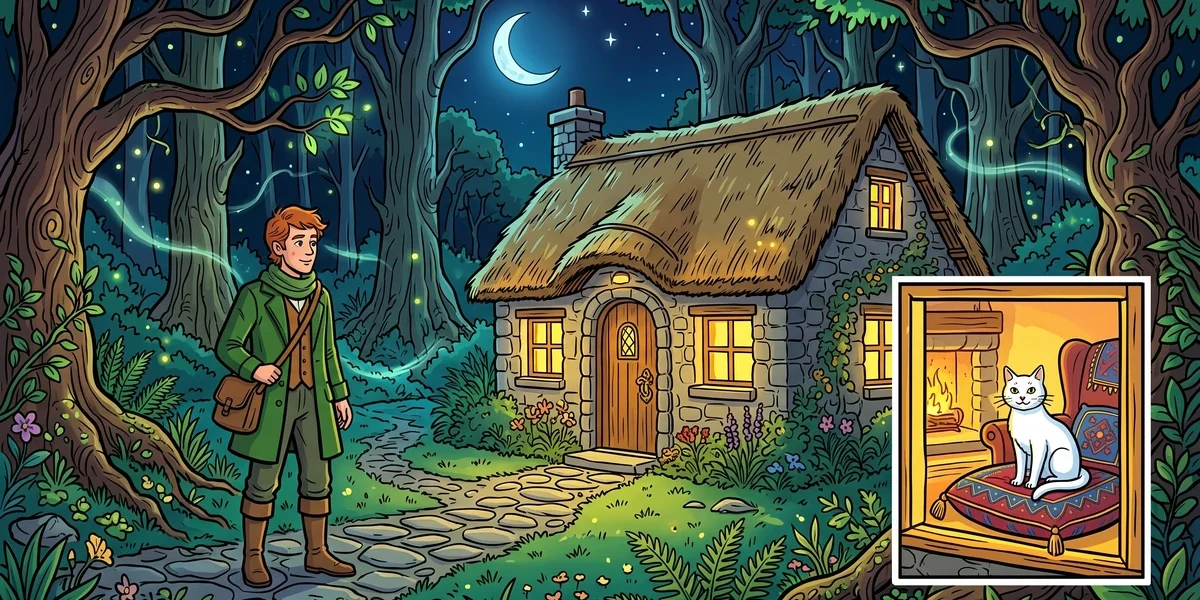
A long, long time ago, in a faraway valley, the giant Trencoss lived in a great castle among evergreen trees. The castle had a hundred doors, and each was guarded by a huge, shaggy hound with a tongue of fire and claws of iron that tore apart anyone who came near without the giant’s leave. Trencoss had made war on the King of the Torrents, killed him and his people and burned his palace, and carried off his only daughter, Princess Eileen, to the castle in the valley. He gave her beautiful rooms, a hundred dwarfs in blue and yellow satin to wait on her, harpers to play sweet music and more diamonds than she could count, brighter than the sun. But he would not let her outside, and told her that if she took one step beyond the doors, the hounds would tear her to pieces.
A week after she arrived, war broke out between the giant and the king of the islands. Before setting out, Trencoss told the princess that when he came home, he would make her his wife. She burst into tears, for she would rather die than marry the giant who had killed her father.
“Tears will only spoil those bright eyes, little princess,” said Trencoss. “You’ll marry me whether you like it or not.” He sent her to her room and ordered the dwarfs to give her whatever she asked for while he was away.
The princess cried as if her heart would break. The night brought her no sleep, and in the grey morning light she opened the window to look for any chance of escape. But the window was far above the ground, and below prowled the hungry, ever-watchful hounds. With a heavy heart she was about to close it when she saw the branches of the nearest tree move, and a little white cat came creeping along one of them.
“Mew!” said the cat.
“Poor puss,” said the princess. “Come here, puss.”
“Move away from the window, then,” said the cat, “and I’ll come in.” She stepped back, and the little white cat jumped into the room. She took him on her lap and stroked him, and he arched his back and purred.
“Where do you come from, and what is your name?” asked the princess.
“Never mind where I come from or what my name is. I am your friend, and I have come to help you. When the giant comes back and asks you to marry him, say you will.”
“But I will never marry him!”
“Do as I say. Say yes, on one condition: his dwarfs must first wind three balls this size out of the fairy dew found on bushes on misty mornings.” The cat put his right forefoot into his ear and pulled out three little balls, one yellow, one red and one blue.
“They are very small,” said the princess. “Hardly bigger than peas. The dwarfs won’t be long about it.”
“Won’t they? It will take them a month and a day to make each one, so three months and three days for all three. But the giant, like you, will think it can be done in a few days, so he will gladly promise. He will soon find out his mistake, but he will keep his word and won’t hurry you to the wedding till the balls are done.”
“When is the giant due home?”
“Tomorrow afternoon.”
“Will you stay with me until then? I am very lonely.”
“I cannot. I have to go to my palace on the island where no man has ever set foot and where only one man ever shall. It is in the far-off seas where no ship ever sailed. You will see the man before many days are out, and if all goes well, he will one day kill the giant Trencoss and set you free.”
“That can never be,” sighed the princess. “No weapon can wound the hundred hounds, and no sword can kill the giant.”
“There is a sword that will kill him,” said the cat. “But I must go. Remember what to say to the giant, and every morning watch the tree where you saw me. If you see anyone in its branches you like better than yourself,” and here the cat winked, “throw him these three balls and leave the rest to me. But don’t say a single word to him, or all will be lost.”
“Shall I see you again?”
“Time will tell,” said the cat, and without so much as a goodbye he leaped onto the tree and was gone.
The next afternoon the furious barking of the hounds told Eileen the giant was home, and he sent for her at once and told her to get ready for the wedding. Trying to look cheerful, she said, “I will be ready as soon as you like, but first you must promise me something. Before I marry you, your dwarfs must wind me three balls this size out of fairy dew gathered from the bushes on misty summer mornings.”
“Is that all?” laughed Trencoss. “I’ll give the dwarfs their orders straight away, and by this time tomorrow the balls will be wound and we can be married in the evening.”
“And will you leave me alone until then?”
“I will.”
“On your honour as a giant?”
“On my honour as a giant.”
He sent all his dwarfs out at dawn to gather the fairy dew from the bushes. But morning after morning they combed every hedgerow and could only collect enough dew to make a thread as long as a little girl’s eyelash, and though the giant fumed and threatened, it made no difference. He was furious with the princess and vexed with himself that she was so much cleverer than he was, and he saw that the wedding would not be as soon as he had hoped.
Meanwhile the little white cat ran up hill and down dale without stopping until he came to the Prince of the Silver River, who was sitting alone and sorrowful, thinking about Princess Eileen and wondering where she could be. The cat sprang into the room and mewed, but the prince did not notice. He mewed a second time, and still the prince paid no heed. The third time he jumped onto the prince’s knee.
“Where have you come from, and what are you after?” asked the prince.
“From the place you wish you were. As if I didn’t know who you are thinking of! You’d do far better to try to save her.”
“I would give my life a thousand times for her.”
“For whom?” said the cat, with a wink. “I named no names.”
“You know very well who she is, if you know what I am thinking. But do you know where she is?”
“She is in danger, in the castle of the giant Trencoss in the valley beyond the mountains.”
“Then I’ll go and challenge the giant and kill him.”
“Easier said than done. No sword made by human hands can kill him, and even if you could, his hundred hounds would tear you to pieces. Take my advice. Go to the wood round the giant’s castle, climb the tall tree closest to the window looking west, and give its branches a shake, and something will happen. Hold out your silver-plumed hat, and three little balls, yellow, red and blue, will drop into it. Then come back here as fast as you can. But don’t say a word, for if you speak, the hounds will hear you and you will be torn to pieces.”
The prince set off at once, and after two days he reached the wood, climbed the tree nearest the sunset window and shook the branches. The window opened, and there was Princess Eileen, lovelier than ever. He was about to call her name, but she put her finger to her lips, and he remembered the cat’s warning. Silently he held out his plumed hat, and she threw the three balls into it one after another, blew him a kiss and shut the window. It was just as well, for at that moment she heard the giant’s voice as he came home from hunting. The prince waited until the giant was inside, then climbed down and hurried home, and there the little white cat was waiting.
“Have you brought the three balls?”
“I have.”
“Then follow me.” They went on until they came to the edge of the sea. “Now unwind a thread of the red ball, hold it in your right hand and drop the ball in the water, and you will see what you will see.”
The ball floated out to sea, unwinding as it went, until it was out of sight. “Pull now,” said the cat. As the prince pulled, he saw something far off on the sea shining like silver, and it came nearer and nearer until a little silver boat touched the shore.
“Step into this boat,” said the cat, “and it will carry you to the palace on the island where no man has ever set foot, in the unknown seas never sailed by ships made by human hands. In that palace is a sword with a diamond hilt, and only that sword can kill the giant Trencoss. There are also a hundred cakes that will kill the hundred hounds when the hounds eat them. But mind this: if you eat or drink anything before you reach the palace of the little cat, you will forget Princess Eileen.”
“I’ll forget myself first,” said the prince, and he stepped into the boat, which sped away so fast that it was soon out of sight of land.
For two days and nights the boat sailed on without stopping. On the third morning the prince saw an island in the distance, and he was very glad, for he was faint with hunger and thirst and thought his journey was over. But all day the island stayed ahead of him, and only on the next morning did he find himself close to it, with trees heavy with every kind of fruit bending over the water. The boat sailed round and round the island, closer each time, until the drooping branches nearly touched it. The sight of the fruit made the prince hungrier and thirstier than ever, and forgetting his promise, he grabbed a branch, and in a moment he was up the tree eating the delicious fruit. While he ate, the boat drifted out to sea and vanished, but the prince had forgotten all about it, and worse still, he had forgotten all about the princess in the giant’s castle.
When he had eaten his fill, he climbed down and set off inland. Soon he heard music, and a group of maidens playing silver harps came towards him. “Welcome, welcome, Prince of the Silver River,” they cried, “to the isle of fruit and flowers! Our king and queen watched you crossing the sea and sent us to bring you to the palace.”
At the palace gates the king and queen and their daughter Kathleen welcomed him, but he hardly saw the king and queen, for his eyes were fixed on Princess Kathleen, who was more beautiful than a flower. He thought he had never seen anyone so lovely, since of course he had forgotten poor Eileen pining in her prison in the lonely valley. At the great feast he sat between the queen and Princess Kathleen, and long before it ended, he was head over heels in love. That night there was dancing until the morning star, and he danced every dance with the princess and fell more deeply in love by the minute. Between dancing by night and feasting by day, weeks went by, while poor Eileen counted the hours in the giant’s castle and the dwarfs wound a ball and a half.
At last the prince asked for Kathleen’s hand, and the king and queen gladly agreed and fixed the wedding day. But on the evening before, as the prince was dressing for a dance, he felt something rub against his leg, and there was the little white cat. At the sight of him the prince remembered everything, and he was sad and sorry when he thought of Eileen watching and waiting for him. But he was very fond of Princess Kathleen, and he did not know what to do.
“You can do nothing tonight,” said the cat, who knew what he was thinking. “But in the morning go down to the sea, and look neither right nor left, and let no living thing touch you, or you will never leave the island. Drop the second ball into the water, and step straight into the boat when it arrives. After that you may look back, and you will see what you will see, and you will know whom you love best, Princess Eileen or Princess Kathleen, and you can go or stay.”
The prince did not sleep a wink, and at first light he crept out of the palace and down to the sea and threw out the second ball. When it had floated out of sight, he saw the little boat glittering on the horizon like a newly risen star. But he had hardly left the palace before he was missed, and the king, the queen, the princess and all the lords and ladies came hurrying after him by the quickest way to the sea. The harp maidens played their sweetest music, and the princess, whose voice was sweeter than any music, called the prince by name, and his heart was so moved that he very nearly looked round, until he remembered the cat’s warning. Just as the boat touched the shore, the princess stretched out her hand and almost caught his arm, but he stepped into the boat in time, and it sped away like a wave pulling back from the beach. A loud scream made him turn, and there was no king or queen or princess or lords and ladies, only huge green serpents with red eyes and tongues, hissing fire and poison and writhing in a hundred horrible coils.
For three days and nights the prince sailed on, hoping every morning to see the island he was looking for. He was faint with hunger and starting to despair when, on the fourth morning, he saw an island far off that gleamed like fire in the first rays of the sun. As he came closer, he saw it was covered with trees so loaded with bright red berries that hardly a leaf showed. The boat began to circle the island until it was right under the bending branches, and the scent of the berries was so sweet that his hunger grew sharper and sharper. Remembering what had happened on the enchanted island, he was afraid to touch them. But a great wind rose from the sea and shook the branches, and the bright berries rained down until the boat was full of them. They fell on his hands, and he picked some up to look at them, and the longing to eat them grew stronger, and he told himself it would do no harm to taste just one. It tasted so good that down it went, and that instant Eileen slipped out of his mind, and the boat drifted off and left him standing in the water.
He climbed onto the island and ate his fill of berries, and he had not gone far when there was a great noise, and a huge iron ball smashed down a tree in front of him, and a hundred giants came running after it. When they saw the prince, one of them picked him up in his hand and held him up for all to see, squeezing him nearly to death, so he set him down.
“Who are you, my little man?” asked the giant.
“I am a prince.”
“Oh, a prince, are you? And what are you good for?” The prince did not know, for nobody had ever asked him that.
“I know what he’s good for,” said an old giantess who had one eye in her forehead and the other in her chin. “He’s good to eat.”
The giants laughed so loudly that the prince was frightened half to death. “Why, he wouldn’t make a mouthful,” said one.
“Leave him to me,” said the giantess, “and I’ll fatten him up, and when he’s cooked he’ll make a dainty dish for the king.”
So they handed him over to the old giantess, who took him home to her kitchen and stuffed him with sweet and spicy things, so that he would be a sweet morsel for the giant king when he came home to the island. At first the poor prince would not eat, but the giantess dangled him over the fire till the soles of his feet were scorched, and then he decided it was better to eat than to be roasted alive. Day after day he grew sadder, thinking that he would soon be cooked for the king. But sad as he was, he was not half as sad as Princess Eileen, watching and waiting for him in the giant’s castle, while the dwarfs wound two balls and started on the third.
At last the giantess told him the giant king would arrive the next day. “Since this is your last night alive,” she said, “tell me if you wish for anything, and your wish shall be granted.”
“I don’t wish for anything,” said the prince, whose heart was dead inside him, and she went away, saying she would come back later.
The prince sat in a corner thinking and thinking, until he heard a soft “purr, purr” close to his ear, and there was the little white cat.
“I shouldn’t be here at all,” said the cat, “and indeed it isn’t for your sake I’ve come, but for Princess Eileen’s. Of course you forgot all about her, and of course she never stops thinking of you. It’s always the way: lovers who are favoured may forget, but slighted lovers never.”
The prince blushed with shame at the princess’s name.
“It’s you who ought to blush. But listen to me, and remember, if you don’t obey me this time, you will never see me or Princess Eileen any more. When the giantess comes back, tell her your wish is to go down to the sea in the morning and look at it for the last time. When you get there, you will know what to do. I must go now, for I hear her coming.” And the cat jumped out of the window.
“Well,” said the giantess, “is there anything you wish?”
“Is it true I must die tomorrow?”
“It is.”
“Then I would like to go down to the sea and look at it for the last time.”
“You may, if you get up early.”
“I’ll be up with the lark,” said the prince.
The night seemed endless, but at last it faded into grey dawn, and he raced down to the sea and threw out the third ball. Soon the little boat came towards him faster than the wind, and he threw himself into it the moment it touched the shore. Faster than the wind it carried him out to sea, and almost at once the giantess’s island was a faint red speck in the distance. All day and all night it sailed, and as the sun rose, it ran its silver prow onto the golden sand of an island greener than summer leaves.
The prince jumped out and walked on until he came into a pleasant valley with a palace as white as snow at its head. The central door opened for him, and he passed through several empty rooms until he came to the main hall, a round room with a thousand marble pillars, and on every pillar but the one in the middle sat a little white cat with black eyes. Round the walls, from one doorpost to the other, ran three rows of precious things: first a row of gold and silver brooches with their pins stuck in the wall and their heads outwards, then a row of gold and silver neck-rings, and then a row of great swords with gold and silver hilts. On many tables there was food of every kind and drinking horns full of foaming ale.
While the prince looked about him, the cats kept leaping from pillar to pillar, but none of them jumped onto the pillar in the middle. He was beginning to wonder why when suddenly, before he could tell how, there on the middle pillar sat the little white cat.
“Don’t you know me?” said the cat.
“I do.”
“Ah, but you don’t know who I really am. This palace belongs to the Little White Cat, and I am King of all the Cats. Now eat, for you must be starving.”
When the feast was over, the King of the Cats sent for the giant-killing sword and the hundred cakes meant for the hounds, and the cats laid them before him. “Take these,” said the king. “You have no time to lose. Tomorrow the dwarfs will finish the last ball, and tomorrow the giant will claim the princess as his bride. But before you go, take this from me to your little girl.” And he gave the prince a brooch lovelier than any on the palace walls.
The king and the prince went down to the shore with all the cats behind them, and when the prince stepped into the boat, all the cats mewed three times for luck, and the prince waved his hat three times, and the little boat flew over the water all night as bright and swift as a shooting star. At dawn it touched the shore, and the prince ran up hill and down dale to the giant’s castle. The hounds bounded at him barking furiously, but he threw them the cakes, and as each hound swallowed its cake, it fell dead.
Then the prince struck his shield three times with the sword from the palace of the Little White Cat. “Who dares to challenge me on my wedding day?” roared the giant. The dwarfs went to look and told him it was a prince challenging him to battle, and the giant, foaming with rage, seized his heaviest iron club and rushed out to fight.
The fight lasted all day, and when the sun went down, the giant said, “We have fought enough for today. We can start at sunrise tomorrow.”
“No,” said the prince. “Now or never. Win or die.”
“Then take this!” cried the giant, aiming a blow at the prince’s head with all his might. But the prince darted forward like lightning and drove the sword into the giant’s heart, and with a groan Trencoss fell across the bodies of the poisoned hounds.
The dwarfs began to weep and tear their hair, but the prince told them they had nothing to fear and sent them to fetch Princess Eileen. She had watched the battle from her window, though, and when she saw the giant fall, she ran out to greet the prince. That very night the prince, the princess and all the dwarfs and harpers set off for the Palace of the Silver River, which they reached the next morning.
There has never been a merrier wedding than the wedding of the Prince of the Silver River and Princess Eileen. She had diamonds and pearls to spare, but the only jewel she wore on her wedding day was the brooch the prince carried home for her from the Little White Cat’s palace across the distant seas.
Where this story comes from
“The Little White Cat” is one of the stories Edmund Leamy wrote for his Irish Fairy Tales, republished in Dublin in 1906 in his memory.
In his notes Leamy says the rows of brooches, neck-rings and swords on the walls of the Little White Cat’s palace are taken from “The Voyage of Maildun,” an old Irish voyage tale he knew from Joyce’s Old Celtic Romances.
The telling retains the giantess burning the prince’s feet, threats of cannibalism, the poisoning of the hounds and the killing of Trencoss. Their brevity does not make them harmless episodes.
Read the original: Edmund Leamy, Irish Fairy Tales (Project Gutenberg #29311, The Little White Cat)
For older readers: includes massacre, captivity and forced-marriage threats, torture, threatened cannibalism and poisoned animals.
Two clocks run at once
Eileen’s three balls are a way to buy time: the dwarfs need three months and three days to copy them. For the prince, the original balls provide three chances to summon the boat. Each delay at an island uses time that Eileen cannot recover. The repeated scenes therefore connect his journey directly to her shrinking freedom.
The cat scolds him as a faithless lover, but the narration also describes days of hunger and a magical loss of memory. Those conditions complicate the blame. This is an enchanted ordeal, not an example of why a hungry person should refuse food. Eileen meanwhile negotiates the delay, signals for silence and passes on the means of rescue. Her wedding brooch recalls the cat’s indispensable help rather than simply displaying the giant’s wealth.
Follow the balls and the deadline
Make a timeline with the dwarfs’ progress above it and the prince’s stops below it. Mark where each original ball is used and where the cat restores his memory. What would be missing from the rescue if the story were told only as the prince’s final victory in combat?
Talk about it
- How did Princess Eileen delay her wedding to the giant?
- Why did the prince keep forgetting Eileen, and what brought her back to his mind each time?
- Who was the little white cat really?
Related stories
- The House in the Lake — another of Edmund Leamy’s Irish fairy tales
- The Golden Spears — another of Edmund Leamy’s Irish fairy tales
- The Huntsman’s Son — another of Edmund Leamy’s Irish fairy tales
Frequently Asked Questions
How does Eileen delay the wedding?
Why does the prince forget her?
Who is the Little White Cat?
Why is the wedding brooch significant?
You May Also Like
 Celtic Folk Tales
Ages 9-12
Celtic Folk Tales
Ages 9-12
The Black Horse
A king’s youngest son swaps a lame old pony for a black horse that can go anywhere in the world, then must fetch a Greek princess for the Prince Underwaves.
 Celtic Folk Tales
Ages 9-12
Celtic Folk Tales
Ages 9-12
The Golden Spears
Connla and Nora save a thrush from a hawk, and in thanks it leads them after nine fairy pipers into a crystal hall, across the sunset and under the sea.
 Celtic Folk Tales
Ages 9-12
Celtic Folk Tales
Ages 9-12
The Fairy Tree of Dooros
A tiny fairy drops one magic berry in Dooros Wood, is banished to the land of giants, and brings back Sharvan the Surly to guard the tree that springs up.