The Fate of the Children of Lir
The Fate of the Children of Lir: t happened that the five Kings of Ireland met to determine who should have the head kingship over them, and King Lir of the
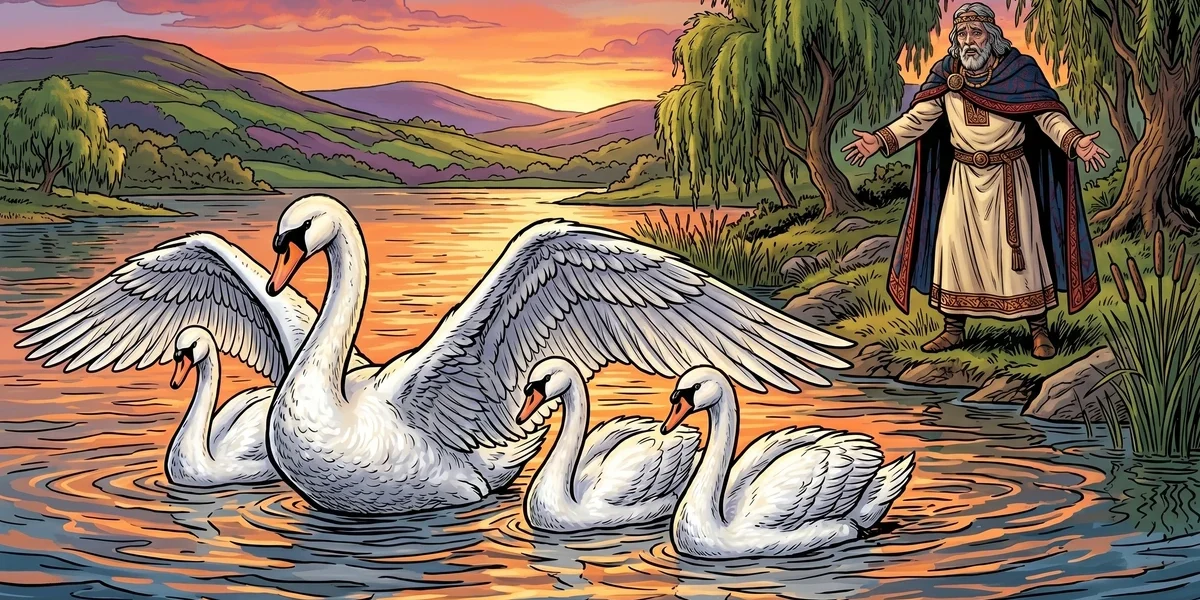
The Fate of the Children of Lir (Old and Middle Irish Oidheadh Chloinne Lir, sometimes Aided Chloinne Lir) is one of the three great tragic prose-tales known to Irish literary tradition as the Trí Truíghe na Sgéaluidheachta — the “Three Sorrows of Storytelling” — together with The Fate of the Sons of Tuireann (Oidheadh Chloinne Tuireann) and The Fate of the Sons of Uisneach (Oidheadh Chloinne Uisneach). It belongs to the Mythological Cycle of Irish literature, the body of native learned narrative that recounts the doings of the Tuatha Dé Danann, the divine race of pre-Gaelic Ireland, after their defeat by the incoming Milesians at Tailtiu. The earliest surviving manuscript witnesses are late, dating from the late seventeenth and eighteenth centuries (notably Royal Irish Academy MS 23 N 15 and the related copy in Trinity College Dublin MS H.2.17), but the language of the tale and its embedded poetry preserve features that scholars from Eugene O’Curry (Lectures on the Manuscript Materials of Ancient Irish History, Dublin, 1861, pp. 313-320) onwards have read as evidence for an underlying Old or Early Middle Irish substrate of perhaps the tenth to twelfth centuries; the modern prose recension we read today is the late-classical Early Modern Irish stylisation of that older matter.
The popular English form, on which this re-telling depends, is the version printed by Patrick Weston Joyce (1827-1914) as the opening tale of his Old Celtic Romances (London, 1879; second edition C. Kegan Paul, 1894), translated freshly from the eighteenth-century Royal Irish Academy manuscript and given the form by which it has been read by generations of Irish schoolchildren. Important parallel translations include those of Eugene O’Curry in Atlantis IV (1863), pp. 113-157, with the Irish text from RIA 23 N 15 facing; Lady Augusta Gregory’s retelling in Gods and Fighting Men (London: John Murray, 1904), Book I, Part III; R.A.S. Macalister’s abridged scholarly version in his Two Irish Arthurian Romances (1908); and T.W. Rolleston’s Myths and Legends of the Celtic Race (London: Harrap, 1911), which was for two generations the most widely-read English account. In the Aarne-Thompson-Uther international tale-type index the kernel narrative belongs to ATU 451 (The Maiden Who Seeks Her Brothers) — the great European cluster of swan- and bird-transformation tales which includes the Grimms’ Die sieben Raben (KHM 25), Die zwölf Brüder (KHM 9) and Die sechs Schwäne (KHM 49) — with Irish elaboration toward the deeply native motif of the geis, the binding word of the supernatural, and the appointed-time release by Christian sound (Stith Thompson D682, D683.1, D721, D721.3, D757, B652.1, F302.4.2; Tom Peete Cross, Motif-Index of Early Irish Literature, Indiana University Folklore Series 7, 1952).
I. Lir of Sídhe Fionnachaidh and the Wedding of Aoibh
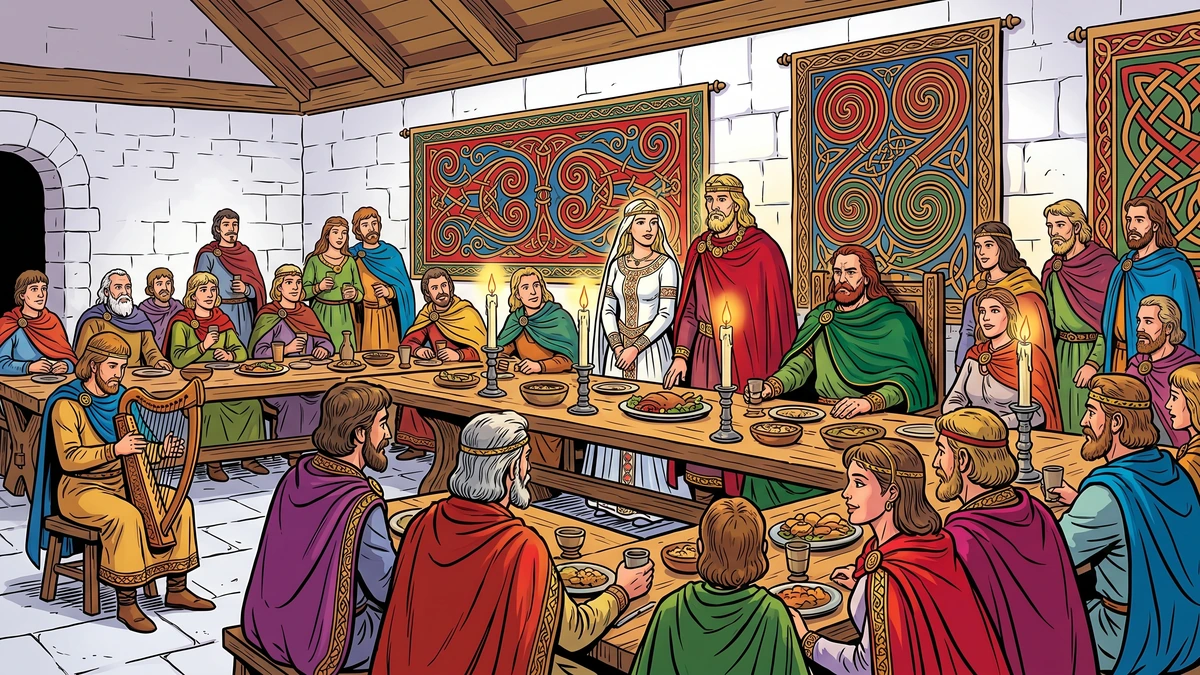
The tale opens on the political settlement that follows the Tuatha Dé Danann’s withdrawal into the sídhe-mounds at the close of the Mythological Cycle. After the assembly of the chiefs at Tailtiu, the Tuath choose Bodb Dearg, son of the Daghda, as their king of the sídhe; Lir of Sídhe Fionnachaidh, lord of the white-fairy mound that scholars locate at the Hill of the White Field, near Newtown Hamilton in Co. Armagh, takes offence and withdraws to his own sídhe. Bodb, in the high diplomatic register of the Mythological Cycle, sends to him in his bereavement (Lir’s wife having died) the eldest of his three foster-daughters, Aoibh (Eve), who is fair beyond the standards of the Tuatha Dé even of that age. The marriage is one of those small healings on which Joyce’s prose dwells with characteristic economy: it knits Lir back into the federal sídhe-polity, and it gives him in due course four children — Fionnuala (the eldest, a daughter), Aodh (the eldest son), and the twin boys Fiachra and Conn — the last two born together at the cost of their mother’s life.
That bereavement is the first of the tale’s three sorrows, and the diplomatic generosity of Bodb is its first narrative pivot: rather than letting the alliance fail with Aoibh’s death, the king of the sídhe sends Lir his second foster-daughter, Aoife (in many late copies the name is spelled Aifa), Aoibh’s own sister and a woman of equal rank if of a colder cast of mind. To Joyce’s nineteenth-century English readers, fed on Walter Scott and Tennyson, it is hard to convey how natural this second marriage seems within the kinship-economy of the early Irish aimsir: foster-sisters were a single legal unit of marriageable property, and Bodb’s gesture is restoration of an alliance, not romantic gift. But the narrative seed of the great central tragedy of the tale is in that movement: Aoife loves the four children of Aoibh as her own — for a while — and then the small Irish demon of jealousy (in Joyce’s translation, “a wicked thought stole into her heart”) takes hold, and the second sorrow begins.
II. The Lake of Derravaragh: Aoife’s Druid-Rod and the Geis of the Swans
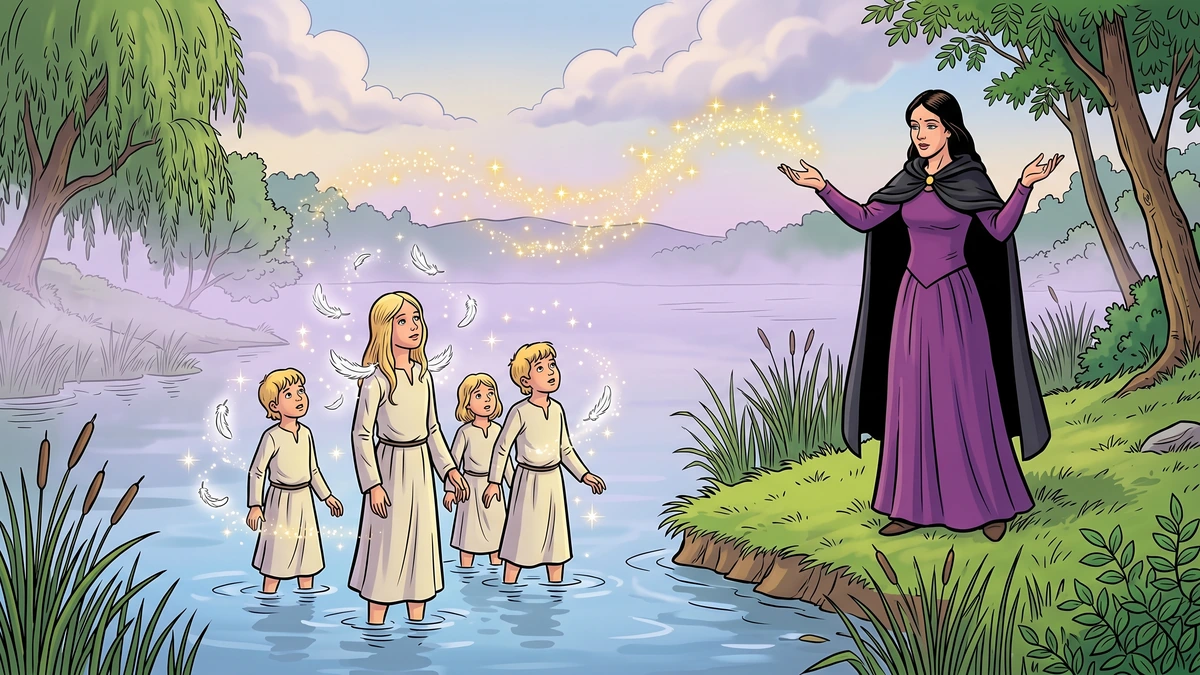
The pivot of the tale, and the moment from which its grief unrolls, is set on the open water of Loch Dairbhreach — the Lake of Derravaragh in modern Co. Westmeath, which still bears the same name and is still pointed out, by guides on the Kilbeggan-Mullingar road, as the place where the Children of Lir first felt the swan-feathers come up through their skin. Aoife, on a journey of feigned visit to her foster-father Bodb, takes the four children with her in her chariot. At the lake-shore she sets them in to bathe. Then she draws her druid-rod — the fleasc draiochta of the Mythological Cycle, an instrument of transformation that Joyce always renders “druidical wand” — and strikes them with it. Their human shapes wither away; in their place rise four white swans, with the children’s own minds and Irish speech still in them.
The terms of the curse, which Aoife pronounces in metrical verse-rann (the original Irish lays are preserved in O’Curry’s edition), are the most famous geis in Irish prose. The four are to spend three hundred years on Loch Dairbhreach, three hundred more on the cold sea-strait of Sruth na Maoile (the Moyle, the strait between northern Antrim and the Mull of Kintyre), and three hundred again on the Atlantic at Iorrus Domhnann and Inis Gluaire off the wild Mayo coast — nine hundred years in all — until the geis is broken by the conjunction of three signs: the marriage of the Woman of the South to the Man of the North, the coming of the new faith with the sound of a Christian bell, and the meeting with Mochaomhóg, a saint of the Patrician dispensation. With remarkable artistic economy the storyteller has set both the duration and the resolution of the curse on the calendar of Irish history itself, hinging the children’s release on the moment when Christianity displaces the pagan dispensation of the sídhe.
Aoife’s punishment, when Bodb learns of it, is famously of-a-piece with the offence: she is asked, in the legal-formal idiom of the Tuath, to name the shape she most fears, and naming “a demon of the air” (aer-dhemhan, in O’Curry), is struck by Bodb’s own druid-rod into that shape and exiled from the sídhe for ever. Tom Peete Cross collects this mirror-judgment under motif Q551.3.4 (transformer transformed) and notes its parallels in the Welsh Mabinogi (the punishment of Gwydion in Math fab Mathonwy) and in the Slavic Koshchei cycles — but the Irish version is unusually precise in tying the punishment to the criminal’s own naming of it, a juridical gesture that scholars from Rí Padraig Ó Riain onwards have read as a residue of the early Irish fast-procedure (troscud) of self-imposed penalty.
III. The Three Voyages: Derravaragh, Moyle, and Iorrus Domhnann
The three hundred years on Loch Dairbhreach are a quiet sorrow. The Tuatha Dé gather on the shore to hear the swans sing; their music, in Joyce’s phrase “sweeter than all music ever heard,” carries miles inland and stops the wars among the sídhe; for three centuries Lir himself, the swans’ father, comes to the lake to talk with his bewitched children, and there is a kind of unbroken intercourse between the human-becoming-divine and the beast-bound-divine. The children’s grief is real but it is bracketed by song and by family.
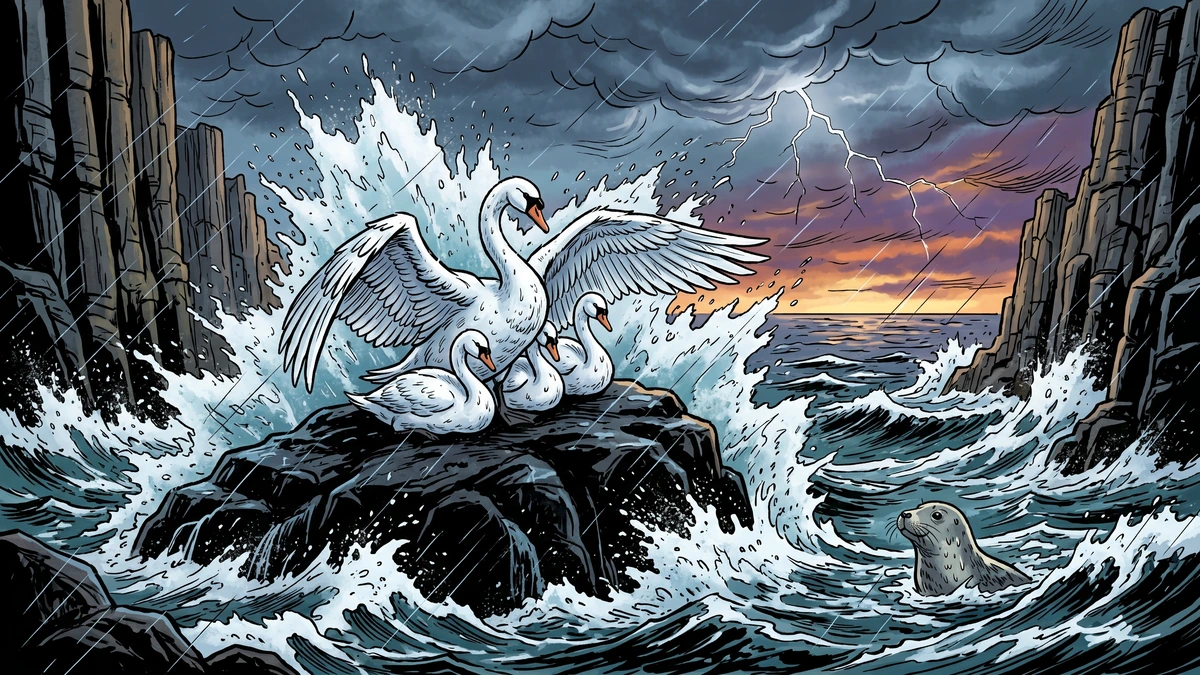
The three hundred years on Sruth na Maoile are the central terror of the tale, and the part of the narrative that Lady Gregory and Joyce both render with their best Hiberno-English prose. The Moyle is the open ocean strait between the basalt cliffs of Antrim and the Mull of Kintyre — in the modern world a busy shipping lane, in the world of the tale a sleet-pelted gulf in which four sentient swans must keep above water through nine winters of tempest. Joyce’s translation preserves the most famous quatrain of Fionnuala from this stretch, “Aoife, our father’s wife, has banished us; in winter cold she has set our wandering / and there shall be no help for us till bell and book and the white miracle come”; in the Irish text, the lay ends with the line “mairg a chaill a cáirde maith” — “woe to one who has lost her good kindred.” In one of the most famous winter passages of the cycle the four are separated by storm, and Fionnuala stands a long night at the Carraig na Rón (the Seal-Rock) folding her three brothers under her white wings as they come back to her one by one out of the dark.
The third three hundred years are passed at Iorrus Domhnann, the wild peninsular country at the western tip of Mayo, with their winter resorts on the islands of Inis Gluaire in Erris and on Inis Geadha west of the Mullet. Here the political world of the Tuatha Dé is irretrievably gone — Lir’s sídhe has long since been forgotten by men — and the swans live a life of bare elemental endurance, fed by the seaweed and the storm-fish, until the appointed time of release approaches.
IV. The Bell of Mochaomhóg and the Three Signs
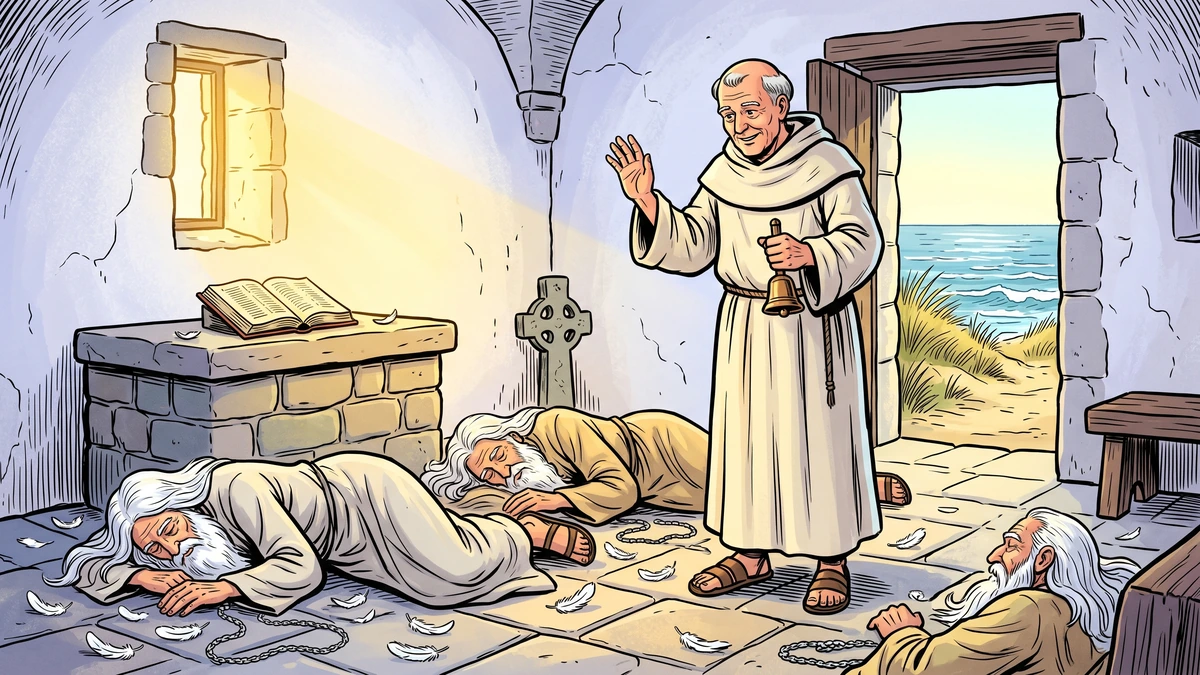
The end of the geis is framed in the tale with the same prosodic precision as its imposition. The Christian dispensation has come to Ireland in the persons of Patrick and his successors; on the coast of Erris a small church has been built by Saint Mochaomhóg (Mo-Chaomhóg of Inishglora, an early seventh-century anchorite). One morning the swans, who can hear human speech and have not heard a Christian voice in nine hundred years, are wakened by the sound of his bell drifting across the water; on Joyce’s page the line is, perfectly, “a strange thin sound, sweeter than the sweetest music they had ever known”. The first of the three signs has come.
The second is the coming of Mochaomhóg himself, who hears their human voices behind the swan-cries and welcomes them; he chains them — in the courteous sense of the early-Irish word cuibhreann, a yoking of love — with two silver chains as a sign that they are now under his protection. The third is the marriage announced upon the wind: Largnen, prince of Connacht (the Man of the North, in some recensions a Munster lord), is marrying Deoch, daughter of Finghin of Munster (the Woman of the South); and Deoch hears of the wonderful swans who speak Irish at Mochaomhóg’s church and asks for them. Largnen, in the only act of brutality the tale allows itself in its final passage, comes to the church with his men and seizes the swans by their silver chains.
What follows is the catastrophe of the tale, told with the same metrical compression as its opening. At the moment Largnen lays hands on them — in the church, by the altar, where Mochaomhóg’s bell still hangs — the geis dissolves. The swan-feathers fall away, and four ancient human bodies lie in their place, “old, old, with hair as white as the swan’s down they had worn.” The nine hundred years have come back into them in a single breath. Mochaomhóg baptises them at once before their souls go — Fionnuala, Aodh, Fiachra, Conn — and Fionnuala, with her last instruction, asks to be buried in a single grave with her three brothers folded under her arms: Conn under her right wing, Fiachra under her left, Aodh against her breast, exactly as she had folded them on the Carraig na Rón in the worst night of the Moyle. They are buried in the churchyard of Mochaomhóg of Inishglora; the saint composes their marbh-rann, their death-song; and the long sorrow of the Children of Lir comes to its appointed end.
V. The Geis, the Sound, and the Christian Bell
Three things in the construction of Oidheadh Chloinne Lir reward closer study. The first is the precise mechanism of the geis. The Irish geis is not a curse in the loose modern sense but a binding word with terms, witnesses and a release-condition; Aoife’s geis names duration, places, and three signs of dissolution, exactly as a legal contract in the early Irish law-tracts would name parties, term and conditions of voidance. The fact that the geis is voided not by violence but by its own appointed time and signs is one of the marks of native Irish narrative theology: the supernatural is law-bound, and the law it obeys is older than its breakers.
The second is the sound-aesthetic of the tale. From beginning to end it is a story about hearing — the children’s swan-music heard for miles, the Christian bell heard across the water at Inishglora, Fionnuala’s voice answering across the Moyle in a quatrain. Scél-aesthetics in early Irish literature is unusually concerned with the carrying-power of voice; here that concern is raised to the level of metaphysics. The release comes not by the sword nor by the wand but by the right sound rightly heard, exactly as in the Liddesdale farmer’s prayer (P-830) the Faustian bargain is broken not by force but by the right word rightly spoken. Both stories belong to the same moral physics.
The third is the placement of the tale on the calendar of Irish history. The nine hundred years of the geis carry the Children of Lir from the world of the Tuatha Dé Danann — the dispensation of the sídhe — into the world of Patrick and Mochaomhóg; the moment of release is the precise hinge between pagan and Christian Ireland. The story-makers have used the Children of Lir, in other words, to figure the conversion of the country as a whole: the swan-children, who are themselves pre-Christian divinities held in animal form, are baptised and buried in the new dispensation, and the Tuatha Dé Danann pass out of the historical world the way the swans pass out of the swans, by the falling-away of an outer form. Eleanor Hull (The Cuchullin Saga, London, 1898; A Text Book of Irish Literature, Dublin, 1906) was the first English-speaking scholar to read the tale this way; Tomás Ó Cathasaigh, in his recent Coire Sois: The Cauldron of Knowledge (Notre Dame, 2014), reads it as the Irish national story of conversion par excellence.
Moral
“Mairg a chaill a cáirde maith.” (“Woe to her who has lost her good kindred.”) The moral of the Children of Lir, in the storyteller’s own language, is the moral of the broken household. Aoife, by her one act of envy, breaks the kindred that had been knit by Bodb’s diplomacy; nothing she does afterwards repairs it; her name passes into the Irish proverb-tradition as a synonym for the kin-breaker, and she ends, in the version Joyce gives, blown forever as a demon of the air. The tale’s quiet warning to its first audiences, themselves living in tightly-woven kin-bands of foster-mothers and foster-sisters, is that an act of jealousy within the kin is not undone by punishment, by penance, or even by the passage of nine hundred years; the only thing it undoes, eventually, is the forms in which the kin once lived together. What survives in the tale is what survives every great Irish sorrow: the sound of the kin still speaking to one another across the water, and the Christian bell which receives them at the end of their time.
Why The Children of Lir Has Lasted
The tale has lasted because it does in late-medieval Irish prose what only the very greatest folk-tales do in any language: it makes the supernatural moral, the moral domestic, and the domestic universal. Children read it for the swan-feathers and for Fionnuala folding her brothers under her wings on the Carraig na Rón; adults read it for the slow grief of nine hundred years and for the right sound rightly heard at Inishglora; folklorists read it as the ATU-451 swan-transformation type given the most articulate native Irish form it ever received; historians of religion read it as the country’s mythological figuring of its own conversion; and Irish-speakers in Connemara and Mayo, where the last winters of the swans were said to have been passed, still hear it (in the modern Irish translation of Tomás Ó Floinn’s 1937 Trí Truíghe na Sgéaluidheachta) as the founding story of their own coastline. Patrick Weston Joyce, opening his 1879 Old Celtic Romances with this tale rather than with the louder warrior-stories of the Ulster Cycle, knew exactly what he was doing: it is the Irish story that begins with bereavement, ends with baptism, and uses nine hundred years of swan-feathers to tell the truth about how families fail and how, in time, the right sound at the right hour can release them.
You May Also Like
 Celtic Folk Tales
Ages 9-12
Celtic Folk Tales
Ages 9-12
Elidore
Elidore: the days of Henry Beauclerc of England there was a little lad named Elidore, who was being brought up to be a cleric. Day after day he would trudge
 Celtic Folk Tales
Ages 9-12
Celtic Folk Tales
Ages 9-12
Battle Of Birds
<p>A hero witnesses a magical battle between birds and must choose between safety and helping those in peril.</p>
 Celtic Folk Tales
Ages 9-12
Celtic Folk Tales
Ages 9-12
The Horned Women
The Horned Women: A rich woman sat up late one night carding and preparing wool, while all the family and servants were asleep. Suddenly a knock was given at