The King Of Crocodiles
The King Of Crocodiles: Once upon a time a farmer went out to look at his fields by the side of the river, and found to his dismay that all his young green
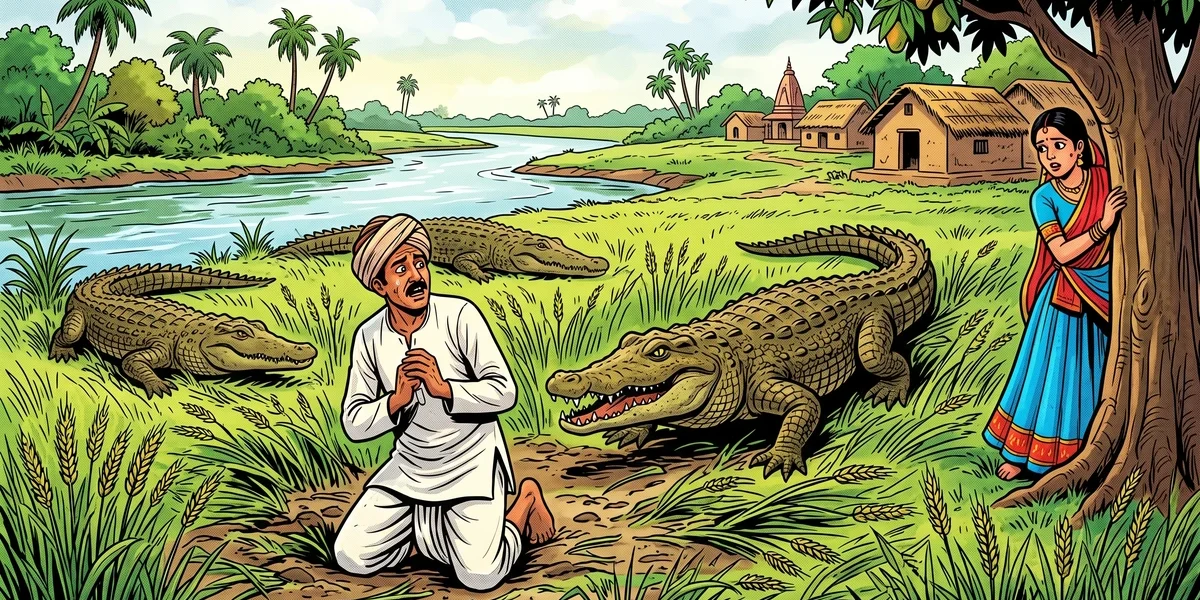
The King of Crocodiles rules neither land nor open water but the threshold between them — the riverbank, the ford, the ghat where worlds meet. In Indian mythological and folk imagination, this liminal zone carries special power and special danger, and the crocodile (nakra or makara) is its presiding spirit. To encounter the King of Crocodiles is to encounter the sovereignty of the threshold itself: an authority that operates by different rules than the authorities of the open land or the open water, and that must be approached with specific knowledge if the encounter is to end well.
I. The Makara and the Nakra: Crocodiles in Indian Sacred Geography
The crocodile occupies a distinctive position in the Indian sacred imagination. The makara — a composite aquatic creature whose body is typically part crocodile, part fish, and part elephant — is the vehicle (vahana) of the river goddess Ganga and of Varuna, the Vedic god of waters and cosmic order. The crocodile’s association with sacred rivers is ancient and deep: it is the creature that guards the crossing, that makes the ford dangerous, that reminds the traveller that passage between worlds is never trivial.
The folk tradition’s “King of Crocodiles” taps into this sacred geography directly. A king among crocodiles is not merely the largest or most dangerous individual; it is the presiding authority of the liminal zone, the being whose permission or displeasure determines whether crossings succeed or fail. Rivers in Indian folk narrative are not simply bodies of water; they are boundaries between domains — between this village and that kingdom, between the living world and the realm of the dead, between the human community and the forest’s wild sovereignty. The crocodile king rules this boundary, and his rule is as legitimate and as demanding of proper conduct as any human king’s.
The crocodile’s physical characteristics make it a natural symbol of liminal authority. It lives in both water and on land, breathes air but hunts underwater, lies still as a log until the moment of strike, and can outlast almost any prey through patience alone. It is invisible at rest and terrible in motion, cold-blooded and ancient — the crocodilian lineage is among the oldest of vertebrate lines, a survivor from before the age of mammals. The King of Crocodiles embodies all this: patience, ancientness, the capacity to be both inert and lethal, the authority of something that has been here longer than the current order of things.
II. Threshold Sovereignty: Rules of the Crossing
In folk tales where a human character must interact with the King of Crocodiles, the interaction is structured by the logic of threshold sovereignty: there are rules for crossing, and violations of these rules have consequences. The most common rules involve respect (acknowledging the crocodile king’s authority over the ford), reciprocity (offering something in exchange for safe passage or assistance), and honesty (the crocodile king, as a being of ancient authority, typically sees through deception with ease).
This logic of threshold rules is widespread in world folk tradition. River crossings in European folk tales involve payment of the ferryman (Charon in Greek myth, various folk ferrymen in Germanic and Slavic traditions), correct answers to riddles, or gifts that satisfy the guardian spirit. The underlying structure is the same: the threshold is governed, passage must be negotiated, and the negotiation requires knowledge of the threshold’s specific protocols. The person who attempts to cross without acknowledgment of the governing authority typically drowns, or is devoured, or finds the crossing becomes impossible.
The King of Crocodiles tale thus functions as an implicit lesson in the ethnography of thresholds — in how to navigate between domains that operate by different rules. The person who treats the river crossing as merely a physical challenge, who brings only muscle and courage, is unprepared for an encounter with the threshold’s authority. The person who understands that thresholds are governed — that the liminal zone has its own sovereignty — comes with the right knowledge: what to offer, how to speak, when to be silent, and how to recognise the moment when safe passage has been granted.
III. The King’s Demand and the Hero’s Response
Folk tales about encounters with crocodile kings typically test the human protagonist’s character through a demand or a series of demands that require specific virtues: honesty (tell the truth about your business in the crocodile’s domain), courage (do not flinch from the king’s presence or his questions), wisdom (understand what the king actually needs and offer it), and respect (acknowledge the king’s sovereignty over his domain without false flattery or genuine defiance).
The crocodile king is a demanding but usually fair judge of these qualities. In Indian versions, the king’s judgments reflect the broader folk tradition’s sense that non-human authorities often have better access to truth than human ones: the crocodile, who has watched the river’s crossings for centuries, knows what humans are really after when they attempt to ford the river. He can distinguish the honest pilgrim from the thief using the pilgrimage as a pretext, the genuine traveller from the predatory merchant. His demands are thus also a kind of moral sorting: those who respond well to his challenges are those whose purposes at the threshold are legitimate.
The resolution of the crocodile king tale often involves a recognition: the human protagonist, having passed the threshold’s tests, is either granted safe passage, given a gift or knowledge that will serve them later, or brought into a relationship with the crocodile kingdom that becomes a source of ongoing protection. Successful navigation of the liminal zone, in the folk tradition, does not merely enable a single crossing; it establishes a relationship with the threshold authority that makes future crossings easier and more protected. The wise traveller who honours the King of Crocodiles becomes the guest of the river, not merely a safe crosser of it.
“The river remembers who has honoured it. So does its king.”
— Folk saying from the Godavari basin tradition
Why This Story Lasted
The King of Crocodiles lasted because the experience of the threshold — the moment of crossing between domains, when the rules change and the authorities change and the traveller must navigate a space that belongs to neither the world just left nor the world ahead — is among the most universal of human experiences. The folk tradition gives this experience a narrative form and a governing figure: the threshold has a king, the king has rules, and knowing the rules is what makes the crossing possible.
The tale also lasted because it names something true about the authority of ancient, non-human presences in the world. The crocodile has been here longer than the kingdom; the river existed before the village on its bank; the boundary has its own sovereignty that predates and will outlast the human arrangements on either side of it. The folk tale’s insistence on honouring that authority — on approaching the threshold with respect and proper conduct rather than mere force — is an ecological wisdom as well as a narrative one, and it has proved durable precisely because the threshold’s authority continues to demand acknowledgment.
What is the makara in Indian mythology?
The makara is a composite aquatic creature in Indian mythology — typically part crocodile, part fish, and part elephant — that serves as the vehicle (vahana) of the river goddess Ganga and the Vedic deity Varuna. Associated with sacred rivers and cosmic waters, it is the guardian of river crossings and the presiding spirit of fords. In folk tradition, the crocodile (nakra) shares these symbolic associations: a being of ancient authority whose permission must be sought by anyone who wishes to cross safely between the worlds the river separates.
What is threshold sovereignty in folk narrative?
Threshold sovereignty is the concept that liminal zones — crossings, boundaries, transitions between domains — are governed by their own authorities whose rules differ from those of the domains on either side. Folk traditions worldwide recognise this: river ferrymen, forest spirits, mountain pass guardians, and boundary markers all have presiding authorities whose protocols must be followed for safe passage. The King of Crocodiles embodies this concept, ruling the riverbank and ford with authority as legitimate and demanding as any human king’s.
What virtues does the crocodile king test in folk tales?
The King of Crocodiles typically tests honesty (tell the truth about your purpose at the threshold), courage (do not flinch from the king’s presence), wisdom (understand what the king needs and offer it appropriately), and respect (acknowledge the king’s sovereignty without false flattery or defiance). The crocodile king is a demanding but fair judge — the folk tradition holds that ancient non-human authorities perceive truth more clearly than human ones, and the crocodile king can distinguish legitimate from illegitimate crossings at a glance.
How does successfully meeting the crocodile king change the protagonist?
Successful navigation of the crocodile king’s demands typically establishes a lasting relationship between the protagonist and the threshold authority — the human becomes a guest of the river, not merely a safe crosser of it. Future crossings are easier and more protected. This relational outcome reflects the folk tradition’s understanding that threshold navigation is not a one-time physical challenge but an ongoing relationship with the liminal zone’s governing authority, one that yields compounding benefits to those who maintain proper conduct and honour the king’s sovereignty.
Why is the crocodile associated with ancient authority in Indian folk tradition?
The crocodile’s symbolic association with ancient authority draws on its actual biological antiquity — the crocodilian lineage predates the age of mammals by tens of millions of years — as well as its physical characteristics: lives in water and on land, lies still as a log until the moment of strike, outlasts prey through patience, invisible at rest and terrible in motion. The King of Crocodiles embodies primordial patience and the authority of something that has been here longer than the current order of things — an authority that must be acknowledged, not conquered.
Frequently Asked Questions
**Q: Why is this story important?**
You May Also Like
 Aesop's Fables
Ages 3-5
Aesop's Fables
Ages 3-5
The Three Calamities
The Three Calamities: From that time these four young men became the confidential advisers of king Alakesa in all important affairs of state, and, as night is
 Aesop's Fables
Ages 3-5
Aesop's Fables
Ages 3-5
The Five Wise Words Of The Guru
The Five Wise Words Of The Guru: Once there lived a handsome young man named Ram Singh, who, though a favourite with everyone, was unhappy because he had a
 Aesop's Fables
Ages 3-5
Aesop's Fables
Ages 3-5
Grasp All Lose All
Grasp All Lose All: Once, in former times, there lived in a certain city in India a poor oil-seller, called Déna, who never could keep any money in his