The Honest But Rash Hunter
The Honest But Rash Hunter: When the Second Minister’s watch was over, he went to inspect the guard at the royal bedchamber, and Alakesa hearing his footsteps
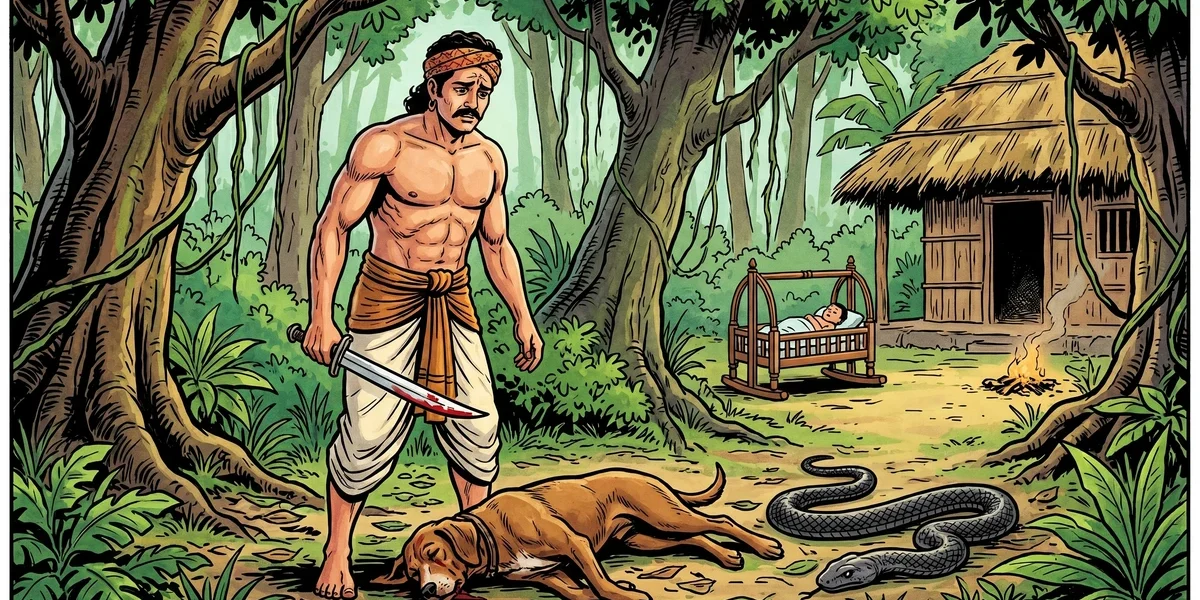
“Honest but rash.” The conjunction is the tale’s entire argument in two words. The hunter is not dishonest, not cowardly, not cruel — he is genuinely virtuous in the quality the tradition most celebrates. And yet he fails, and fails disastrously, because honesty alone is not enough. Rashness — the failure of deliberation, the impulse that acts before thinking, the courage that does not pause to verify — takes what honesty has built and destroys it in a moment. This tale belongs to the ancient moral tradition that insists virtues are not independent achievements but a system: each requires the others to function, and the absence of any one creates a flaw that the others cannot compensate for.
I. The Conjunction of Virtues: Why “But” Is the Most Moral Word
The Indian philosophical tradition developed sophisticated accounts of virtue that anticipate what Aristotle called the “unity of the virtues” — the idea that genuine virtue in one dimension requires and supports virtue in the others. The concept of sadguna (the good qualities) in Sanskrit ethical literature is not a list of independent excellences that can be acquired separately; it is an integrated system in which each quality depends on the others for its proper functioning. Honesty without wisdom leads to harmful truths delivered without regard for consequence; wisdom without honesty becomes mere cunning; courage without deliberation is rashness; deliberation without courage is cowardice.
The folk tradition encodes this philosophical insight through narrative rather than argument. The hunter who is “honest but rash” is a character study in incomplete virtue — a person who has achieved real excellence in one dimension while leaving another undeveloped. The “but” in the title is the folk narrator’s most precise tool: it signals that what follows will undo or complicate what preceded, that the second quality is not merely a minor flaw but a structural limitation that determines the character’s fate as surely as his virtue determines his character.
This grammatical structure — virtue followed by “but” and a compensating flaw — appears across world folk literature as a specific narrative formula. “Brave but foolish,” “kind but weak,” “wise but proud” — each conjunction announces a character who will fail in a way that illuminates the relationship between the virtue and the flaw. The folk audience knew, from the title, that the honest hunter’s rashness would be the instrument of his undoing; the narrative’s job was to show them exactly how, and why, and what might have been different if the two qualities had been better integrated.
II. The Hunter’s Rashness: Anatomy of a Specific Failure
Rashness (pracanda or asamprajanat-karma — acting without proper knowledge or deliberation) is distinguished in Indian ethical analysis from courage, with which it is easily confused. Courage acts despite fear, having assessed the situation. Rashness acts without assessment, having skipped the deliberative step that would reveal whether action is appropriate. The rash person is not cowardly — he does not hesitate from fear — but he acts on incomplete information, typically the first impression of a situation rather than a considered understanding of it.
In the hunter’s case, rashness in the context of his craft is particularly consequential. The hunter’s art requires patience (dhairya) and careful observation before action: the hunter who shoots before confirming the target destroys what he meant to protect, kills what he did not mean to kill, or fails to kill what he aimed at. Every hunting tradition in the world has versions of the “hasty hunter” cautionary tale — the hunter who mistook his own dog for game, the hunter who shot at a shadow, the hunter who acted on a sound without visual confirmation. These tales are not merely about hunting ethics; they are about the relationship between perception and action, between the first impression and the considered judgment.
The honest hunter’s tragedy is that his honesty does not help him in the crisis moment. When rashness produces a catastrophic action — the shot fired without confirmation, the accusation made without evidence, the commitment undertaken without thought — honesty about what happened afterward is valuable but insufficient. The disaster has occurred. The hunter’s honest acknowledgment of his mistake does not undo the mistake; it merely adds the weight of his own clear-eyed understanding of what he has done to the grief of its consequences. Honesty in the aftermath of rashness is not salvation; it is the capacity to witness one’s own ruin clearly.
III. What the Tale Teaches About Integrated Virtue
The tale’s deepest lesson is not “be less rash” — though it teaches that — but rather “understand that your virtues require each other.” The hunter’s honesty is not undermined by some external force; it is undermined by the internal gap in his character development. He has cultivated honesty without cultivating the deliberative patience that honesty, to be fully functional, requires. Honest assessment of a situation is impossible without first pausing to observe the situation correctly; the rash person’s problem is not that they are dishonest but that they do not wait long enough to have something honest to say.
This is the insight that later virtue ethicists would call the “unity of virtue” — that practical wisdom (phronesis in Aristotle, viveka in the Indian tradition) is the meta-virtue that makes all the other virtues function correctly. Without practical wisdom, honesty can hurt, courage can destroy, generosity can impoverish. Practical wisdom is the capacity to apply the right virtue in the right degree at the right moment — and it is precisely this capacity that the hunter’s rashness indicates is underdeveloped.
The tale thus works on two levels simultaneously. At the narrative level, it is a story of a good man whose incomplete virtue leads him to a specific tragedy. At the philosophical level, it is a demonstration that moral development is not complete when any single virtue is achieved, but only when the virtues are sufficiently integrated to support each other. The hunter needed not only to be honest but to be the kind of person whose honesty was informed by enough patience and deliberation to prevent the rashness that honesty, afterward, could only witness without remedy.
“Honesty without patience sees clearly what it has already broken.”
— Saying from the Indian moral folk tradition
Why This Story Lasted
The Honest But Rash Hunter lasted because the character type it describes — the person who is genuinely virtuous in one dimension while genuinely deficient in another, and who is undone by the gap between the two — is one of the most recognisable and poignant in human experience. We all know people (and are, at times, the people) whose real excellence in one area is undone by a real failure in another. The tale provides a vocabulary for understanding this pattern: not as random misfortune but as the structural consequence of incomplete virtue-development.
The tale also lasted because it is fair to its protagonist. The hunter is not blamed for being dishonest — he is not dishonest. He is not blamed for being cowardly — he is not cowardly. He is understood as a person of genuine worth whose one undeveloped quality creates a tragedy that his developed quality cannot prevent. This is morally serious rather than merely morally simple, and its seriousness is part of what earned it a place in the tradition’s enduring repertoire of cautionary tales.
What is the moral of The Honest But Rash Hunter?
The primary moral is that virtues form a system — each requires the others to function properly — and that excellence in one dimension cannot compensate for a serious deficiency in another. The hunter’s honesty is genuine but cannot prevent the disaster caused by his rashness, nor undo it afterward. The tale teaches that complete moral development requires the integration of virtues: honesty without deliberative patience is incomplete, because rashness will destroy what honesty builds and honesty afterward can only witness the ruin clearly without remedying it.
What is the difference between rashness and courage in Indian ethics?
In Indian ethical analysis, courage (shaurya or dhairya) acts despite fear after assessing the situation — it is deliberate action in the face of recognised danger. Rashness (pracanda or asamprajanat-karma — acting without proper knowledge) skips the deliberative step, acting on the first impression of a situation rather than a considered understanding. The rash person is not cowardly — he does not hesitate from fear — but his action is based on incomplete information. The hunter embodies this distinction: his failure is not timidity but the absence of the pause that would have allowed honest assessment before action.
What is the unity of the virtues concept and how does it apply here?
The unity of the virtues is the philosophical claim that genuine virtues are not independent achievements but an integrated system: each virtue requires and supports the others, and the absence of any one creates a structural flaw that the others cannot compensate for. In Indian tradition, viveka (practical wisdom or discernment) is the meta-virtue that allows all other virtues to function correctly — it is the capacity to apply the right virtue in the right degree at the right moment. The honest hunter lacks sufficient viveka to prevent his rashness from overriding his honesty in the crisis moment.
Why does the hunter’s honesty not save him from the consequences of his rashness?
The hunter’s honesty does not save him because honesty in the aftermath of a disastrous action is valuable but insufficient — the disaster has already occurred. Honesty can witness clearly what rashness has done; it cannot undo it. The tale makes a precise point: the time when honesty would have been most useful was before the rash action, when careful honest assessment of the situation might have prevented it. Honesty applied after the fact adds the weight of clear-eyed understanding of one’s own ruin to the grief of the consequences, but cannot reverse them.
How does the hasty hunter tale appear across world folk traditions?
The hasty hunter cautionary tale appears across world hunting cultures: the hunter who mistook his dog for game (the Welsh legend of Gelert), the hunter who shot at a shadow, the hunter who acted on a sound without visual confirmation. All of these tales explore the same relationship between perception and action: the failure to pause between first impression and response, the substitution of reflex for deliberation. The Indian “honest but rash hunter” version is distinctive in explicitly naming both the virtue and the flaw, making the philosophical analysis of their relationship central to the tale rather than implicit in its events.
Frequently Asked Questions
**Q: Why is this story important?**
You May Also Like
 Aesop's Fables
Ages 3-5
Aesop's Fables
Ages 3-5
Timid Hare Flight Beasts
Timid Hare Flight Beasts: Once upon a time when Brahmadatta reigned in Benares, the Bodhisatta came to life as a young lion. And when fully grown he lived in a
 Aesop's Fables
Ages 3-5
Aesop's Fables
Ages 3-5
The Jackal And The Pea Hen
The Jackal And The Pea Hen: A Tale of Friendship and Greed In a peaceful forest where trees grew tall and flowers bloomed in every season, there...
 Aesop's Fables
Ages 3-5
Aesop's Fables
Ages 3-5
The Gold-Giving Serpent
The Gold-Giving Serpent: A poor Brahmin farmer named Haridatta once rested in the shade after working in his field and saw a hooded serpent emerge from a