The Pigeon And The Crow
The Pigeon And The Crow: Once upon a time the Bodhisatta was a Pigeon, and lived in a nestbasket which a rich man’s cook had hung up in the kitchen, in order
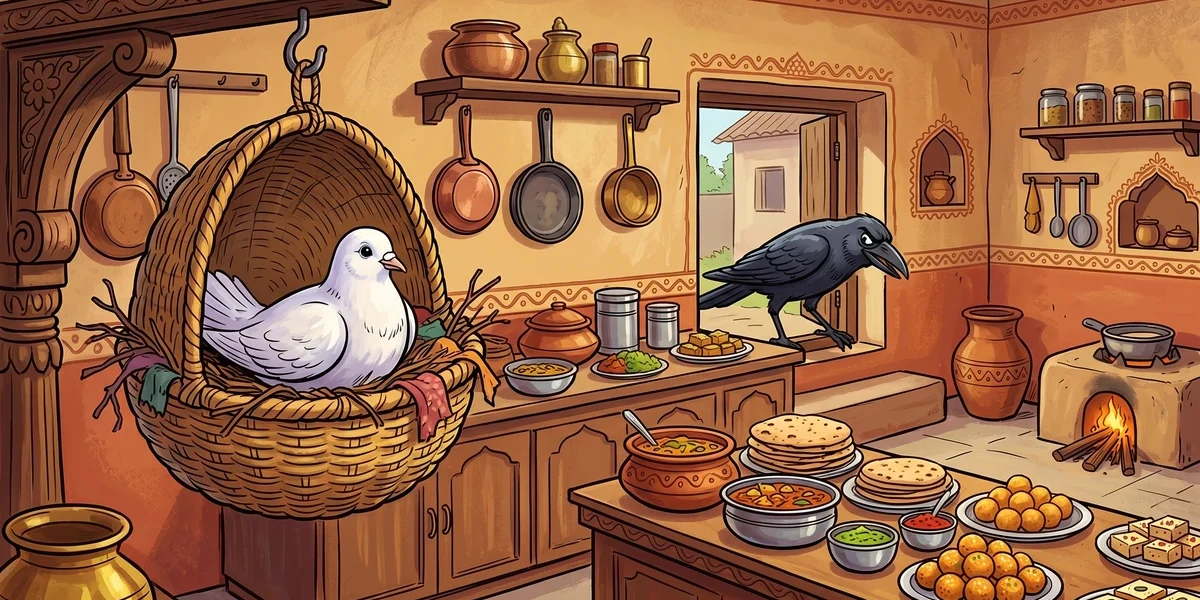
A pigeon and a crow. The combination is deliberately unexpected. In the Indian folk and religious imagination, these two birds occupy opposite ends of the symbolic spectrum: the pigeon (kapota) is the bird of peace, love, and divine favour — the messenger that carries good news, the bird associated with the goddess Lakshmi’s grace — while the crow (kaka) is the scavenger, the omen-reader, the bird that speaks to the dead and eats what others have left behind. That these two should form an alliance — that they should need each other, help each other, and together achieve what neither could alone — is the tale’s philosophical provocation. What does it mean when the sacred and the scavenger become friends?
I. The Pigeon and the Crow in Indian Symbolism
The pigeon’s symbolic status in Indian tradition is predominantly positive. The kapota appears in Vedic ritual as an auspicious bird; in Buddhist art, the white pigeon is associated with the compassion of the Bodhisattva; in folk tradition, a pigeon alighting on the house is a good omen, and the return of a pigeon to its coop is associated with domestic harmony and faithfulness. The pigeon is a bird that stays — that returns, that is loyal, that does not abandon its roost for scavenging in the margins. Its symbolic associations cluster around peace, fidelity, and the blessings of the settled domestic world.
The crow’s symbolic status is far more complex and ambivalent. In Hindu ritual, crows are fed as offerings to ancestors during shraddha (ancestral rites) — they are the birds through whom the dead receive offerings from the living, liminal beings that move between the worlds of the living and the dead. The crow is a bad omen when it cries on the roof at certain times; a good omen when it brings food from outside. It is intelligent — famously so, in both folk observation and modern ornithology — adaptable, and comfortable in precisely the marginal spaces that the pigeon’s domestic world excludes. The crow eats what others leave; it survives on the boundary between the ordered human world and the waste it produces.
The pairing of these two birds in a friendship tale exploits their symbolic contrast with deliberate precision. The pigeon brings what the crow lacks: the endorsement of the sacred, the shelter of the domestic world, the trust of the ordered community. The crow brings what the pigeon lacks: knowledge of the margins, the intelligence that comes from surviving without guaranteed provision, the capacity to navigate the spaces between worlds. Together they are more complete than either is alone — the sacred and the scavenger, the domesticated and the liminal, pooling their different but complementary wisdoms.
II. The Panchatantra Tradition of Unlikely Alliances
The Panchatantra, whose third book (Kaakolukiyam — “On Crows and Owls”) is specifically dedicated to the question of how traditional enemies relate, is the Indian tradition’s most systematic exploration of the politics of alliance. Its central insight is that alliances formed across natural enmity lines — between species that would normally prey on each other or compete for the same resources — are both the most powerful and the most fragile of relationships. They are the most powerful because they combine complementary strengths that no single-species alliance can match; they are the most fragile because the mutual threat that underlies the alliance is never fully extinguished, and any deterioration of trust can rapidly turn alliance back into predation.
The pigeon and the crow alliance, while less structurally antagonistic than the crow-owl dynamic, participates in this Panchatantra tradition of cross-category friendship. The pigeon and the crow do not naturally prey on each other, but they do not naturally associate either; their ecological niches, their social worlds, their symbolic meanings are sufficiently different that their friendship requires a specific occasion to form. That occasion — typically a shared threat, a moment of mutual vulnerability, or a situation that each can resolve only with the other’s help — is the tale’s inciting event, and the alliance that forms in response to it is the tale’s central relationship.
The Panchatantra’s deeper lesson about such alliances is that they work only as long as both parties remember why they formed. The alliance dissolves not through dramatic betrayal but through the forgetting of the original vulnerability — the moment when the stronger party (or the one who has benefited more) begins to treat the alliance as no longer necessary, and the weaker party discovers that the protection it had trusted is no longer available. The pigeon-crow tale tests this dynamic through whatever specific crisis its narrative provides, and the resolution depends on whether the alliance holds or breaks under pressure.
III. What Each Learns: The Wisdom of Crossing Categories
The friendship of the pigeon and the crow in folk narrative is pedagogically valuable precisely because it is unexpected. When two beings from opposite symbolic categories form a genuine friendship — when the sacred learns from the scavenger and the scavenger learns from the sacred — the tale teaches something that same-category friendships cannot: that wisdom is not the property of any single niche, that the margins have knowledge the centre lacks, and that the boundaries we draw between the pure and the impure, the domestic and the liminal, the sacred and the profane are not fixed by nature but are social constructions that can be renegotiated in specific relationships.
What the pigeon learns from the crow is typically practical: how to survive in circumstances the domestic world does not prepare for, how to recognise danger in the margins, how to eat when the usual provision is not available. What the crow learns from the pigeon is typically relational: what trust looks like when it is not strategic, what peace means when it is not the peace of exhaustion after conflict, what the sacred world offers that the scavenger world cannot generate from its own resources.
This mutual pedagogy is the folk tale’s most hopeful claim: that the alliance of opposites produces not the compromise of both but the enrichment of each. The pigeon who has been friends with a crow is a wiser pigeon; the crow who has been friends with a pigeon is a more complete crow. The categories survive the friendship; the friends are transformed by it. This is the Indian folk tradition’s most nuanced account of what genuine cross-category friendship accomplishes — and it is available only in the story of beings whose categories were never supposed to produce friendship at all.
“The pigeon knows where to roost; the crow knows where to eat. Together they know where to live.”
— Folk saying from the Indian animal fable tradition
Why This Story Lasted
The Pigeon and the Crow lasted because the friendship it describes — between beings from opposite symbolic categories, who each bring to the alliance what the other lacks — is one of the most valuable and most difficult of human experiences. We recognise in the pigeon-crow friendship the human friendships that cross the lines of class, caste, education, temperament, or worldview that normally keep people in their separate niches. These friendships are the most enriching and the most challenging, because they require each party to genuinely acknowledge that the other’s different perspective is not merely tolerable but actually valuable — not despite the difference but because of it.
The tale also lasted because it quietly challenges the symbolic hierarchy it describes. The pigeon may be sacred and the crow scavenger, but the tale makes clear that the crow’s knowledge is genuine and the pigeon genuinely needs it. The sacred has no claim to be the only valid form of wisdom; the domestic world has no claim to be the only valid form of life. The crow’s marginal intelligence is the pigeon’s survival kit in the world beyond the roost — and acknowledging this is itself a form of wisdom that the sacred tradition required the folk tale to teach, because it was not something the sacred tradition was naturally inclined to say about itself.
What does the pigeon symbolise in Indian tradition?
The pigeon (kapota) in Indian tradition is predominantly an auspicious bird associated with peace, fidelity, and domestic harmony. It appears in Vedic ritual as an auspicious omen; in Buddhist art the white pigeon represents compassion; in folk tradition a pigeon alighting on a house brings good fortune and its return to the coop symbolises faithfulness. The pigeon’s symbolic associations cluster around the blessings of the settled domestic world — peace, loyalty, the grace of the familiar — in contrast to the crow’s liminal, marginal symbolism.
What is the crow’s symbolic significance in Indian culture?
The crow (kaka) occupies an ambivalent symbolic position in Indian tradition. It is fed during shraddha (ancestral rites) as the vehicle through which offerings reach the dead — a liminal bird that moves between the worlds of the living and the dead. It is a bad omen when it cries at certain times, a good omen when it brings food. Famously intelligent and adaptable, the crow thrives in the marginal spaces between the human world and its waste. Its wisdom is the wisdom of survival without guaranteed provision — practical, boundary-crossing, and earned through living in the spaces the domestic world excludes.
What is the Panchatantra’s teaching on unlikely alliances?
The Panchatantra’s third book (Kaakolukiyam — On Crows and Owls) examines the politics of alliances across natural enmity lines. Its central insight is that cross-category alliances are simultaneously the most powerful (combining complementary strengths) and the most fragile (the underlying mutual threat is never extinguished). Such alliances work as long as both parties remember why they formed — they dissolve not through dramatic betrayal but through the forgetting of original vulnerability, when the stronger party begins to treat the alliance as no longer necessary.
What does each bird teach the other in this tale?
The pigeon teaches the crow what trust looks like when it is not strategic — what peace means when it is not the exhausted peace after conflict, and what the sacred domestic world offers that the scavenger world cannot generate. The crow teaches the pigeon how to survive when the usual provision is not available — how to recognise danger in the margins, how to navigate spaces the domestic world does not prepare for. The mutual pedagogy enriches both: the pigeon who has befriended a crow is wiser; the crow who has befriended a pigeon is more complete.
What is the broader significance of cross-category friendships in folk tales?
Cross-category friendships — between beings from opposite symbolic or social niches — are the folk tale tradition’s most direct challenge to the rigid categories that social life normally enforces. They teach that wisdom is not the property of any single niche, that margins hold knowledge the centre lacks, and that the boundaries between pure and impure, sacred and scavenger, domestic and liminal are social constructions that genuine relationships can renegotiate. The friendship of opposites produces not compromise but mutual enrichment — each party is transformed by genuinely acknowledging that the other’s different perspective is not tolerable but actually valuable.
Frequently Asked Questions
**Q: Why is this story important?**
You May Also Like
 Aesop's Fables
Ages 6-8
Aesop's Fables
Ages 6-8
The Four Brothers
Four brothers each have different talents: strength, keen sight, speed, and kindness. Together, they prove that teamwork and friendship overcome any challenge.
 Aesop's Fables
Ages 3-5
Aesop's Fables
Ages 3-5
Jonah and The Whale – Bedtime Bible Stories for Children
Jonah and The Whale. A man runs from his duty but learns a lesson. This bedtime story teaches about second chances and doing what is right.
 Aesop's Fables
All Ages
Aesop's Fables
All Ages
The Lamb and the Wolf
The Lamb and the Wolf: In a bustling town in ancient India, A young lamb encountered a hungry wolf at a stream. This tale, beloved across generations, carries