The Magic Drum: A Lesson in Purity of Heart
The Magic Drum: A Lesson in Purity of Heart: The Drum That Sang With Abundance In a remote village nestled in the foothills of the Vindhya Mountains, there

In the heart of Rajasthan, where red-ochre sands meet teak forests and the damaru—the hourglass drum beloved of Śiva—is said to vibrate between the seen and unseen worlds, there circulates a tale so old its Sanskrit ancestor may be traced to the Bṛhatkathāmañjarī tradition. Yet the story as most Indian children know it today was shaped decisively by Vijaydan Detha (1926–2013), the Rajasthani master who gathered it in his monumental Bātāṃ rī Phulvāṛī (“The Garden of Stories,” twenty-two volumes, 1960–2010). Detha found in the magic drum a vehicle perfectly calibrated to his abiding moral concern: that poverty purified by goodness is more powerful than wealth corrupted by greed.
The Tale of the Magic Drum
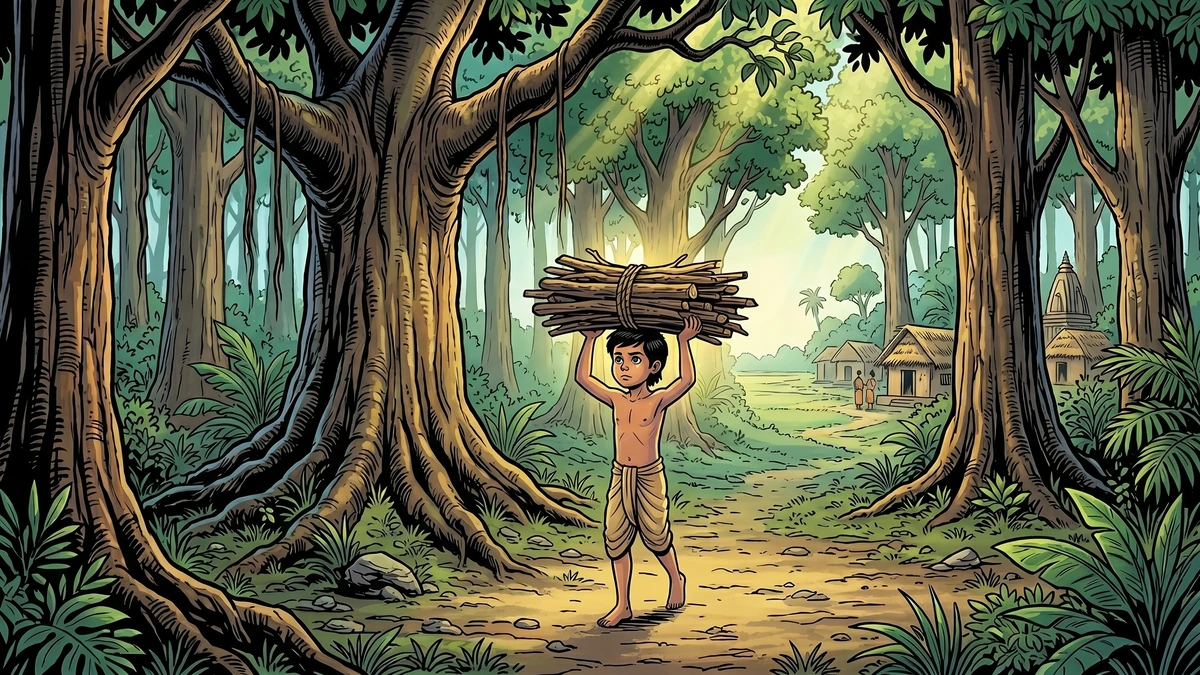
In a village of the Marwar region lived a young woodcutter’s son named Dhruva. His widowed grandmother, Dadi, raised him with nothing but love, a leaky mud hut, and the daily uncertainty of whether the evening meal would arrive. Dhruva rose before dawn, walked three kos (roughly nine kilometres) into the teak forest, cut wood, bound it with twine, and returned by midday to sell the bundles in the bazaar. What he earned he gave entirely to his grandmother; together they ate and were grateful.
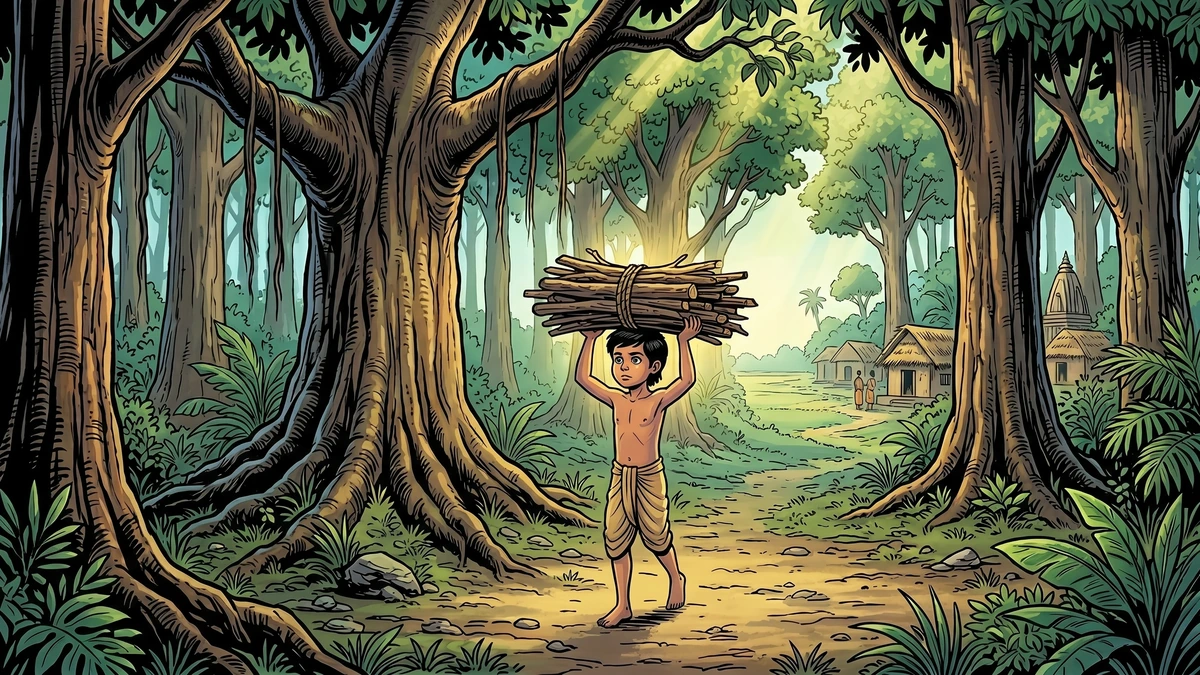
One blazing afternoon, his axe handle split and Dhruva sat under a khejri tree to rest. An old wandering sage—in some tellings identified as a Nātha ascetic, in others as Śiva himself in disguise—appeared from the forest shade. Sensing the purity of the boy’s heart, the sage presented him with a small damaru made of rosewood and goatskin: “Shake this drum whenever your household needs food. It shall provide. But it will serve only him whose hands are clean of greed.” Before Dhruva could ask a single question, the old man was gone.
That evening, Dhruva shook the drum hesitantly. From nowhere—from everywhere—warm rice, lentil soup, vegetables, and milk appeared on the earthen floor of the hut. Dadi wept and offered prayers. From that day forward, Dhruva continued his woodcutting not from necessity but from love of honest labour. He never shook the drum for more than the family needed, never for luxury, never for profit.
The Village Headman’s Son
Word reached Bhojraj, the village headman, a man of considerable landholding and considerable appetite for more. His son Kailash, a boy of Dhruva’s age but reared in the indulgent comfort of a prosperous household, heard the story and burned with envy. Bhojraj summoned Dhruva to the haveli courtyard and demanded to know the source of his sudden plenty. The boy, guileless as the sage had known him to be, told the truth and produced the drum.
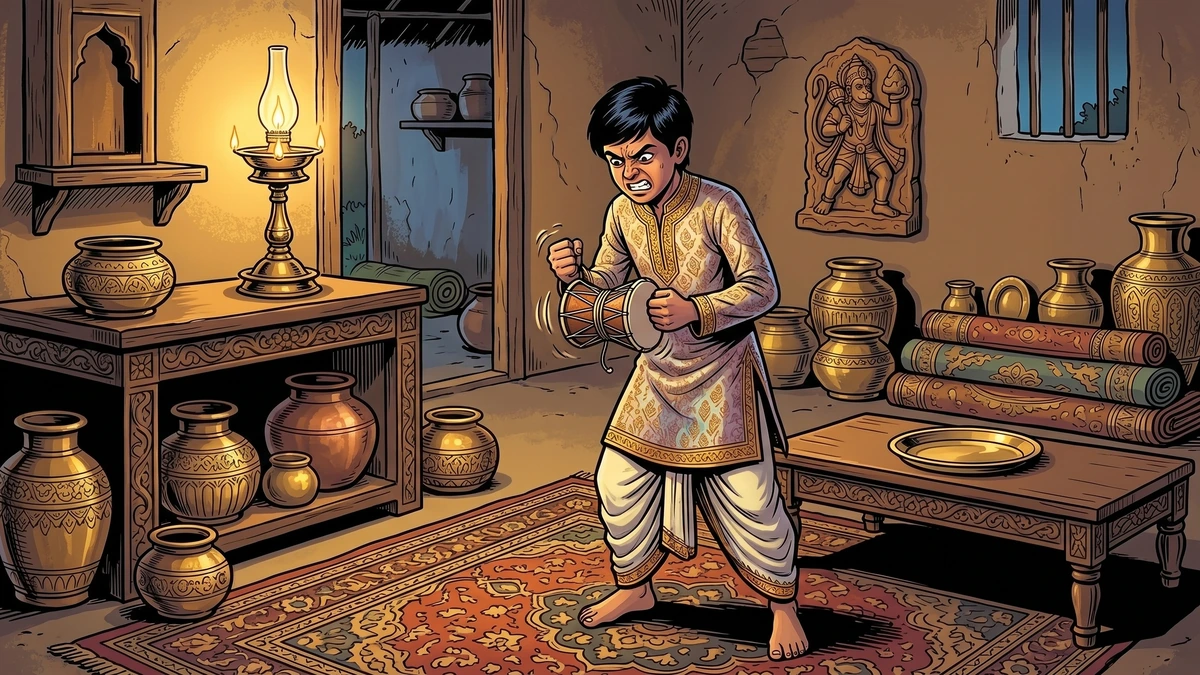
Bhojraj borrowed the drum “to examine it for the night.” In the morning he did not return it. Kailash seized it eagerly and shook it with the impatient authority of a boy accustomed to having his wishes granted. Nothing happened. He shook harder. Nothing. He threw it to the floor, picked it up, shouted at it, and finally stormed to his father in a rage. Bhojraj himself tried, thinking the boy had used it wrong. Still nothing.
Servants were sent to interrogate Dhruva. Had the drum a secret word? A ritual? The woodcutter’s son shook his head: “You must simply need what you ask for. And your need must be true.” Kailash, who had never in his life needed anything in the deep sense the word carries, could not unlock it. A Rajasthani proverb was proven true that day: मन सच्चो, तन सच्चो, धन पाछो आवे—”When heart is pure and hands are true, wealth follows of itself.”
Justice at the Village Well
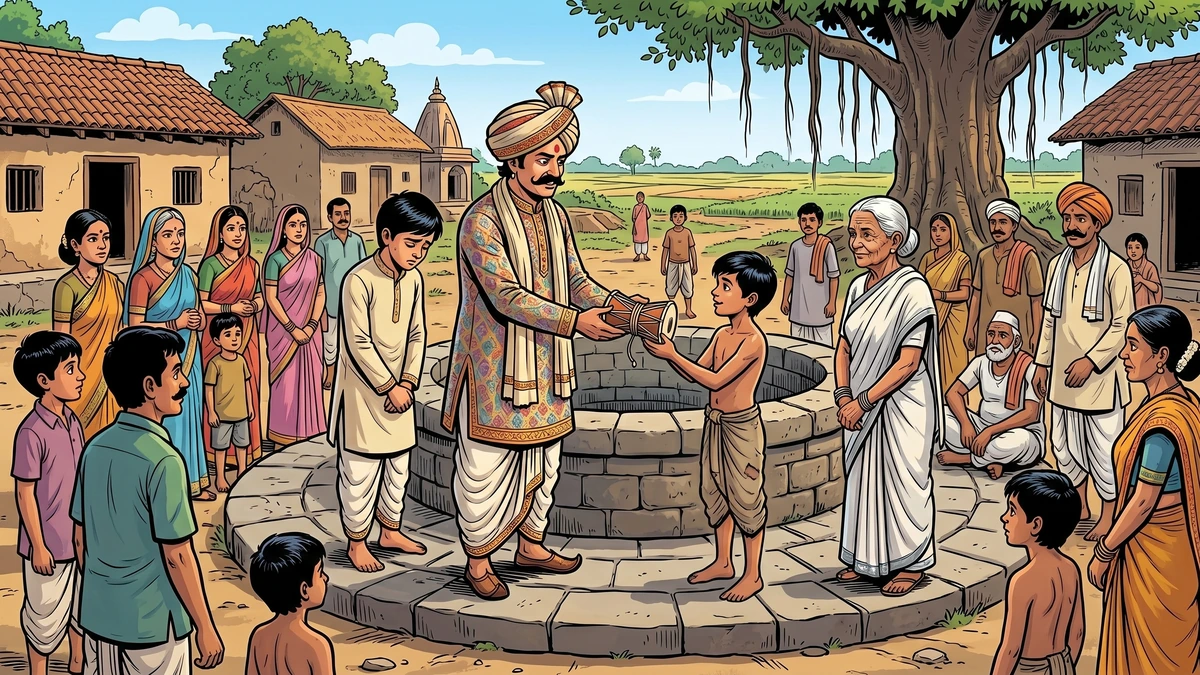
After three days of embarrassment, Bhojraj held a panchāyat at the village well. The five village elders gathered under the old banyan whose roots drink from the same aquifer as the well—a traditional meeting space because water, in arid Marwar, is the one honest witness. Faced with the elders’ questions and the silent testimony of a drum that had fed a poor family and refused a rich one, Bhojraj had no refuge. He returned the damaru to Dhruva. Kailash, standing behind his father, would not meet Dhruva’s eyes.
The headman, to save face, declared that the drum had been “kept for safekeeping.” But the elders, the grandmother, and every woman filling her pot at the well understood the truth. Dhruva accepted the drum without a word of reproach. He walked home with Dadi, shook the drum that evening, and the meal appeared as before. Nothing in the house had changed except that the village now knew the measure of both families.
Folkloric Roots and Scholarly Context
The Magic Drum belongs to the international tale-type ATU 745A (“The Luck-Bringing Object Given to a Poor Man”), which Stith Thompson classified under the broader rubric of grateful supernatural helpers rewarding virtue. Thompson’s Motif-Index records the relevant motifs as D1470.1 (Magic object provides food and drink), Q40 (Kindness rewarded), and Q272 (Avarice punished). The pattern appears across Eurasian traditions—from the Grimms’ “The Wishing Table” (KHM 36) to the Japanese Urashima Tarō variants where a boon object loses power in unworthy hands—but the Rajasthani version is notable for its institutional resolution: the panchāyat, not a divine intervention, delivers justice.
Vijaydan Detha’s literary reworking, which appears under the title Damaro in the eighth volume of Bātāṃ rī Phulvāṛī, deepens the social critique. Where older oral variants simply punish the greedy rich man supernaturally, Detha grounds the resolution in community accountability—a choice that reflects both his Gandhian sympathies and his ethnographer’s fidelity to actual village governance in Rajasthan. Scholar Christi Merrill, who has translated Detha’s work into English, notes that his retellings “refuse the comfort of the magical fix; instead they insist that the community itself must be the mechanism of moral reckoning.”
The Bengali parallel is equally instructive. Thakurmar Jhuli (“Grandmother’s Bag of Tales,” 1907), compiled by Dakshinaranjan Mitra Majumdar, preserves a story called Sona Danta (“Golden Tusk”) in which a forest spirit grants a magic object to a kind-hearted child that immediately becomes inert in greedy hands. The structural similarity across the vast linguistic distance between Rajasthani and Bengali—approximately 2,500 kilometres and two distinct literary traditions—suggests a deep pre-colonial substratum to the motif in South Asian storytelling.
The damaru itself carries cosmological freight that ordinary utensils do not. In Śaiva theology the hourglass drum is the instrument with which Śiva set the cosmos in motion at creation (Nāṭarāja iconography) and will unmake it at dissolution. To hold a damaru is, symbolically, to hold the pulse of the universe—a pulse that cannot be compelled, only attuned to. The story thus encodes a sophisticated theological argument in the grammar of a children’s tale: cosmic rhythms respond to inner alignment, not external force.
The Moral Architecture of the Story
What separates this tale from simpler “good child rewarded, bad child punished” fables is its psychology of need. Dhruva’s drum works not because he is well-behaved or pious in a performative sense, but because he genuinely needs—his asking is whole, unshadowed by fantasy or excess. Kailash’s failure is not moral wickedness in any dramatic sense; he is simply a boy who has never experienced real need and therefore cannot form a real request. The drum, in this reading, is a mirror.
This psychological precision is characteristic of the best South Asian folk narratives, which tend to locate virtue not in rule-following but in a quality of being that cannot be performed. The Jātaka tales—the 547 stories of the Buddha’s previous lives—use the same technique: the bodhisattva’s generosity works because it arises from understanding, not calculation. The purity that unlocks magic in these traditions is not ceremonial but existential.
For children hearing the story today, the lesson is accessible without the theological scaffolding: be honest about what you truly need; do not covet what belongs to another; work cannot be replaced by cleverness alone. For adults, the panchāyat scene adds another layer—that communities have the power and responsibility to correct imbalances of power when individuals fail to self-correct.
Legacy and Living Tradition
Vijaydan Detha’s version of the Magic Drum has been adapted for the stage by the Rajasthan Sangeet Natak Akademi and performed in open-air tamāshā theatre style across village fairs in Jodhpur, Barmer, and Jaisalmer districts. A puppet version using traditional Katputli (string puppets) has been documented by the Rupayan Sansthan, the folklore institution Detha co-founded, as part of its effort to preserve living performance traditions alongside the written text.
The story also finds echoes in the Panchatantra‘s framing principle—that wisdom tales exist to transmit governance knowledge to young rulers—though the Magic Drum inverts this: it is the poor child, not the prince, who holds the lesson. In this sense it belongs to the great counter-tradition within Indian storytelling that insists on the moral competence of ordinary people and the corruption latent in unearned privilege.
Grandmother Dadi’s quiet dignity throughout the story—she never gloats, never reproaches, never seeks retribution—is itself a lesson the tale carries in its bones. Her restraint mirrors the drum’s restraint: power that does not advertise itself, wisdom that does not need to be proven. In the oral performances Detha studied, it was often Dadi who received the final line, a blessing addressed to the audience: “May your drums always answer.”
The Woodcutter’s World: Marwar in Historical Context
To understand why the Magic Drum tale resonates so deeply in its Rajasthani home, one must understand the landscape that shaped it. Marwar—the “Land of Death” in Sanskrit, referring to its inhospitable terrain—encompasses much of western Rajasthan. Annual rainfall rarely exceeds 300 millimetres. The khejri tree (Prosopis cineraria), sacred to the Bishnoi community and legally protected since the 18th century, is the ecological anchor of this desert: its roots go deep enough to find water that surface crops cannot, and its pods provide protein when grain fails. Dhruva’s teak forest is a narrative convention borrowed from wetter landscapes—real Marwar woodcutters worked with khejri, rohiṛā, and babool—but the detail signals to a pan-Indian audience that this is honest, back-breaking labour in a difficult land.
The social structure the story assumes is the jajmāni system, in which village artisans and labourers provide hereditary services to landowning families in exchange for grain payments at harvest. Woodcutters in this system occupied a low but indispensable rung: they supplied fuel for cooking, cremation, and the ritual fires that marked every rite of passage. That Bhojraj the headman would feel entitled to “borrow” Dhruva’s drum without meaningful consent is not merely personal villainy—it is systemic; the powerful routinely annexed the resources of the powerless. The panchāyat‘s intervention represents the theoretical corrective that the system promised but often failed to deliver.
Vijaydan Detha was acutely aware of this social texture. Born into a Charan community—traditional bards and genealogists who served Rajput courts—he chose to reject courtly patronage and devote himself to the folk traditions of ordinary Rajasthanis. His decision to write in Rajasthani rather than Hindi was itself political: Rajasthani has no official status as a language in India despite being spoken by tens of millions, and each story Detha published in it was an act of cultural preservation and resistance simultaneously.
Comparative Mythology: The Drum Across South Asia
The damaru‘s role as a magical instrument is not unique to this tale. In the Śaiva tradition it is one of the fourteen utterances (māheśvara sūtras) that Śiva’s drum produced at the first moment of creation—these fourteen phonemes are said to contain the seeds of all Sanskrit grammar, and by extension all language and all knowledge. The 5th-century grammarian Pāṇini is traditionally depicted as receiving his insight into Sanskrit structure directly from the sound of Śiva’s drum. A drum that provides food in this story is thus, in the deepest cosmological sense, a drum that provides order—aligning the household’s needs with the rhythm of the universe.
Tamil Shaiva literature offers a parallel in the Tēvāram hymns of the Nāyanārs (7th–9th century CE), where Śiva is repeatedly invoked as the great provider who holds the drum in one hand and the sacred fire in the other—the two symbols capturing creation and destruction as simultaneous, not sequential. The drum that gives food and the drum that makes the cosmos are, in this theological schema, the same drum. To be given a damaru by a sage in a folk tale is thus to receive a piece of cosmic infrastructure, and the story’s insistence that it functions only for those with pure intent is theologically coherent: cosmic order cannot be subverted by individual greed.
Moving eastward, the Maṇimēkalai (Tamil, 5th–6th century CE)—a Buddhist counter-epic to the Cilappatikāram—contains the episode of the amuta surabhi, the inexhaustible food-bowl given to the protagonist Maṇimēkalai by the goddess of the sea. The bowl feeds the hungry of the city of Kāveripaṭṭinam but becomes inert when a greedy man attempts to steal it. The structural echo of the Magic Drum is exact, suggesting a shared narrative substrate beneath the theological differences between Shaivism and Buddhism in their literary representations.
The Odia tradition preserves a version of the drum tale in the Panchasakha corpus associated with the 15th-16th century poet-saints of Jagannath’s Puri temple. In these retellings, the magic object is a conch rather than a drum—the śaṅkha replacing the damaru as the symbol of divine sound—but the logic is identical: the conch produces rice and vegetables for the poor devotee and falls silent when seized by the temple’s powerful sevaka priest. The Odia version explicitly names the mechanism: “The conch knows the difference between need and greed, as Jagannath knows the difference between the pure offering and the performance of purity.”
The Grandmother Figure in Indian Folk Narrative
Dadi—the grandmother—deserves extended attention, for she is not merely a sympathetic background figure. In the grammar of Indian folk narrative, the grandmother occupies a specific functional role: she is the repository of traditional knowledge, the keeper of the household’s moral ecology, and simultaneously the most vulnerable member of the economic unit. Her dependency on Dhruva mirrors the dependency of the entire tradition on the young: the old wisdom survives only if the young carry it faithfully.
The title Thakurmar Jhuli—”Grandmother’s Bag of Tales”—captures this function precisely. In the Bengali collection of the same name, the grandmother is the narrative’s ultimate source; the stories come from her memory, her body, her accumulated experience. When Detha writes Dadi’s dignified restraint at the panchāyat—she says nothing, but her silence speaks loudly—he is invoking a long tradition of grandmotherly wisdom that operates below the threshold of direct speech.
In Rajasthani oral performance, the role of Dadi is often played by the eldest woman of the troupe, whose age itself conveys authority the words do not need to spell out. Ethnomusicologist Komal Kothari, who collaborated with Detha at the Rupayan Sansthan in Borunda, documented that in Kathputli puppet performances of the Magic Drum story, the Dadi puppet was always made larger than the other characters—a visual signal to the audience of her moral stature even within an economically diminished life.
The Panchāyat as Moral Institution
The panchāyat—literally “assembly of five”—is one of the oldest civic institutions in the Indian subcontinent, attested in the Arthaśāstra of Kauṭilya (approximately 300 BCE) and in the village administration records of the Maurya, Gupta, and Chola empires. Its authority derived not from royal delegation but from community consensus: the five elders were chosen for their perceived impartiality, and their decisions were binding within the village even without any external enforcement mechanism. The institution depended entirely on the social cost of non-compliance—the ostracism, the reputational damage, the withdrawal of community cooperation that would follow from defying the elders’ judgment.
In the Magic Drum tale, the panchāyat works because Bhojraj himself is embedded in this system of accountability. He is the headman—his power derives from the same community that is now sitting in judgment. To defy the elders would be to saw off the branch on which he sits. The drum’s failure in his hands has already undermined his authority; the panchāyat merely formalises what everyone in the village already knows. This is sophisticated social dynamics encoded in a children’s story: power is relational, not absolute, and the powerful are always more constrained by community opinion than they prefer to acknowledge.
Contemporary India has seen significant efforts to revitalize the panchāyati raj system through constitutional amendments (notably the 73rd Amendment of 1992, which mandated elected village councils with reserved seats for women and lower castes). The Magic Drum story, in this context, reads almost as a founding myth for participatory village democracy: the message that justice is possible without recourse to the state, that communities have the tools to correct imbalances if they choose to use them, is not merely historical but urgently contemporary.
The Story in Modern Education and Media
The Magic Drum has been included in moral education curricula in Rajasthan, Gujarat, and Maharashtra state schools under various titles—Jādu kā Ḍholak (Hindi), Jādūī Ḍamru (Hindi-Rajasthani hybrid), and Māyāvī Damaru (Gujarati). The National Book Trust of India published a picture-book version in twelve languages as part of its “Bal Sahitya” children’s series. The story was adapted into a short animated film by Children’s Film Society India (CFSI) in 1994, directed by Nilima Sinha, which won the National Film Award for Best Film for Children that year.
In the digital age, the tale has found new life through YouTube storytelling channels in Rajasthani, Hindi, and English, where it consistently outperforms other folk tales in view counts among the 6-10 age group—a metric that suggests something in the story’s core logic continues to resonate with children who have never encountered a panchāyat or a damaru in their daily lives. The universality of the need-versus-greed distinction transcends the cultural specificity of its Rajasthani clothing.
Detha’s daughter-in-law Vijaya Chitriv, who has continued the work of the Rupayan Sansthan after his death in 2013, has expressed concern that digital adaptations often strip away the social critique embedded in the original: “They keep the magic and they keep the moral about honesty, but they lose the village. They lose the panchāyat. They make it a story about a good boy and a bad boy, and it becomes thin. The depth is in the community, not just the individual.” Her observation points to the perennial challenge of adapting folk narrative for mass media: the compression that makes a story transmissible often discards the very context that made it wise.
What the Story Teaches
The Magic Drum is, at its core, a story about the epistemology of need. It asks us to distinguish between wanting and needing—a distinction that affluence systematically blurs. Dhruva’s power over the drum is not a reward for virtue in any transactional sense; it is a recognition of an existing alignment between his inner life and the object’s nature. The drum does not judge him and give him food. It simply functions as it was designed to function, and he happens to be the kind of person it was designed for.
Kailash’s failure is similarly non-judgmental in its mechanism. The drum does not punish him. It simply does not recognize his request as real. There is something almost compassionate in this: the universe, the story suggests, is not waiting to punish us for greed, but it cannot hear us through the static of our own excess.
For a modern reader, the drum is an apt metaphor for attention: we live in an economy of attention that responds to genuine need (curiosity, connection, meaning) but is deaf to performative wanting (status display, competitive consumption). The Rajasthani sage who gave Dhruva his drum could not have anticipated smartphones, but the principle he embodied is startlingly current: what you truly need, the world will supply. What you merely covet, you will exhaust yourself chasing in silence.
Vijaydan Detha concluded his written version of the story with a sentence that his translators have struggled to render adequately: in Rajasthani, “Dhruvo ro ḍamro āj bī bajavē chē—jo sūṇo vāro hoy toe sūṇo”—”Dhruva’s drum still beats today—for those who have ears to hear it.” It is an invitation, not a conclusion. The story does not end; it waits.
Frequently Asked Questions
What is the origin of the Magic Drum story?
The Magic Drum belongs to the international tale-type ATU 745A and has deep roots in Indian oral tradition. The most celebrated literary version was written by Vijaydan Detha (1926–2013) and published in his 22-volume Rajasthani collection Bātāṃ rī Phulvāṛī. Earlier structural parallels appear in the Tamil Buddhist epic Maṇimēkalai (5th–6th century CE) and in Bengali folk collections such as Thakurmar Jhuli (1907).
Why does the magic drum not work for the greedy headman’s son?
According to the story’s internal logic—and its Shaiva theological underpinning—the damaru (hourglass drum) responds only to genuine, unselfish need. Kailash, raised in comfort, has never experienced real need and cannot form an authentic request. The drum does not punish him; it simply cannot recognise his covetous wanting as a true call. Stith Thompson’s Motif-Index classifies this mechanism under Q272 (Avarice punished) and D1470.1 (Magic object provides food).
What is the significance of the damaru drum in Indian mythology?
In Shaiva theology the damaru is Shiva’s cosmic instrument: its sound at creation produced the fourteen phonemes (māheśvara sūtras) that contain all Sanskrit grammar and, by extension, all knowledge. The 5th-century grammarian Pāṇini is traditionally said to have received his insight from the drum’s sound. A folk tale featuring a gift damaru thus encodes a rich cosmological argument: the drum’s rhythm aligns with universal order, and only a heart in harmony with that order can activate it.
Who was Vijaydan Detha and why is his version important?
Vijaydan Detha (1926–2013), often called the Shakespeare of Rajasthani literature, spent fifty years collecting and retelling folk tales from his native Marwar region. His 22-volume Bātāṃ rī Phulvāṛī preserves hundreds of stories that might otherwise have been lost to urbanisation and linguistic marginalisation. His version of the Magic Drum is distinctive for its social realism: justice comes not from a supernatural deus ex machina but from a village panchāyat—the traditional council of five elders—reflecting his Gandhian belief in community accountability.
What moral does the Magic Drum story teach children today?
At its simplest, the story teaches that honest work, genuine need, and freedom from greed are more powerful than wealth or social status. The magic drum provides for Dhruva not because he is specially gifted but because his intentions are transparent and his needs are real. For modern children, scholars like Christi Merrill—who has translated Detha’s work—suggest the tale offers a critique of consumer culture: the drum is a metaphor for attention and fulfilment that responds to authentic desire but remains silent in the face of competitive wanting.
You May Also Like
 Indian Folk Tales
Older Kids / Teens / Adults
Indian Folk Tales
Older Kids / Teens / Adults
Good Will Grow Out Of Good: Tamil Folk Tale of the Lime & the Blessing
Southern Indian folk tale — Brāhmin Pāpabhīru’s daily yellow lime, the Tamil blessing “if good is sown, good will grow,” and how sown good and sown evil return. Full story + FAQ.
 Indian Folk Tales
All Ages
Indian Folk Tales
All Ages
The Ass in the Lion’s Skin
The Ass In The Lions Skin: In a dense forest near a small Indian village, there lived a washerman named Dhobi who owned a tired old donkey. The poor donkey had
 Indian Folk Tales
Ages 3-5
Indian Folk Tales
Ages 3-5
The Story of a Kind Hearted Little Girl Named Tara
The Story of a Kind Hearted Little Girl Named Tara: Once there lived a little girl named Tara with her mother in a small hut near the forest. Tara was