The Talking Turtle
A chatty turtle flies high in the sky holding a stick between two clever geese, but his talking tongue will bring him crashing down in this funny Panchatantra fable.
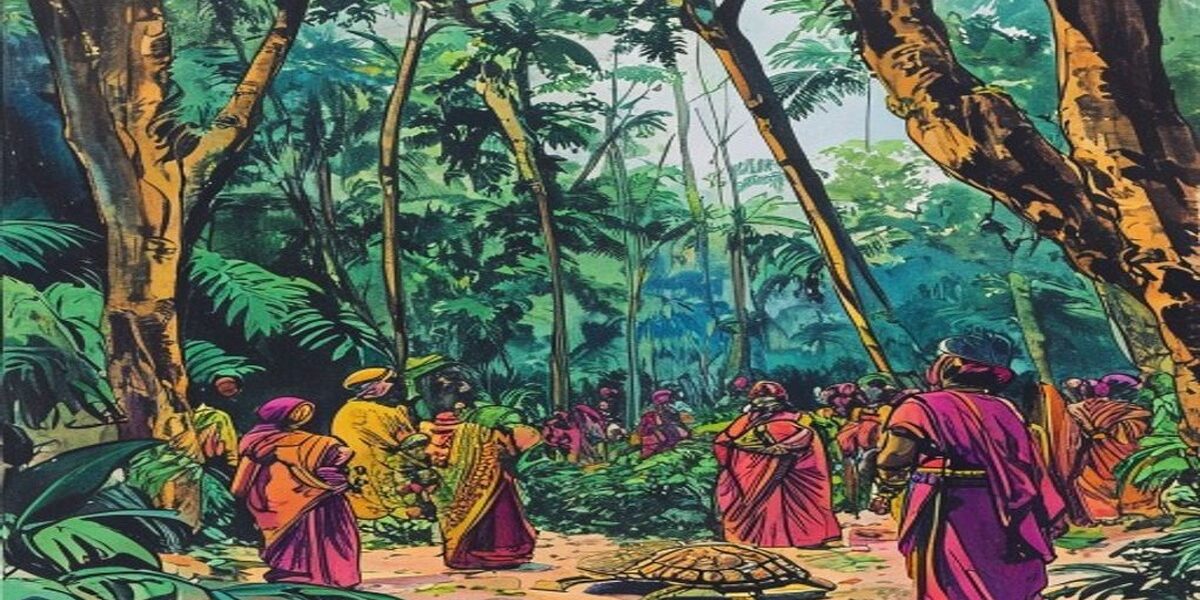
The Talking Turtle — Panchatantra, Book V: Aparīkṣitakāraka (Ill-Considered Action); also in Buddhist Jātaka canon
This tale — sometimes called “The Turtle Who Could Not Keep Quiet” — belongs to both the Panchatantra tradition, compiled by Vishnu Sharma around 300 BCE, and the Buddhist Jātaka canon, making it one of the few stories shared between both great Indian pedagogical traditions. Book V of the Panchatantra — Aparīkṣitakāraka, “Ill-Considered Action” — collects cautionary tales about the inability to govern one’s own responses at critical moments. The Talking Turtle is the tradition’s most direct treatment of this failure: a creature who knows he must be silent, who has been explicitly warned, who has agreed to the condition, and who opens his mouth anyway at the exact worst moment. The story is structurally identical to The Tortoise and the Geese and serves as its philosophical twin.
Beat I — The Drought and the Decision to Leave
A turtle had lived his entire life in a comfortable lake, well-watered through all seasons, abundant in food. He had good friends there: two wild geese who visited regularly from their migrations and had spent enough seasons at this particular lake to form a genuine attachment to the turtle and to each other. They were an unusual friendship — bird and reptile, migratory and sedentary, sky-creature and water-creature — held together by the daily company that had accumulated into real affection.
Drought came to the region. The lake shrank, season by season, until what had been deep water was mud, and what had been mud was cracking earth. The geese recognised this as the kind of progressive environmental change that their migration experience had taught them to read: this lake was finished, at least for several seasons, and anything that depended on it needed to leave.
They came to the turtle with a proposal and with the same instruction that appears in the Tortoise and the Geese story: a stick, held in the turtle’s mouth at its centre, one goose holding each end. They would carry him to their summer lake, well-watered and abundant, several days’ flight north. He needed to understand one thing clearly before they began: he must not open his mouth during the flight. Not for any reason. Not to exclaim, not to respond, not to correct anyone who said anything about them. His life depended entirely on maintaining his grip on the stick.
The turtle agreed. He was intelligent enough to understand the physics and frightened enough of the dying lake to accept the terms without negotiation.
Beat II — The Flight and the Crowd
The geese lifted him cleanly. He found himself high above a landscape he had never seen — his lake a shrinking oval in a brown plain, forests spreading in directions he had never oriented himself toward, a distant silver line that might be the river the geese had described. It was extraordinary. He held the stick with all the discipline he could summon.
They passed over a village. Children saw them first, as children always do — two large geese carrying a turtle on a stick, moving across the sky in a slow, deliberate line. The children shouted. Adults came. A crowd gathered below, pointing upward, debating what they were seeing. This was, objectively, remarkable. Very few people had ever seen a turtle in flight. The crowd’s commentary was loud, varied, and not particularly considerate of the turtle’s dignity.
Someone in the crowd said — loudly, clearly, in a voice that carried well — that the turtle was being carried like a piece of market produce. Someone else said the geese must have mistaken it for a basket. A third voice offered that perhaps the turtle had hired the geese as transport, which struck the crowd as very funny.
The turtle listened to all of this with a composure that lasted, by his own internal assessment, longer than he might have expected. He was above the cloud of provocation for several long seconds. And then he was not. He opened his mouth to explain — that this was a rescue, that the geese were friends, that the relationship was one of genuine affection rather than commercial transaction — and fell.
Beat III — The Analysis of One Syllable’s Cost
The Panchatantra presents the outcome without extended commentary: the turtle fell, struck the earth, and the crowd that had been laughing at a turtle being carried like produce discovered it was now standing around a turtle that had fallen from a considerable height. The geese circled once and then flew on. They could not help him now and had their own journey to complete.
What is philosophically precise about this story is the relationship between the trigger and the response. The turtle had survived genuine physical difficulty — the weight of the stick, the cold of altitude, the disorienting wrongness of being airborne — and had maintained his grip through all of it. What broke his discipline was not physical stress but social provocation: the public mischaracterisation of a relationship he valued. He could endure the fear of falling. He could not endure being publicly misunderstood about his friendship with the geese.
The Panchatantra observes that this specific vulnerability — the inability to tolerate public mischaracterisation in silence — is among the most dangerous a person can carry into high-stakes situations. Physical courage and social pride are very different things. The turtle had the former and was destroyed by the latter. His need to correct the crowd’s impression of his relationship with the geese was the specific weakness that killed him — and it was triggered not by anyone attacking him but by anyone simply being wrong about him in his hearing.
Beat IV — Silence as the Hardest Form of Self-Mastery
The Buddhist Jātaka version of this story frames the Bodhisattva’s reflection afterward: the turtle had wisdom, planning capacity, and genuine friendship. What he lacked was the specific discipline of tuṇhī-bhāva — the capacity for strategic silence, for refraining from speech not because one has nothing to say but because one has assessed the cost of saying it against the cost of not saying it, and chosen accordingly.
The Panchatantra frames the same lesson through its fifth book’s persistent theme: knowing what must be done is not the same as doing it when the emotional pressure arrives. The turtle knew he must not speak. He had agreed. He had been warned. The knowledge was not insufficient. What was insufficient was the bridge between the knowledge and the action — the trained habit of silence, the practiced capacity to feel the impulse to speak and let it pass without acting on it. This capacity is not natural; it is built through specific practice. The turtle had not built it.
For Vishnu Sharma’s royal students, the lesson was direct: a king who cannot maintain silence when publicly mischaracterised — who must correct every wrong impression about himself or his motives in the moment it is formed — will find himself opening his mouth at exactly the moments when silence is the only viable strategy. Diplomatic situations, negotiations, public ceremonies: all of these contain moments when the wrong impression is held and the correct response is to let it stand until a better moment arrives. The king who cannot sustain that silence is the turtle.
“The hardest form of self-mastery is silence in the presence of a lie that costs nothing to correct and everything to survive.”
Why This Story Has Lasted 2,300 Years
The Talking Turtle endures because its central moment — the choice between speaking and surviving — is not exotic. Everyone has been in a situation where the provocation was small, the cost of responding was enormous, and the impulse to respond was nearly irresistible anyway. The turtle is not a fool; he is a creature whose one specific weakness — the inability to be publicly misunderstood in silence — meets the one specific situation that destroys him. The Panchatantra and the Jātaka tradition both chose to tell this story precisely because it is not about extraordinary weakness. It is about the entirely ordinary gap between knowing what silence costs and having the trained capacity to maintain it.
About the Panchatantra
The Panchatantra (“Five Treatises”) was composed by Vishnu Sharma circa 300 BCE as a compendium of nītiśāstra — statecraft, ethics, and worldly wisdom — expressed through interlocking animal fables. The Talking Turtle appears in both the Panchatantra’s fifth book and the Buddhist Jātaka canon, making it one of the few tales shared between the Brahminic and Buddhist Indian narrative traditions. It has been translated into Pahlavi, Arabic, Hebrew, Latin, and all major European vernacular languages, and remains one of the most widely recognised and cited fables in world literature.
Frequently Asked Questions
**Q: Why is this story important?**
You May Also Like
 Panchatantra Stories
Ages 6-8
Panchatantra Stories
Ages 6-8
The Story of the Bug and the Flea
The Story of the Bug and the Flea: In a certain country lived a king who had a verybeautifully decorated bedroom. An exquisite white silksheet covered the bed
 Panchatantra Stories
Ages 6-8
Panchatantra Stories
Ages 6-8
The Story of the Potter
Read 'The Story of the Potter' — a classic Panchatantra story about courage. of the Potter is a beloved Panchatantra tale featuring a ant. This ancient ...
 Panchatantra Stories
Ages 3-5
Panchatantra Stories
Ages 3-5
The Monkey and the Log
A restless monkey pokes at what he does not understand — and pays a painful price that has lasted thousands of years in the Panchatantra.