The Jackal And The Drum
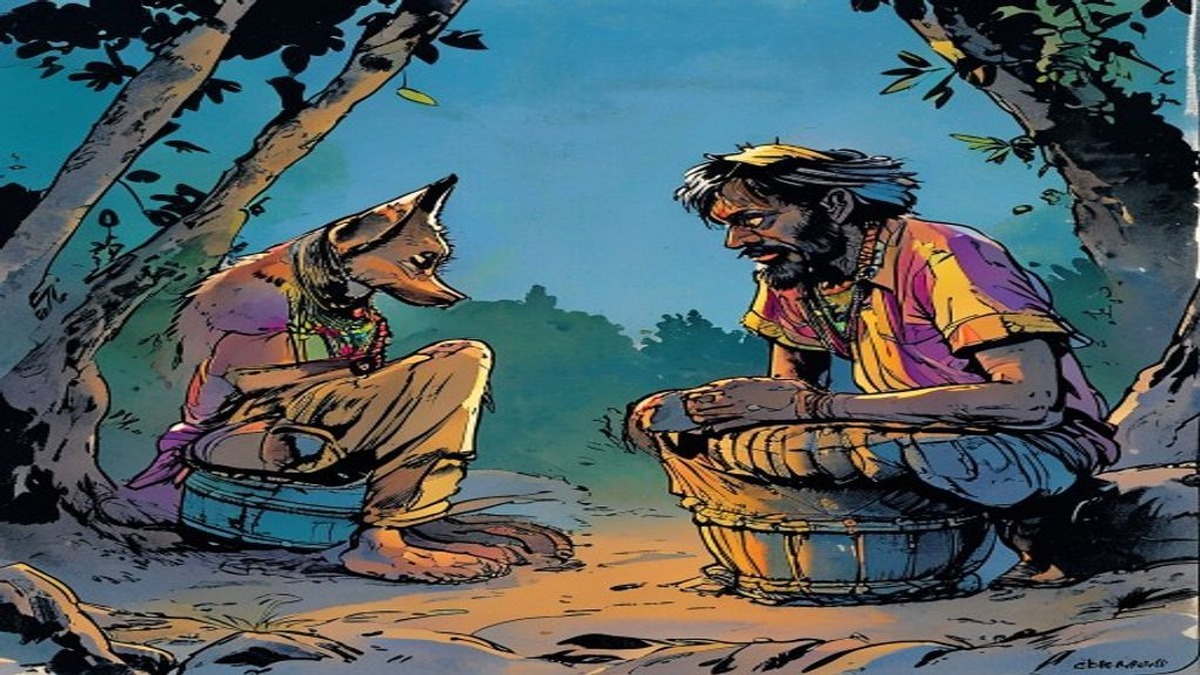
The Jackal And The Drum: Once upon a time, in the heart of a vast and ancient forest, there lived a jackal named Gomaya. He was a thin and scraggly creature

The Jackal and the Drum
Canonical Attribution and Manuscript Tradition
This tale belongs to Pancatantra Book I, Mitra-bheda, and represents one of the collection’s most economical demonstrations of a principle it returns to repeatedly: that fear, like appetite and grief, suppresses the investigation that would resolve it. The story is preserved in all major Sanskrit recensions including the Tantrakhyayika (c. 200 BCE, Kashmir) and paralleled in the Hitopadesha. It belongs to the widespread tale type of the creature that encounters an unfamiliar noise or phenomenon, attributes it to a dangerous source without investigation, and either flees or is paralysed — only to discover through eventual investigation or accident that the source was harmless. The Pancatantra’s version is among the most structurally compressed in world fable literature: the jackal’s error, investigation, and correction occupy a very small narrative space, and the compression is itself a rhetorical strategy. Vishnu Sharma does not give the jackal a lengthy journey of fear before the discovery; the juxtaposition of terror and the trivial truth is immediate and deliberate.

Beat I — The Sound and the Fear
A jackal, wandering through an abandoned battlefield, heard a loud and unfamiliar sound. The sound was large, resonant, and without visible source. The jackal stopped. Its first response was fear: something large enough to make that sound must be nearby, and something large and nearby on a battlefield might be dangerous. The jackal considered fleeing immediately.
The sound came again. The jackal’s fear intensified. It constructed, in the way frightened creatures construct explanations, an account of the sound that was consistent with its fear: this was a large and dangerous animal, probably predatory, probably between the jackal and the exit. The account had no evidentiary basis whatsoever. The jackal had not seen any animal. It had heard only the sound. But fear had already provided the explanation, and the explanation was now operating as though it were a fact rather than a hypothesis.
Beat II — The Investigation
The jackal did not flee immediately. This is the tale’s crucial structural detail: despite its fear, the jackal paused and chose to investigate before acting. It approached the source of the sound carefully, staying low, moving slowly, prepared to retreat. As it came closer the sound resolved into something visible: a large drum, left behind when the armies had abandoned the battlefield. A branch, moved by the wind, was striking the drum’s surface repeatedly, producing the resonant booming the jackal had heard.
The jackal examined the drum. It walked around it. It struck the surface itself and produced the same sound. It understood: there was no dangerous animal; there was a drum and a branch and the wind. The explanation fear had provided — large predatory animal — was entirely wrong. The actual explanation — percussion instrument and weather — required no response at all except perhaps the observation that abandoned battlefields contain abandoned equipment, and equipment can produce sounds that resemble threats.

Beat III — The Pancatantra’s Anatomy of Fear-Reasoning
Vishnu Sharma’s account of the jackal’s fear response is anatomically precise in a way that makes it useful far beyond the specific situation of a jackal and a drum. Fear, the Pancatantra implies, operates as follows: an unfamiliar stimulus arrives; before it is investigated, fear generates an explanation of it that is consistent with danger; this explanation is then treated as a fact rather than a hypothesis; subsequent reasoning takes the danger-fact as a premise and produces conclusions (flee, fight, freeze) that would be appropriate if the fact were true. The investigation step — the move from unfamiliar stimulus to examined source — is what fear suppresses and what the jackal, to its credit, eventually performed despite the suppression.
The parallel with the Pancatantra’s other judgment-failure tales is structurally explicit. The jackal here makes the move that the crane failed to make in The Foolish Crane and the Mongoose, and that the fighting-goats jackal failed to make before entering the dangerous space: it paused, it investigated, and it revised its initial inference when the investigation produced contrary evidence. The result is not glory but it is the correct outcome: the jackal leaves the battlefield with accurate information and no unnecessary harm done.
Beat IV — What the Jackal Teaches About Fear and the Investigation Imperative
The tale operates in the Pancatantra’s sustained teaching on the relationship between emotional states and the quality of judgment. Fear, appetite, grief, and protective urgency are all presented across the collection as states that systematically interfere with the investigation step. The common feature is that each state provides a ready-made explanation of the situation — fear says dangerous; appetite says rewarding; grief says lost — and each explanation, once accepted, tends to produce action rather than further investigation. The Pancatantra’s consistent instruction is that investigation should precede action regardless of the emotional state generating the ready-made explanation.
For Vishnu Sharma’s royal pupils the political application is direct. Courts are environments where alarming information arrives frequently, often from sources with interests in producing alarm. The minister or king who responds to alarming reports with the fear-generated explanation — this is a genuine threat, act immediately — rather than with investigation, is the jackal before it chose to approach the drum. The sound may indeed be a threat; it may equally be a drum and a branch. Investigation determines which. Acting on fear’s explanation, without investigation, produces responses calibrated to the explanation rather than to the reality, and the costs of that miscalibration compound.

Moral and Sanskrit Wisdom Tradition
“Fear provides explanations; investigation provides facts. Act on facts.”
— Moral of The Jackal and the Drum, Pancatantra Book I (Mitra-bheda)
This moral is among the Pancatantra’s most compact formulations of its central epistemological teaching. The distinction between fear’s explanation and investigated fact is not merely a psychological observation; it is a political instruction. The Arthashastra of Kautilya recommends extensive use of intelligence networks precisely because the king who acts on unverified reports is operating on fear’s explanations rather than facts. Vishnu Sharma’s narrative approach reaches the same conclusion: the jackal that investigates before acting is the model for the counsellor or king who demands verification of alarming reports before committing to a response. The drum is always a possible explanation; the threat is always a possible explanation; only investigation determines which.
Why This Story Has Lasted 2,300 Years
The Jackal and the Drum endures because the cognitive mechanism it illustrates — fear generating a dangerous explanation that is then treated as fact — is genuinely universal and genuinely persistent. Every generation produces situations in which alarming stimuli arrive, fear provides immediate explanations, and the investigation that would reveal the actual situation is skipped in favour of action calibrated to the fear-explanation. The tale’s compression is its strength: the distance between the terrifying booming and the mundane drum is covered in a very few narrative steps, and the juxtaposition is the lesson. Vishnu Sharma needs no extended analysis because the structure of the tale itself demonstrates the structure of the error and its correction.
Sanskrit Tradition: Tantrakhyayika (c. 200 BCE, Kashmir); Hitopadesha
Key Distinction: Fear’s explanation vs. investigated fact; the investigation imperative under emotional activation
Author: Vishnu Sharma (attributed, c. 3rd century BCE)
Arthashastra Parallel: Kautilya’s intelligence networks as the institutional embodiment of the investigation imperative
You May Also Like
 Panchatantra Stories
Ages 9-12
Panchatantra Stories
Ages 9-12
The Story of the Hares and the Elephants
The Story of the Hares and the Elephants: In a certain place, there lived an elephant king andwith him, his retinue. The king’s name was Chatura danta. The
 Panchatantra Stories
Ages 12+ / YA
Panchatantra Stories
Ages 12+ / YA
The Barber Who Killed the Monks | Panchatantra (Ages 9–12+)
A Panchatantra cautionary tale: a barber copies what he saw at a merchant’s house without understanding — and learns that imitation without knowledge is dangerous.
 Panchatantra Stories
Ages 3-5
Panchatantra Stories
Ages 3-5
The Bird and the Monkey
The Bird and the Monkey: Never give advice unless you are asked for it.” There lived a group of monkeys in the mountains. During one winter, there were heavy