The Lion and The Foolish Donkey
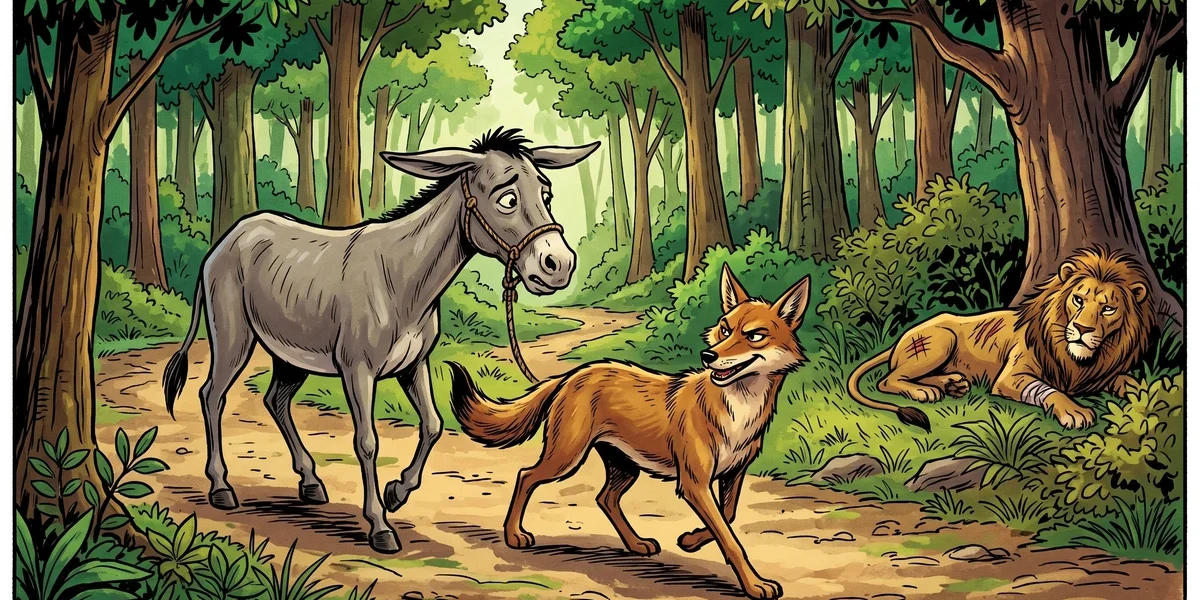
The Lion and The Foolish Donkey: A lion named Karalakesara was living in a forest, loyally served by Dhoosaraka, a jackal that used to accompany the lion
Origin & Canonical Placement
“The Lion and the Foolish Donkey” is a brisk and instructive fable about the danger of returning to a peril one has already survived through good fortune, exploring the specific cognitive error of treating a lucky escape as proof of safety rather than as evidence of danger. The story belongs to Vishnu Sharma’s Pancatantra (c. 300 BCE–300 CE) and is preserved in related Sanskrit collections including the Hitopadesha. It fits squarely within the thematic territory of Book V: Aparikshitakaraka (“Ill-considered Action”), which catalogues the many forms of recklessness that lead to self-destruction, with particular attention to failures of memory and the human tendency to discount past danger once immediate pressure has lifted.
“Ekavaram yah prakshinen mrityuna mochito mudhah punar eti sa mrityum.”
“The fool who has once been released from death goes back to meet it again.”
— Panchatantra maxim, Book V
Beat I — The First Encounter: A Lion, a Jackal, and a Convenient Escape
A lion named Madasura lived in a forest cave and employed a jackal as his scout and steward. The jackal’s job was to identify prey and drive it toward the lion, whose age and a minor injury had somewhat reduced his hunting range. One day the jackal located a fine, plump donkey grazing at the forest’s edge and reported this to the lion. The lion positioned himself in the undergrowth while the jackal approached the donkey with a friendly, casual manner.
The jackal told the donkey that there was an exceptionally lush meadow deep in the forest, known only to a few privileged animals, where the grass was sweeter and more abundant than anything available at the forest’s edge. The donkey, who was hungry and inclined to trust a creature who appeared so relaxed and informed, followed the jackal into the forest. As they approached the lion’s position, the lion leaped — but the donkey, startled by some prior instinct of danger, bolted before the lion could reach full speed and escaped into the open. The lion returned to his cave, disappointed. The jackal said nothing critical; he had another idea.
Beat II — The Fatal Return: Memory Erased by Relief
The jackal went back to the donkey, who was still breathing hard from his escape but already beginning to relax as the immediate sense of danger faded. The jackal affected puzzlement and mild reproach. “What happened to you back there?” he asked. “You ran from a perfectly safe place. That was only the wind in the trees — the meadow is still there, and I had to leave our other friends behind to come and find you. They were quite disappointed.” The donkey, whose brain had begun the rapid process of reinterpreting the recent alarm as a false alarm, was susceptible to this framing. The meadow was real in his mind; the grass had been described so vividly; the escape route he had used was still available if needed. He agreed to return.
He followed the jackal back into the forest. This time the lion was better positioned and the donkey was insufficiently alarmed. He did not bolt in time. The lion made his kill cleanly.
Beat III — The Analysis: Why Lucky Escapes Are Cognitive Traps
The Panchatantra’s analysis of this tale focuses on a specific and dangerous feature of human (and animal) cognition: the tendency to reinterpret past near-misses as evidence of safety rather than evidence of danger. The donkey’s first escape was genuine and the threat was real. But the cognitive work of processing a frightening experience under the influence of relief and social pressure from the jackal’s reframing converted a correct alarm into a false memory of overreaction. By the time the jackal finished speaking, the donkey had mentally reclassified “I nearly died” as “I panicked unnecessarily.” This reclassification was fatal.
This is what modern cognitive science calls “normalisation of deviance” — the process by which near-misses are systematically reinterpreted as acceptable outcomes rather than warning signals, until eventually the actual catastrophic outcome occurs. The Panchatantra identified this pattern two millennia before the formal concept was named, and embedded it in a fable precise enough that the mechanism is immediately visible. The jackal’s role is equally instructive: he is an active agent of normalisation, providing a social and narrative context in which the donkey’s correct alarm is relabelled as embarrassing cowardice. Peer pressure and social reframing are among the most powerful drivers of normalisation in any group or organisation.
Kautilya’s Arthashastra discusses the specific risk of generals who, having survived one encounter with a superior force through luck or surprise, discount the danger in subsequent engagements. The text prescribes institutional mechanisms — formal after-action reviews, independent intelligence assessments — to prevent the individual cognitive bias of lucky-escape normalisation from contaminating military decision-making.
Beat IV — Moral Dimension & Enduring Relevance
The tale’s moral is not a counsel of permanent terror or paralysis. It is a counsel of accurate memory and honest appraisal: the alarm that saved your life the first time was correct; do not allow relief, social pressure, or the passage of time to reclassify it as error. The donkey’s instinct was sound on both occasions — he felt the danger correctly both times. What changed between the first encounter and the second was not the danger but his willingness to trust his own accurate perception of it.
In contemporary terms, the story speaks with particular force to safety-critical organisations — aviation, healthcare, nuclear power, financial regulation — where near-misses are systematically studied precisely because they contain the same information as actual disasters, but without the catastrophic cost. The discipline of treating a near-miss as “the accident that almost happened” rather than “the alarm that turned out to be nothing” is directly encoded in this two-thousand-year-old fable about a donkey, a lion, and a persuasive jackal.
The jackal’s role in normalising the danger — converting the donkey’s correct alarm into embarrassment — is also a permanent feature of organisational and social life. Anyone who has raised a concern, been made to feel that the concern was an overreaction, and then watched the predicted problem occur will recognise the jackal in the colleague, the superior, or the institutional culture that provided the reframing. The Panchatantra’s lesson for those in the jackal’s position is implicit but unmistakable: the person who normalises another’s correct alarm carries moral responsibility for what follows.
Moral: A lucky escape is not proof of safety; honour the alarm that saved your life once, and do not let relief or social pressure reclassify it as error.
Why This Story Has Lasted 2,000 Years
The donkey who returns to the lion has endured across cultures and millennia because the cognitive error it depicts — treating survival as proof of safety, allowing relief to erase the lesson of a near-miss — is a permanent feature of how minds process danger once immediate pressure lifts. The story is short, its mechanism is precise, and its outcome is grimly inevitable from the moment the jackal begins his second speech. Readers across two thousand years have recognised in the donkey’s receptiveness to the jackal’s reframing something that they have experienced themselves: the seductive ease of believing that the alarm was a false alarm, that the danger was imagined, that returning is safe. The story’s longevity is its lesson’s universality.
About the Panchatantra
The Panchatantra (“Five Treatises”) was composed in Sanskrit by the scholar Vishnu Sharma around 300 BCE–300 CE as a niti-shastra — a guide to wise conduct and statecraft — framed as animal fables for the instruction of young princes. Its five books cover the dissolution of allies, the winning of allies, war and peace, the dangers of naivety, and the hazards of rashness. The text spread westward through Pahlavi and Arabic translations to become the most widely translated secular book of the ancient world after the Bible.
You May Also Like
 Panchatantra Stories
Ages 3-5
Panchatantra Stories
Ages 3-5
The Intelligent Merchant – Hindi Folktales from India
The Intelligent Merchant – Hindi Folktales from India: Long ago, there was a king who was very unjust and cunning. He used to look for opportunities to tax his
 Panchatantra Stories
Ages 9-12
Panchatantra Stories
Ages 9-12
The Story of the Farmer’s Wife
The Story of the Farmer’s Wife: In a certain town, there lived a farmer and his wife. As her husband was old, the woman was always thinkingof other men and
 Panchatantra Stories
Ages 3-5
Panchatantra Stories
Ages 3-5
Suchimukha and The Monkey
A Panchatantra fable about a well-meaning bird named Suchimukha, a troop of cold monkeys, and the danger of giving advice where none is wanted.