The Story of the Iron Balance and the Merchant’s Son
The Story of the Iron Balance and the Merchant’s Son: In a certain town, there lived a merchant’s son by the name of Jveernadhana. Because he had lost all
The Story of the Iron Balance and the Merchant’s Son
Origin and Manuscript Tradition
This tale is one of the most legally sophisticated fables in the entire Panchatantra corpus, deploying the logic of courts and contracts rather than animals or magic. It survives in all major manuscript families including the Tantrakhyayika, the Southern recension, and the Purnabhadra compilation. Persian and Arabic translators preserved it in Kalila wa Dimna, where it served as a cautionary example of fraudulent breach of trust. The story’s legal precision — its deliberate mirroring of absurd claims to expose the fraud at the heart of both — suggests it was composed for an educated mercantile or administrative audience familiar with the principles of Sanskrit dharmashastra (jurisprudence).
The Balance Left in Trust
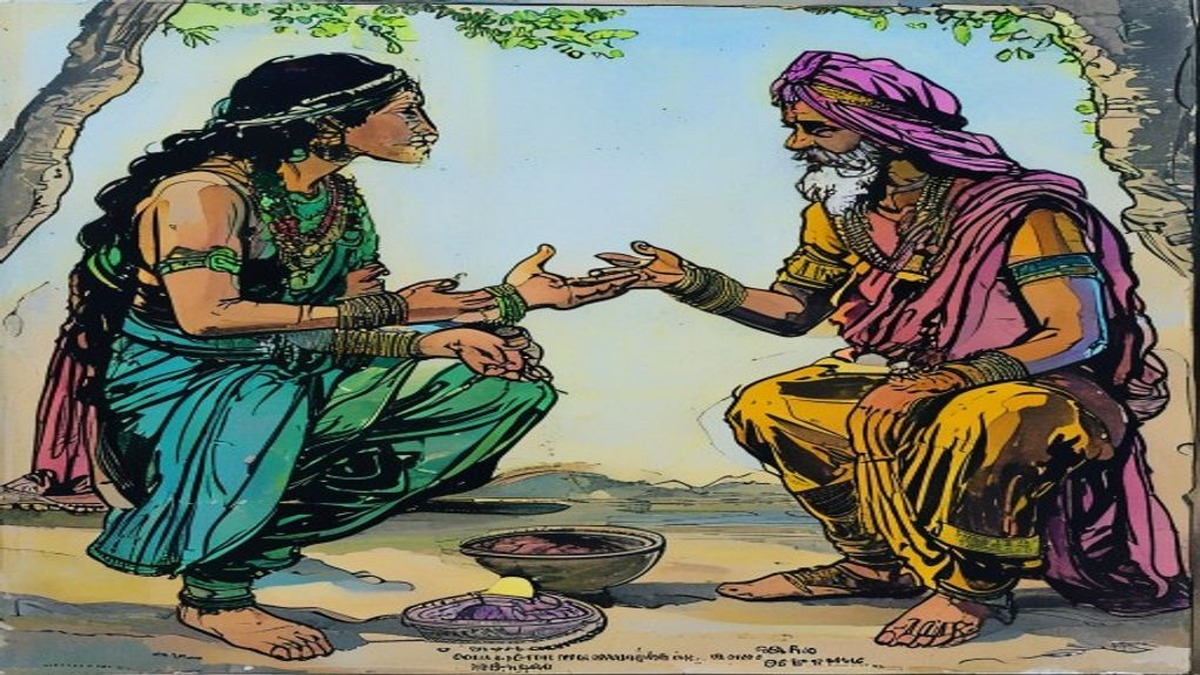
A merchant’s son named Dhanadatta lived in a prosperous town and had inherited, among other assets, a very large iron balance of exceptional quality — heavy, well-calibrated, and worth more than many men earned in a year. When business required him to travel to distant provinces for an extended period, he could not carry the balance with him and dared not leave it unattended in his house. He brought it to his friend Lakshman, explained his journey, and asked him to store it safely until his return. Lakshman agreed, the balance was carried into Lakshman’s godown, and Dhanadatta departed.
The journey lasted longer than anticipated. When Dhanadatta returned, months later, he was leaner and road-worn but successful in his trading. He called on Lakshman, offered the customary greetings, and asked for the return of his balance. Lakshman spread his hands with an expression of elaborate grief. “Brother, I am devastated to tell you this. I stored it exactly as you left it, but rats — unusually large, unusually bold rats — gnawed through the wood of the storage chest and ate every last bit of iron. There is nothing left to return.”
Dhanadatta looked at his friend for a long moment. He knew what rats could and could not eat. He also knew that the balance was worth enough to tempt a dishonest man considerably. He said nothing inflammatory, simply thanked Lakshman for his hospitality and took his leave, already forming a plan.
The Merchant’s Counter-Stratagem
The following day Dhanadatta encountered Lakshman’s young son playing alone near the river. He spoke kindly to the boy, gave him sweets, and suggested they walk together to a pleasant grove outside the town. The child, delighted, accompanied him. Dhanadatta hid the boy safely in a trusted relative’s house and then went about his business as normal.
When evening came and the boy had not returned, Lakshman’s household searched with growing alarm. By the next morning, frantic, Lakshman confronted Dhanadatta in the street. “You were the last person seen with my son. What have you done with him?” Dhanadatta replied with the same theatrical sorrow that Lakshman had deployed the day before: “I am heartbroken to tell you this. A large hawk swooped down from the sky right before my eyes and carried your son away. I was helpless to intervene. There was nothing left.”
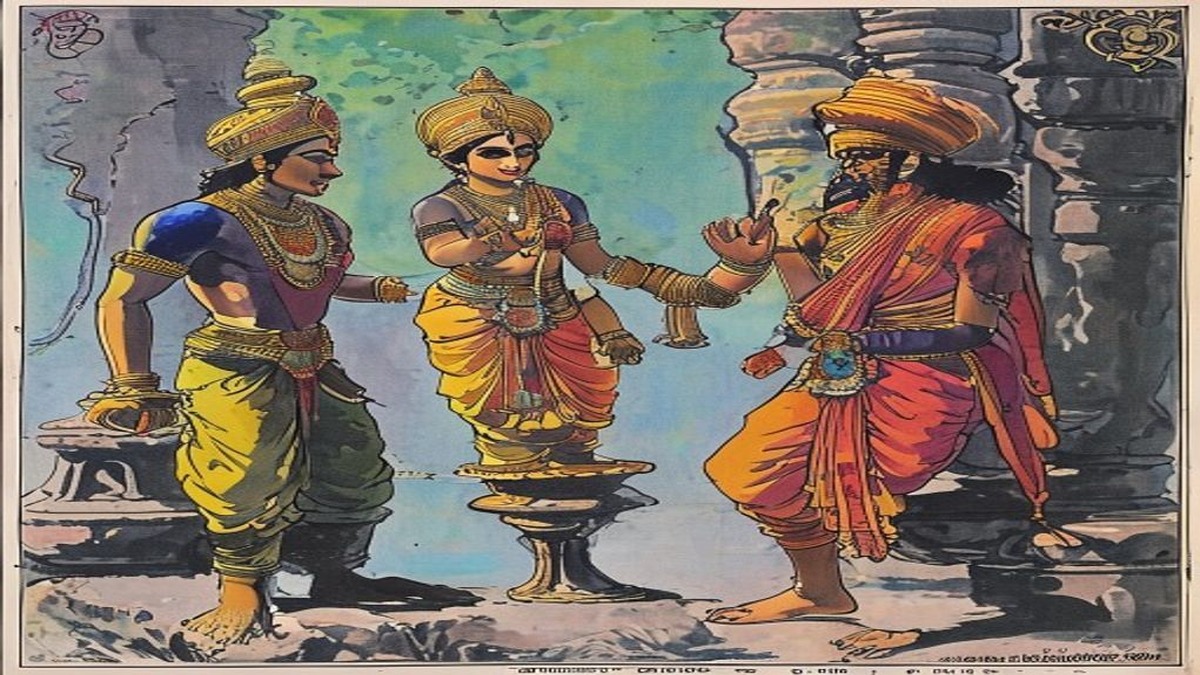
Lakshman, trembling with fury, dragged Dhanadatta before the town magistrate. “This man has kidnapped my son!” The magistrate asked Dhanadatta to explain himself. Dhanadatta repeated his hawk story with a straight face. The magistrate frowned. “A hawk carries off a child? That is impossible. Hawks do not carry human children.” Dhanadatta nodded respectfully and said: “Your Honour, I agree entirely. And rats, as Your Honour will know, cannot eat iron. Yet my friend Lakshman claims that rats devoured my iron balance. If large hawks can carry boys, surely large rats can eat iron. But if iron cannot be eaten by rats, then boys cannot be taken by hawks. I leave the judgment to your wisdom.”
The Judgment and Its Lesson
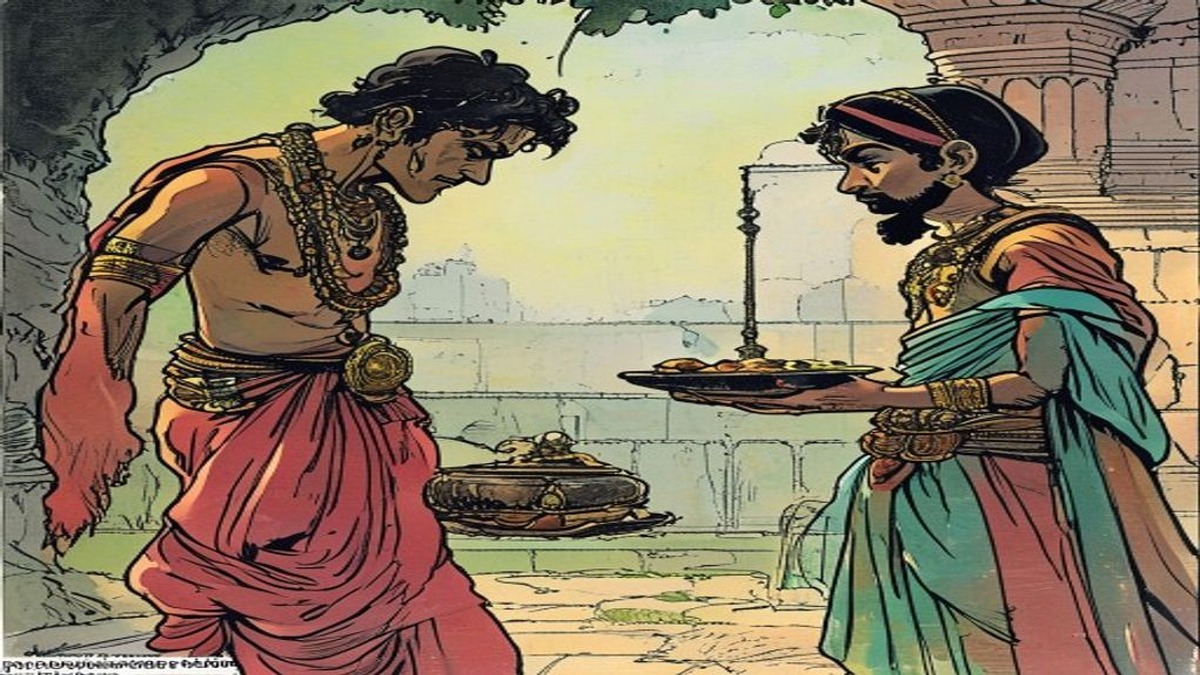
The magistrate sat back and considered the two claims side by side. One man said rats had eaten an iron balance weighing several hundred pounds. Another man said a hawk had carried off a child. Both claims were physically impossible. But one claim had been made first and the second had been constructed specifically to match it in absurdity. The symmetry was the argument.
The magistrate ordered that Dhanadatta return the boy unharmed immediately, and that Lakshman return the iron balance or its full market value in silver by the following day. Both men complied. The boy emerged from his hiding place healthy and well-fed. Lakshman produced the balance, which had been sitting undisturbed in the corner of his godown precisely as left. No accounting was taken of the anxiety Lakshman had caused, but no accounting was needed: the law had been satisfied and the fraud exposed without litigation, prison, or enmity.
Dhanadatta collected his balance, carried it home on the shoulders of two hired men, and spent the evening polishing the iron to a deep grey lustre. He had paid for his lesson in trust with anxiety and a day’s effort, and had recovered from it with arithmetic and patience. Lakshman, for his part, lived with the knowledge that his neighbour had proved him a liar in open court using only the logic of his own lie.
Moral and Sanskrit Wisdom
यादृशं भजते तादृशं लभते
Yadrisham bhajate tadrisham labhate — “As one deals, so one receives.”
— Sanskrit proverbial tradition, Panchatantra I
This tale is unusual in the Panchatantra for having no animal characters and no supernatural elements; it is pure social comedy executed with legal precision. Vishnu Sharma uses it to demonstrate that justice does not always require a higher authority: sometimes the structure of a lie contains, when mirrored back exactly, its own refutation. The clever person does not rail against injustice or appeal to emotion; he constructs a counter-example of identical logical form and presents both to the court simultaneously.
Why This Story Has Lasted 2,300 Years
The Iron Balance fable endures because it is a masterclass in what rhetoricians call reductio ad absurdum deployed as practical self-help rather than philosophical argument. Dhanadatta does not say “Lakshman is a liar.” He says, in effect: “If Lakshman’s statement is true, then mine must also be true. If mine is obviously false, Lakshman’s must be false. Judge accordingly.” The beauty is that this argument requires no witnesses, no documents, and no access to the private godown where the balance sits. It requires only the ability to construct a parallel absurdity and present it with a straight face.
The story also encodes a practical principle of negotiation that remains valid in commercial and diplomatic contexts: when direct confrontation is unavailable or ineffective, symmetrical leverage often succeeds. Dhanadatta does not have the power to compel Lakshman’s honesty directly. But he does have access to Lakshman’s most valued asset — his son — which creates exactly the motivated reasoning he needs to bring the dispute to a court that will resolve it favourably.
Lawyers and legal scholars in the Indian tradition have cited this story for centuries as an illustration of the principle that a fraudulent claim is most efficiently destroyed by accepting it as a premise and following it to an unacceptable conclusion. This is not merely a literary technique; it is a structural insight about the nature of deception. A lie, to be maintained, must be consistent with all other observable facts. When an honest counter-party introduces a new observable fact of identical absurdity, the liar is trapped: to deny the counter-claim, he must also deny his own original claim.
Frequently Asked Questions
What is the moral of the Iron Balance story?
A fraudulent claim can be refuted most effectively by accepting it as a premise and constructing an equally absurd counter-claim of identical logical structure. Justice sometimes emerges from symmetrical absurdity rather than direct accusation.
Is this story unique among Panchatantra tales?
Yes, it is notable for having no animal characters and no supernatural elements. It is a pure exercise in social logic and legal reasoning, illustrating that Vishnu Sharma could teach statecraft through human comedy as effectively as through animal fable.
What does the iron balance symbolise?
The iron balance is a weighing instrument and a symbol of commerce and trust. Its theft by a custodian represents the betrayal of mercantile good faith, which in ancient India was one of the most serious violations of dharma for the trading class.
Is this story related to Western legal or rhetorical tradition?
The technique Dhanadatta uses is what Western rhetoric calls reductio ad absurdum — accepting a premise and following it to an unacceptable conclusion to expose its falsity. The Panchatantra reached Europe through Arabic and Persian transmission and likely influenced later European jurisprudence indirectly.
Was kidnapping Lakshman's son ethical in this story?
Vishnu Sharma presents it as justified self-help within a context where direct legal remedy was unavailable. The boy was kept safe and well, no harm was done, and the action was calibrated precisely to compel restitution rather than cause injury. Ancient Indian thought distinguished between proportionate self-help and genuine wrongdoing.
You May Also Like
 Panchatantra Stories
Ages 3-5
Panchatantra Stories
Ages 3-5
The King and The Foolish Monkey
The King and The Foolish Monkey: In a magnificent kingdom surrounded by lush gardens and sparkling fountains, there once lived a powerful king who was very
 Panchatantra Stories
Ages 3-5
Panchatantra Stories
Ages 3-5
The Story of the Thief and the Brahmins
The Story of the Thief and the Brahmins: In a certain town, there lived a very learned Brahminwho, as a result of his actions i, n his previous life, had. The
 Panchatantra Stories
Ages 6-8
Panchatantra Stories
Ages 6-8
The Musical Donkey
Read 'The Musical Donkey' — a classic Panchatantra story about nature and animals. The Musical Donkey is a beloved Panchatantra tale featuring a donkey ...