The Story of the Blue Jackal
The Panchatantra's brilliant tale of Caṇḍarava — the "Fierce Howler" jackal — who tumbles into a vat of indigo dye and walks out a king of the jungle. The story is found in Book I of the Panchatantra (Mitrabheda, "The Separation of Friends"), and it is one of Vishnu Sharma's most quietly devastating lessons: disguise is not transformation, and the test of who you are is not how you look on a calm day, but what comes out of you on the night when you forget you are pretending.
“One who scorns his own kind shall surely come to a bitter end.”
This is the verse that Indian grandmothers have spoken at the end of one of the Panchatantra’s most famous stories — the tale of a starving jackal who, by accident, turned blue. It is a story about disguise, and about the limits of disguise. It is a story about a creature who became, for a brief and dazzling time, what he had always wanted to be — and was destroyed by the one thing inside him that he could not change. And it is a story about a small grey jackal whose name, in the original Sanskrit, was Caṇḍarava — “Fierce Howler” — a name that, in the end, foretold his own ending.
The Hungry Jackal
In a great forest at the edge of an ancient kingdom, there once lived a thin, anxious, hungry jackal. His ribs showed under his patchy grey-brown coat. His eyes were bright with the constant alertness of an animal who is never quite full. His name was Caṇḍarava, and the storytellers gave him this name for a reason — caṇḍa meant fierce, and rava meant cry or howl. He was the Loud-Howling Jackal. It was a name suited to his lungs. It was also, though he did not know it, the name of his future.
For many days the hunting had been bad. The smaller game had grown wary. The leftovers near the village edges had been picked clean by other scavengers. Caṇḍarava had eaten almost nothing in a week. His belly burned. His mouth was dry. And so, on a grey monsoon-edge evening, he did what hungry jackals sometimes do when the forest gives them nothing — he crept out of the trees, slipped down the rough cart-track, and made his way toward the lights of the human village.
The Dogs
The village was a small one — a dozen low houses, a stone well, a banyan tree, a few buffalo tethered for the night. Caṇḍarava moved low along the back walls, sniffing for scraps. He found a chicken bone. He found a rind of something that had once been a cucumber. And then he found something else — the village dogs.
They were big, leg-thick farm dogs, four of them, and they had spotted him in an instant. They came at him in a hot dark rush, baring teeth, throats opening with the deep low warning of dogs who know exactly what a jackal is. Caṇḍarava did not stop to think. He turned and ran.
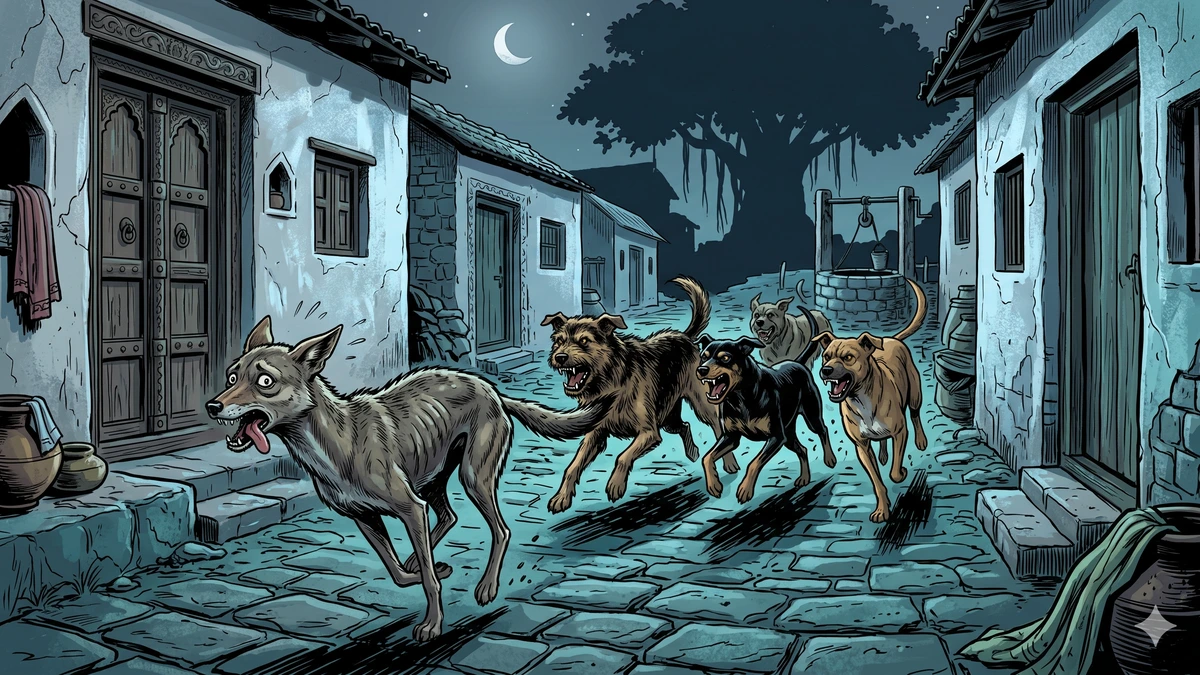
He ran through the narrow lanes between the houses. He ran past the well, past the buffalo, past the silent tethered goats. The dogs ran behind him with the easy speed of animals who eat well every day. He could hear their breath. He could feel them gaining. His own breath was a tearing thing in his lungs. And then, in front of him, a doorway opened — a low wooden door at the back of a house — and Caṇḍarava, half-blind with terror, dove through it without looking at what was on the other side.
The Vat of Indigo
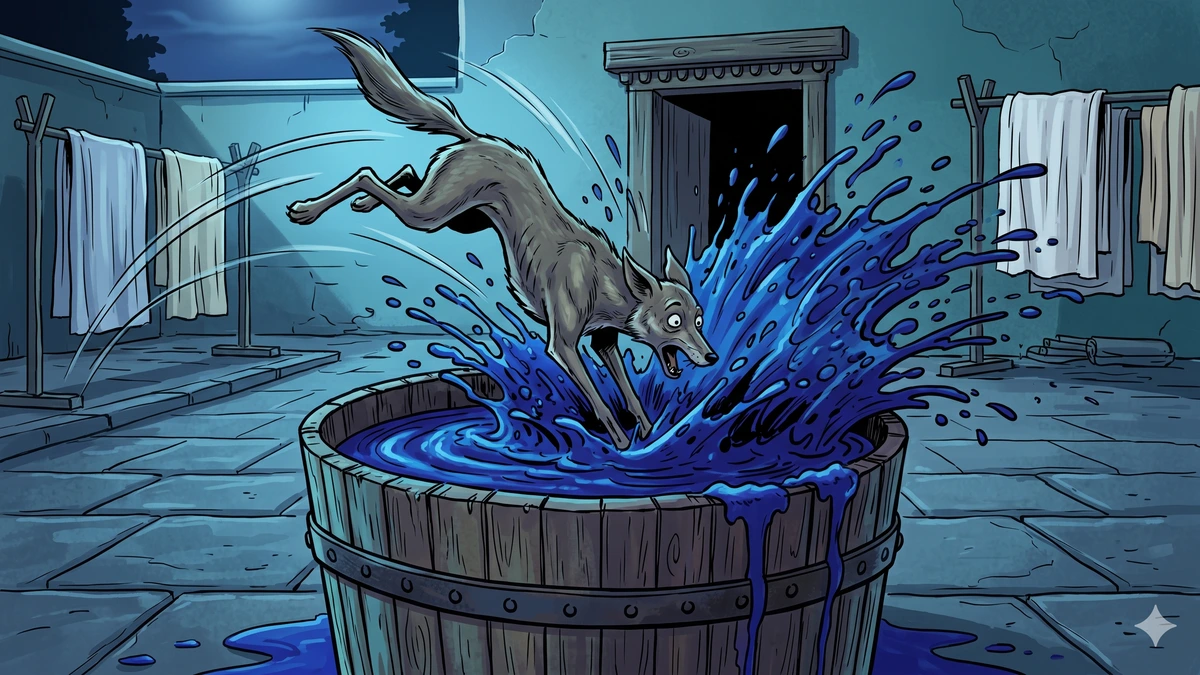
The other side, as it happened, was the back courtyard of a washerman — a man who dyed cloth for the village and the surrounding country. The courtyard was full of wooden vats. The vats were full of liquid. The liquid in the largest vat — the one Caṇḍarava had landed in — was the deep, slow, blue-black indigo dye for which the village washermen had been famous for many generations.
He went under. The world turned dark and blue and cold. He kicked. He surfaced. He scrambled up the side of the vat, shaking off thick blue droplets, his eyes stinging, his mouth full of bitter blue. He hauled himself out, panting, and stood on the courtyard stones — and looked down at himself.
He was no longer a jackal. He was something else. From the tip of his nose to the tip of his tail, he was a brilliant, unbroken, otherworldly indigo blue.
Outside the courtyard, the dogs had come around the wall and were waiting for him. He had nowhere else to run. He stepped out into their lane.
The dogs took one look at this strange, blue, glowing creature — and stopped. Their growls died in their throats. They had never seen a thing like this in their lives. It did not smell like a jackal. It did not look like a jackal. It looked like a fragment of the night sky come down to walk on the earth. With one small whimper they broke and ran in four directions, tails flat between their legs.
Caṇḍarava blinked. Then he straightened. He looked at the empty lane. And in his small, hungry, suddenly-clever heart, an idea began to grow.
The King of the Three Worlds
He returned to the forest. The dye would not wash out — he tried, in a small puddle, and only made the puddle indigo. So he was blue, and he would remain blue, and the jungle would have to take him as he came.
The jungle, when it saw him, reacted exactly as the dogs had. A herd of deer wheeled and bolted at the sight of him. A peacock screamed and flew up. A wild boar took one look and crashed away through the undergrowth. Even the older, wiser animals — a tiger watching from a rock, an elephant raising her trunk in alarm — did not know what to do with this glowing blue creature padding calmly down the forest path.
“Friends!” called Caṇḍarava brightly, in his most royal voice. “Animals of the jungle! Why do you flee from me? Come back. There is no need to be afraid. I have come to do you good.”
One by one, cautiously, the animals crept closer. The lion approached at the head of them, tail twitching, eyes narrow with confusion.
“Who are you, blue one?” the lion asked.
Caṇḍarava drew himself up. He had been thinking, on the long walk back from the village, about exactly what he was going to say at this moment.
“I have been sent to you,” he said gravely, “by Brahma the Creator himself. With his own four hands he formed me, blue as the night sky, and he set me down in this forest. He said to me: The animals of the jungle have no proper king. Go to them. Rule them. Protect them. You shall be lord of all three worlds — the Heaven above, the Earth below, and the Underworld beneath that. That is who I am. That is why I am here.”
The animals looked at one another. Then they looked at the impossible blue creature standing calmly before them. Then they looked at one another again. And one by one, beginning with the lion himself, they bowed their great heads to the ground.
The Court of the Blue King
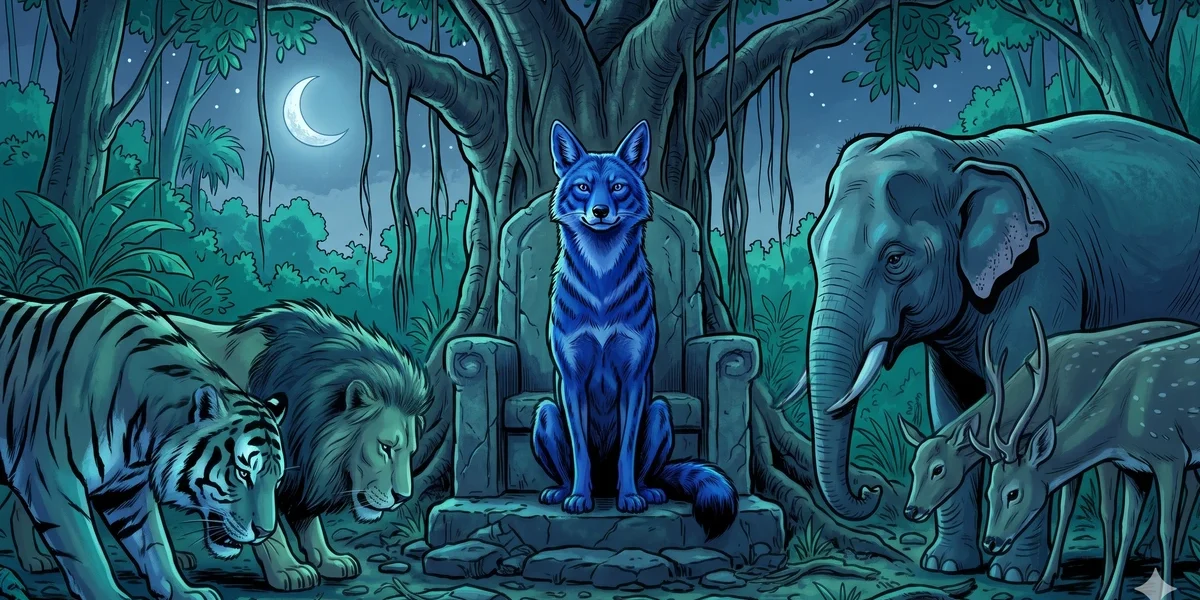
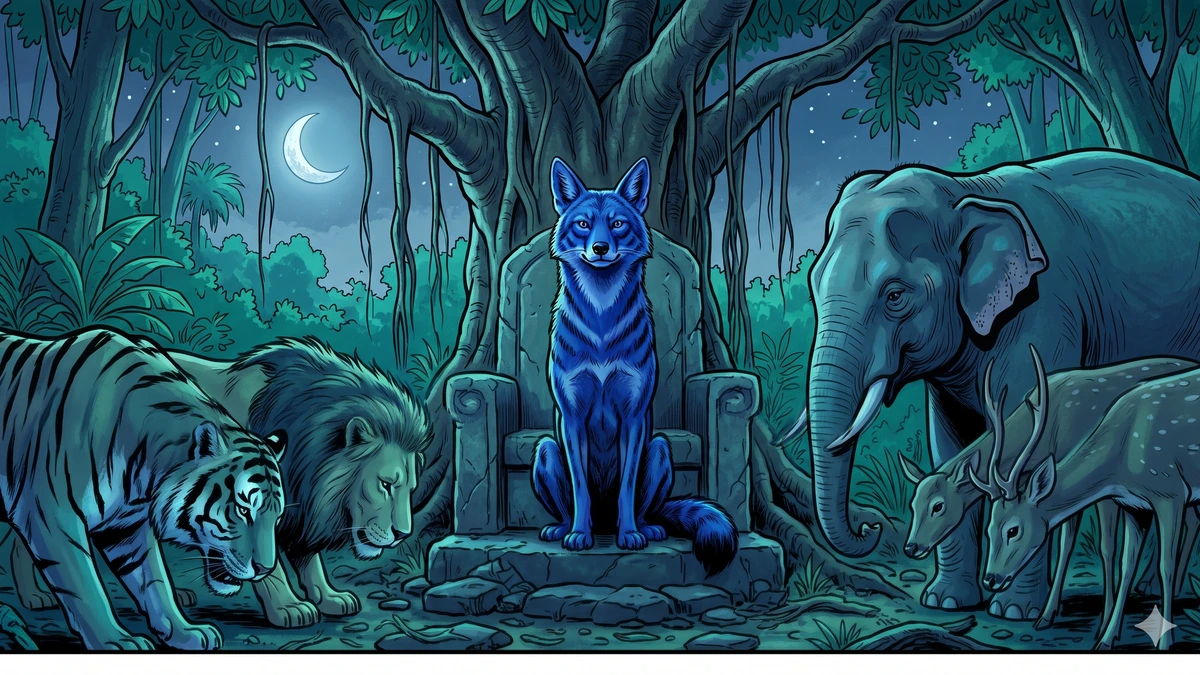
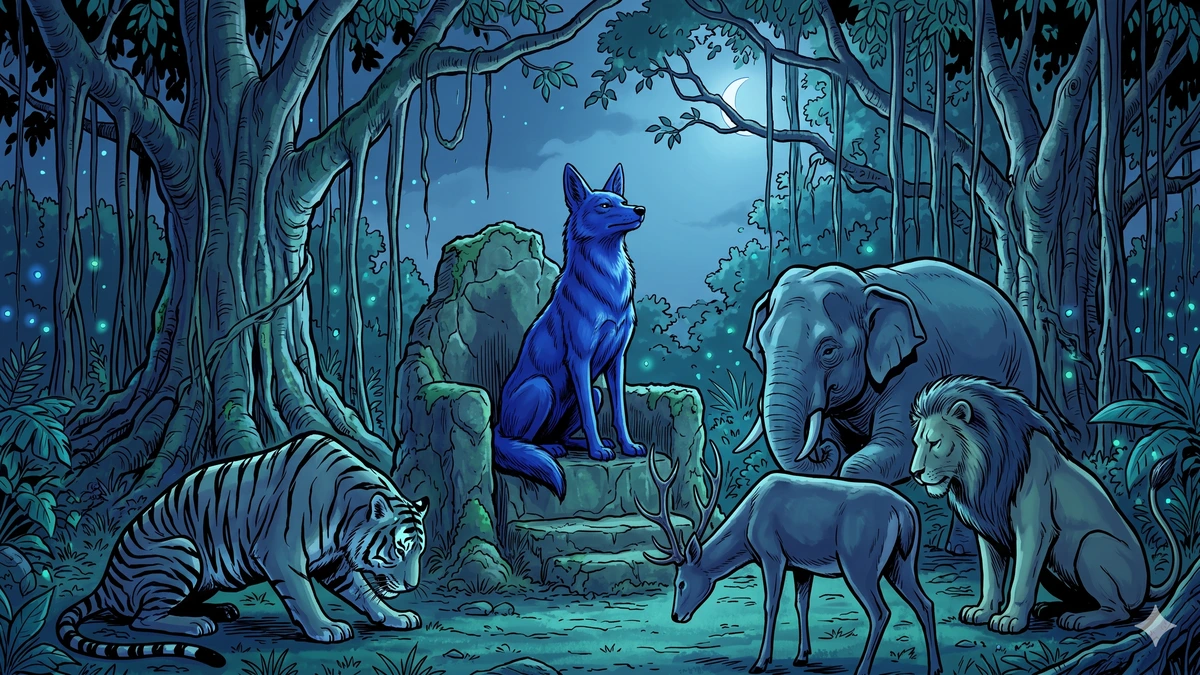
For many weeks, Caṇḍarava reigned. The animals built him a stone seat under a great spreading banyan tree, and there he sat each day, holding court. He was a careful king. He had thought it through. The lions and the tigers, who were the strongest, he sent out daily to hunt — they brought him deer and wild pig and small antelope and laid them at his blue feet. The elephants kept order. The monkeys ran messages. The smaller animals fetched water and brought leaves for his bed. And the blue king, sitting on his stone seat, distributed the food among his subjects with great fairness, keeping the choicest portions for himself, of course, but always leaving enough for the others. He was, by the standards of jungle kings, an excellent ruler.
There was only one thing he would not allow.
The other jackals — his own brothers and sisters and cousins, the small grey jackal-pack with whom he had been born — he banished from the court. He could not bear to have them near him. He was terrified that someone, looking at the small grey jackal at the foot of his throne and then up at the blue king on it, would notice the resemblance. So the jackals were chased out of the king’s territory. They were forbidden to come within sight of the banyan throne. Whenever they were spotted, the lions and tigers ran them off with growls and bared teeth. Caṇḍarava had no idea, of course, that the very animals he was driving away were the only ones in the world who shared the secret of what he really was. He only knew they were dangerous to him, and so he sent them into exile.
The other jackals, gathering in the deep night-forest at the edge of the kingdom, watched the strange blue king in their midst with a quiet, patient sorrow. They knew exactly who he was. But they were jackals, and a jackal does not betray the pack. They said nothing.
The Howl
One evening, perhaps three months into his reign, Caṇḍarava was sitting on his stone throne in the soft cool blue dusk. The forest was settling down for the night. The deer were folding their legs. The peacocks were settling into the tall trees. The lions were dozing at the foot of the throne. The blue king himself was full and content. The day had been long. The hunt had been good. He was beginning, at last, to relax.
And then, from somewhere far off in the dark forest — perhaps a mile away, perhaps more — there came a sound he had not heard in a very long time. It was a long, high, rising, falling sound. It was the song his mother had taught him as a small grey pup. It was the way his pack-brothers called to one another across the open scrub on a hunting night. It was the howl of a pack of jackals.
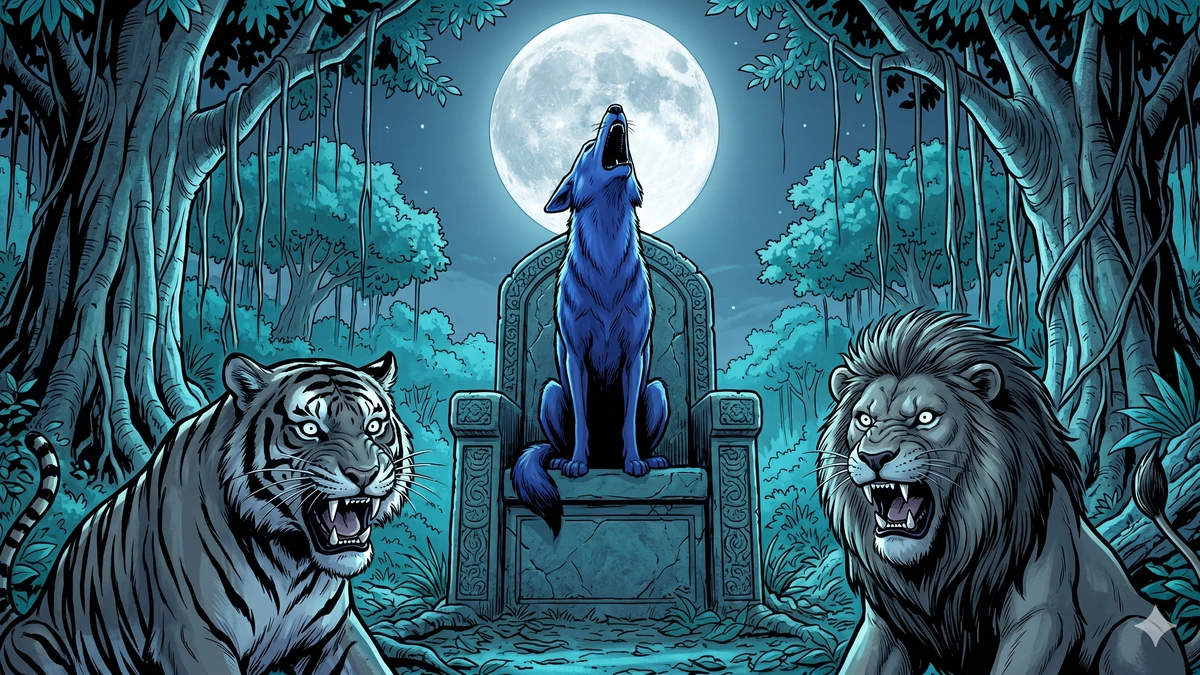
And Caṇḍarava, sitting blue and crowned on his stone throne, with the lion king dozing at his feet and the great elephant standing guard at his side, opened his blue mouth.
And he howled back.
The sound that came out of him was not the sound of a king. It was the high, yipping, unmistakable cry of a jackal answering its own pack. It went up over the banyan tree and out across the moonlit forest. The jackals in the distance heard it, and they answered. Caṇḍarava, eyes closed, throat lifted, lost in the deep ancient pleasure of his own kind, did not even realize what he was doing.
Below the throne, the lion’s eyes opened. Beside it, the elephant’s trunk rose. The tigers behind him froze. Every animal in the court, in that single instant, understood. The blue king was a jackal.
The End
For one long heartbeat, no one moved. The lion looked at the tiger. The tiger looked at the elephant. They were ashamed — deeply, hotly ashamed. They had bowed to a jackal. They had hunted for a jackal. They had carried this small grey creature on their shoulders, in their pride, in their loyalty, for three months. And he had been laughing at them the whole time.
Shame in animals, as in people, does not stay shame for long. It turns very quickly into rage. The lion’s lip curled back over his teeth. The tigers rose. The elephant trumpeted.
Caṇḍarava opened his eyes.
He saw what was around him, and he understood, in one cold instant, exactly what had happened. He leapt from the throne and ran. But there was nowhere to run. The court he had built was the trap that closed around him. The lions caught him before he had gone twenty paces. And the storytellers, who are gentler than the animals in their stories, simply say this: the blue jackal was killed by his own court. They do not describe the rest.
The Old Verse
The verse the Panchatantra storytellers attached to this tale, and that has been spoken by Indian grandmothers for more than two thousand years, is this:
“One who scorns his own kind,
Who turns away from the pack he was born to,
Shall surely come, in the end, to a bitter end.”
It is the moral on the surface of the story. The jackal who banished his fellow jackals was, of course, the jackal whose own howl finally undid him. The pack he turned his back on was the pack whose voice still lived inside his throat. He could not have stopped that voice from coming out, no matter how many years he had reigned. The body remembers what the mind tries to hide.
What the Story Quietly Teaches
This is one of those Panchatantra tales whose meaning shifts as the listener grows. A small child hears the surface plot — a funny blue jackal, a great pretense, a sudden discovery — and laughs at the foolishness. A teenager begins to recognize the pattern. We have all known, perhaps, a moment of small pretense — the new accent we tried at a different school, the version of ourselves we put on for a job we did not quite belong in, the way we hid the small embarrassing fact about our family from a new set of friends. And we have all felt, at some point, the tiny terror of being found out.
An adult sees something deeper. The Blue Jackal is not, finally, a story about a jackal who lied. It is a story about the impossibility of permanent disguise — and about the rage of those who have been deceived. The lions and tigers did not kill Caṇḍarava because he was a jackal. Being a jackal is not a crime. They killed him because they could not forgive themselves for having bowed to him. He had not just deceived them; he had made them feel like fools. And the fool, the Panchatantra knows, is never angrier than at the person who showed him his foolishness.
There is a quieter, sadder reading still. Caṇḍarava could have been a fine king of his own kind — a respected leader of jackals, hunting in a clever pack, raising pups, growing old in his own patch of scrub. Instead, dazzled by an accident of indigo, he reached for a kingdom that was never his. The sorrow of the story is that he could not bear to be what he was. The lesson — gentle, uncomfortable — is that there is dignity in being a jackal among jackals, and there is danger in trying to be a god among lions.
Where This Story Lives in the Panchatantra
The Blue Jackal — Caṇḍarava-jambuka in Sanskrit — appears in Book I of the Panchatantra, called Mitrabheda, “On the Separation of Friends.” In Pūrṇabhadra’s classical recension and in the older Tantrākhyāyikā, it appears as one of the embedded inner tales, traditionally numbered Story 10 within the book. Book I is the longest of the Panchatantra’s five books and the one most concerned with court politics, betrayal, and the management of trust between unequal partners. The Blue Jackal sits in this book exactly where it belongs — as a story about a courtier whose disguise outruns him, told by one jackal-courtier to another within the larger frame of the lion-king Piṅgalaka and his two scheming jackal advisors, Karaṭaka and Damanaka.
The tale was so popular that it traveled almost immediately. It appears in the 8th-century Arabic Kalīla wa Dimna of Ibn al-Muqaffaʿ, in the Persian Anvār-i Suhaylī, in the medieval Hebrew Mishlei Sendebar, and in countless Indian retellings — including the much-loved Amar Chitra Katha comic and the NCERT primary-school readers that have introduced the tale to generations of Indian children. It is one of the most-translated Indian stories in world literature.
The Panchatantra was composed in Sanskrit by the scholar Vishnu Sharma (Viṣṇu Śarmā) around 200 BCE, written for the education of three young princes who had not, until then, shown the slightest interest in books. Vishnu Sharma’s idea was simple and revolutionary: do not lecture princes — tell them stories. Give them animals and trickery and sharp little reversals, and the princes will pick up the wisdom on their own. It worked then, and — as anyone who has ever told this story to a wide-eyed child can tell you — it still works now.
Moral
स्वजातिं यः परित्यज्य परजातिं निषेवते। स्वयमेव लयं याति यथा राजा ह्यजातिशत्रुः॥ — sva-jātiṃ yaḥ parityajya para-jātiṃ niṣevate, svayam eva layaṃ yāti — “One who abandons his own kind and takes up with another’s kind comes himself to ruin.” This is the closing verse of the fable in Pūrṇabhadra. But the Panchatantra’s deeper observation is gentler than its surface phrasing. Caṇḍarava is not destroyed for being a jackal. He is destroyed because he tried to keep his howl — the most jackal-thing about him — hidden inside a king. The body remembers what the mind tries to hide. The howl is in the throat, and the throat is in the jackal, and the jackal — blue or grey, kingly or hungry — is in the end always a jackal. To be at peace with one’s own howl is to be unmasked safely.
A Final Word
If you take only one thing from “The Story of the Blue Jackal,” let it be this: the body remembers what the mind tries to hide. Whatever you really are will rise up in you, sooner or later, on a quiet evening when you have forgotten to keep watch. This is not a frightening thing. It is, in fact, one of the most reassuring things the Panchatantra ever said: you cannot, in the end, be made into something you are not. The howl is in the throat, and the throat is in the jackal, and the jackal — blue or grey, kingly or hungry — is in the end always a jackal.
And the next time you hear, far off in the night, a small wild creature singing its own ancient song, remember Caṇḍarava the Fierce Howler — and let your own true voice, whatever it is, come out without shame.
Frequently Asked Questions
What is the moral of The Blue Jackal story?
Which Panchatantra book contains The Blue Jackal?
How did the jackal turn blue in the story?
Why was the Blue Jackal finally exposed?
What age group is The Blue Jackal good for?
You May Also Like
 Panchatantra Stories
Ages 3-5
Panchatantra Stories
Ages 3-5
The Monkey and The Wedge – For Children
The Monkey and The Wedge – For Children: Once upon a time in a town, a rich merchant decided to build a temple in his courtyard. He assembled many skilled
 Panchatantra Stories
Ages 3-5
Panchatantra Stories
Ages 3-5
Prince Lionheart And His Three Friends
Prince Lionheart And His Three Friends: Once upon a time there lived a King and Queen who would have been as happy as the day was long had it not been for this
 Panchatantra Stories
Ages 6-8
Panchatantra Stories
Ages 6-8
The Story of the Brahmins Who Put Life Into the Lion
The Story of the Brahmins Who Put Life Into the Lion: In a certain town, there lived f3our sons of Brahrn ins. They were great friends. Three of them werevery