The Bird with Two Heads
The Bird with Two Heads: Unity demands sacrifice. A two-headed bird's selfish conflict destroys them both A classic Indian folk tale retold for young readers.

In the ancient forests along the banks of a jade-green lake, where lotus blossoms opened at dawn and herons stood motionless as carved ivory, there lived a creature unlike any other in the three worlds. The Bharunda — the great double-headed bird — soared above the canopy on wings as wide as a festival tent, its twin necks curving with regal grace, its twin heads crowned with iridescent feathers of emerald and sapphire.
Yet for all its splendour, the Bharunda was, at its core, a single creature. One body. One heartbeat. One fate. And it was this unity of body — paired with a fatal disunity of spirit — that would determine everything.

The Sweet Fruit and the Bitter Refusal
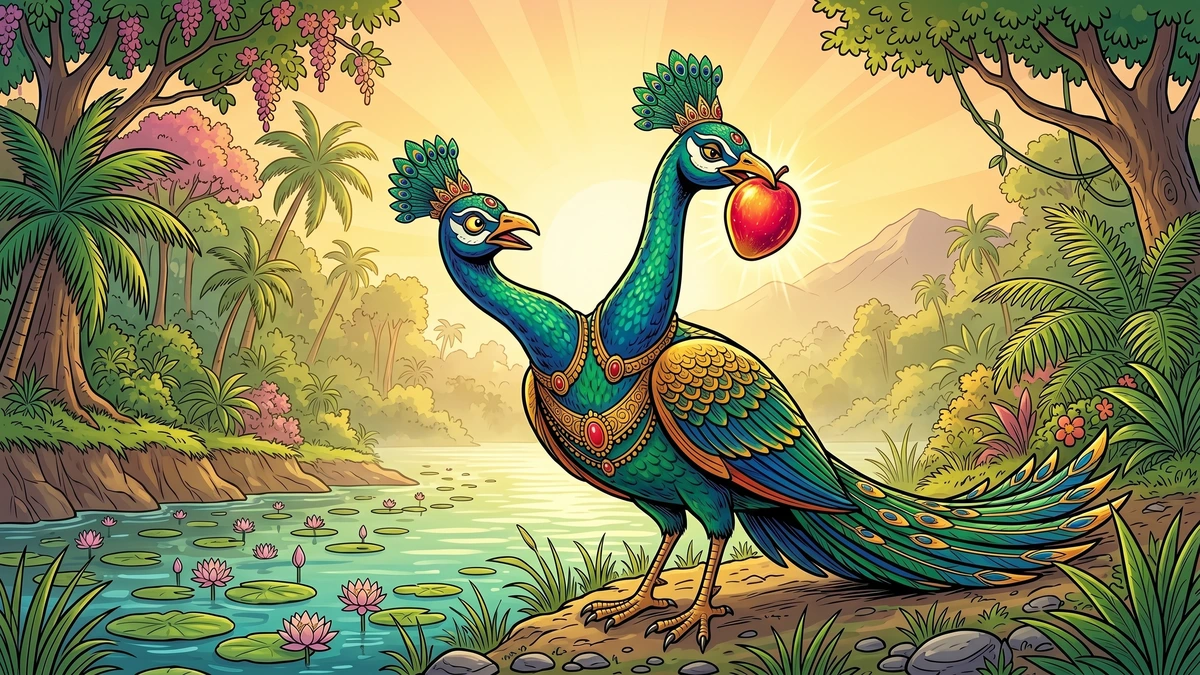
One golden morning, as the Bharunda glided low over the water’s edge, the first head — let us call it the Right Head, for it was by temperament the more temperate of the two — spotted something extraordinary half-buried in the soft earth of the bank. It was a fruit unlike any the bird had encountered: glowing red-gold as a setting sun, its skin translucent, its fragrance so intoxicating that bees had begun to circle from a distance.
The Right Head dipped swiftly, seized the fruit in its beak, and bit. The flesh dissolved on the tongue like nectar. Every nerve sang. It was, the Right Head decided in that instant, the most perfect fruit in all creation.
The Left Head watched this transaction with enormous interest. “Brother,” it said — for both heads were equally entitled to address the other thus — “share with me. Let me taste this wonder.”
The Right Head paused. It considered. And then, with a reasoning that was logical yet catastrophic, it said: “We share one stomach. The fruit has already descended into our common body and nourishes us both equally. You have already received your half of its goodness. Why should I give you the last bite of pleasure that remains in my beak?”
The Left Head said nothing. But behind its eyes, something shifted — a small, cold flame of humiliation that, once lit, would not be easily extinguished.
The Poison Chosen
Days passed. The Bharunda hunted fish and bathed in the lake and slept with both heads tucked beneath their respective wings. But the Left Head did not forget.
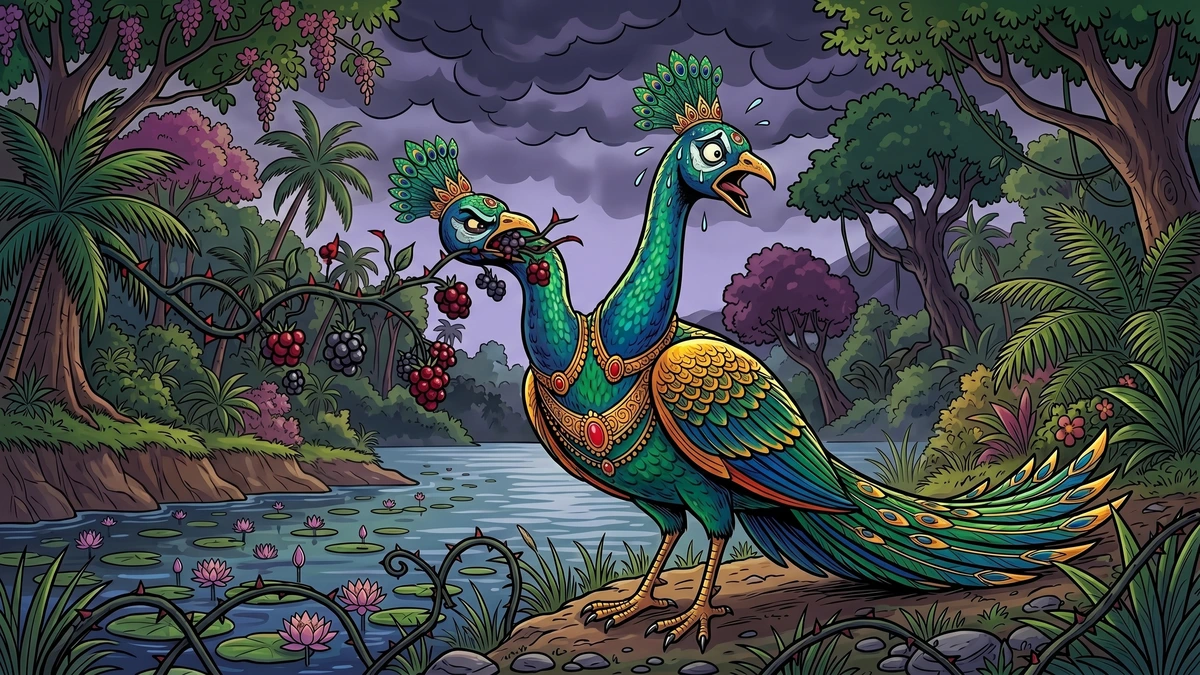
On the fifth day after the incident of the golden fruit, the Left Head spotted a cluster of berries clinging to a thorny vine near the water’s edge. The berries were dark — so dark they were almost black — with a faint iridescent sheen that should have warned any wise creature away. These were visha-phala, the poison fruits, known to every forest dweller as fatal to bird and beast alike.
The Left Head stretched its neck toward the berries.
“Stop!” cried the Right Head in immediate alarm. “Those are poison! We will both die — we share one body!”
“Precisely,” said the Left Head, with a calmness more terrible than rage. “You refused to share pleasure with me. Now let us share this equally.”
And it ate the berries.
The Ruin of the Bharunda
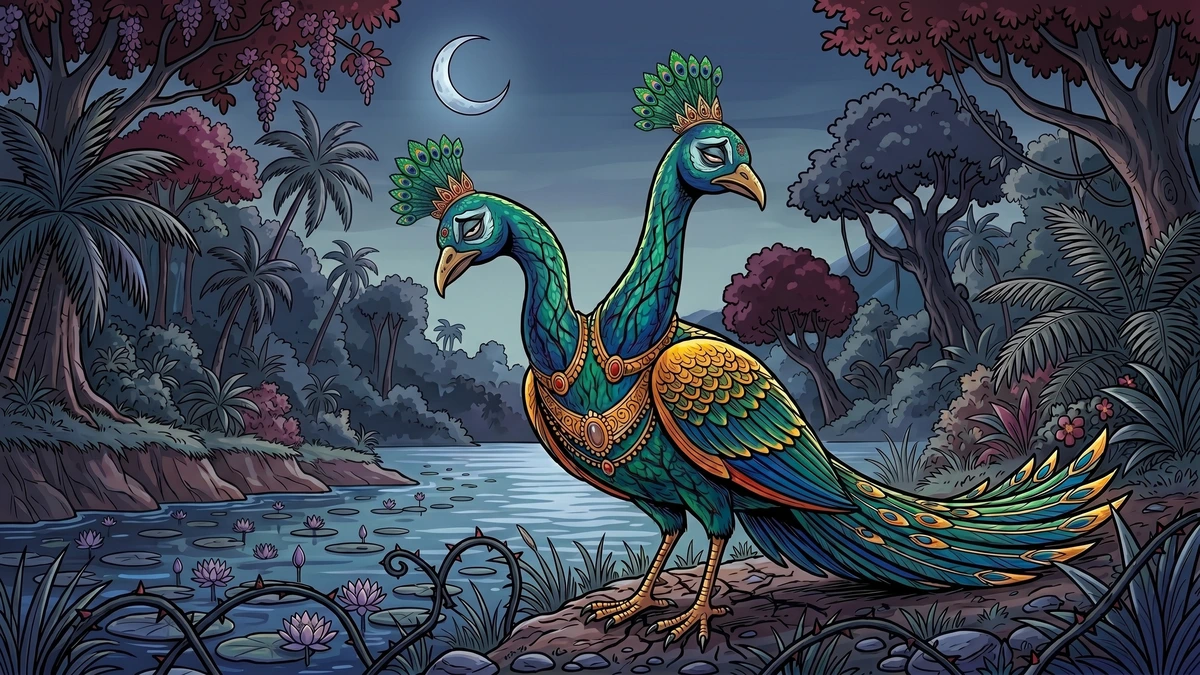
The poison moved swiftly through their shared blood. The Bharunda staggered at the water’s edge, both heads crying out together — one in grief, one in an agony it had invited upon itself. The great wings beat once, twice, and then went still. The twin necks drooped. The magnificent creature that had soared over the jade-green lake since before the oldest tree on its banks had been a sapling crumpled into the mud at the water’s edge.
The fish continued to leap. The herons continued to stand. The lotus continued to open at dawn.
But the Bharunda — the double-headed wonder of the forest — was gone.
Scholarly Context: The Bharunda in Classical Indian Literature
The tale of the Bharunda bird occupies a precise location within the vast taxonomy of Sanskrit didactic literature. Its earliest traceable home is the Hitopadesha (Book IV: Vigraha — “Discord”), attributed to Nārāyaṇa Paṇḍita (c. 12th century CE, Bengal), though the motif clearly draws on the older Panchatantra tradition (attributed to Viṣṇuśarman, estimated 3rd century BCE–3rd century CE) and its cognate text the Tantrākhyāyika. The tale functions as a nīti-kathā — a didactic narrative designed to transmit political and ethical wisdom through animal allegory, a form perfected in Indian literature centuries before Aesop recorded analogous stories in the Greek world.
The Bharunda itself appears to be an invention unique to the Sanskrit narrative tradition — a mythological creature whose fantastical nature (two heads, one body) makes explicit what the tale treats implicitly: that a community, a kingdom, or even a self divided against itself cannot survive. The Sanskrit root bhārunda possibly derives from bhāra (burden/weight), suggesting a creature burdened by its own internal contradiction.
Comparative folklorists have aligned the tale with ATU motif W195 (envy/spite as self-destruction) and the broader cluster of ATU 285B-type narratives involving fatal retaliation that harms the retaliator equally. The closest structural parallel in Western tradition is Aesop’s fable of “The Belly and the Members” (Corpus Aesopicum 130), where the body’s organs rebel against the belly and starve themselves in the process — again demonstrating that shared fate cannot be escaped through internal conflict.
In the Buddhist literary tradition, the concept of destructive internal duality resonates with the Dvemukha Jātaka motifs, wherein divided consciousness or divided loyalty leads to the Bodhisatta’s downfall in a particular life — a fall that nonetheless advances the cumulative accumulation of wisdom across rebirths. Kautilya’s Arthashastra (c. 3rd century BCE) addresses the same political reality directly and without allegory: “A kingdom divided against itself falls to an enemy without effort.”
The Bharunda’s story also intersects with pan-Indian concepts of ātman and the unity of the self. In Advaita Vedānta philosophy, the perception of multiplicity within a single unified ground is the root of suffering — the Left Head and Right Head, though biologically one creature, have committed the fundamental error of perceiving themselves as separate beings with competing interests.
The Moral Architecture of the Tale
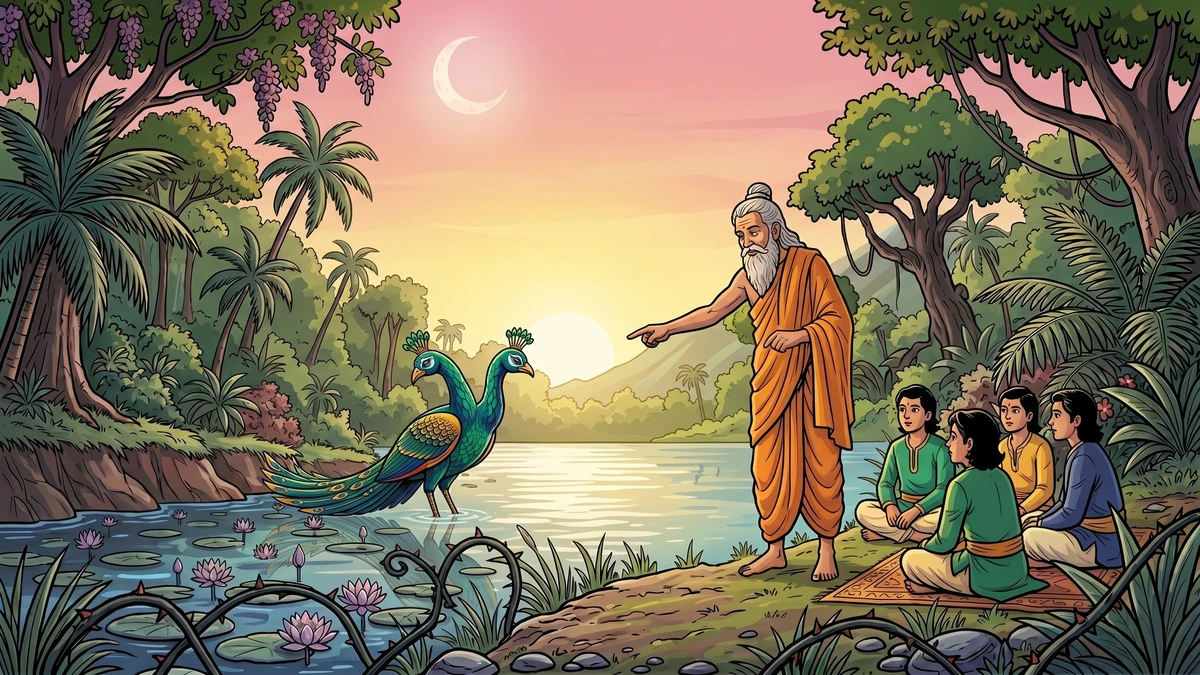
What distinguishes the Bharunda story from cruder morality tales is its scrupulous refusal to assign simple guilt. The Right Head is not villainous: its logic — we share a stomach, so the nutrition benefits us both — is technically correct. The Left Head’s retaliation is disproportionate and suicidal: it destroys both to punish one. Yet the seed of catastrophe was planted not in the Left Head’s vindictiveness but in the Right Head’s failure of hṛdaya — heartfelt generosity — when it had the chance to give freely and chose not to.
The Hitopadesha’s framing is clear: the tale is placed within the book of Vigraha (discord, war, dissension) as a warning to kings about the dangers of factional court politics. A minister who hoards intelligence, a general who refuses to share glory with an ally, a treasury that will not fund a navy — each is a Right Head eating the golden fruit alone. The Left Head’s catastrophic revenge represents the factions that, excluded from power, destroy the kingdom rather than see their rivals enjoy it.
For the common reader, the tale speaks to the indivisibility of shared fates: families, friendships, partnerships, nations. The story’s genius is that the Bharunda cannot be saved by the Right Head alone doing the right thing once the berries are eaten. There is no antidote, no second chance. The time to practice generosity was before the poison was chosen.
The Story’s Journey Across Cultures
The Panchatantra/Hitopadesha corpus is among the most widely translated works in world literature — exceeded in translation history only by the Bible and the Quran. The tales moved west through the Arabic Kalīla wa-Dimna (8th century CE, translated from Pahlavi/Middle Persian versions of the Panchatantra by Ibn al-Muqaffaʿ), thence into Hebrew, Syriac, Greek, Latin, Spanish, Italian, and eventually all major European languages by the 14th century. Whether the Bharunda story itself travelled this route or remained confined to the Sanskrit/vernacular Indian tradition requires further manuscript research, but the underlying motif — shared fate, divisive envy, self-destructive spite — proved so universal that cognate tales emerged independently across cultures.
In the Jain narrative tradition (Jain Āgamas), the concept of the jīva (soul) eternally entangled with the body it inhabits parallels the Bharunda’s dilemma: one cannot harm the vessel without harming the inhabitant. Jain ethics of ahiṃsā (non-violence) extend precisely to the recognition that violence against the self — whether by gross bodily harm or by the subtler violence of spite and envy — constitutes moral failure of the gravest order.
Legacy in Vernacular Traditions Across India
As the Panchatantra and Hitopadesha tales percolated from Sanskrit into the vernacular literary traditions of medieval India, the Bharunda story retained its essential structure while absorbing local colour. In Tamil, the didactic corpus of the Nītivenpa preserves analogous tales of shared fate destroyed by internal quarrel. In Kannada, the double-headed eagle Gandabherunda — distinct from the Bharunda but sharing the structural motif of dual consciousness within a single form — became a royal emblem of the Vijayanagara Empire (c. 14th–17th century CE), its two heads facing outward in vigilance rather than inward in contention: a deliberate inversion of the Bharunda’s cautionary image into an emblem of sovereign completeness.
In Hindi and Braj Bhasha oral traditions, the story survives in simplified tellings aimed at children, typically shorn of its political allegory and reduced to a straightforward moral fable about sharing. This simplification — while effective as a pedagogical tool — loses the tale’s original sophistication, particularly the Hitopadesha’s pointed application to courtly factionalism and the treachery of ministers who withhold counsel from one another within the same administration.
The Panchatantra’s five books are each organised around a central political situation presented through a frame narrative and populated with nested fables. Book IV (Labdhapraṇāśa — “Loss of what has been gained”) and Book V (Aparīkṣitakāraka — “Ill-considered actions”) are the most relevant to the Bharunda, though different manuscript traditions (the Southern recension, the Nepalese recension, the Tantrākhyāyika of Kashmir) organise the tales differently. The Hitopadesha’s placement of the Bharunda under Vigraha (Book IV: Discord) is the most analytically precise, since the tale is fundamentally about the political pathology of dissension rather than mere moral failing.
The Bharunda and Nīti: Political Ethics as Animal Fable
Sanskrit nīti-śāstra — the science of political ethics — was never merely concerned with abstract virtue. Its primary audience was the rājā (king) and his mantra-parishad (council of ministers), and its primary concern was the survival and prosperity of the rājya (realm). The Bharunda story operates simultaneously on three registers within this framework:
At the individual level, it warns against the psychological violence of envy — the Left Head’s decision to destroy both rather than accept a perceived injustice is a portrait of matsarya (malice/envy), one of the six internal enemies (ari-shadvarga) enumerated in yogic and ethical texts alongside kāma (lust), krodha (anger), lobha (greed), moha (delusion), and mada (pride).
At the political level, the tale warns the king against allowing his ministers, generals, or provincial governors to develop rival factions that prioritise internal competition over the common good. A court divided into jealous factions is a Bharunda — magnificent in form but self-poisoning in function.
At the cosmic level, the tale resonates with the Vedic concept of ṛta (cosmic order) and its social counterpart dharma: the natural order requires that those who share a common being act in accordance with that shared nature. The Bharunda’s transgression is not merely moral but ontological — it has violated the fundamental law of its own existence.
This triple register — individual ethics, political philosophy, and cosmic order — is characteristic of the best Panchatantra fables and distinguishes them from the simpler single-register morality tales of many other world traditions. It is why these stories have sustained engagement from philosophers, rulers, and ordinary readers for over two millennia.
Telling the Story Today
The Bharunda bird’s tale remains urgently contemporary. In an era defined by institutional polarisation — political parties that would rather damage shared institutions than allow a rival to benefit from them, corporate boards where factions leak proprietary information to competitors rather than share credit internally, communities that reject beneficial infrastructure because it would also benefit a neighbouring group they dislike — the Bharunda flies again and again.
The story is also a powerful tool for conflict resolution pedagogy. Educators working with children on cooperation, sibling rivalry, and community building have found that the visceral image of the two-headed bird — able to soar magnificently when united, brought low by its own spite — communicates in ways that abstract moral instruction cannot. The body is shared. The poison does not distinguish between heads. Once swallowed, it cannot be unswallowed.
Perhaps the most painful aspect of the Bharunda’s fate — and the aspect that the Hitopadesha’s original Sanskrit renders with particular elegance — is that the Right Head had done nothing irreparable. Its refusal to share the fruit was unkind, but it was not catastrophic. The catastrophe was chosen, freely, by the Left Head, in the full knowledge of what it would mean. The ancient storytellers who crafted this tale understood something that modern psychology has confirmed: the desire to punish, when it exceeds the desire to survive, is not rationality in service of justice but irrationality consuming itself.
The Bharunda had wings enough to carry both heads into the sky. It chose, instead, to bury them both in the mud.
You May Also Like
 Panchatantra Stories
Ages 9-12
Panchatantra Stories
Ages 9-12
The Story of the Hare and the Partridge
The Story of the Hare and the Partridge: Once upon a time, I was living in a certain tree. In the hollow, at the foot of the tree, lived a partridge, by the
 Panchatantra Stories
Ages 9-12
Panchatantra Stories
Ages 9-12
The Story of the Merchant’s Son
The Story of the Merchant's Son: Do your best but leave it to destiny.” Sagardatta was a merchant who had a handsome young son. One day, he observed that his
 Panchatantra Stories
Ages 9-12
Panchatantra Stories
Ages 9-12
The Story of the Jackal Who Fell Into a Vat of Indigo Dye
The Story of the Jackal Who Fell Into a Vat of Indigo Dye: In a jungle, there lived a jac; kal by the name of Chandarava. One day he was very hungry, so he