Four Friends Hunter
The framing tale of Book II of the Panchatantra — a mouse, a crow, a tortoise, and a deer combine their gifts to outwit a hunter. A two-thousand-year-old story about friendship across difference, complementary strengths, and the quiet machinery of survival.
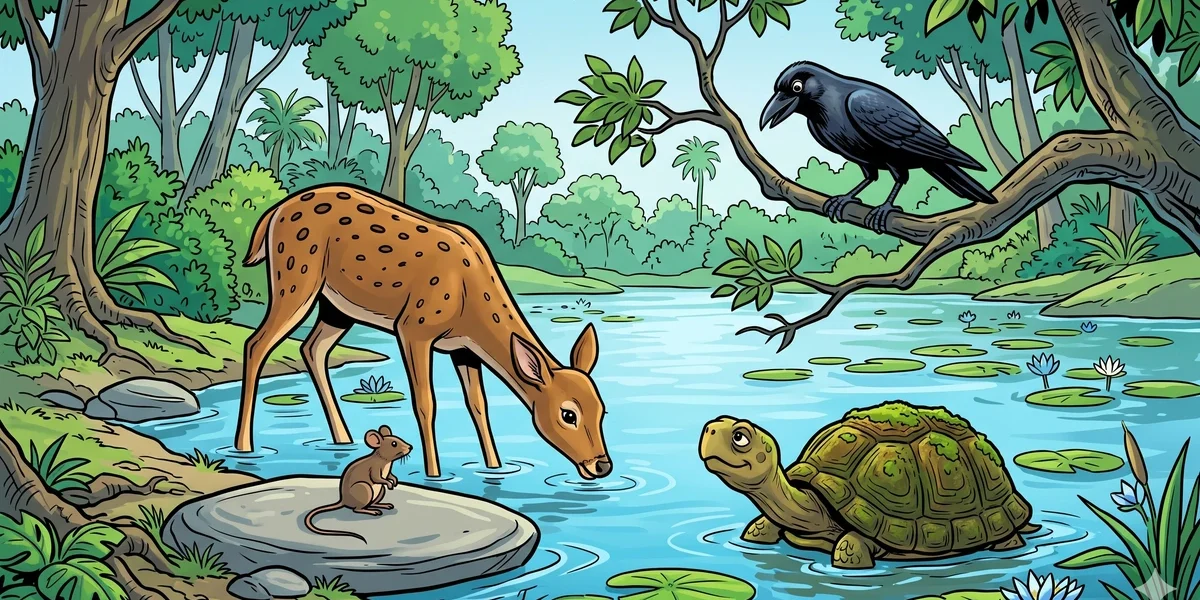
A deer who could outrun the wind. A crow who could see for miles. A mouse who could chew through a forged iron rope as if it were wet grass. And a tortoise so slow that he was always the last to arrive at any conversation, but somehow always knew the most useful thing to say once he got there. Between them — one of the oldest friendships in all of Indian literature, a hunter’s noose, and a single afternoon in which each of the four had to risk their lives for the others.
This is the frame story of Book II of the Panchatantra — the entire book about friendship is built around it — and it is one of the very few tales in world folklore in which four such different creatures, who would never naturally cross paths, choose each other anyway, and survive precisely because they did.
Where this story comes from
“The Four Friends and the Hunter” is the framing tale of Book II of the Panchatantra — Mitra-Sampraapti, which translates as “The Winning of Friends” or “The Acquisition of Allies.” Of the five books of the Panchatantra — traditionally attributed to the sage Vishnu Sharma around 200 BCE — Book II is the one most concerned with friendship, mutual aid, and the practical business of choosing the right people to stand beside you in trouble.
In the original Sanskrit, the four friends have names that survive almost untranslated into modern Indian languages two thousand years later. The mouse is Hiranyaka — “the golden one” — and he is the hero of Book II; almost every fable inside the book is told by him or about him. The crow is Laghupatanaka — “the swift-flier.” The tortoise is Mantharaka — “the slow one,” a name spoken with great affection because he is also wise. The deer, who arrives last, is Chitranga — “the dappled-bodied,” from the bright spotted pattern of his hide.
Modern children’s editions often rename the four friends — in this telling we will call them Tiny, Blackwing, Slowfoot, and Brownie — but the bones of the story have not moved in two thousand years. It has been told in Pahlavi, in Arabic as part of Kalila wa Dimna, in Persian, in Hebrew, and through countless oral traditions across South Asia and the Middle East. Wherever it has travelled, it has carried the same teaching: that friendship is not a luxury added to a comfortable life, but the working machinery of survival.
The story
Act I — How the four friends found each other
Long ago, in a forest near a quiet blue lake at the edge of the hills, there lived a tortoise named Slowfoot. Slowfoot was old, even for a tortoise. He had a hard, mossy shell, kind dark eyes, and the particular calm of an animal who has watched a great many sunrises without ever feeling a need to hurry one along. He spent his days in the shallow water at the edge of the lake, where the reeds were sweet and the sun warmed the rocks.
One morning, a crow named Blackwing came to the lake to drink. Blackwing was sharp-eyed and clever, and he was a long way from home. He had been following another animal — a small brown mouse named Tiny — who had just done something extraordinary. Tiny had chewed through the heavy net of a fowler and freed an entire flock of trapped doves with his small, busy teeth. Blackwing had watched it all from a high branch, and from that moment on he had wanted nothing in the world more than to make Tiny his friend.
Tiny, at first, refused. “Crows eat mice,” he said reasonably from the safety of a hole in the ground. “Why would I trust you?”
“Because,” said Blackwing, who was, above everything else, persistent, “I have just seen you save an entire flock of birds with no thought of reward. A creature like that is rarer than rain in a dry year. I do not want to eat you. I want to know you.”
Tiny, who was clever enough to know flattery from sincerity, eventually came out. And so the first two friendships of this story — the unlikeliest of all — were sealed.
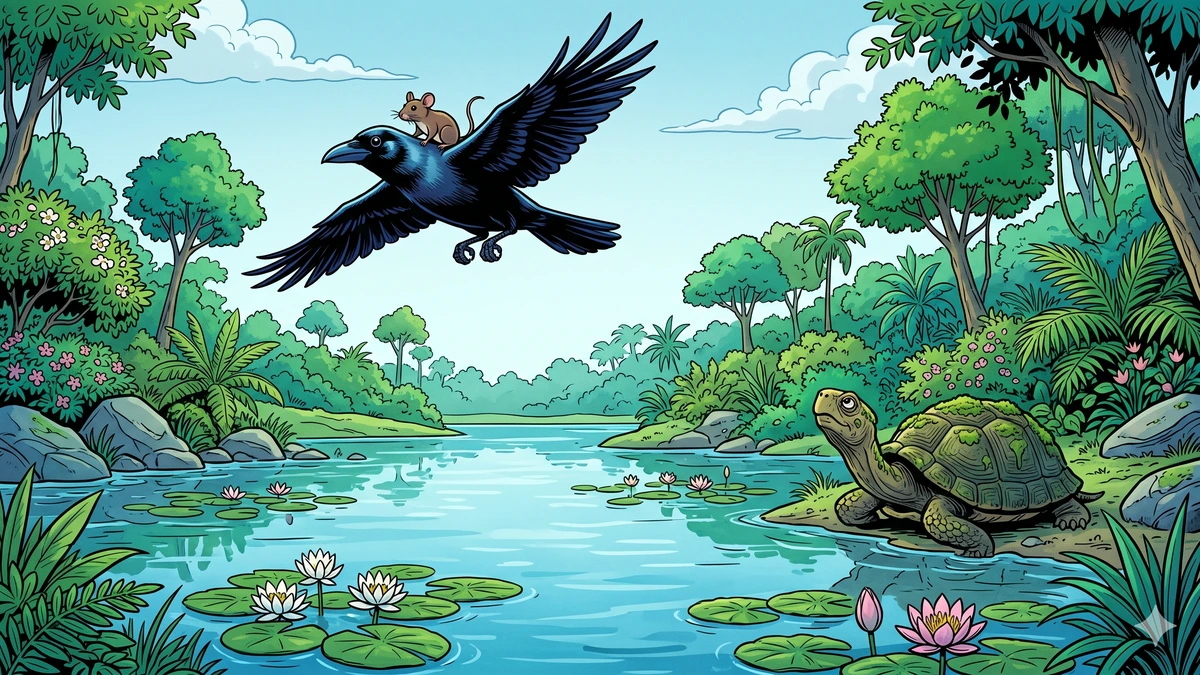
Blackwing, who had been to the quiet lake before, brought Tiny to meet his old friend Slowfoot the tortoise. Slowfoot welcomed the small mouse with the slow grace of a creature who has long since stopped being surprised by anything. The three of them sat at the edge of the water that afternoon and talked, and by sunset they were friends.
It was while they were sitting there, watching the late light on the lake, that the fourth friend came crashing in through the reeds.
It was a young deer named Brownie. He was wide-eyed and out of breath, his sides heaving, his slender legs trembling. He had been running from a hunter, and he had run so far that he no longer knew where he was. He fell to his knees at the edge of the water and drank.
The three friends watched him. After a moment, Slowfoot said, in his unhurried way, “You are safe here, friend. Drink slowly. We will not let anything happen to you.”
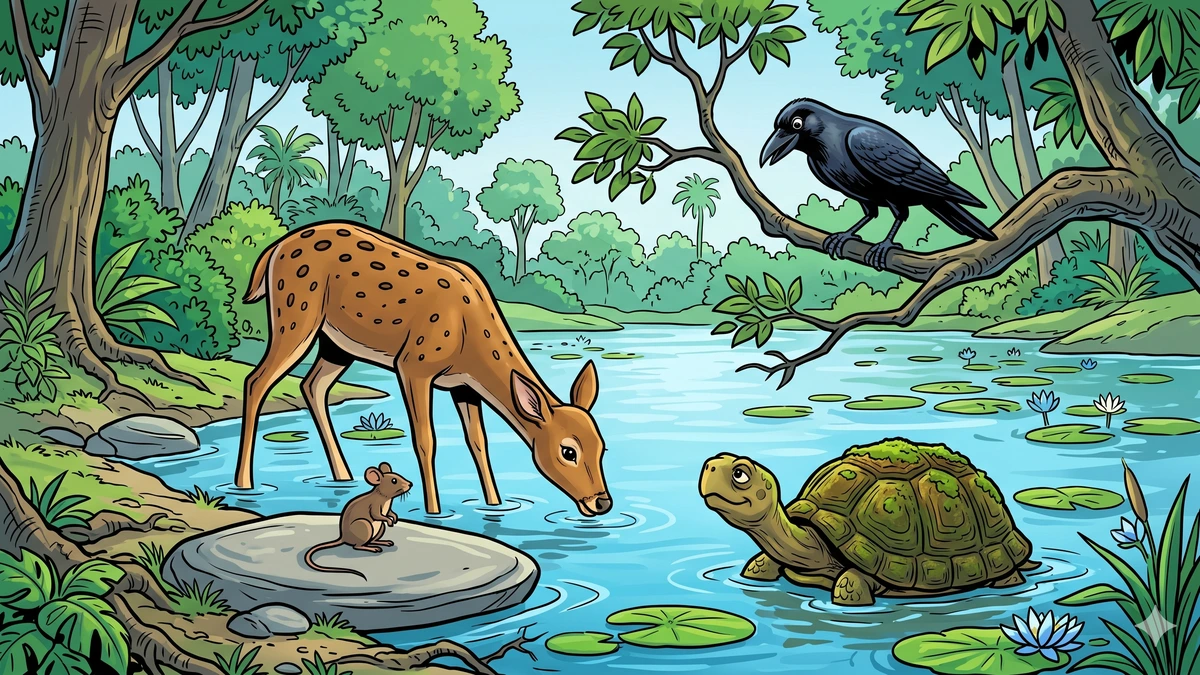
The deer looked up. He saw a tortoise so old that his shell was overgrown with moss, a small mouse no bigger than the deer’s own hoof, and a black crow with bright watching eyes. He should perhaps have been afraid, or laughed, or both. Instead, something in him — exhausted and grateful — only said, very simply, “Thank you.”
So the four friends became four. Tiny and Blackwing and Slowfoot and Brownie. The mouse, the crow, the tortoise, and the deer.
Act II — The morning the deer did not come home
For many seasons, the four friends lived as friends do. They met every evening at the lake. Brownie the deer would graze nearby. Tiny the mouse would scamper across the rocks with seeds and bits of fruit. Blackwing the crow would settle on a branch above and tell them what he had seen from the sky that day — where the streams were running, which trees were fruiting, which paths in the forest had been walked by men. And Slowfoot the tortoise, in the slow water at the edge, would listen and say very little, and now and then offer one quiet sentence that changed the whole shape of a conversation.
They were happy in the way only creatures who have chosen each other can be.
Then, one morning, Brownie did not come.
The sun rose. The mist lifted off the lake. Tiny waited, and Blackwing waited, and Slowfoot waited. And still no Brownie.
“He is never late,” said Tiny, his small heart beating faster.
“Stay here,” said Blackwing. “I can fly. I will look for him from above.”
And the crow rose into the morning sky.
Act III — The hunter’s noose
Blackwing flew in widening circles above the forest. The forest was vast, and a deer is small from the air. But Blackwing’s eyes were sharp and patient, and on the third long circle, he saw a flash of brown beside a clearing — a slender body, tangled in something that should not have been there.
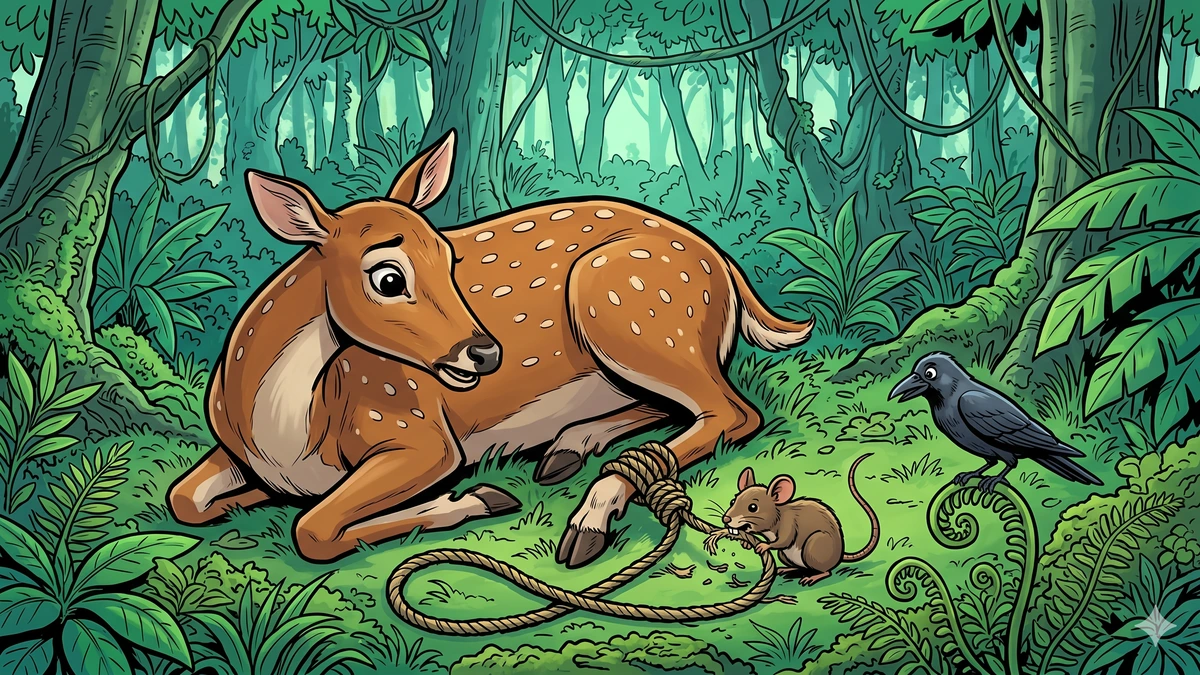
It was Brownie. He was caught in a hunter’s noose. The rope was thick and oiled, the kind of rope that does not give. Brownie’s slender legs were folded under him. He had struggled until he could struggle no more, and now he lay still, breathing hard, his great brown eyes wet with the helplessness that comes when a strong body learns it cannot save itself.
Blackwing dropped from the sky like a stone. “Brownie, my brother, do not move,” he said gently. “I will bring help.”
And he flew, faster than he had ever flown, back to the lake. He told Tiny what he had seen. Tiny did not waste a single breath. He climbed onto Blackwing’s back, and the crow rose again into the sky and carried him, dangerously and as fast as wings could carry, to the clearing where Brownie was caught.
Tiny dropped to the ground beside his friend and went to work. His teeth were small but very, very sharp, and he had spent a thousand small lifetimes gnawing through harder things than oiled rope. He chewed steadily, methodically, without panic. The rope frayed. The rope strained. The rope began to give.
Meanwhile, slow Slowfoot had also heard, and slow Slowfoot had set out at once, on his own, on his own short legs, to come to his friend. He had no wings to carry him and no speed to spend. He simply walked. He had been walking for hours.
Act IV — The hunter, the trick, and the four who came home
The rope gave. Brownie staggered to his feet, free. Tiny climbed onto his back. Blackwing wheeled overhead. They were turning to leave the clearing when, around the far edge of the trees, they heard the heavy step of the hunter.
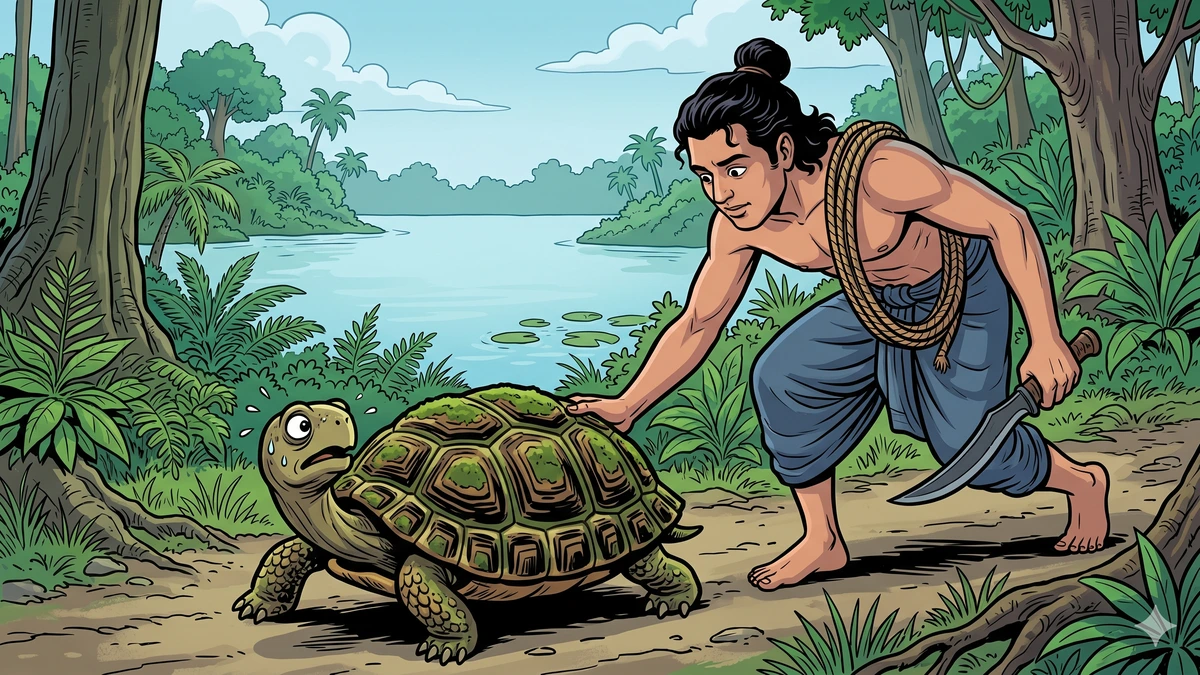
And they saw, on the path between them and home, slow Slowfoot, walking calmly toward them, in plain view, without a hiding place anywhere near.
The hunter saw the empty noose. The hunter saw the deer leap into the bushes. The hunter saw the small mouse scurry away. And the hunter saw, very visibly and very slowly, the old mossy tortoise on the path — and his face brightened, because tortoise meat is good meat, and a tortoise cannot run.
He laughed. He bent. He picked Slowfoot up, tied him in a sack made of broad leaves and twine, slung him over his shoulder, and set out for home along the path through the forest.
From the bushes, three friends watched their fourth friend disappear into the hunter’s hand.
Tiny began to weep. Brownie’s legs trembled. Blackwing landed on a branch and was, for the first time in this story, completely silent.
Then Brownie said, in a voice none of them had ever heard from him before, “Listen to me. We are going to get him back. Here is what we will do.”
And the deer — who was quick and graceful and had until that morning never been the cleverest of the four — laid out a plan.
“I will run ahead,” he said, “and I will lie down on the path far in front of the hunter, in a place where he cannot help but see me. I will pretend to be dead. The hunter will think — a tortoise is good, but a deer is better. He will drop the bag and come for me. While he is bending down, Tiny, you must run out from the bushes and chew Slowfoot free. As soon as Slowfoot is free, I will jump up. I will run. The hunter will chase me. He will not catch me — I am faster than any man. By the time he gives up and turns back, all four of us will be gone.”
Tiny, his eyes shining, nodded.
Blackwing said, “I will fly above. I will tell you with my voice when the hunter is close, and when his back is turned. The plan will move on my call.”
And so they went.
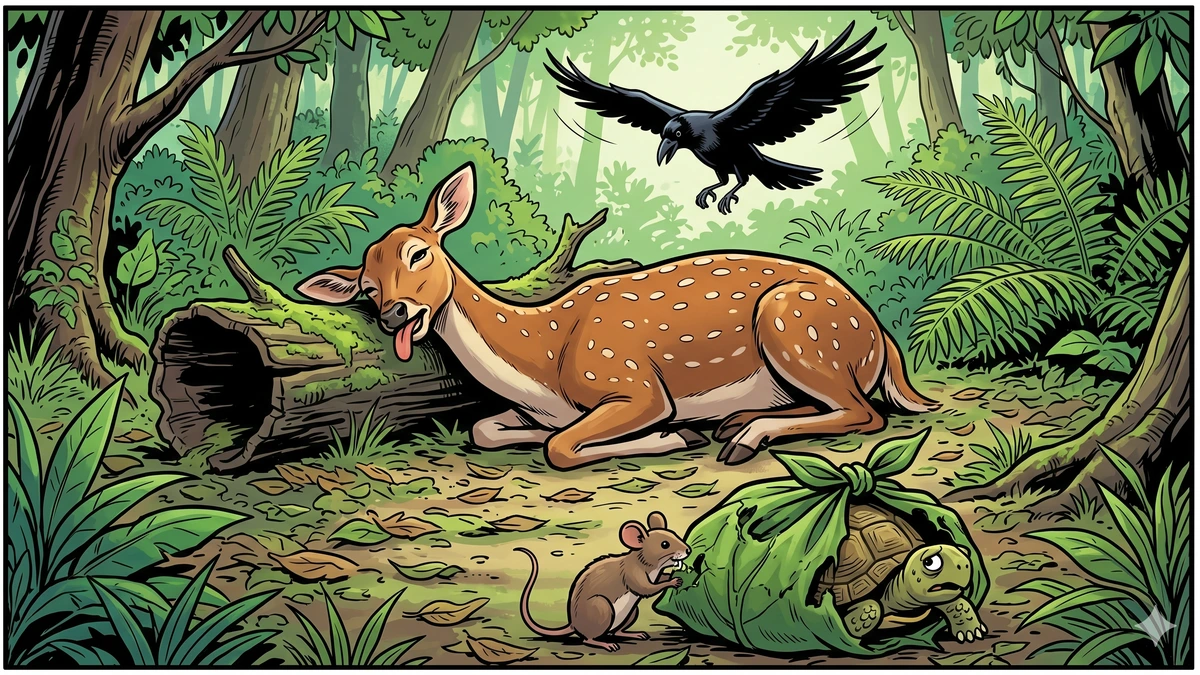
Brownie ran ahead. He found a place on the path where the light was good and the grass was soft. He lay down. He closed his eyes. He let his tongue loll out a little, the way a dead deer’s tongue would loll. He did not move.
The hunter came around the bend with the leaf sack on his shoulder, and he stopped short, astonished. A whole deer! Lying on the path! Without even being shot at! He was a man who believed, naturally, that the world rewarded him. He set the sack down on the path beside him. He took a knife from his belt. He bent down toward the still body of the deer.
From a thornbush at the side of the path, Tiny shot out like a brown spark. He was at the leaf sack in two heartbeats. His teeth went to work. The twine parted. The leaves opened. Slowfoot was free.
Blackwing, from a branch above, gave a single sharp call.
And Brownie, in one impossible motion, came back to life. He was on his feet and away into the trees before the hunter had even straightened up. The hunter shouted. The hunter cursed. The hunter ran after the deer with his knife in his hand, certain he could still catch the wounded creature.
He ran a long way. He ran until he was breathless and bleeding from thorns and lost in a part of the forest he did not know. By the time he turned, panting, back toward his sack, the path was empty. There was no deer. There was no tortoise. There was no leaf sack. There was no rope. There was only the hot afternoon sun and the sound of crows in the distance, going about their lives.
That evening, at the quiet blue lake, four friends sat together and did not speak much, because there was not really anything to say. Tiny pressed his small body against Slowfoot’s mossy shell. Blackwing settled on Brownie’s back. Slowfoot watched the light on the water. After a while, Brownie said, very quietly, “I would not have lived through this morning without any one of you.”
And Slowfoot, in his slow way, said, “Nor I.”
And that was, more or less, all that needed to be said.
Who’s who in the story
Tiny (Hiranyaka) — A small brown mouse with very sharp teeth and an even sharper sense of right and wrong. He is the moral centre of Book II of the Panchatantra; almost every smaller fable inside the book is told by him or about him. He believes, deeply, that mercy and friendship are the same thing.
Blackwing (Laghupatanaka) — A crow with bright watching eyes and a patient, persistent heart. He is the one who reaches across natural enmity first, and his persistence — politely refusing to take “no” for an answer when he sees something rare — is the seed from which the whole friendship grows.
Slowfoot (Mantharaka) — A wise old tortoise who lives at the edge of the lake. He moves slowly and speaks rarely, and the things he says, when he does speak, tend to settle a question. The most quietly courageous of the four.
Brownie (Chitranga) — A young dappled deer, swift and graceful, who arrives last and almost dies first. By the end, in the moment of greatest danger, it is his plan that saves them all.
The hunter — Not a villain so much as a force of nature. Strong, patient, well-equipped, and absolutely ordinary. The story does not need him to be evil. It only needs him to be relentless. The four friends do not defeat him by being stronger; they outlast him by being together.
The lesson
It is easy to read this story as a children’s tale about being kind. It is also a precise statement about what real friendship is for. None of the four friends is, by themselves, a match for the hunter. The mouse is small. The deer is fast but unarmed. The crow has eyes but no claws. The tortoise has armour but no speed.
What each of them has, the others lack. The crow’s wings carry the mouse. The mouse’s teeth free the deer. The deer’s speed lures the hunter. The tortoise’s calm holds the four of them together when fear would otherwise scatter them.
The Panchatantra is not telling us, with this story, to find friends like ourselves. It is telling us, very deliberately, the opposite. It is telling us that the friend most worth having is the one whose strengths cover your weaknesses, and whose weaknesses you are happy to cover in return. A real friendship is not four versions of the same person. A real friendship is a small ecosystem, and an ecosystem survives because each member does something the others cannot.
Why this story still matters today
Modern life is, in some ways, a long argument with this story. We are encouraged to find people “like us” — same age, same job, same class, same temperament — and to call those people our community. The Panchatantra has been quietly disagreeing for two thousand years.
The four friends in this tale would not pass any modern matching algorithm. A mouse and a crow have, on paper, every reason to be enemies. A tortoise and a deer move at incompatible speeds. The crow lives in the sky, the mouse underground, the tortoise in the water, the deer on land — they barely share a habitat. And yet it is exactly because they share so little that, when the hunter comes, they are unkillable.
Whatever the equivalent of “the hunter” is in your life — a difficult season, a setback, an illness, a person who wishes you ill — it is almost always survived by the same four kinds of help. Someone to spot the danger from a height. Someone to chew the rope. Someone to be slow and steady when everyone else wants to panic. And someone, in the end, willing to put themselves in the open, on the path, eyes closed, to give the others time to work. The Panchatantra’s quiet promise is that if you are lucky enough to have all four, the hunter goes home with nothing.
Frequently asked questions
What is the moral of “The Four Friends and the Hunter”?
The moral is that true friendship is built on complementary strengths, not similarity. None of the four animals could have escaped the hunter alone, but together — using speed, sight, sharp teeth, and patience — they save each other. The story teaches that diversity, mutual aid, and trust across difference are the practical foundations of survival.
Which book of the Panchatantra is this story from?
It is the framing tale of Book II — Mitra-Sampraapti (“The Winning of Friends”) of the Panchatantra, traditionally attributed to Vishnu Sharma around 200 BCE. The four friends — Hiranyaka the mouse, Laghupatanaka the crow, Mantharaka the tortoise, and Chitranga the deer — appear throughout Book II, and most of the smaller fables in the book are told as stories within their conversations.
Who are the four friends in the original Sanskrit?
The four friends are Hiranyaka (the mouse, “the golden one”), Laghupatanaka (the crow, “the swift-flier”), Mantharaka (the tortoise, “the slow one”), and Chitranga (the deer, “the dappled-bodied”). Each name in Sanskrit is also a small character description — and each name has been preserved nearly unchanged in classical retellings for two thousand years.
How did the four friends save the deer from the hunter?
The crow flew above the forest until he found the trapped deer. He carried the mouse on his back to the clearing, where the mouse chewed through the rope with his sharp teeth. When the slow tortoise was caught by the returning hunter, the deer pretended to be dead on the path to lure the hunter away, the mouse cut the tortoise free from the leaf sack, and all four friends escaped together.
What can children learn from this story today?
Children can learn that friends do not have to be alike to take care of each other — in fact, the friends who are most different from us are often the ones who can help us most when we are in trouble. The story teaches the value of teamwork, courage, and trust, and gently shows that being smaller, slower, or quieter is not a weakness when those qualities are part of a team.
Related folk tales
If you enjoyed this story, you may also like these other tales from the Panchatantra and beyond, all on this site:
- The Foolish Lion and the Clever Rabbit — a Book I tale of patience defeating brute strength.
- The Elephant and the Sparrows — small allies bring down a giant in Book I.
- Elephants and Hares — a hare uses the moon’s reflection to outwit an elephant king.
- The Monkey and the Crocodile — friendship and betrayal on a Book IV riverbank.
- The Three Fish — a Book I fable about foresight and procrastination.
Did you know?
The four friends of the Panchatantra are some of the most travelled characters in world literature. After the Panchatantra was translated into Pahlavi (Middle Persian) in the 6th century, into Arabic as Kalila wa Dimna, and from there into Hebrew, Latin, Greek, Spanish, and most major European languages, the names changed but the four shapes did not. In the medieval Arabic version, the deer becomes a gazelle and the crow becomes a raven, but the heart of the story — four impossibly different friends combining their gifts to outwit a hunter — is exactly the same. When you tell this story to a child today, you are passing along an idea about friendship that has crossed languages, religions, and continents for more than two thousand years, and is still, somehow, exactly the right size to teach a child why it is worth having a friend who is not at all like you.
Frequently Asked Questions
What is the moral of the Four Friends and the Hunter story?
Who are the four friends in the Panchatantra tale?
Which Panchatantra book is Four Friends Hunter from?
How do the four friends escape the hunter?
Is Four Friends Hunter a good moral story for kids?
You May Also Like
 Panchatantra Stories
Ages 12+ / YA
Panchatantra Stories
Ages 12+ / YA
The Barber Who Killed the Monks | Panchatantra (Ages 9–12+)
A Panchatantra cautionary tale: a barber copies what he saw at a merchant’s house without understanding — and learns that imitation without knowledge is dangerous.
 Panchatantra Stories
Ages 3-5
Panchatantra Stories
Ages 3-5
The Conquest Of Fate
The Conquest Of Fate: In the Dakshinadêśa there lived a Brâhmiṇ boy who from his childhood was given a very liberal education in Sanskṛit. He had read so much
 Panchatantra Stories
Ages 3-5
Panchatantra Stories
Ages 3-5
Suchimukha and The Monkey
A Panchatantra fable about a well-meaning bird named Suchimukha, a troop of cold monkeys, and the danger of giving advice where none is wanted.