The Elephant And The Sparrows: Panchatantra Book I (Mitra-Bheda) — Stories From India Retold
How can creatures the size of your palm bring down a creature the size of a hill? The classic Panchatantra Book I tale of two sparrows, a wise owl, a mosquito, a woodpecker and a frog who teach a proud elephant the cost of forgetting how to listen.
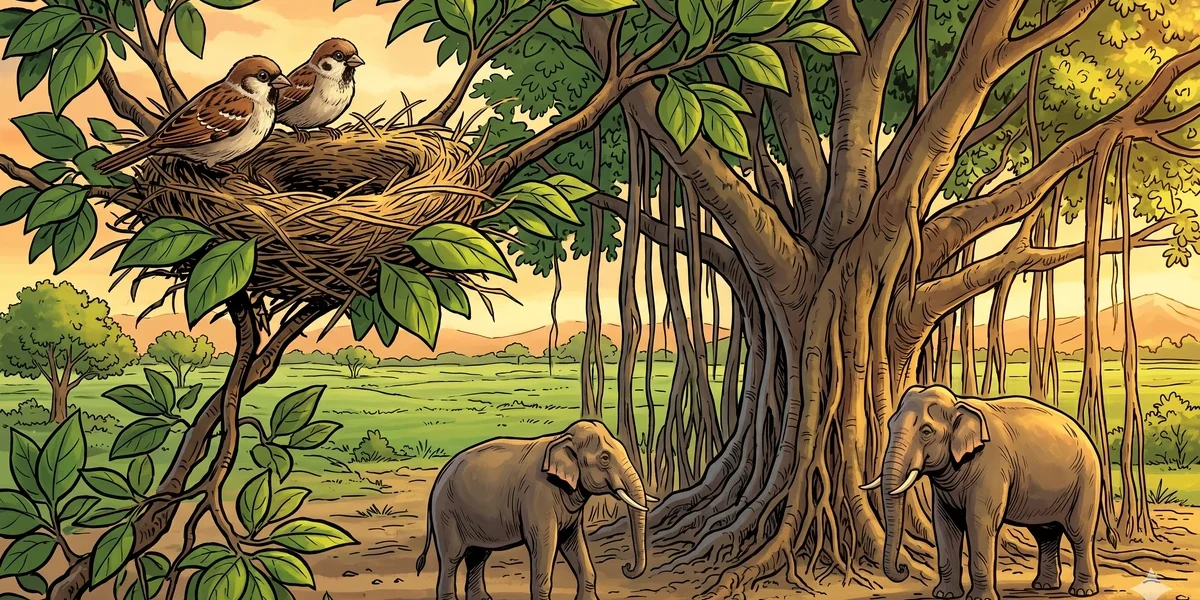
Story origin: “The Elephant and the Sparrows” is from Panchatantra Book I — Mitra-Bheda (“The Loss of Friends”), the oldest collection of Indian fables, attributed to Vishnu Sharma (c. 3rd century BCE).
Two tiny sparrows, no bigger than the palm of your hand. One thundering elephant, big as a small hill, proud of every pound of muscle on his body. The riddle of this Panchatantra tale is simple to ask and surprisingly hard to answer: how could creatures so small ever stand up to a creature so large — and win?
The answer the old storytellers gave is the same answer that good teachers, careful generals and wise elders have given for two thousand years. They will tell you that strength is not what you carry in your shoulders. Strength is what you carry between you and your friends. This is the story of a sparrow couple who learned that lesson in the cruellest way, and then taught it back to the proudest creature in the forest.
Where this story comes from
“Elephant and the Sparrows” belongs to Panchatantra Book I — Mitra-Bheda, “The Loss of Friends” or “The Separation of Friends.” The Panchatantra (“five treatises”) is a collection of interlinked animal fables traditionally attributed to the sage Vishnu Sharma, who is said to have composed them around the 3rd century BCE to teach three reckless princes the practical art of governance — what the old Sanskrit texts called niti-shastra, the science of right conduct.
Book I, where our story lives, asks a single question across all its tales: how do alliances form, and how do they break? Most of the stories in Mitra-Bheda are about friendships ending badly, betrayals, or trust falling apart. This story is one of the few that flips that pattern. Here, friendship is not lost — it is found, in the unlikeliest places, and used to perfect effect. That is part of why the tale has lasted. It is the rare bright thread in a dark book.
The story
Act I — The nest in the banyan tree
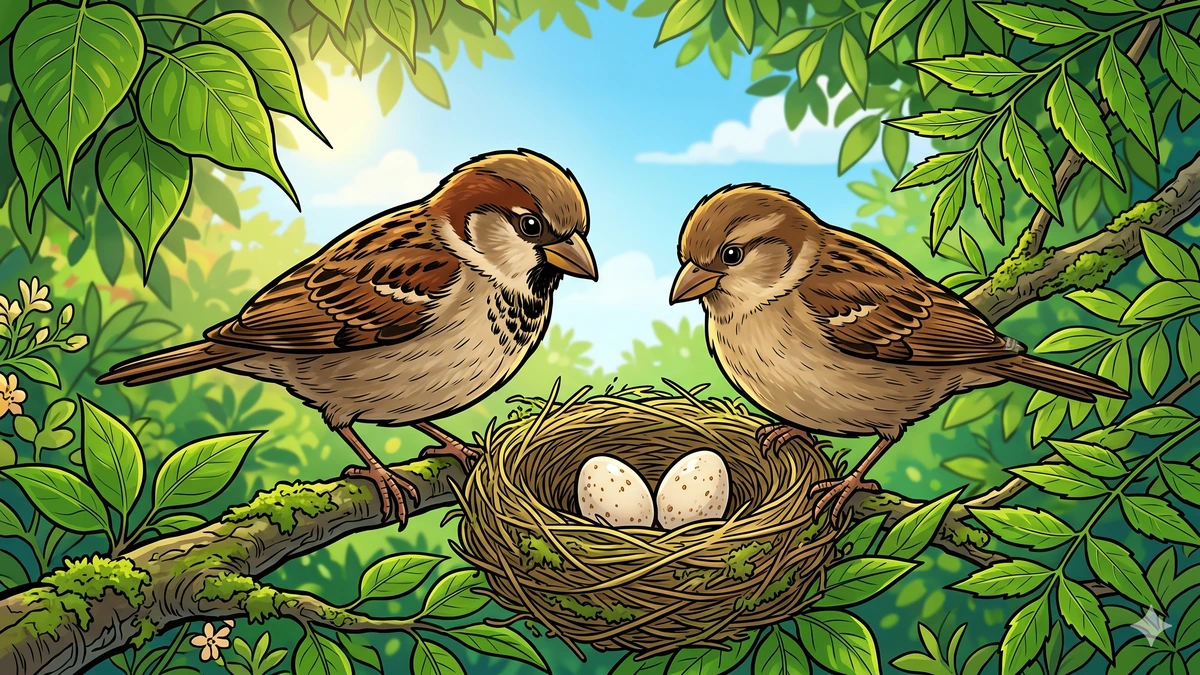
Once upon a time, in a quiet stretch of countryside, a sparrow couple chose a tall banyan tree as the place where they would build their home. They worked for many days, weaving twigs and grass and soft feathers into a nest that was just the right size for two — spacious, snug, safe from rain. When the work was done, they sat together on the rim of the nest and looked out across the fields, very pleased with themselves.
A few weeks later, the female sparrow laid two pale eggs. The pair were beside themselves with joy. They worked out a careful plan together: one of them would always sit on the eggs to keep them warm, while the other flew out for water and seeds. They counted the days. They imagined what the chicks would look like, what they would name them, what songs they would teach them. The two eggs lay nestled in the cup of their nest like two small, perfect promises of the future.
Act II — The proud elephant
Not far from the banyan tree, a wild elephant lived alone. He was enormous, strong, and very, very pleased with himself. He had taken the habit of trampling smaller plants and animals under his feet just to prove that he could. The other animals of the forest gave him a wide berth. They told their children to stay out of his path. No one wanted to anger him. No one dared to argue with him.
One afternoon, the elephant was returning from his bath in a nearby lake. The sun struck the leaves of the banyan tree at an angle, and for the first time he really saw how tall it was. Taller, in fact, than him. The thought displeased him. He had always told himself that he was the largest, strongest creature in this corner of the world. The tree, simply by standing there, was a quiet contradiction of that claim.
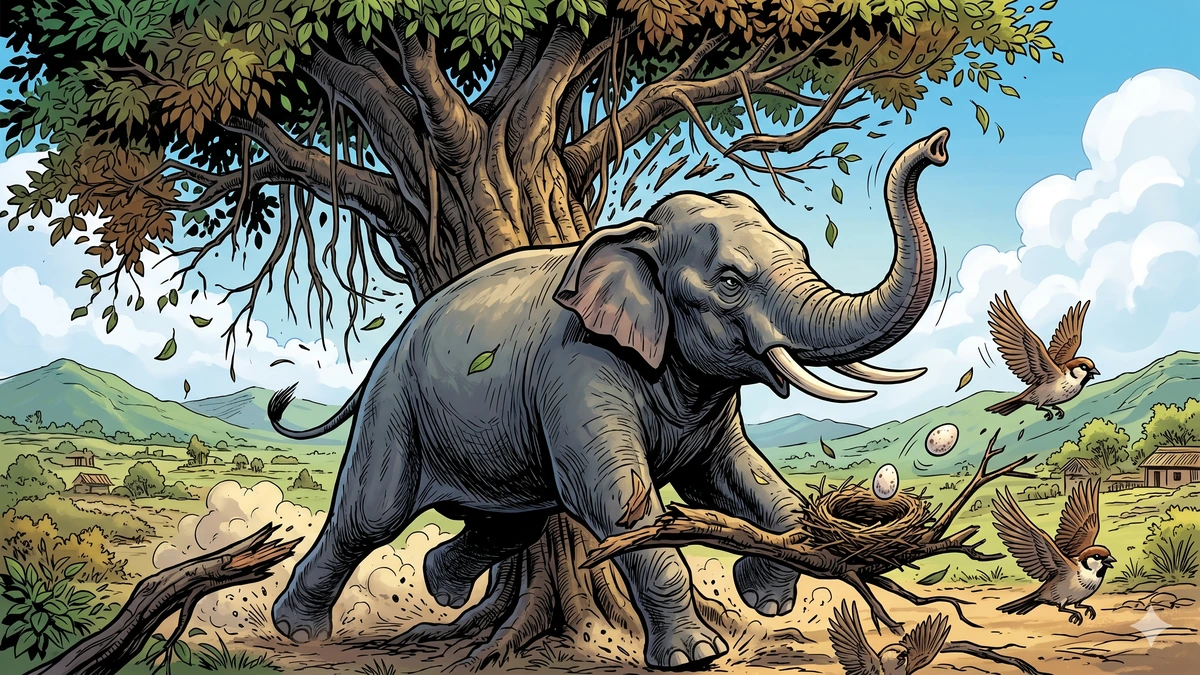
So he decided to do something about it. He lowered his head, set his shoulder against the trunk, and began to push and ram with all the weight of his enormous body.
The banyan was an old tree, and it held its ground. But its branches whipped and shook. Up among those branches, dozens of small homes — nests of sparrows, weavers, finches and bulbuls — began to rock and slide and tumble. The birds came swarming out, panicked. They flew down to the elephant and pleaded with him to stop. The sparrow couple flew down with the others. They told him about the eggs, told him that the nest would fall, begged him to think of the chicks-to-be. They said please. They said all the words a sparrow knows for “stop.”
The elephant did not stop. He was a creature who had forgotten, long ago, how to listen to anything smaller than himself. The sparrows watched, helpless, as their nest slipped from its branch and fell. The two eggs broke on the hard earth below. Many other birds lost their homes and their unborn chicks that day. Then, when his anger had spent itself, the elephant trundled away, tired but satisfied, promising himself he would come back tomorrow and finish the tree.
Act III — The wise owl is consulted

The grieving birds gathered on the broken branches that evening. They were heartbroken, but they were also angry, and a small, hard plan began to take shape among them. They decided that something had to be done about the elephant. He could not be allowed to come back. He could not be allowed to do this to anyone else.
But what could they do? They were tiny. He was a mountain. They could not fight him. They could not outrun him. They could barely make him hear them. So they did the wisest thing creatures in their situation can do: they went looking for somebody wiser than they were.
Deep in a hollow of an old tree lived an owl. He was the elder of that part of the forest, and he had the calm, slow eyes of someone who has watched many years pass and learned what stays and what goes. The birds gathered before him and told him everything — the nest, the eggs, the proud elephant, the threat to come back. The owl listened all the way to the end without interrupting once. Then he closed his eyes for a long moment, and said, “Come back to me tomorrow morning. I will have an answer for you.”
The birds flew home, heartbroken still, but with the smallest seed of hope planted in them.
Act IV — The plan
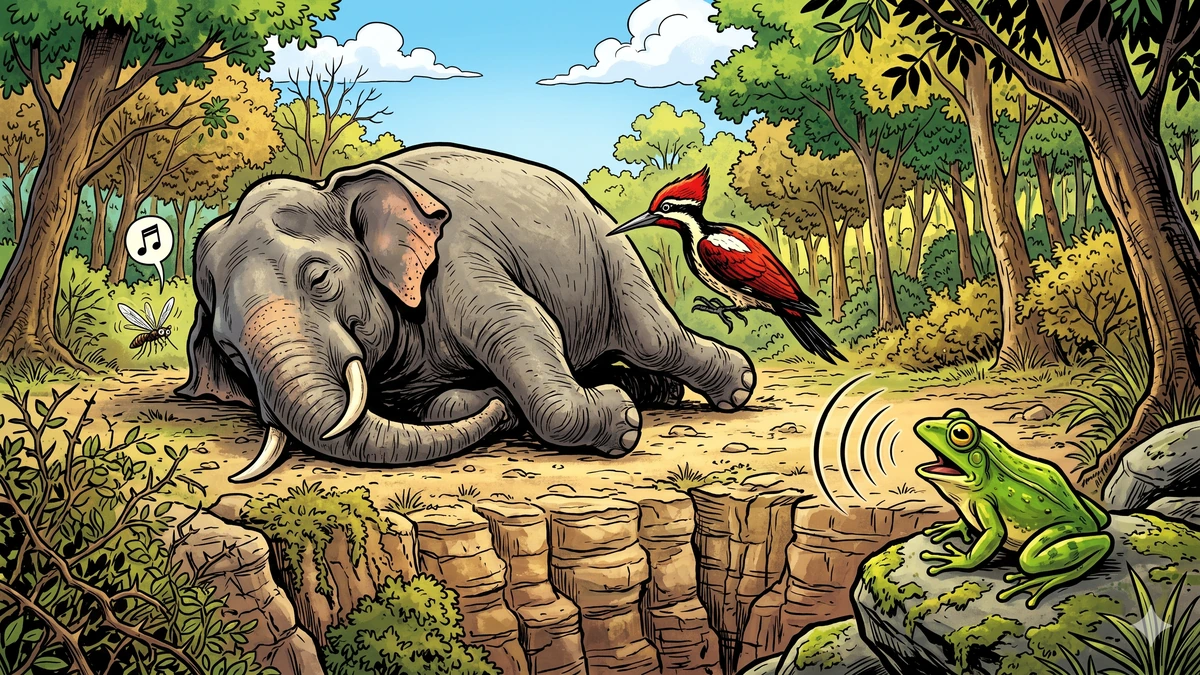
The next morning, the owl arrived at the broken banyan tree with three companions. He had spent the night thinking, and these were the three friends he had chosen to bring with him: a mosquito with a beautiful, lulling buzz; a woodpecker with a beak as sharp as any chisel; and a wise old frog. They sat together with the sparrows in a small council, and the owl explained the plan.
That afternoon, the elephant did exactly what proud creatures do after a heavy meal in the heat: he looked for a shady tree, and he sat down beneath it, and he closed his eyes. The mosquito flew over and began, very softly, to sing near his ear. It was the kind of slow, dreamy hum that makes a tired creature surrender to sleep. The elephant smiled in his half-doze. He kept his eyes shut. The song was so pleasant.
That was the moment the woodpecker had been waiting for. Quick as a snapped twig, he flew in and struck — first one of the elephant’s closed eyes, then the other. The elephant roared in pain. He could not see. He stumbled to his feet, half-blind, and ran in the direction he thought the lake lay, desperate to wash his stinging eyes.
The frog had been waiting too. He sat at the lip of a deep, rocky pit, far from any lake, and he croaked — long, throaty, water-loud croaks. To a blinded animal panting for water, that croak was the sound of his salvation. The elephant turned and ran toward it. He never reached the lake. He fell into the pit, and the rocks finished what the woodpecker had started.
The forest was quiet again. The grieving birds had their justice. And four creatures who together would not fill a child’s cupped hands had brought down a creature the size of a hill.
Who’s who in this story
The cast is small but every character is doing important work — even the ones with very little speaking time:
- The sparrow couple — devoted, hardworking, ordinary. They are not warriors. They are householders. The whole point of the story turns on the fact that ordinary people can rise when something they love is taken from them.
- The elephant — a study in unchecked pride. He is not evil so much as careless. His sin is that he has forgotten how to listen to anyone smaller than himself.
- The owl — the convener. The one who turns grief into a plan. Old stories love this character because every successful alliance needs one.
- The mosquito — disarms with charm. Gets past the defences nobody else could.
- The woodpecker — strikes precisely, and only after the moment is right. Patience and a sharp beak are equally important.
- The frog — uses the elephant’s own panic against him. A reminder that misdirection can be as deadly as a weapon.
The lesson
The headline moral of “Elephant and the Sparrows” is the one most people remember: wit is greater than brute strength, and unity is greater than size. But the older versions of the story are saying something a little more layered than that.
The elephant is not defeated by a bigger elephant. He is defeated by four creatures who, alone, could each have been ignored. None of them is dangerous on their own. The mosquito would not have hurt him. The woodpecker could not have outrun him. The frog could not have lifted a single rock. What makes them lethal is not their individual gifts — it is the fact that those gifts have been arranged in the right order. Charm before strike. Strike before misdirection. Misdirection toward the trap the elephant cannot see.
That is the harder lesson the Panchatantra is quietly teaching: plans matter. Strategy matters. Knowing which friend to send first, and which one to hold in reserve, matters. Unity by itself is not enough. Unity with thinking attached to it is what brings down a giant.
Why this story still matters today
Children encounter elephants long before they ever see one. The bullying older child on the playground is an elephant. The classroom teacher who shouts down small voices is an elephant. The big company crushing a smaller one is an elephant. The stubborn relative who will not stop talking is an elephant. The world is full of creatures who have forgotten how to listen to anyone smaller than themselves.
The story does two grown-up things at once. First, it tells children that they are not powerless against such creatures — that being small is not the same as being weak. Second, it warns them, gently, against ever becoming the elephant. Power, the story says, is the thing that makes you stop noticing other people. The cure is to keep noticing.
Modern readers can pull a few practical takeaways from this two-thousand-year-old tale: when a problem looks too big for one of you, gather a group; when you gather a group, do not just complain, plan; when you plan, give every member of your team the one job they can do best; and when you finally act, act in the right sequence. These are not just storybook morals. They are how good teams get built, how civic movements work, and how small companies sometimes upend giants.
Frequently Asked Questions
What is the moral of Elephant and the Sparrows?
The story’s moral is that unity, intelligence and a clear plan can defeat raw strength. The elephant is the largest creature in the forest, but a sparrow couple, a wise owl, a mosquito, a woodpecker and a frog defeat him by combining their unique skills in the right order. Wit, working together, beats size.
Which book of the Panchatantra is this story from?
“Elephant and the Sparrows” belongs to Book I of the Panchatantra, titled Mitra-Bheda (“The Loss of Friends” or “The Separation of Friends”). Most stories in Book I are about friendships breaking apart; this is one of the rare tales where new alliances form and prove decisive.
Why did the elephant destroy the sparrows’ nest?
The elephant was proud of being the largest creature in the forest. When he noticed that the banyan tree was taller than he was, his pride was injured. He decided to attack the tree to prove that nothing in his world could stand above him. The destruction of the nest was a side effect of that vanity, not the goal.
How did the small animals defeat the elephant?
They worked in sequence rather than all at once. The mosquito sang the elephant to sleep with eyes closed; the woodpecker took advantage of those closed eyes to blind him; the blinded elephant ran toward what he thought was a lake — actually the croaking of a frog beside a rocky pit — and fell to his end. Each small creature did the one thing it could do best, at the right moment.
What can children learn from this story today?
Three things. First, that being small is not the same as being powerless. Second, that good teamwork is more than a group of friends — it is friends doing different jobs in the right order. Third, that pride is dangerous: the elephant lost not because he was weak but because he had stopped listening to anyone smaller than himself.
Related Folk Tales
If you enjoyed this Panchatantra tale, you may also like these stories from indianfolktales.com:
- A Three-in-One Story — three nested tales of king, sage and merchant from Book IV.
- The Foolish Lion and the Clever Rabbit — a tiny rabbit topples a tyrant lion using only a well full of reflections.
- The Tale of the Three Fish — preparation, hesitation and disaster.
- The Talkative Tortoise — what a tortoise discovers about silence in the air.
- The Clever Monkey and the Crocodile — a friendship across two worlds, and how cunning saves a life.
Did You Know?
- The Panchatantra was composed in roughly the 3rd century BCE by Vishnu Sharma, originally in Sanskrit.
- By the 6th century CE the Panchatantra had been translated into Pahlavi (Middle Persian); from there into Arabic; from Arabic into Greek, Hebrew and Latin; from Latin into nearly every European language. It is one of the most translated books in human history.
- The motif of small creatures cooperating to defeat a giant appears across world folk tradition — from Aesop’s “The Lion and the Mouse” to the Brothers Grimm’s “The Bremen Town Musicians” — but the Panchatantra version is the oldest written form of the idea that has come down to us.
- Indian elephants live in matriarchal herds of 15–30 individuals and are famous for their long memories. The proud, solitary bull elephant of this story is therefore unusual — a deliberate storyteller’s choice to put pride and isolation together as causes of his downfall.
Frequently Asked Questions
What is the moral of Elephant and the Sparrows?
Which Panchatantra book is Elephant and the Sparrows from?
What lesson does the sparrow teach in the Panchatantra story?
Who wrote Elephant and the Sparrows?
Why is Elephant and the Sparrows a good story for kids?
You May Also Like
 Panchatantra Stories
Ages 6-8
Panchatantra Stories
Ages 6-8
The Story of Two Fishes and the Frog
The Story of Two Fishes and the Frog: In a certain pond, there lived two fishes. Theirnames were Shatabudhi and Sahasrabuddhi. They hadmade friends with a frog
 Panchatantra Stories
Ages 12+ / YA
Panchatantra Stories
Ages 12+ / YA
The Barber Who Killed the Monks | Panchatantra (Ages 9–12+)
A Panchatantra cautionary tale: a barber copies what he saw at a merchant’s house without understanding — and learns that imitation without knowledge is dangerous.
 Panchatantra Stories
Ages 9-12
Panchatantra Stories
Ages 9-12
The Grain of Corn
A farmer plants a single grain of corn and cultivates it into an abundant harvest through faith and hard work.