Meeting a New Friend
Meeting a New Friend: Hiranyaka, the mouse, and Laghupatanaka, the crow, became great friends. One day, the crow came calling on the mouse with eyes full of
Canonical Attribution & Manuscript Tradition
“Meeting a New Friend” is one of the most beloved tales from Pancatantra Book II, Mitralabha (“The Gaining of Friends”), attributed to Vishnu Sharma, c. 3rd century BCE. The story is preserved in all major Sanskrit recensions including the Tantrakhyayika (c. 200 BCE, Kashmir) and the Southern recension (Tantrabhyakhyayika), and appears in parallel form in the Hitopadesha as one of its primary illustrations of the value of true friendship. The tale also entered medieval Persian literature through the Kalila wa Dimna translation and reached European fable traditions through that route. It is among the most widely translated folk-tales in world literature.
“Mitraṇā sarva kāryāṇi siddhyanti, nā anyaḥ ko’pi upakarakah.”
“Through friends, all purposes succeed; no other helper is so reliable.”
— Pancatantra, Mitralabha, Shloka 1
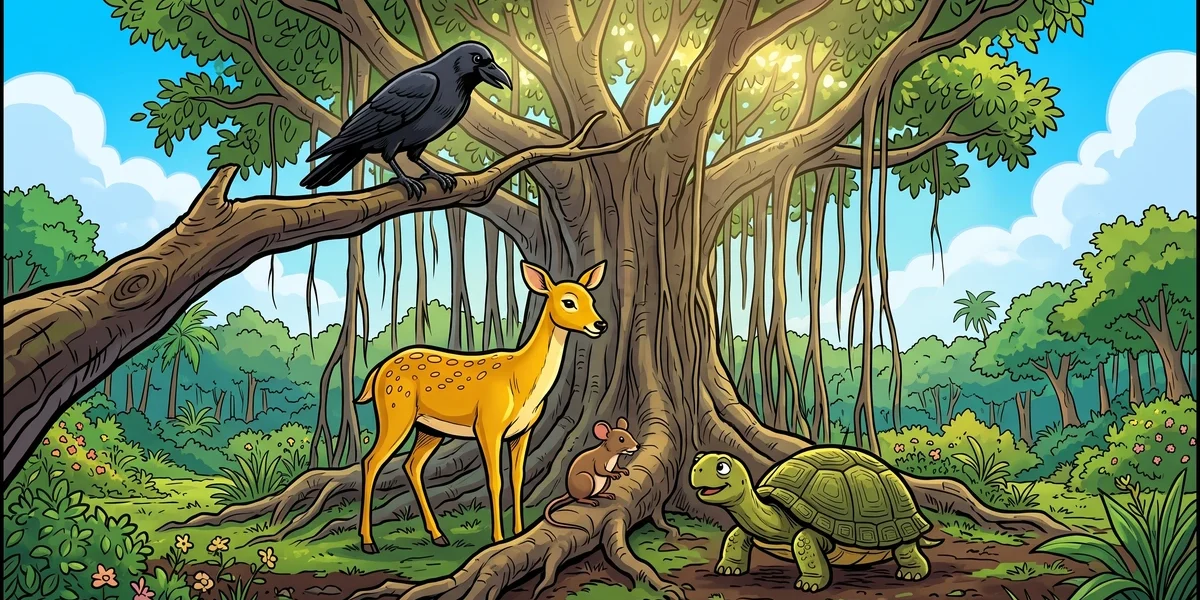
The four principal characters — Laghupatanaka the crow, Hiranyaka the mouse, Chitranga the deer, and Manthara the tortoise — are named in the Sanskrit text, and their individual traits are carefully constructed: the crow is clever, swift-moving, and resourceful; the mouse is technically capable (his teeth can cut through any net); the deer is fast but vulnerable and needs protection; the tortoise is loyal and wise but physically the slowest, and therefore the one who will be most at risk when the crisis arrives. The story’s plot is constructed precisely around this asymmetry: the friendship is tested at exactly the point of the weakest member’s greatest vulnerability.
Beat I — The Meeting in the Forest
In a dense forest near the town of Champaka lived Laghupatanaka, a crow of great wisdom and sharp sight. One day, as he rested on the branch of a great banyan tree, he observed below him a remarkable scene: a golden deer named Chitranga was sleeping contentedly beneath the tree, utterly at peace, as if he had found the only safe place in the forest. The crow watched for a time with professional curiosity — for crows miss nothing — and then descended to speak to him.
“You sleep very soundly for an animal of the forest,” he said.
“I sleep because I feel, in this place, safe,” said Chitranga. “I cannot explain it. It may be the company.”
The crow looked around and saw no other company. He understood: the deer was speaking of him, though they had only just met. And indeed the crow found himself, against all expectation, inclined to stay. This is how the first two members of the fellowship came together: not by plan or necessity, but by the inexplicable rightness of an unexpected encounter.
In time the crow and the deer discovered a third companion: Hiranyaka, a mouse who lived in an elaborate burrow beneath the banyan’s roots. He was a mouse who had once been the minister of a great kingdom of mice and had seen enough of the world to know that safety lies not in walls but in alliances. He and the crow took to one another at once — both were quick, observant, and given to taking the longer view.
Beat II — The Tortoise Asks to Join
The three friends had established a daily life of great contentment: the crow brought news from the air, the mouse managed the burrow and the near terrain, and the deer grazed peacefully in the knowledge that two sets of eyes watched over him. Then one morning a tortoise appeared at the edge of their clearing.
Manthara was old, slow, and had watched the three friends from a distance for many days. He came forward hesitantly, because tortoises are wise enough to know that asking to belong is the most vulnerable thing a creature can do.
“I have observed your friendship from afar,” he said. “I have no family remaining, and I am very slow, as you can see. I cannot offer speed or great strength. But I am loyal, I am patient, and I have lived long enough to know things that faster creatures sometimes miss. I would be honoured to join your company — if you will have me.”
The crow looked at the mouse. The mouse looked at the deer. The deer said: “Anyone who speaks so honestly of his own limitations has already demonstrated a quality rarer than any strength. Welcome.”
And so the four friends were complete.
Beat III — The Hunter’s Net
For some time the four lived in contentment. Then one morning Laghupatanaka returned from his daily reconnaissance flight in great agitation. He had spotted a hunter moving through the forest with a net and a cage — an experienced trapper who knew exactly where deer came to graze. The crow warned his friends. Hiranyaka retreated to his burrow; Laghupatanaka took to the air; Manthara withdrew under the roots of the banyan. But Chitranga, startled by the crow’s cry and confused by the direction of the warning, ran — directly into the hunter’s concealed net.
The net snapped closed around the deer. The hunter, seeing his catch, began to approach. The situation was as dire as it could be: Chitranga was trapped, the hunter was close, and among the four friends only one had the tools to cut the net — Hiranyaka, who had the teeth for it but was the smallest and most easily crushed underfoot in the confusion.
Beat IV — The Friends Act as One
Laghupatanaka, the crow, saw the situation clearly from the air. He flew ahead to the hunter and landed near the path, dragging one wing as if injured, then hopped away as the hunter approached — leading him away from the net, back along the path by which he had come. The hunter, eager for a bird as well as a deer, followed.
The moment the hunter turned, Hiranyaka scrambled to the net and began to gnaw through its cords with focused, rapid precision. His teeth were made for exactly this work. Cord by cord the net weakened. Chitranga stood perfectly still — which was the hardest thing, with the hunter only just out of sight — and did not thrash or struggle, because he trusted that his friend knew what he was doing.
When the last cord parted, Chitranga was free. He leapt for the cover of the trees. Laghupatanaka took to the air the moment the deer cleared the net. Hiranyaka disappeared into the undergrowth. The hunter returned to find nothing but a cut net and an empty clearing.
Manthara, slow as he was, had also played his part: he had moved, painstakingly, to the far edge of the clearing, so that if anything went wrong and the hunter searched the area, Manthara’s conspicuous trail in the mud would have drawn the hunter away from Hiranyaka’s approach to the net. It was the sort of sacrifice that a creature who knows he cannot run thinks of when a faster creature might not.
Beat V — The Reunion
The four friends came together again at the roots of the banyan tree as the sun moved into afternoon. The crow descended from the air, the mouse emerged from the undergrowth, the deer stepped out from the trees, and the tortoise — who had made perhaps fifteen feet of progress in the whole affair — arrived last, as always.
“You saved me,” said Chitranga to Hiranyaka.
“We all saved you,” said the mouse. “Laghupatanaka led the hunter away. Without that I would never have had time.”
“And Manthara was prepared to be found so that the hunter would look in the wrong direction,” said the crow. “Not every act of courage is fast.”
Manthara said nothing. He had arrived and settled and was breathing slowly, as tortoises do. But the expression on his ancient face was that of an animal who has, at last, found the place he belongs.
Why This Story Has Lasted 2,500 Years
The tale of the four friends endures because it illustrates something the Pancatantra’s authors understood with great precision: true friendship is not about similarity of kind, proximity, or even utility — it is about the willingness to use whatever gifts you have in the service of someone else’s survival. The crow uses speed and deception; the mouse uses teeth and precision; the deer uses stillness and trust; the tortoise uses patience and the willingness to be the decoy. None of them can save the deer alone. Together they cannot fail.
The story is also a quiet meditation on the tortoise’s form of courage: the courage of the slowest member, who knows that in a crisis he will be the last to safety and the first to be caught, and who chooses to belong anyway. The Pancatantra is not sentimental about this. It does not pretend that Manthara’s slowness is not a liability. It simply insists that the friendship is worth the risk — and that Manthara’s particular gift, the patience to think of the diversion plan that no faster creature bothered to think of, is precisely what makes him indispensable.
Moral: True friendship requires neither similarity nor convenience. It asks only that each friend bring, fully and without reservation, whatever gift they have — and trust that the others will do the same.
Cultural & Narrative Context
The Mitralabha section of the Pancatantra is concerned with the theme of gaining and keeping allies — the mirror of Mitra-bheda (the losing of friends), which opens the collection. Vishnu Sharma’s framing is political as well as moral: the king’s councillor who knows how to form genuine alliances is more valuable than one who knows only how to exploit existing relationships. The four friends story is the purest illustration of this principle: each creature has something the others lack, and the friendship works because each one acts from the other’s need rather than from self-interest.
The story has been told and illustrated across South Asia for 2,500 years. It appears in the Kalila wa Dimna (Arabic, 8th century), the Panchatantra illuminated manuscripts of the Mughal period, the Hitopadesha of Narayana (c. 9th century CE), and countless regional oral traditions in Hindi, Tamil, Telugu, Kannada, Bengali, Marathi, and Gujarati. Each version preserves the essential structure — the four unlikely companions, the net, the coordinated rescue — because the core truth of the story is universal and timeless.
About This Story
“Meeting a New Friend” (also known as “The Four Friends and the Hunter”) is from Pancatantra Book II, Mitralabha (Gaining of Friends), attributed to Vishnu Sharma, c. 3rd century BCE. The four friends — Laghupatanaka (crow), Hiranyaka (mouse), Chitranga (deer), and Manthara (tortoise) — appear in all major Sanskrit recensions including the Tantrakhyayika and the Hitopadesha. The story entered Arabic literature in the Kalila wa Dimna (8th century CE) and has been translated into over 50 languages.
You May Also Like
 Panchatantra Stories
Ages 3-5
Panchatantra Stories
Ages 3-5
The Crane and the Mongoose
The Crane and the Mongoose: The solution of the problem should not be worse than the problem itself. That is, while trying to solve the problem, you should not
 Panchatantra Stories
Ages 9-12
Panchatantra Stories
Ages 9-12
The Fall and Rise of a Merchant
The Fall and Rise of a Merchant: One should treat one and all, even the lowest, with respect.” In a city called Vardhamana, lived a very efficient and
 Panchatantra Stories
Ages 6-8
Panchatantra Stories
Ages 6-8
The Story of the Donkey and the Washerman
The Story of the Donkey and the Washerman: In a town, there lived a washerman, by the name of Shuddhapata. He had only one donkey. Because oflack of grass and