The Story of the Enmity Between Crows and Owls
The Story of the Enmity Between Crows and Owls: Once upon a time, all the birds, the swans, the parrots, cranes, cuckoos, nightingales, owls, peacocks, doves
This is one of the great frame-narratives of Indian literature — the master tale that gives Book III of the Panchatantra (Pañcatantra, c. 200 BCE) its very name: Kākolūkīyam (काकोलूकीयम्), “Of Crows and Owls.” Within this frame, Vishnu Sharma — the legendary Sanskrit teacher who composed the Panchatantra to instruct three indolent princes in the art of nīti, statecraft — gathers a long sequence of inset fables on war, deception, espionage, and the weak’s defeat of the strong. The frame is not a children’s story dressed up; it is the Indian science of strategic action, three centuries before Machiavelli, given the form of a fable so that the lesson would survive every retelling. The Panchatantra has reached more readers than almost any non-religious text ever written: through Borzūya’s 6th-century Pahlavi translation it became the Arabic Kalīla wa Dimna, then the Persian Anvār-i Suhaylī, then Hebrew, then Latin, then Spanish, German, French, English. Wherever it travelled, the chapter “Of the Owl and the Crows” travelled with it.
The bird-assembly and the rejected king
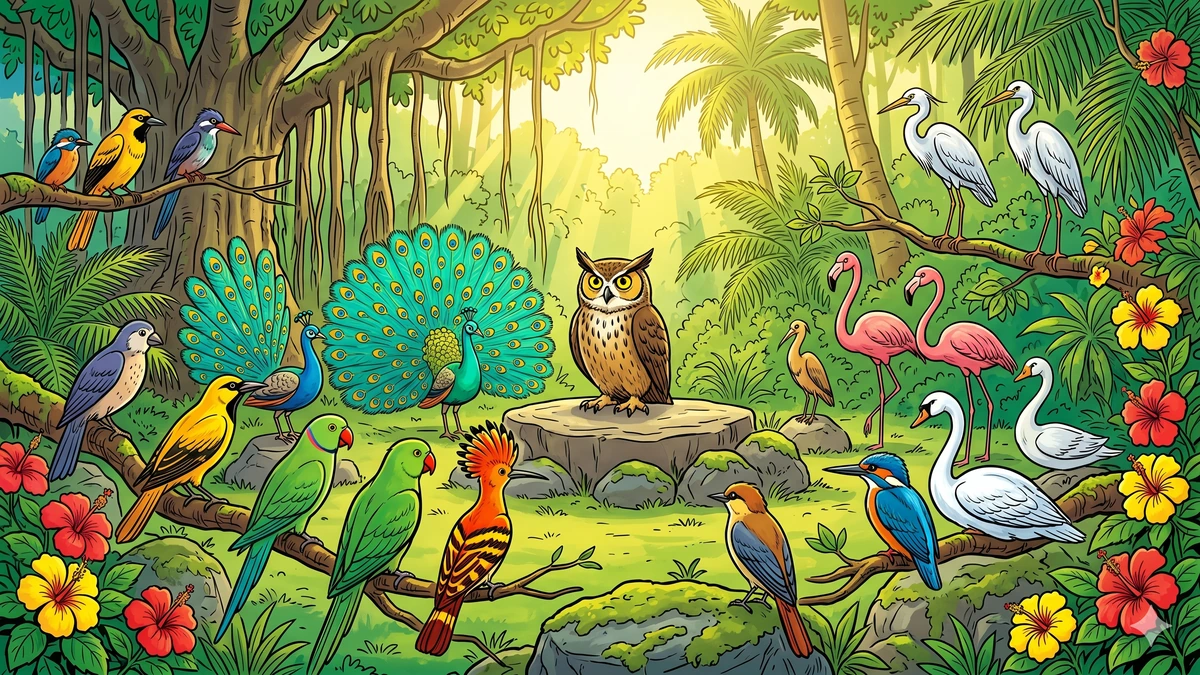
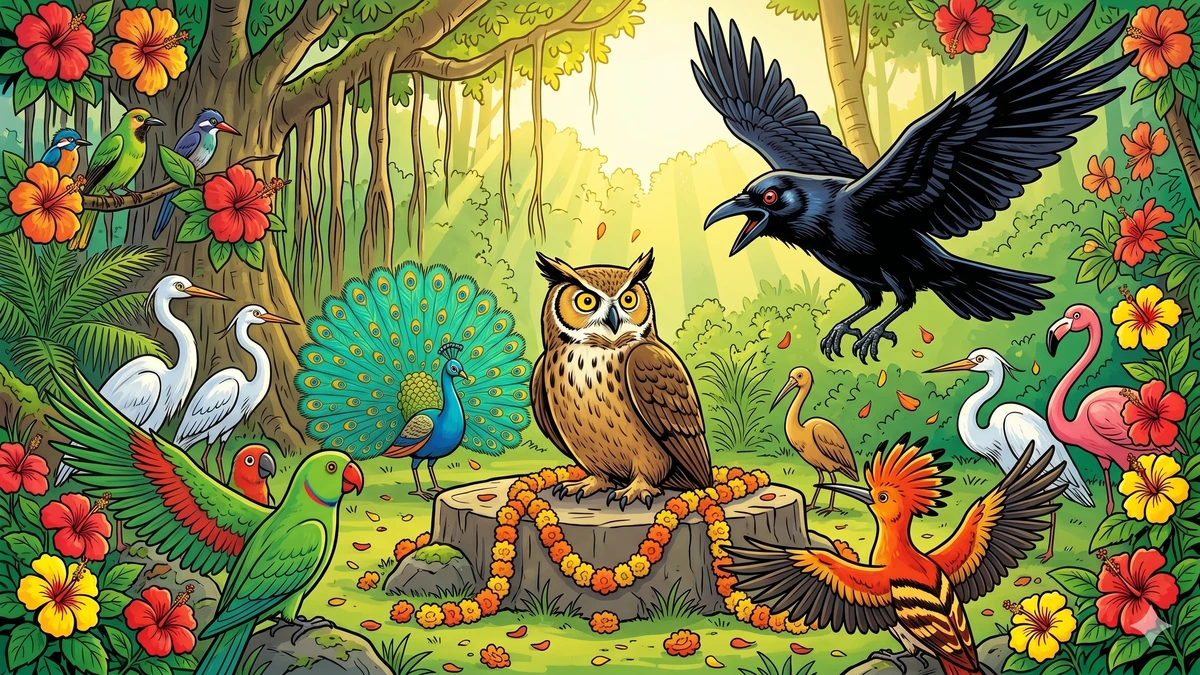
The story begins long ago, in the age of the great bird-assemblies. The birds of the world — peacocks, swans, cranes, parrots, cuckoos, nightingales, pigeons, partridges, doves, owls — held a council. Garuḍa, the king of all birds and mount of Lord Viṣṇu, was their nominal sovereign, but Garuḍa was always away in the celestial regions serving the god, and the ordinary birds of the forest never saw him. “What use is a king who is only a name?” they asked. “When the hunter sets his snare, Garuḍa is not there to free us. As the verse says: nāyakena vinā loko vinaśyati nirāśrayaḥ — without a leader the leaderless world perishes. A boat without a helmsman drifts with the tide and is wrecked; so too a people without a king.”
So they resolved to elect a new king. They looked at one another in the long grass of the council ground, and their gaze settled on the owl. He was tall, broad-shouldered, dignified, with great luminous yellow eyes. The birds said as one: “the owl shall be our king.” They sent messengers to bring the items of consecration: water from the seven holy rivers — Gaṅgā, Yamunā, Sarasvatī, Godāvarī, Narmadā, Sindhu, Kāverī — a hundred and eight medicinal roots, a tiger-skin to spread before the throne, a map of the seven continents and seven oceans, a pair of conches, drums, and a saffron-clad Brahmin to recite the Vedic hymns. They built the throne under a flowering palāśa tree and decorated it with garlands of marigold and jasmine.
And just as the chief Brahmin was about to lift the consecration-water and the maidens were beginning the songs of joy, a black streak crossed the sun. A crow had arrived. He landed on the branch above the throne and looked down at the gathered birds with bright dark eyes. “What is this great gathering?” he asked. The birds, who knew the saying — “kāka eva pakṣiṣu: the crow alone among birds is the shrewd one” — turned to him eagerly. “Friend, we are crowning the owl as our king. You have come just in time. Give us your opinion.”
The crow looked at the owl on the flower-decked throne, and laughed. “Crown this bird? You already have a king — Garuḍa, son of Vinatā, mount of Viṣṇu — whose mere name puts your enemies to flight. Why throw away a great king for a small one? And of all the small ones, why this one? An owl who is blind by day and ugly by night, with crooked nose and squinting eyes that look cruel even when he is not angry — what will he look like when he is angry? Among you are peacocks of the rainbow, swans white as conches, cuckoos of pure voice, cranes of solemn dignity. Yet you choose the owl. Have you all gone mad?”
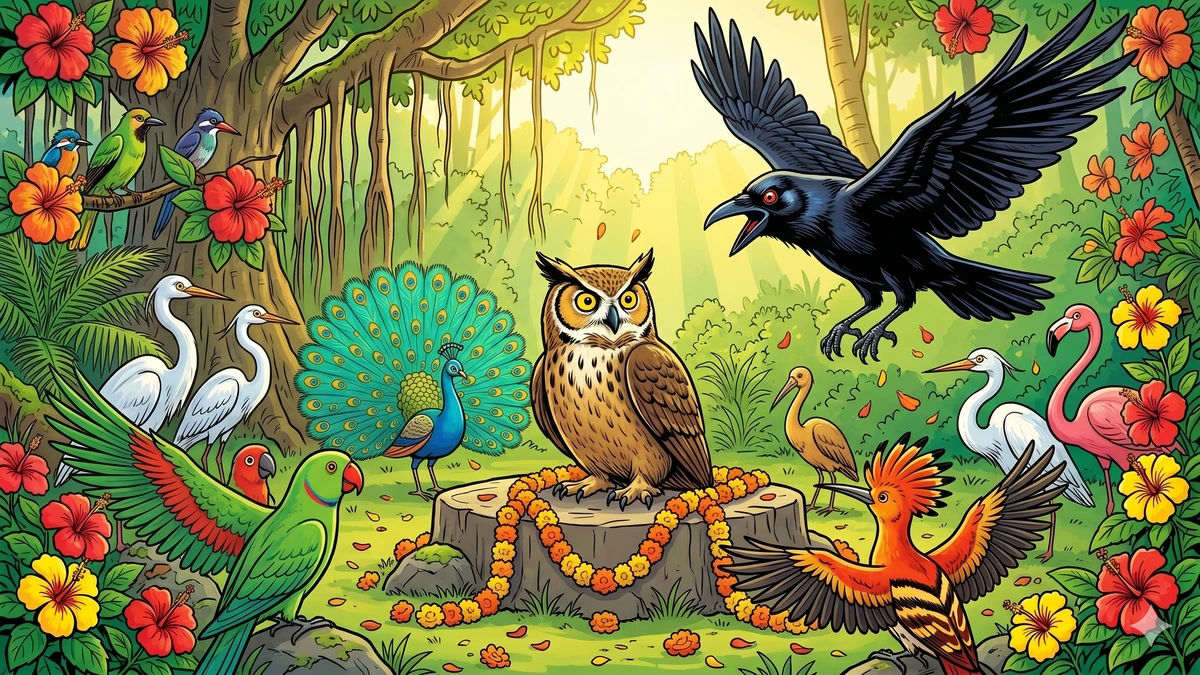
The crow’s laughter rang through the council ground. The Brahmin lowered the water-pot. The maidens stopped singing. The birds looked at each other and at the owl. One by one they rose from the assembly and flew away. The owl was left alone on the flower-decked throne, in his ceremonial garlands, with the tiger-skin spread before his feet that no one would now ever bow upon. He turned his great yellow eyes upon the crow, and the look in them was not the look of a king but the look of an enemy. “akāraṇāt,” the owl said quietly — “for no reason of mine, you have wronged me. From this day there is no peace between us. You and your kind have broken what I had not yet been given. There will be a hereditary war between crows and owls, from this day to the end of the ages.”
And so it was. From that day on, the owls hunted the crows by night, when the crows could not see; and the crows would have liked to hunt the owls by day, when the owls could not see, but the owls hid in their cave-forts. The war became a war of one-sided slaughter — every dawn brought new dead crows on the forest floor.
Meghavarṇa, the crow-king, calls his counsellors
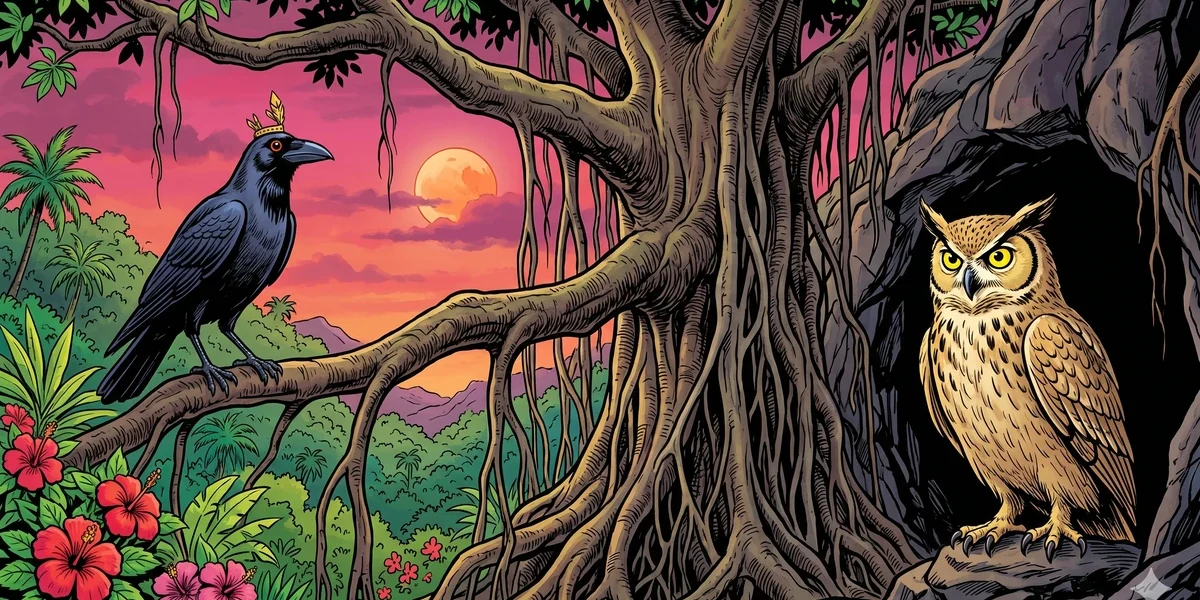
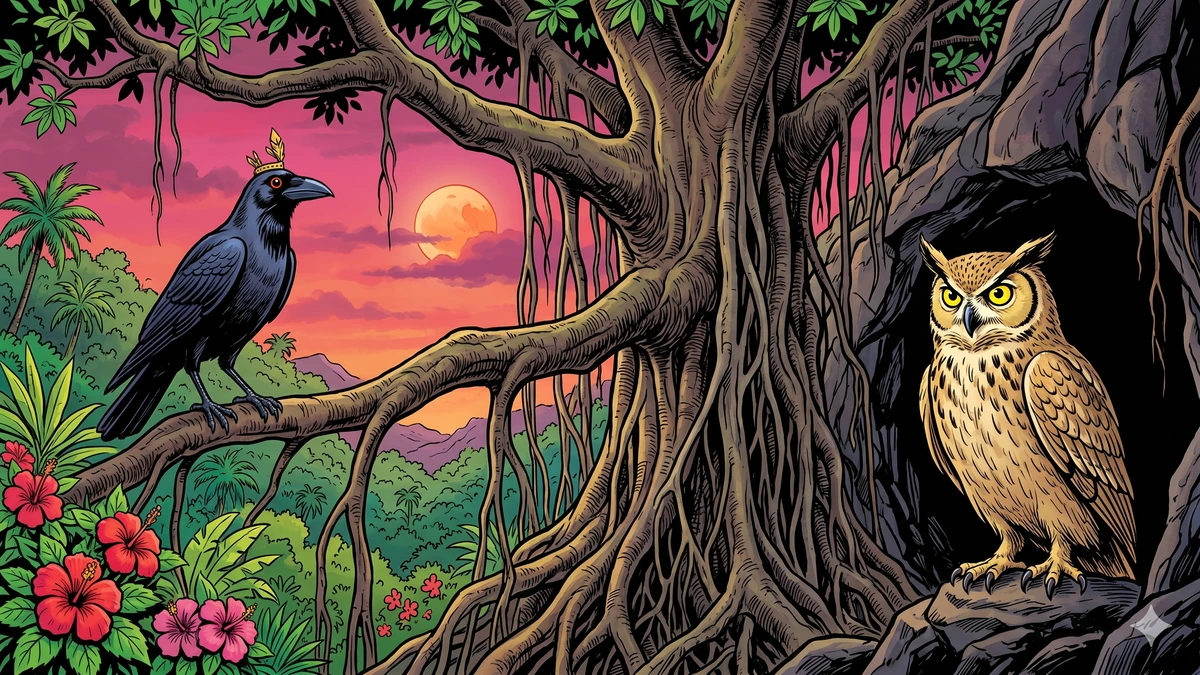
Generations passed. The seat of the crows came to be a vast banyan tree in the southern forest, and their king was Meghavarṇa (मेघवर्ण) — “cloud-coloured” — wise, deliberate, sorrowful with the weight of the long war. The seat of the owls came to be a great cave-fort in the rocky hills, and their king was Arimardana (अरिमर्दन) — “crusher of foes” — strong, vain, a king who liked compliments and disliked counsel.
Every night Arimardana led his owls in a silent raid upon the banyan, and every dawn Meghavarṇa counted his dead. Finally he could bear it no longer. He summoned his five counsellors — Uddīpana the kindler, Sammohana the bewilderer, Anujīvīn the dependent, Pratyutpanna the quick-witted, and Sthirajīvin (स्थिरजीवी), “the long-lived one,” the senior of them all, white-feathered with age — and put his question to them.
“There are six royal strategies the ancient ṛṣis have given us,” Meghavarṇa said. “Sandhi — peace, treaty. Vigraha — open war. Yāna — the marching campaign. Āsana — sitting still, holding position. Dvaidhībhāva — double policy, playing both sides. Saṃśraya — taking shelter under a stronger power. To these the wise have added a seventh: upāya — stratagem, indirect action, the splitting of the enemy from within. Which shall we use?”
Each counsellor gave a verse. Uddīpana urged peace; Sammohana urged open war; Anujīvīn urged retreat to a friendly forest; Pratyutpanna urged building higher walls. The king listened to each in turn, and his eyes grew darker. Then he turned to Sthirajīvin and said: “And you, my old friend, what do you say?”
Sthirajīvin bowed his head. “My king, none of these will do. Peace they will refuse — they have hated us for a hundred generations. Open war we will lose — they are stronger and they fight at night. Retreat will only carry the war with us. Walls they will fly over. There remains only the seventh — bheda, division, the strategy of stratagem. We must split them from within. And we must do it through a single agent who can pass through their gates as a friend.” He paused. “And that agent must be myself.”
The plan: the false defector
“Tomorrow,” Sthirajīvin continued, “you shall publicly accuse me of treason. The court shall fall upon me, pluck my feathers, beat me, smear me in my own blood, and leave me at the foot of the banyan as one cast out. The owl-spies, who watch us always, will report this. By night the owls will come and find me there, half-dead. They will bring me to their fort. I will swear undying hatred for you. They will believe me — for who would do this to himself? — and they will let me live among them. From that day onward, I am inside their fort, and I will work.”
The young counsellors were horrified. The king bowed his head. “It is too much to ask of any servant.” Sthirajīvin smiled. “It is exactly what I am here to give. na vidhīyate kāryam asahāyena dhīmatā — no plan is achieved without help, even by the wise. Let me be your help.” And so it was done.
The next morning the banyan rang with shouting. The crow-court “discovered” Sthirajīvin’s “treason.” They fell upon him with beaks and claws. Feathers flew. Blood ran. He was dragged to the foot of the tree and left there as a broken thing. By dusk the owl-spies had reported. By night the owl-king Arimardana himself came down upon the banyan with his army — and finding it deserted (Meghavarṇa had ordered the entire crow-clan to fly to a far ridge for the night), and finding instead a single half-dead crow at the foot of the tree, the owls picked Sthirajīvin up and carried him to their cave-fort.
Inside the owl-fort: Raktākṣa sees the trap
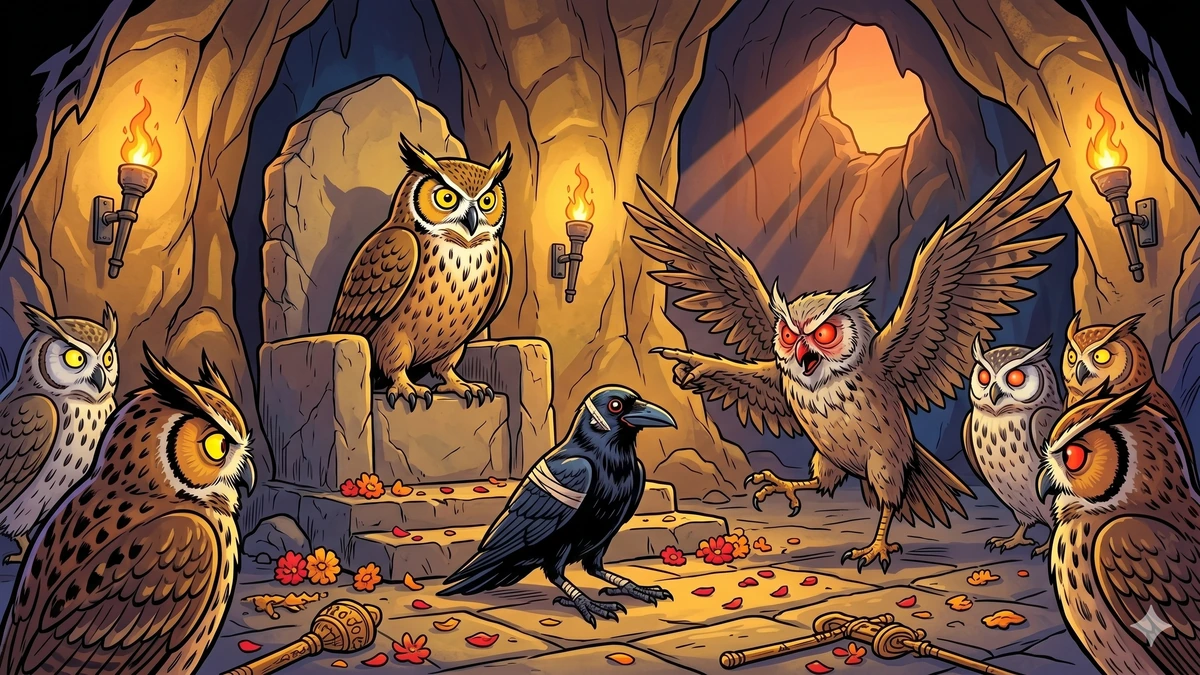
Inside the great cave-fort of the owls — torchlit, vaulted, smelling of smoke and feathers — Arimardana sat upon his stone throne, surrounded by his five counsellors: Raktākṣa (रक्ताक्ष, “red-eye”), Krūrākṣa (“cruel-eye”), Dīptākṣa (“blazing-eye”), Vakranāsa (“crooked-nose”), and Prākārakarṇa (“wall-eared”). Sthirajīvin was set down before the throne, bleeding, ragged. He told them his prepared story: that he had counselled Meghavarṇa against the war; that for this the king had turned upon him; that he had no home now and only one wish remaining — revenge.
The four younger counsellors — Krūrākṣa, Dīptākṣa, Vakranāsa, Prākārakarṇa — were moved. “What honour is greater,” said Krūrākṣa, “than to shelter a refugee who has thrown himself upon our mercy? The very gods favour the kingdom that protects the persecuted.”
But Raktākṣa, the senior of the owl-counsellors, with his red-rimmed eyes that had seen many wars, looked once at Sthirajīvin and once at his king, and his voice was hard. “Mahārāja, kill him at once.”
The cave fell silent. Raktākṣa continued: “purvāpara-vicārajñaḥ kāryam ārabhate budhaḥ — the wise man considers what came before and what will come after, before he begins. Look at this crow. He is too convenient. He is the senior counsellor of our enemy, and he arrives at our gate cast out, beaten, with a story of grievance. This is the oldest deception in the books of war. Kill him now, before his presence costs us everything.”
Arimardana hesitated. Then he looked at the four other counsellors, and at Sthirajīvin’s bowed and bleeding head, and his vanity won. “We will not kill a refugee in our hall,” he said. “We are owls, not jackals. He shall live among us, and serve us if he can.” He turned to Raktākṣa with a small, cold smile: “you grow old, my friend. Perhaps you grow timid as well.”
Raktākṣa rose. He bowed once. He said only: “Then the kingdom is lost. I will not stay to watch it die.” And he walked out of the council chamber, and out of the cave, and his small loyal following walked out behind him. They flew west, into the further hills, and disappeared. From that day Raktākṣa was no longer of the owl-fort. He was the only one of all the owls who would survive what was coming.
The fifth column at work
And so Sthirajīvin lived inside the owl-fort. He was clever; he was patient; he was old. He healed slowly. He praised Arimardana endlessly and won the king’s heart. Every day he flew out and brought back a few dry sticks, twigs, leaves. “What is this for, old crow?” the owls asked. “Mahārāja,” he said gently, “it grieves me that the king of all owls sleeps on bare stone. I am building a soft bed for our king at the cave-mouth, of dry leaves and twigs, that he may rest like a king should rest.” The owls praised his devotion. The heap of dry sticks at the cave-mouth grew, and grew, and grew.
Months passed. The heap was now as tall as the cave-mouth itself, dense, dry, packed. One spring morning, when the sun had climbed high — when every owl in the fort was deep in noon-blind sleep, eyes shut against the light, blind and helpless — Sthirajīvin slipped out through the heap of dry sticks. He flew straight as an arrow to the banyan tree. He found Meghavarṇa. He said only: “Now.”
The burning
Every crow in the kingdom of the banyan flew that day to the cave-fort, and each crow carried in its beak a small burning twig from the cooking-fires of a nearby village. Meghavarṇa led them. The sun was at its zenith. They came in a great black cloud over the rocky hills, in perfect silence, in perfect noon. They reached the mouth of the cave. They dropped their burning twigs into the great heap of dry sticks Sthirajīvin had built. The heap caught instantly. The flames roared up the cave-mouth and were sucked deep into the fort by the natural draught.
Inside, the owls woke from noon-sleep into fire. They were blind in the sunlight, blinder still in the smoke. They could not find the cave-mouth; the cave-mouth was a wall of flame. Arimardana the king, Krūrākṣa, Dīptākṣa, Vakranāsa, Prākārakarṇa — every owl in the fort died that noon. Only Raktākṣa, who had walked out months before because he had told the truth and was not heard, lived.
That evening Sthirajīvin returned to the banyan tree. The crows came one by one to lay flowers at his feet. Meghavarṇa rose from his throne and bowed before his old counsellor. The verse the bards sang that night has been sung ever since: na śatrur atikrāmati saṃskṛta-buddhi-matā — “no enemy gets past the wise man.” And the deeper teaching — that the wise enemy ignored is the only one who lives — was understood without need to be said.
The Sanskrit moral verse
The closing verse Vishnu Sharma attaches to Kākolūkīyam is one of the most famous in the Panchatantra:
na vidhīyate kāryam asahāyena dhīmatā / na śatrur atikrāmati saṃskṛta-buddhi-matā
“No plan is achieved without help, even by the wise; but no enemy gets past the wise man.”
The doubled lesson is precisely the architecture of the story. The first half of the verse is Sthirajīvin’s lesson to Meghavarṇa: even a wise king cannot save his kingdom by his own wisdom alone — he needs an old friend willing to be torn apart in the public square. The second half is Raktākṣa’s lesson to Arimardana: a wise enemy who is heard cannot be deceived; the deception only succeeded because Arimardana silenced the one voice that named it.
Where the story comes from and where it travelled
The Panchatantra was composed in Sanskrit, by tradition by the learned Brahmin Vishnu Sharma, around 200 BCE in northern India, as a textbook in nīti — political wisdom — for three princes who had been declared incapable of ordinary instruction. Kākolūkīyam is the third of its five books and is concerned, as a unit, with the science of war. The frame story of the crows and the owls anchors that book; the inset tales hang upon it like ornaments upon a thread.
The Panchatantra’s westward journey is one of the most remarkable in the history of literature. In the 6th century CE the Persian physician Borzūya, sent to India by the Sasanian emperor Khosrow I, brought it back in Pahlavi translation. In the 8th century the Persian convert to Islam Ibn al-Muqaffaʿ rendered the Pahlavi into Arabic as Kalīla wa Dimna; in that book the chapter Bāb al-Būm wa al-Ghirbān — “Chapter of the Owl and the Crows” — preserves Sthirajīvin’s stratagem almost word for word. From Arabic the book passed into Hebrew through Rabbi Joel; into Latin as John of Capua’s Directorium Humanae Vitae in the 13th century; into Castilian as Calila e Dimna in 1251 under Alfonso X; into Italian, German, French, English. The “false defector who burns the enemy’s stronghold” motif is one of the most-travelled folk-narrative units in the world, and traces of its passage can be found in European stratagem manuals from the late medieval period through the early Renaissance.
Within the Indian tradition there is a closely related Buddhist version: the Ulūka-Jātaka (Jātaka 270), in which the assembly of birds chooses the owl as king and the crow speaks against him. In the Pali version, the crowning is averted but the war is not narrated; the Sanskrit Panchatantra version is the one that develops the full strategic teaching. The motif is catalogued by folklorists as ATU 220A “Birds elect a king” for the opening assembly, and as ATU motif K2010 “Hypocrite pretends friendship and attacks” together with K2369 “Various deceptions in war” for the Sthirajīvin episode. The deeper “Raktākṣa lesson” — that the wise enemy ignored is the only survivor — is logged as motif J641.
The two layers of the moral
Read at the surface, the moral of the story of the enmity between crows and owls is the Panchatantra’s most useful single sentence about politics: a weaker power defeats a stronger power not by attack but by stratagem. The crows could not have won the war by force. They could not have outflown the owls or outfought them. They could not have built walls high enough. They won by infiltration, patience, and a single fifth-column agent. This is the Indian science of upāya, stratagem, indirect action — three centuries before Sun Tzu’s commentators in China articulated the same principle, and twenty centuries before Machiavelli rediscovered it in Florence.
But the Panchatantra is never satisfied with the surface. The deeper moral is the moral of Raktākṣa. Sthirajīvin’s deception only succeeded because Arimardana, the owl-king, dismissed the one counsellor who named it. Raktākṣa saw the trap immediately. He spoke clearly. He was overruled. He left. He was the only owl who survived. The Panchatantra’s most precise warning is to anyone in authority: the moment you find a clever-sounding reason to dismiss a counsellor who tells you the unwelcome truth, you have already lost. The enemy did not beat Arimardana; Arimardana beat himself by silencing his own wisdom. Sthirajīvin’s stratagem was only the instrument of a self-defeat that had already happened the moment Raktākṣa’s voice was scorned in council.
Read this way, Kākolūkīyam is not really a story about birds at all. It is a story about institutions — kingdoms, courts, companies, families — and the slow, almost invisible moment at which they begin to die: the moment they decide that their wisest member is “timid” or “out of touch” and stop listening. The fire in the cave is a long time coming. Every act after that moment is only the working out of a result already determined. This is the Panchatantra’s deepest political teaching, hidden in the form of a fable so that it would be remembered.
Why the story endures
The reason the tale of the enmity between crows and owls has been told and retold for more than two thousand years, in Sanskrit and Arabic and Persian and Hebrew and Latin and Spanish and English, is that its lessons are inexhaustible. A child hears the surface — the clever crow, the foolish owl, the great fire at noon. A young soldier hears the strategic teaching — the seven royal strategies, the doctrine of upāya, the use of the false defector. An older reader hears the warning of Raktākṣa — that the silencing of a wise voice is the first step toward catastrophe. A reader who returns to the story in middle age hears something new again — the cost of Sthirajīvin’s plan, the loneliness of being torn apart in the public square for one’s king, the slow work of patience over months that a younger reader skipped over. The Panchatantra was composed for three princes, but its real audience is everyone who ever exercises authority, ever speaks unwelcome truth, ever serves a leader who does not want to hear it. That is to say: everyone.
A note for adult readers
This story is not, despite its setting in a forest of birds, a children’s story in any straightforward sense. It is a treatise on strategic action that uses the form of a fable for the same reason a great teacher uses parables: because the lesson, if stated bluntly, would be forgotten in a year, but in the form of a story it is remembered for two thousand years. Reading it as an adult is reading a kind of political philosophy. Reading it to a child is planting a seed that will keep growing through the child’s whole life. The seven royal strategies, the doctrine of upāya, the lesson of Raktākṣa — these will keep coming back to a reader who first met them at six and meets them again, in a different form, at sixty. That is the gift of the Panchatantra. It does not become smaller with age. It only deepens.
Frequently Asked Questions
What is the moral of The Enmity Between Crows and Owls?
Which Panchatantra book tells about the crows and the owls?
Why do crows and owls hate each other in Indian folklore?
What lesson does the Crows and Owls story teach leaders?
Is The Enmity Between Crows and Owls good for kids?
You May Also Like
 Panchatantra Stories
Ages 9-12
Panchatantra Stories
Ages 9-12
The Story of the Potter Called Yudhisthira
The Story of the Potter Called Yudhisthira: In a certain town, there lived a potter, by the nameof Yudhisthira. One day he was drunk, and, stumbling. on the
 Panchatantra Stories
Ages 3-5
Panchatantra Stories
Ages 3-5
The Potter Who Became a Warrior
A humble potter with a strange scar nearly marches into battle - until a wise captain sees the truth.
 Panchatantra Stories
Ages 9-12
Panchatantra Stories
Ages 9-12
The Bird Pair and the Sea
The Bird Pair and the Sea: Do not underestimate the power of the timid.” A pair of Tittibha birds, husband and wife lived on seashore. The female Tittibha bird