The Blue Jackal
A Panchatantra tale about a jackal accidentally dyed blue who briefly rules the jungle until his true nature gives him away. A classic story about honesty.
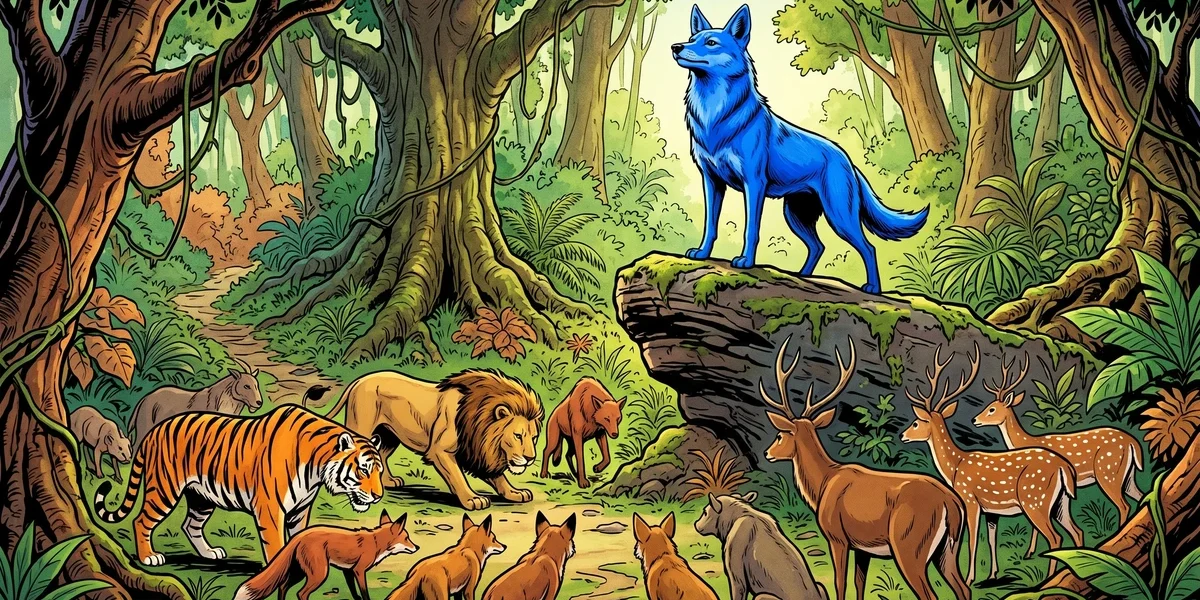
The Blue Jackal — Panchatantra, Book III: Kākolūkīyam (Of Crows and Owls)
This tale belongs to Book III of the Panchatantra, composed by Vishnu Sharma around 300 BCE, though many recensions place it independently as a standalone cautionary fable. Book III — Kākolūkīyam — concerns the dangers of deception within alliances: how false identities unravel, how pretenders are destroyed by the very act they use to maintain their pretence. The Blue Jackal is among the most widely translated of all Panchatantra tales, appearing in virtually every version from the Pahlavi original through the Arabic Kalīla wa-Dimna and the medieval European collections. Its lesson — that borrowed identity cannot survive the moment of authentic impulse — has been cited by scholars from al-Muqaffa’ to Schopenhauer.
Beat I — The Accident and Its Extraordinary Consequence
A jackal who lived on the outskirts of a city was one day chased into a dyer’s courtyard by a pack of dogs. In his panic he stumbled and fell into a large vat of deep blue indigo dye. He scrambled out, shook himself, and fled into the forest — but when he arrived among his fellow jackals, they fled from him in terror. He had become, from nose to tail, an extraordinary shade of vivid blue.
The jackal was momentarily disoriented by this response. Then his quick, scheming mind turned the situation over and found its possibilities. He retreated to a clearing and waited. One by one, the animals of the forest came to investigate this impossible blue creature — lions, tigers, elephants, bears, deer, all stopping at a cautious distance and staring.
The blue jackal drew himself up and spoke with the authority of the newly invented: “The Creator Brahma himself has sent me to you. I have been anointed with the sacred colours of the universe and appointed your king. My name is Kakudruma. No one whom I judge may appeal to another. No one whom I protect may be harmed. Obey and prosper.” The claim was preposterous; it was also exactly what every animal wanted to hear — that the uncertainty of forest life had been resolved, that a rightful authority had arrived. The animals bowed and accepted Kakudruma as their king.
Beat II — The Kingdom of the Blue Pretender
Kakudruma governed with cunning shrewdness. He surrounded himself with lions and tigers as ministers and enforcers, keeping them obedient through the mystique of divine appointment and the distribution of the meat they hunted. He drove away all the other jackals — his actual kin — lest they recognise him and expose the imposture. He ate well, slept safely, and commanded the forest’s most powerful creatures through pure persuasion.
The arrangement was stable as long as Kakudruma could maintain the role. He could not speak too freely — jackals have a distinctive cry that any forest creature would recognise. He could not be seen eating the wrong things, behaving in the wrong ways, or keeping company with the wrong animals. The performance required constant vigilance. Every day was an act.
The Panchatantra draws here a quietly devastating portrait of the costs of sustained imposture. Kakudruma had power, safety, and plenty — and he could share none of them authentically. His lions were not his friends; they were subordinates who would destroy him the moment the fiction collapsed. His authority rested entirely on the continued suppression of his actual nature. He was, in every meaningful sense, imprisoned inside the blue dye.
Beat III — The Night of the Jackals and the Fatal Howl
One evening, as the dyed blue wore thinner in places and moonlight fell across the forest clearing, a chorus of jackals began howling in the distance — the wild, cascading call that jackals produce at certain hours of the night, drawn by some instinct as inevitable as the tides. Kakudruma heard the sound. Something older than strategy moved in him.
Before his calculating mind could intervene, before performance could override impulse, he threw back his blue head and howled. The sound came out perfectly, unmistakably: the cry of a jackal. Not a god. Not a king. A jackal, responding to other jackals in the dark.
The lions heard it. The tigers heard it. Every animal in that clearing heard it — and the moment of collective recognition was immediate. The dye might have changed his colour, but it had not changed his voice, his instincts, or his deepest identity. Kakudruma was a jackal. He had always been a jackal. And the animals, who had given him their obedience on the basis of a claim that had just collapsed in one howl, fell on him and killed him.
Beat IV — Identity, Pretence, and the Limits of Performance
The Panchatantra is rarely subtle about its morals, but the Blue Jackal story has layers that survive surface reading. The obvious lesson — do not pretend to be what you are not — is correct but incomplete. The story’s deeper observation is that identity is not primarily a matter of appearance or declaration. Kakudruma looked blue, spoke divinely, and commanded lions. None of it mattered, because identity is expressed not in chosen moments of performance but in unguarded moments of impulse.
He could control his colour (until the dye wore off) and his speech (until the howl escaped him) and his associates (until the moment of recognition). He could not control the response of his nervous system to the cry of his own kind calling in the dark. The Panchatantra here anticipates something that modern psychology would formalise: that suppressed identity finds expression through exactly the channels that suppression ignores. The jackal thought he had suppressed everything that would give him away. He had not suppressed the howl.
For Vishnu Sharma’s royal students — young princes who would one day hold power — the story carried a specific warning: false legitimacy is not merely morally wrong, it is structurally fragile. The moment of authentic expression that collapses the fiction is not unusual and not preventable. It is inevitable. Build your authority on your actual nature; any other foundation will betray you at the worst possible moment.
“He who pretends to be what he is not will be destroyed by what he is.”
Why This Story Has Lasted 2,300 Years
The Blue Jackal endures because the scenario — someone who acquires extraordinary circumstances by accident and then constructs a false identity around them — is not merely a folk tale. It is a template. Every era and every culture produces people who fall into blue vats of one kind or another: accidents of birth, fortune, circumstance, or technology that confer unearned status. The Panchatantra’s question is not whether such people exist, but what happens to them when the howl comes — the moment of authentic expression that no performance can permanently suppress. The blue dye always wears thin. The jackals always call in the night.
About the Panchatantra
The Panchatantra (“Five Treatises”) was composed by Vishnu Sharma circa 300 BCE as a compendium of nītiśāstra — statecraft, ethics, and worldly wisdom — expressed through animal fables. Translated first into Pahlavi in the 6th century CE and subsequently into Arabic, Hebrew, Syriac, Greek, Latin, and all major European languages, it became one of the most widely read books in the pre-modern world. The Blue Jackal is among its most celebrated tales, cited across cultural traditions as an exploration of identity, legitimacy, and the structural instability of pretence.
Frequently Asked Questions
**Q: Why is this story important?**
You May Also Like
 Panchatantra Stories
Ages 9-12
Panchatantra Stories
Ages 9-12
Four Friends Hunter
The framing tale of Book II of the Panchatantra — a mouse, a crow, a tortoise, and a deer combine their gifts to outwit a hunter. A two-thousand-year-old story about friendship across difference, complementary strengths, and the quiet machinery of survival.
 Panchatantra Stories
Ages 9-12
Panchatantra Stories
Ages 9-12
The Story of the Four Learned Fools
The Story of the Four Learned Fools: In a certain town, there lived four Brahmins whohad become great friends. They were all extremely naiveby nature. The
 Panchatantra Stories
Ages 9-12
Panchatantra Stories
Ages 9-12
The Washerman’s Donkey
The Washerman's Donkey: In a village that existed on the boundary between civilization and wilderness, there lived a washerman named Hari who owned a donkey