The Story of Soma Sharma’s Father
The Story of Soma Sharma’s Father: In a certain village, there lived a Brahmin, by the name of Swabhavakripana He used to live by begging. Whenever he got
Origin & Canonical Placement
“The Story of Soma Sharma’s Father” is a compact fable of wishful thinking, misplaced scholarly pride, and the humiliating distance between a man’s estimate of his own value and the world’s assessment of it. It belongs to Vishnu Sharma’s Pancatantra (c. 300 BCE–300 CE) and is thematically situated within Book V: Aparikshitakaraka (“Ill-considered Action”), which catalogues the costs of acting on assumptions rather than evidence. The tale is a domestic variant of the “counting one’s chickens” pattern found also in the farmer’s wife story, but with a specifically Brahmanical flavour: the protagonist is a scholar who mistakes the value of his own erudition for a currency more widely accepted than it actually is.
“Atmanah stutih ashlaghya; parena gunah kathyante.”
“Self-praise is unseemly; virtues are spoken of by others.”
— Sanskrit maxim, Panchatantra tradition
Beat I — The Scholar and His Asset: A Son’s Scholarship as Capital
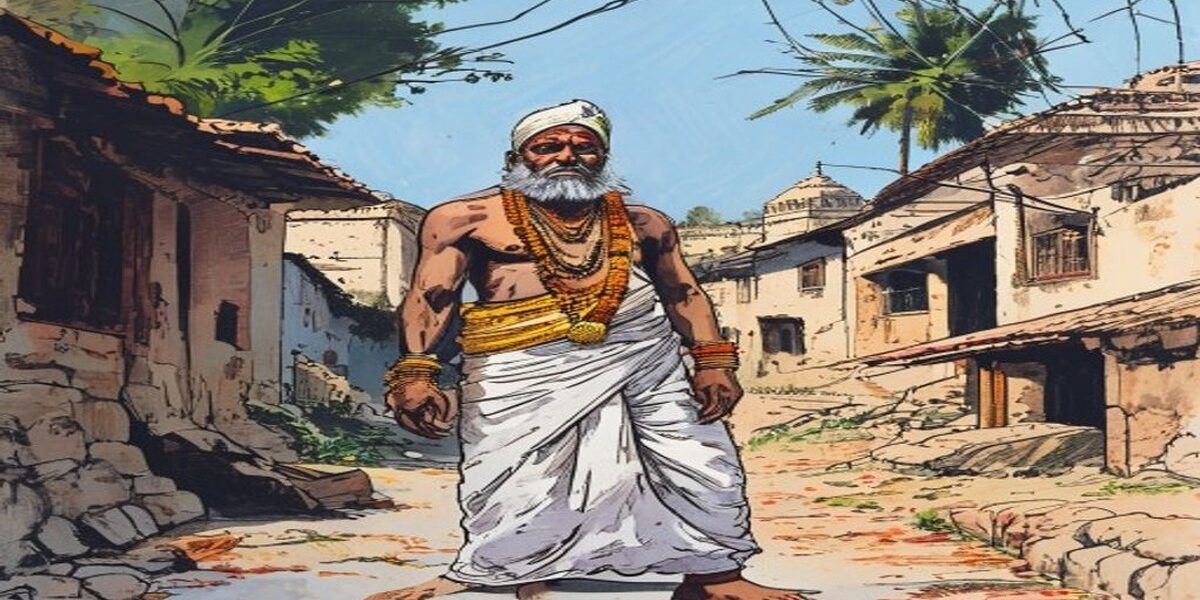
Soma Sharma’s father was a Brahmin scholar of genuine learning who had invested everything he had — his time, his modest savings, the years of his middle age — in the education of his son Soma Sharma, whom he was sending to study at a distant gurukula of high reputation. He was not a wealthy man, but he had calculated that a son educated at a great centre of learning and returned with a diploma from a celebrated teacher was an asset that would repay all investment many times over.
While Soma Sharma was away at study, his father began to count the returns in advance. He sat one afternoon in the sun outside his house and calculated: when Soma Sharma returned, renowned, he would attract the patronage of a wealthy merchant as family priest; the merchant’s household fee would allow the father to retire his small debts; surplus income would fund a second investment in land; the land would produce grain that could be sold; he would acquire a cow; the cow’s milk would provide ghee for sale at the market… The calculation grew elaborate and deeply satisfying. The father, entirely absorbed, made a physical gesture of dismissal at something in the corner of his vision — a dismissal directed at some imaginary petitioner in his imagined prosperous future. His hand struck the clay water-pot beside him. It shattered. He sat in the spreading puddle of water, returned abruptly to the present, with nothing changed except the loss of the pot.
Beat II — The Return and the Reality
Soma Sharma returned from his years of study. He had indeed learned well and earned the respect of his teacher. But the world into which he returned was not the world his father had imagined. The wealthy merchant whose patronage the father had been counting on had already retained a priest with connections more influential than a returned scholar’s fresh diploma. Other households that might have been interested had their own arrangements. The son’s genuine scholarship was real value — but value is not the same as immediate income, and immediate income was what the father’s calculations had been treating as already secured.
The father found that his elaborate mental accounting — merchant’s retainer to debt repayment to land to grain to cow to ghee — had been built on the assumption that the first link in the chain (wealthy patron immediately retained upon son’s return) was guaranteed. It was not guaranteed. It was a possibility, which is a very different thing. All the subsequent links in the chain, which had felt so solid in the afternoon sun, dissolved when the first link failed to materialise on schedule. The father had spent years of patient anticipation on a fortune that did not yet exist and might not exist in the form he had imagined.
Beat III — The Analysis: The Gap Between Potential Value and Realised Value
Vishnu Sharma uses this tale to explore a specific error in economic reasoning that is distinct from simple greed: the conflation of potential value with realised value. The father’s investment in his son’s education was rational and the son’s scholarship was genuine. The error was in the father’s assumption that potential value — a well-educated son’s earning power — would automatically convert into specific realised value (this particular merchant, this particular retainer fee, on this particular timeline) without any intervening uncertainty.
This is the error that the Panchatantra consistently identifies as characteristic of wishful thinkers: the systematic exclusion of uncertainty from planning. The farmer’s wife excluded uncertainty about the pot of rice remaining intact; the father excluded uncertainty about the social market for his son’s services. In both cases the plan was internally coherent — if the first assumption held, the subsequent steps all followed logically. The problem was the first assumption.
Kautilya’s Arthashastra is explicit that treasury calculations must be based on revenues actually received, not revenues anticipated: “Let not the king spend from the treasury except upon revenues already collected.” This rule exists precisely to prevent the kind of planning on anticipated rather than actual resources that Soma Sharma’s father practises so elaborately. The political version of his error — committing military expenditures against tax revenues not yet collected — is identified in the Arthashastra as among the most reliable paths to fiscal crisis.
Beat IV — Moral Dimension & Enduring Relevance
The tale’s specific Brahmanical context adds a dimension absent from the farmer’s wife story: the father’s calculations rest not only on his son’s scholarship but on his own assessment of that scholarship’s market value, which is significantly higher than the market’s actual assessment. This is a form of the atma-stuti (self-praise) that Sanskrit tradition consistently identifies as a cognitive and social error: estimating one’s own value at a rate the world has not agreed to pay.
Genuine scholarship has genuine value, but its conversion into economic return depends on factors outside the scholar’s control: the supply of comparable scholars, the demand of patrons at a particular moment, the personal networks that facilitate introductions. A father who has invested his emotional and material resources in a particular imagined conversion rate has no margin of adjustment when the actual conversion rate differs. He has pre-spent the gap between his estimate and reality — which is exactly the margin he needs most.
In contemporary terms, the story speaks to any person or organisation that has confused the quality of a product, credential, or capability with the certainty of its market success. Quality is necessary but not sufficient; the conversion from quality to commercial success involves uncertainties that quality itself does not eliminate. Planning as though quality guaranteed specific commercial outcomes on a specific timeline is precisely the error that shatters pots and leaves scholars’ fathers sitting in puddles of water.
Moral: Potential value is not realised value; plan for what you have, not for what you hope to have, and leave margin for the uncertainties that good intentions and genuine quality cannot eliminate.
Why This Story Has Lasted 2,000 Years
Soma Sharma’s father endures alongside the farmer’s wife as a companion study in wishful economic thinking because each embodies a slightly different variant of the same fundamental error. The farmer’s wife loses her actual asset through inattention caused by absorption in a fantasy. The father loses nothing material — his pot breaks, not his son’s scholarship — but the story’s real subject is the years he has spent in anticipatory spending of a fortune that did not arrive on schedule. Both stories teach the same lesson from a different angle: the present reality requires the attention due to the present reality, and the future can only be planned for honestly when its uncertainties are included in the plan rather than excluded from it.
About the Panchatantra
The Panchatantra (“Five Treatises”) was composed in Sanskrit by the scholar Vishnu Sharma around 300 BCE–300 CE as a niti-shastra — a guide to wise conduct and statecraft — framed as animal fables for the instruction of young princes. Its five books cover the dissolution of allies, the winning of allies, war and peace, the dangers of naivety, and the hazards of rashness. The text spread westward through Pahlavi and Arabic translations to become the most widely translated secular book of the ancient world after the Bible.
You May Also Like
 Panchatantra Stories
Ages 9-12
Panchatantra Stories
Ages 9-12
The Camel, The Jackal And The Crow
The Camel, The Jackal And The Crow: In a far off forest, there lived a lion named Madotkata served by a leopard, a jackal and a crow. One day they sighted
 Panchatantra Stories
Ages 3-5
Panchatantra Stories
Ages 3-5
The King and The Foolish Monkey
The King and The Foolish Monkey: In a magnificent kingdom surrounded by lush gardens and sparkling fountains, there once lived a powerful king who was very
 Panchatantra Stories
Ages 6-8
Panchatantra Stories
Ages 6-8
The Carpenter’s Wife
The Carpenter's Wife: Once upon a time, a carpenter lived in a village with his wife. He had heard bad stories about her and wanted to know the truth about