The Wedge-Pulling Monkey
The Wedge-Pulling Monkey: In a great forest of central India, where enormous trees grew close together and the undergrowth formed an intricate maze of paths
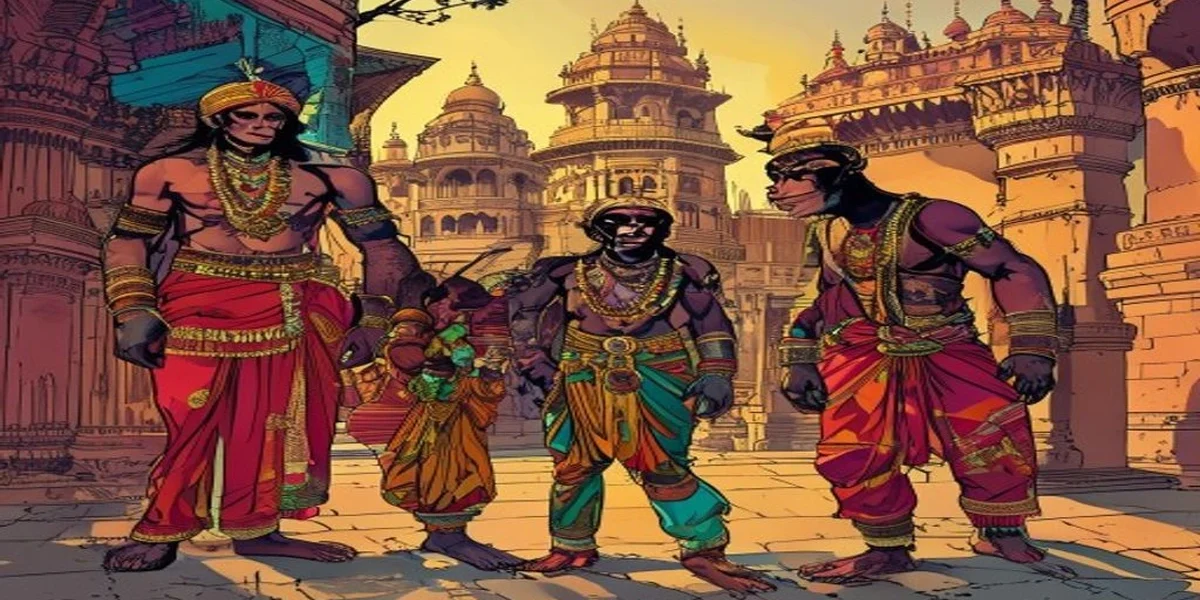
The Wedge-Pulling Monkey — Panchatantra, Book V: Aparīkṣitakāraka (Ill-Considered Action)
This tale is the canonical version of one of the Panchatantra’s most celebrated cautionary stories, appearing in the fifth book compiled by Vishnu Sharma around 300 BCE. Book V — Aparīkṣitakāraka, “Ill-Considered Action” — is the collection’s systematic treatment of the gap between what can be seen and what must be understood before acting. The Wedge-Pulling Monkey is the book’s signature illustration: a monkey interferes with a carpenter’s work during the midday rest, removes a wedge that was holding a log’s cut open, and is caught when the log closes. The tale has been translated into virtually every major language in which the Panchatantra circulates and is cited across Arabic, Persian, Hebrew, and European traditions as the definitive image of curiosity-driven self-destruction through interference in systems one does not understand.
Beat I — The Workshop at Midday
A team of carpenters was at work in a clearing, splitting a large sal log into planks. The work required a specific technique: a long cut was made partway through the log with a heavy saw, and a stout wooden wedge was driven into the cut to keep the two halves apart and under tension while the saw continued its work. The wedge was the key element of the operation — without it, the wood’s natural compression would close the cut around the saw, binding it, and preventing further progress. With it, the two halves were held open and the work could advance steadily.
At midday the foreman called a halt. The carpenters laid down their tools, left the half-sawn log with the wedge in place, and walked to the nearby village for their meal. It was the custom to leave work mid-task in this way — the log would wait, the wedge would hold, the afternoon would bring the work to completion. They had done this every day of the project without incident.
A troop of monkeys descended from the forest edge as soon as the clearing was empty. They were the usual afternoon visitors to any human work site — curious, manipulative with their hands, drawn to objects of unfamiliar shape and purpose. Most moved through the clearing examining what there was to examine: saws, chisels, wooden mallets, coils of rope, the various equipment of the carpenter’s trade. They picked things up and put them down. They tested weights and textures.
One monkey, larger and bolder than the rest, found the log. The half-sawn cut drew his attention — there was something in it, something holding the two halves apart, and the whole arrangement had the quality of a problem waiting to be solved. He straddled the log, one leg on each side of the cut, and examined the wedge with the careful attention of a creature who is about to do something irreversible.
Beat II — The Wedge, the Compression, and the Consequence
The monkey grasped the wedge with both hands and pulled. The wedge was set deep and required genuine effort; he worked at it with the single-minded persistence that characterises primates engaged with a manual problem. He tried different grips. He applied more of his body weight. He twisted and wrenched and finally, with a sudden give, the wedge came free.
The log acted immediately. Wood that has been cut and held under tension for hours does not release gradually; it releases all at once, with the full force of the compression that the wedge had been managing. The two halves of the log snapped together with a force that was, by the laws of physics, exactly as large as the force required to have held them apart. The monkey’s legs, dangling into the cut on either side, were caught between the closing halves before he could withdraw them.
He cried out. The other monkeys came to investigate and found him pinned — incapable of freeing himself, incapable of moving the log, trapped by the consequence of having released what should not have been released. When the carpenters returned from their meal and found the disrupted site, the evidence of what had happened was clear: the wedge on the ground, the log closed around the monkey’s legs, the cause and the effect in perfect, irreversible relationship to each other.
The Panchatantra closes the story without extended commentary. The physical facts carry the lesson. The monkey pulled the wedge; the log closed; the monkey was trapped. This is what happens when curiosity acts without the understanding of what is being disturbed.
Beat III — The Panchatantra’s Analysis of This Specific Failure
The Panchatantra is careful to specify what kind of failure the Wedge-Pulling Monkey represents. He is not evil. He is not malicious. He is not even unusually reckless by the standards of his kind — curiosity about objects and manipulation of them is entirely normal monkey behaviour, and it serves the species well in most contexts. The failure is not a character flaw but a situational one: monkey behaviour, entirely appropriate in the contexts for which it evolved, applied to a human-made mechanical system operating on physical principles the monkey had no means of understanding.
The wedge was holding tension. The monkey could see the wedge; he could not see the tension. He could see the cut in the log; he could not see the force the wood was exerting to close it. He could see that the wedge was removable; he could not see that removing it would release a force of precise magnitude directed at exactly the space where his legs were. The invisible determined the outcome. The visible guided the action. This gap — between what can be seen and what determines consequence — is what the Panchatantra identifies as the fundamental danger in all ill-considered action.
The Arthashastra of Kautilya makes the same analysis in the context of military and political intervention: the forces that actually determine outcomes in a complex system are rarely the visible ones. A minister who intervenes based on the visible surface of a situation, without investigating the invisible forces that surface is managing, may release consequences far larger than the visible elements would suggest. The wedge is small. The tension it holds is enormous. The minister who removes the wedge has not made a small intervention.
Beat IV — The Lesson of Position and Preparation
The Panchatantra draws one additional lesson from the monkey’s story that goes beyond the obvious warning about curiosity: the monkey’s position when he pulled the wedge was the direct cause of his injury. He was straddling the log with legs in the cut. Had he been standing to one side, the log’s closing would not have harmed him — he might still have disrupted the carpenters’ work, but he would have survived to continue being curious. The position he chose — the most natural position for examining the wedge closely and applying maximum pull force — was the position that placed him directly in the path of the force he was about to release.
This is the Panchatantra’s secondary lesson to its royal students: before any action that might release forces you cannot fully predict, consider your position in relation to those forces. This is not merely physical advice. A minister who dismantles a political arrangement that has been managing significant social tension should consider where he will be standing when that tension releases. The question is not only “should this wedge be pulled?” but “if it is pulled, where am I?”
“Before you pull the wedge, consider what is holding what apart — and where you are standing when it comes free.”
For more Panchatantra tales about decisions made before the facts are understood, compare The Washerman’s Donkey, The Potter Who Became a Warrior, and The Barber Who Killed the Monks.
Why This Story Has Lasted 2,300 Years
The Wedge-Pulling Monkey endures as one of the world’s most perfectly constructed cautionary fables because every element of it is necessary and none is extraneous. The midday rest creates the opportunity; the straddling position creates the vulnerability; the invisible tension creates the consequence; the removal of the wedge releases it. Every element that the Panchatantra includes is load-bearing — including the detail that the monkey must straddle the log to pull the wedge, which means he cannot avoid the consequence of his action. The story is as tight and as inevitable as the mechanical system it describes. This is Vishnu Sharma at his most precise: a lesson about the invisible delivered through the perfectly visible, without a word wasted.
About the Panchatantra
The Panchatantra (“Five Treatises”) was composed by Vishnu Sharma circa 300 BCE as a compendium of nītiśāstra — statecraft, ethics, and worldly wisdom — expressed through interlocking animal fables. Book V, Aparīkṣitakāraka (“Ill-Considered Action”), is devoted to stories about the gap between visible surface and invisible force — between what can be observed and what determines consequence. The Wedge-Pulling Monkey is the book’s canonical example and among the most widely translated of all Panchatantra tales, appearing in Pahlavi, Arabic, Hebrew, Latin, and all major European vernacular traditions.
You May Also Like
 Panchatantra Stories
Ages 3-5
Panchatantra Stories
Ages 3-5
The Story of Mantharaka, the Weaver
The Story of Mantharaka, the Weaver: In a certain town, there lived a weaver, by the name of Mantharaka. One day, while he was weaving, the wooden supports of
 Panchatantra Stories
Ages 9-12
Panchatantra Stories
Ages 9-12
The Four Learned Fools
The Four Learned Fools: Four learned men resurrect a dead lion, forgetting the danger they've unleashed A classic Indian folk tale retold for young readers.
 Panchatantra Stories
Ages 6-8
Panchatantra Stories
Ages 6-8
The Elephant and the Sparrow
The Elephant and the Sparrow: Even the low and humble achieve results when they work together.” A couple of sparrows lived happily in their nest on top of a