The Barber Who Killed the Monks
The Barber Who Killed the Monks: A Panchatantra Tale of Blind Imitation In the great city of Ujjain, where temples rose like mountains of stone and gold
The Barber Who Killed the Monks — Panchatantra, Book V: Aparīkṣitakāraka (Ill-Considered Action)
This tale belongs to the fifth book of the Panchatantra, compiled by Vishnu Sharma around 300 BCE — a book dedicated to cautionary stories about the catastrophic consequences of acting without adequate understanding of what one is imitating. The Barber Who Killed the Monks is among the Panchatantra’s starkest illustrations of the principle that the mere observation of an action is not the same as understanding what the action requires. A barber witnesses monks performing a ritual that, in their trained hands, is safe and spiritually meaningful. Without their training, discipline, or understanding of what the ritual involves, he attempts to replicate it. The result is irreversible. The Panchatantra names this failure precisely: not stupidity in the ordinary sense, but the specific arrogance of the imitator who believes that seeing is equivalent to knowing.
Beat I — The Monastery and the Barber’s Observation
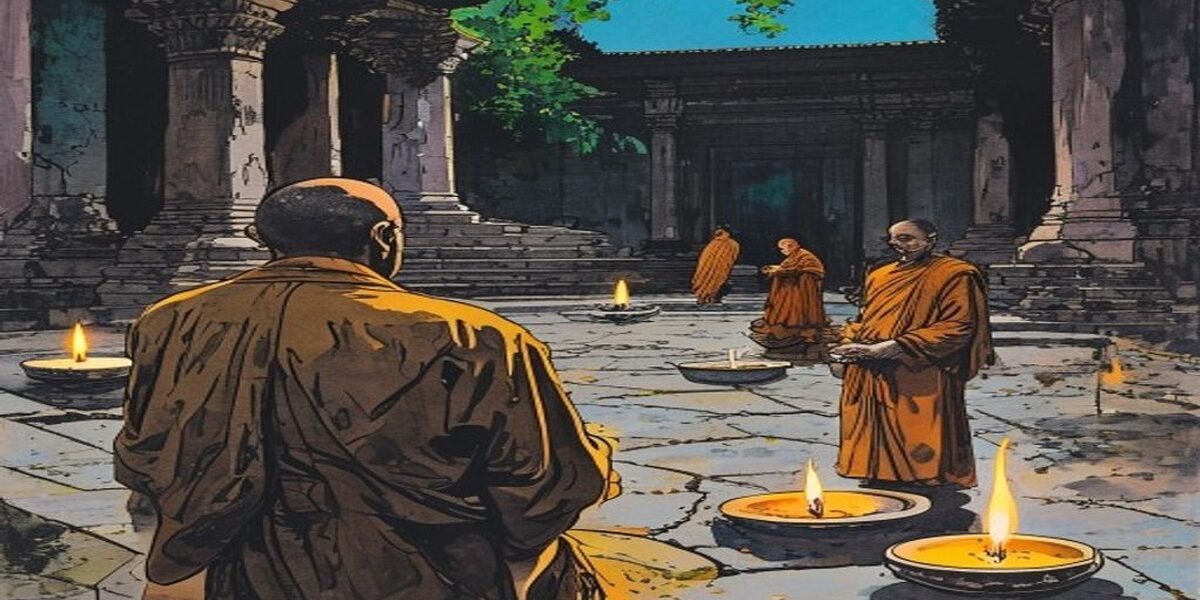
A barber lived near a monastery where a community of monks practised an ascetic discipline. Among the monks’ practices was a periodic ritual that involved the symbolic use of a blade — a ceremony that, in the hands of trained monastics who understood its meaning, its requirements, and its precise execution, was conducted with great care and produced the intended spiritual effect. The barber, passing the monastery and observing through an opening, watched the ritual with the attention of a craftsman who knows about blades: he was, after all, skilled with a razor. He thought he understood what he saw.
What the barber saw was the physical action — the movement of a blade in a specific context with specific participants. What he did not see was everything that surrounded the physical action: years of training, the specific understanding of the ritual’s purpose, the precise calibration of what the ceremony required and what it forbade, and the discipline that allowed trained practitioners to use what was potentially dangerous in a way that was actually safe. The physical action, removed from its context of training and understanding, was simply a dangerous act performed with a blade.
The barber decided to replicate the ritual. He had his razor. He had observed the physical movement. He did not believe that anything the monks could do was beyond the reach of a man skilled with a blade. He went home and attempted the ceremony on members of his own household. The consequences were exactly what the Panchatantra’s readers would expect and the barber had not imagined: the blade, in the hands of someone who understood the physical action but not the trained discipline and precise knowledge that made the physical action safe, produced harm rather than the ceremony’s intended effect.
Beat II — The Anatomy of Blind Imitation
The Panchatantra’s analysis of this failure is precise about what the barber lacked. He did not lack intelligence in the ordinary sense; a barber who lacks ordinary intelligence does not successfully ply his trade over years. He did not lack skill with a blade; his skill with a razor was genuine and acknowledged. What he lacked was the understanding of what specifically made the monks’ ritual safe — the specific training, the specific context, the specific purpose that transformed a dangerous physical action into a beneficial one.
Blind imitation — the attempt to replicate an observed outcome without understanding the conditions that make the outcome possible — is the failure mode Book V of the Panchatantra catalogues most carefully. The monk’s ritual was not safe because of the physical motion of the blade. It was safe because of everything surrounding and informing that motion. The barber copied the motion and discarded, without knowing he was discarding them, all the elements that made the motion safe.
The Arthashastra of Kautilya makes a parallel observation in the context of statecraft: a minister who observes a successful policy in a neighbouring kingdom and attempts to import it without understanding the specific conditions — social, economic, administrative — that made it successful in its original context, will find that the policy produces different results in the different context. The physical form of the policy (its rules, its implementation mechanism) is not what made it succeed. What made it succeed was its fit with specific conditions. Change the conditions and the form produces different outcomes.
Beat III — What Observation Produces and What It Does Not
The Panchatantra distinguishes carefully between two kinds of knowledge that observation can appear to produce but only sometimes actually does. The first is knowledge of what: what the physical action looks like, what sequence it follows, what tools it uses. This is what observation reliably provides. The second is knowledge of why: why the action is performed in this specific way, what specific understanding guides each element of its execution, what the training behind the action consists of, what makes the apparent form safe or effective. This is what observation alone rarely provides, because the why is mostly invisible — it exists in the minds and trained bodies of the practitioners, not in the observable surface of the action.
The barber had excellent knowledge of what. He had no knowledge of why. His confidence in the sufficiency of what-knowledge was the specific error that the Panchatantra identifies as dangerous: not the ignorance itself — ignorance is correctable — but the failure to know that he was ignorant of the why, which made him incapable of seeking the training that would have provided it.
Vishnu Sharma’s royal students were being taught to distinguish between observing a policy, a military formation, or an administrative procedure in operation and understanding what makes it work. The gap between these two things — visible to those who know about the gap and invisible to those who do not — is precisely where blind imitation fails.
Beat IV — The Permanence of the Consequence
The Panchatantra does not soften this story’s ending. The barber’s mistake is permanent in its effects — the harm he caused cannot be undone, the opportunity to understand before acting has passed, and no amount of subsequent learning can restore what was lost in the moment of ill-considered imitation. This is the specific register of Book V: not the correctable mistakes of Books I through IV, where the consequences leave survivors who can learn, but the irreversible mistakes of actors who have not understood that their understanding was insufficient before they acted.
The lesson is not that imitation is inherently wrong. The Panchatantra teaches through examples and precedents — it is itself a form of encoded wisdom meant to be observed and applied. What it teaches about imitation is the requirement of a specific intermediate step: between observing a practice and attempting to replicate it, the learner must seek and acquire the understanding of why the practice works as it does. This step — the pursuit of actual understanding rather than confident replication of observed form — is the one the barber did not take, and could not take, because he did not know enough to know that the step existed.
“He who imitates the form without understanding the why has not learned anything — he has merely acquired a more dangerous form of ignorance.”
Why This Story Has Lasted 2,300 Years
The Barber Who Killed the Monks endures because blind imitation — copying the observable form of a practice without the understanding that makes that form safe or effective — is among the most persistent and destructive failure modes in human behaviour. Every era produces people who observe a practice producing good results and replicate the observable features of the practice without the understanding that produces the results. The Panchatantra’s contribution is to name the specific gap — between knowledge of what and knowledge of why — and to insist that this gap, invisible to the imitator precisely because of the imitator’s confidence, is where the blade slips.
About the Panchatantra
The Panchatantra (“Five Treatises”) was composed by Vishnu Sharma circa 300 BCE as a compendium of nītiśāstra — statecraft, ethics, and worldly wisdom — expressed through interlocking animal and human fables. Book V, Aparīkṣitakāraka (“Ill-Considered Action”), is the Panchatantra’s systematic treatment of the gap between observation and understanding, and of the irreversible consequences that follow when actors confuse the two. Translated into Pahlavi, Arabic, Hebrew, Latin, and all major European languages, the Panchatantra became one of the most widely read books in the pre-modern world.