The Merchant and the Bullock
A bullock left behind in the forest befriends a mighty lion - until a jealous jackal whispers lies.
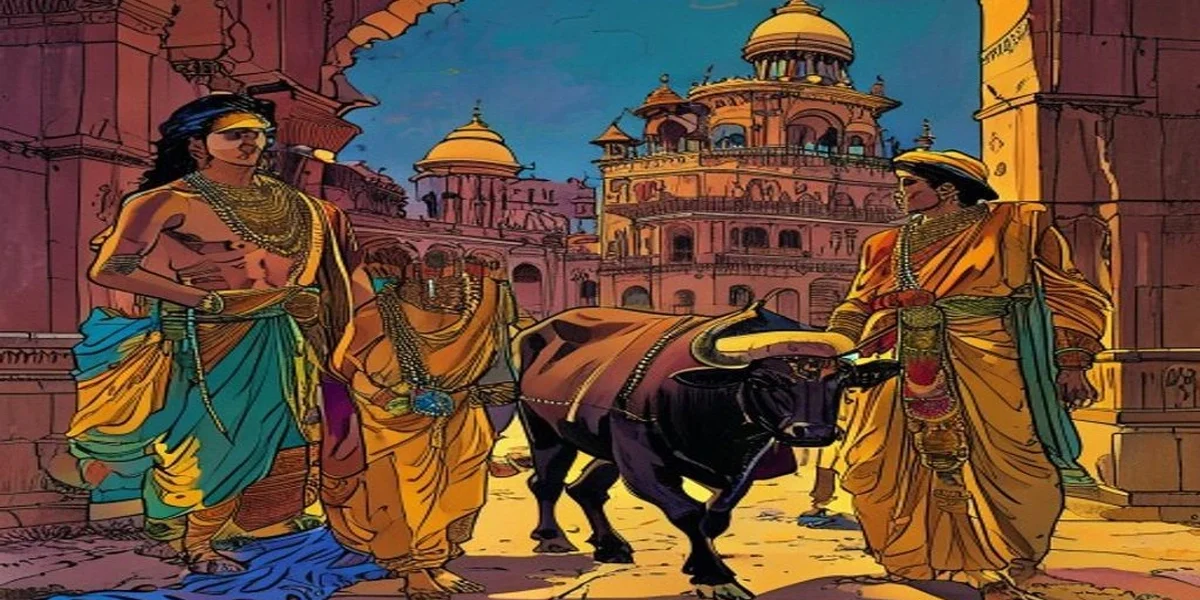
The Merchant and the Bullock — Panchatantra, Book I: Mitra-bheda (The Loss of Friends)
This tale appears in the opening frame story of the Panchatantra, composed by Vishnu Sharma around 300 BCE as a compendium of nītiśāstra — the science of wise conduct. The Panchatantra’s framing device centres on a wealthy merchant named Vardhamana whose bullock Sanjivaka collapses on a forest road; the merchant, pressed for time, abandons the animal to fate. Sanjivaka recovers through sheer vitality, grazes the forest, and grows magnificent — setting in motion the chain of acquaintance, trust, and betrayal that drives the entire first book. The story distils two of the Panchatantra’s deepest preoccupations: the gap between intent and consequence, and the ethics of responsibility toward dependants.
Beat I — The Journey and the Abandonment
Vardhamana was a prosperous merchant of Mathura who loaded a great caravan of oxen and set off southward on a trading venture. Among his bullocks was Sanjivaka, a magnificent white beast — the pride of the herd, strong-necked and willing. Halfway through the Vindhya forest, Sanjivaka stumbled on a patch of treacherous mud and collapsed, one leg wrenched badly beneath him. He bellowed and strained, but could not rise.
Vardhamana dismounted and examined the injured leg with a practised eye. The journey was long, the monsoon was threatening, and his trading partners in the south awaited goods with fixed deadlines. Every calculation of commerce whispered the same answer: one bullock, however fine, was not worth the ruin of an entire caravan. He issued orders to his men — leave fodder and water near the animal, post a brief watch for two days, and if Sanjivaka had not risen by then, leave him to the forest and move on.
The watch-men, frightened of tigers and eager to catch the departing caravan, stayed only a few hours before slipping away. When they rejoined Vardhamana, they reported what they had not witnessed: that Sanjivaka had died peacefully in the night. Vardhamana accepted the account, conducted a brief prayer for his faithful ox, and pressed forward without looking back.
But Sanjivaka had not died. He lay in the mud as the sounds of the caravan faded, then began, inch by laborious inch, the work of survival. Rain came. He drank from a muddy pool beside him. Grass grew thick at the forest’s edge. Days passed, and the leg mended, and then — miraculously — Sanjivaka rose.
Beat II — The Forest Transformed
Free of yoke and goad for the first time in his life, Sanjivaka discovered a different world. The Vindhya forest along the Yamuna was lush with the first monsoon rains — tall grasses, wild sugarcane, clear streams tumbling over pale stones. He grazed at leisure, rolled in river shallows, and grew sleek and enormous. Without the daily labour of commerce, his body expanded into its full potential. His bellowing, which had once been the strained complaint of a working ox, became a thunderous declaration that echoed across the forest and sent smaller animals scattering.
It was this bellow that reached the ears of Pingalaka, the lion-king of that forest. Pingalaka had never heard a sound so large — not the roar of rival lions, not the trumpet of elephants. He gathered his court and confessed, with the candour that distinguishes the truly powerful from the merely proud, that the sound had frightened him. His two jackal ministers, Karataka and Damanaka, saw immediately what Pingalaka did not: that the voice belonged to a grass-eater, not a predator. Damanaka, the more ambitious of the two, volunteered to investigate and broker an introduction.
Damanaka found Sanjivaka grazing peacefully and learned his story — the merchant, the mud, the abandonment, the recovery. When Damanaka reported back to Pingalaka and described this huge, gentle, forest-enriched creature, the lion-king’s fear curdled into fascination. He wanted to meet this Sanjivaka. And so began the friendship — lion and bullock, forest predator and former merchant’s beast — one of the most unlikely companionships in world literature.
Beat III — On Abandonment, Recovery, and the Ethics of Dependence
The Panchatantra embeds a precise moral examination within the story’s apparent simplicity. Vardhamana is not painted as a villain. His abandonment of Sanjivaka was calculated, not cruel — the kind of cold arithmetic that commerce everywhere demands. Yet the Panchatantra refuses to let that calculation stand as wisdom. The lie of the watchmen (reporting a death they did not witness) compounded Vardhamana’s error and stripped him of any chance to correct it. Both acts — the merchant’s expedient abandonment and the watchmen’s convenient falsehood — set in motion consequences neither could foresee.
Sanjivaka’s recovery challenges the merchant’s entire framework of calculation. The bullock whom commerce had written off as a liability became, in freedom, an asset so magnificent he attracted the attention of a lion-king. The Panchatantra suggests that living beings, when given conditions to flourish, often exceed every expectation based on their performance under constraint. This principle had direct application for rulers calculating the worth of subjects, ministers weighing the loyalty of subordinates, and merchants assessing the value of servants.
The Arthashastra of Kautilya, composed in the same era, advises rulers to distinguish between soldiers who fail under poor leadership and soldiers who are genuinely incompetent. Vardhamana lacked the patience to apply this distinction to his own bullock. The forest applied it without effort — and Sanjivaka became proof of the principle. Vishnu Sharma does not belabour the point; he simply shows us the gap between what the merchant’s calculus predicted and what actually occurred.
Beat IV — The Moral in the Bones of the Story
The merchant and the bullock open the Panchatantra’s longest and most intricate book not because their story is the most dramatic — it isn’t — but because it establishes the collection’s foundational question: what do those with power owe to those who depend on them? Vardhamana owed Sanjivaka the benefit of doubt. The watchmen owed Vardhamana honest reporting. Pingalaka, later in the book, will owe Sanjivaka the loyalty of a true friend — and his failure there, engineered by Damanaka’s scheming, will be the book’s great catastrophe.
Each failure of responsibility in the Panchatantra ripples outward. The merchant’s expedient decision becomes the precondition for a friendship that becomes the precondition for a betrayal. Vishnu Sharma is teaching his royal students — the three dull princes whom legend says he educated through these tales — that the consequences of choices made under pressure are never confined to the immediate moment. A bullock abandoned in a forest becomes a king’s companion; a king’s companion, mistrusted, becomes a kingdom destabilised.
“He who abandons a servant in difficulty, gains an enemy in prosperity.”
Why This Story Has Lasted 2,300 Years
The Merchant and the Bullock endures because it refuses easy targets. Vardhamana is not wicked — he is practical in the way that practical people always are, right up to the moment their practicality produces disaster. The watchmen are not malicious — they are afraid and tired and human. Sanjivaka is not heroic — he simply refuses to die and then eats grass. Yet from these perfectly ordinary decisions and non-decisions, the Panchatantra builds the scaffolding for one of literature’s most studied explorations of friendship, trust, and betrayal. The tale shows us that the largest consequences grow from the smallest abandonments.
About the Panchatantra
The Panchatantra (“Five Treatises”) was composed by Vishnu Sharma circa 300 BCE as a manual of nītiśāstra — statecraft, ethics, and worldly wisdom — expressed through animal fables. Translated into Pahlavi in the 6th century CE and thereafter into Arabic (Kalila wa Dimna), Syriac, Hebrew, Greek, Latin, and eventually all major European languages, it became one of the most widely circulated books in pre-modern world literature. Its five books use nested story-within-story frames to teach five principles: the danger of allowing friends to be separated, the difficulty of making friends, the rewards of diligence, the consequences of rashness, and the perils of impulsive action.
Frequently Asked Questions
**Q: Why is this story important?**
You May Also Like
 Panchatantra Stories
Ages 3-5
Panchatantra Stories
Ages 3-5
The Brahmin’s Dream of Pots of Rice
A hungry Brahmin dreams of turning one pot of rice into a kingdom — and loses it all with a single careless kick.
 Panchatantra Stories
Ages 9-12
Panchatantra Stories
Ages 9-12
Four Friends Hunter
The framing tale of Book II of the Panchatantra — a mouse, a crow, a tortoise, and a deer combine their gifts to outwit a hunter. A two-thousand-year-old story about friendship across difference, complementary strengths, and the quiet machinery of survival.
 Panchatantra Stories
Ages 9-12
Panchatantra Stories
Ages 9-12
The Story of the Heron And’ the Crab
An ancient Panchatantra tale teaching timeless wisdom about virtue and character.