The Musical Donkey
Read 'The Musical Donkey' — a classic Panchatantra story about nature and animals. The Musical Donkey is a beloved Panchatantra tale featuring a donkey ...
The Musical Donkey
Source: Panchatantra, Book V — Apariksitakarakam (Ill-considered Action), attributed to the sage Vishnu Sharma, composed c. 300 BCE–300 CE; this redaction follows the Sanskrit Tantrakhyayika recension and A. N. D. Haksar’s annotated translation (HarperCollins India, 1998).
न काले वक्तव्यं वचनं हितम्आत्मनःः
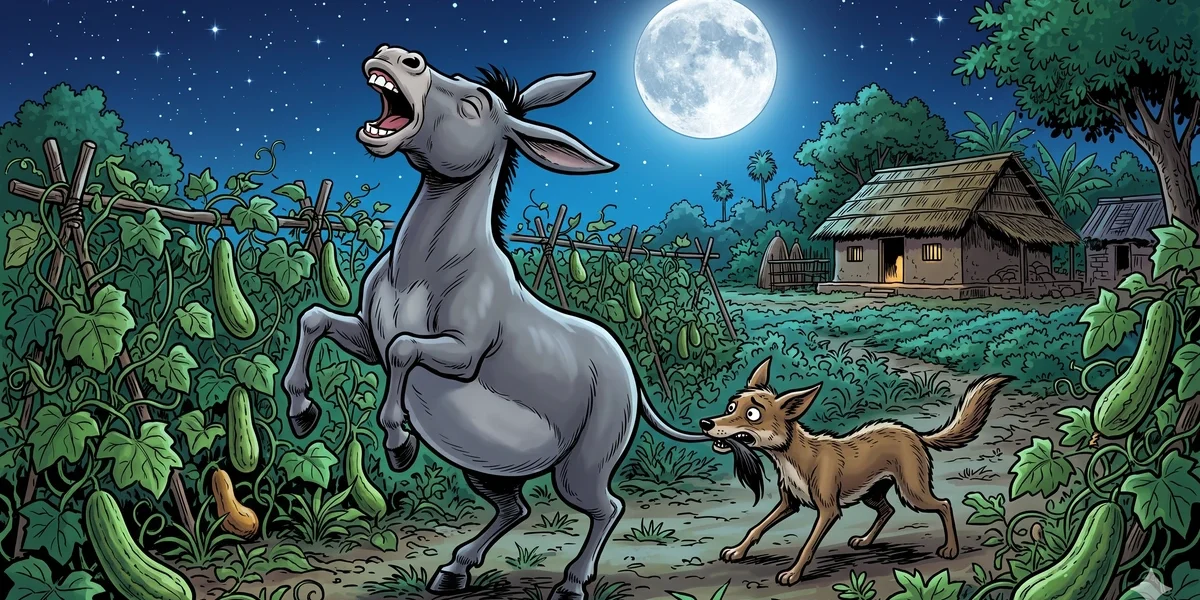
A donkey who has been eating farmers’ crops in secret by night discovers a new passion: he wishes to sing. His companion, a jackal, warns him repeatedly and with increasing urgency that donkeys braying in the night will alert the farmers and bring violence upon them both. The donkey insists on the beauty of his voice and the rightness of his impulse. He sings. The consequences arrive exactly as predicted. This tale is the Panchatantra’s most pointed fable about the gap between desire and judgment, and one of its funniest — though its comedy is entirely at the expense of the character who fails to listen.
Part I: The Partnership and the Impulse
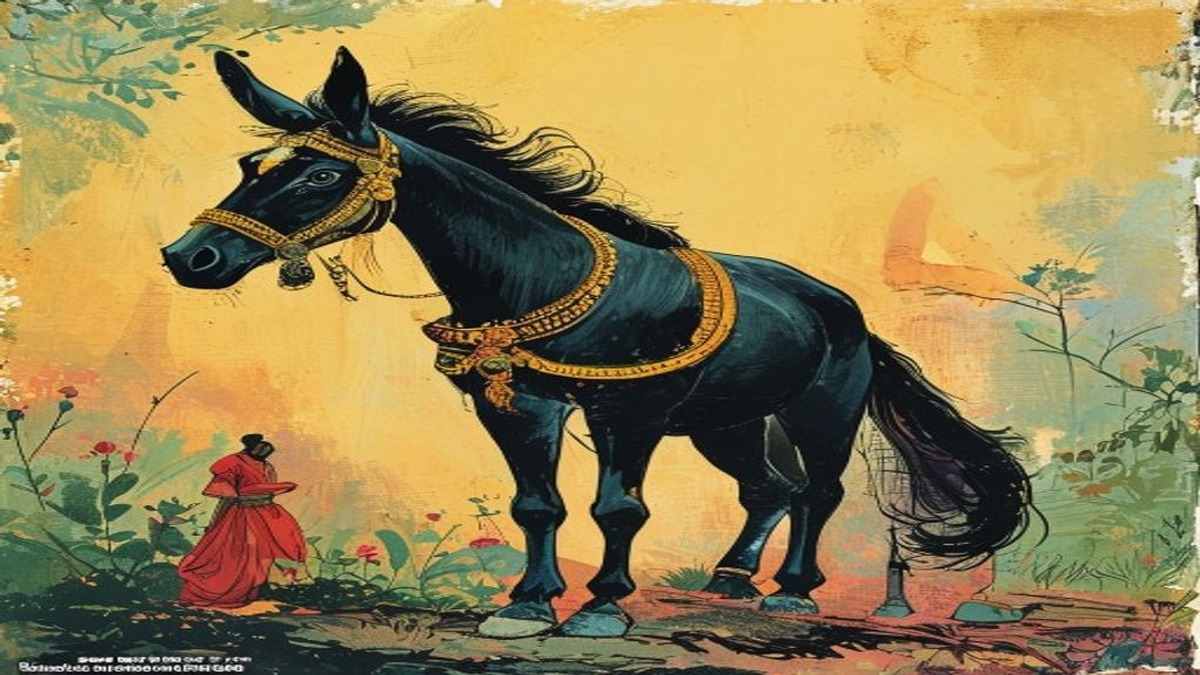
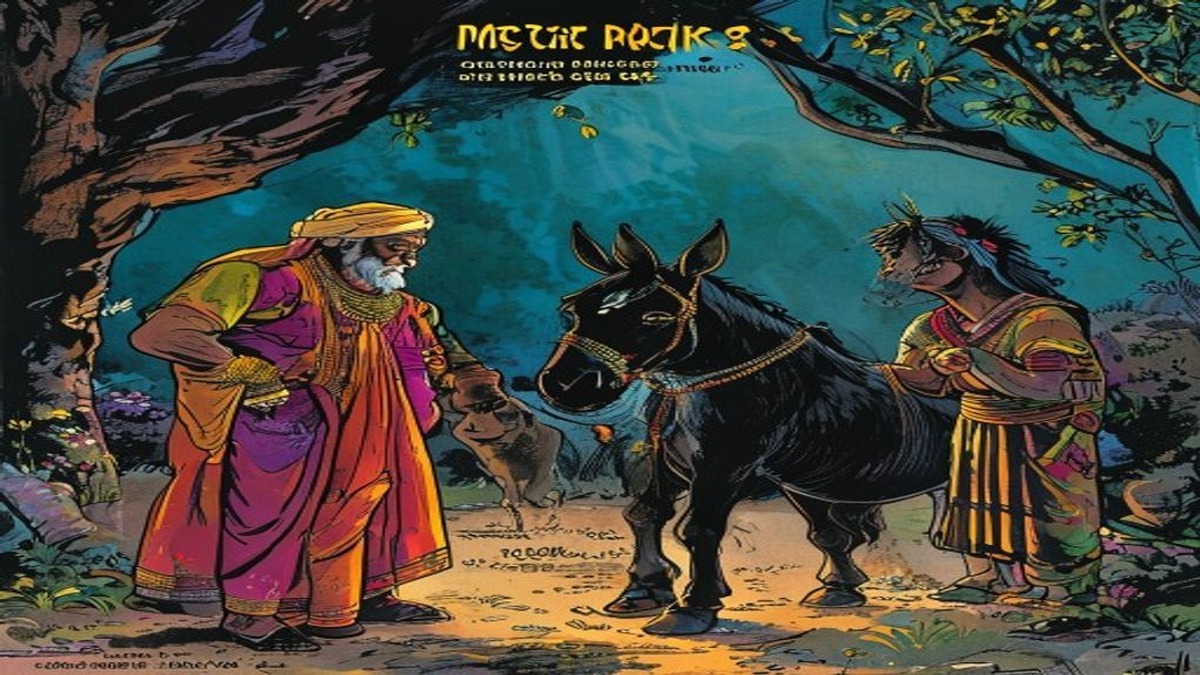
In the countryside near the city of Vardhamana there lived a washerman’s donkey named Uddhata who had, over several seasons of overwork and underfeeding, developed the habit of escaping his enclosure at night and raiding the farmers’ cucumber fields. He had acquired a companion in this enterprise: a jackal named Gomukha, who found the fields equally hospitable and had the additional virtue of being an excellent lookout, his hearing far sharper than the donkey’s and his nose attuned to the approach of torches long before they became visible.
The arrangement worked well. Uddhata ate; Gomukha ate; neither was caught. The key to their success was the same in all seasons: absolute silence after the village dogs had finished their evening barking. In the silence of the deep night, two animals eating in a field are nearly invisible to sleeping farmers. One animal braying in a field at midnight is a catastrophe.
On the particular night that concerns us, Uddhata had eaten exceptionally well. A surfeit of cucumbers had produced in him a condition of physical well-being so complete that it overflowed into something like joy, and joy in a donkey expresses itself in a very specific way. He raised his head, opened his mouth, and prepared to bray.
Gomukha felt this preparation with his whole body before the sound arrived. He was at the donkey’s side in an instant. “Uddhata,” he said, very quietly and very fast, “do not do this. There are five farmhouses within hearing distance of this field. If you make that sound the farmers will wake and beat us both. We will be lucky to reach the road.”
Uddhata lowered his head briefly. Then he raised it again. “You do not understand,” he said. “I feel an impulse toward song. This impulse is genuine. It would be dishonest to suppress a genuine impulse.”
Part II: The Argument
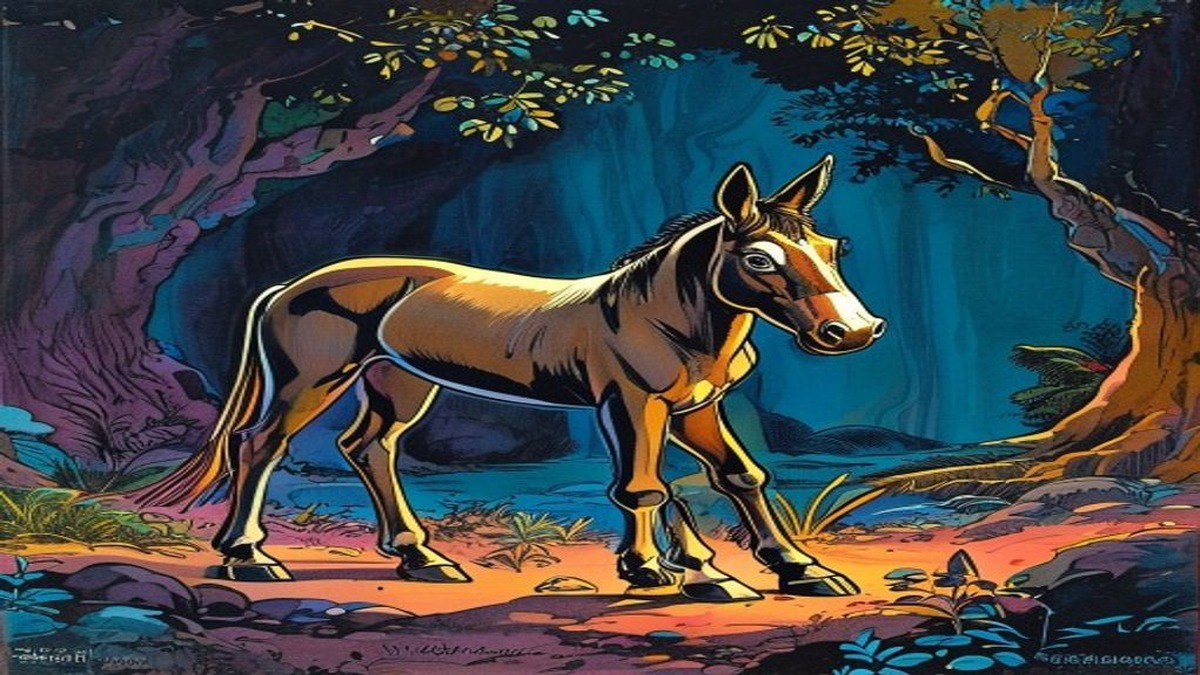
The debate that followed is one of the Panchatantra’s most entertaining passages, and one of its most instructive. Gomukha was a capable arguer. He made the practical case first: the night, the farmers, the sticks, the likely outcome. Uddhata dismissed this as excessive caution. Gomukha then tried the aesthetic case: a donkey’s bray, whatever its sincerity, was not what the night wanted. “The season is hemanta,” he said, “the cold month. The appropriate music for this hour is the owl and the cricket. A bray in this context is not song; it is noise.”
“That is your opinion,” said Uddhata. “My opinion is that I have a voice of great power and that the night would be improved by hearing it.” He paused, then added with the dignity of a connoisseur: “The sound of the dundubhi drum is harsh to those who have not been trained to hear its depth. That does not mean the drum should not be played.”
Gomukha looked at the donkey for a long moment. “The dundubhi is played at festivals in daylight, surrounded by people who expect it,” he said. “It is not played at midnight in a sleeping farmer’s cucumber field.” He paused, then made his final and most honest argument: “Uddhata. You are not a musician. You are a donkey who is full of cucumbers and would like to bray. These are not the same thing.”
Uddhata was, by this point, immune to argument. The desire to bray had grown during the debate — suppressed desire often does — until it was no longer a preference but a conviction. He had convinced himself, in the way that creatures do when they wish very much to do something, that the thing he wished to do was also the right thing to do. He told Gomukha that he would sing, and that Gomukha could leave if he wished to avoid the rewards of great music.
Gomukha, who was genuinely fond of the donkey and also genuinely did not wish to be beaten by farmers, retreated to a safe distance at the field’s edge. “I will be here,” he said, “for when you need to run.”
Part III: The Song and Its Reception
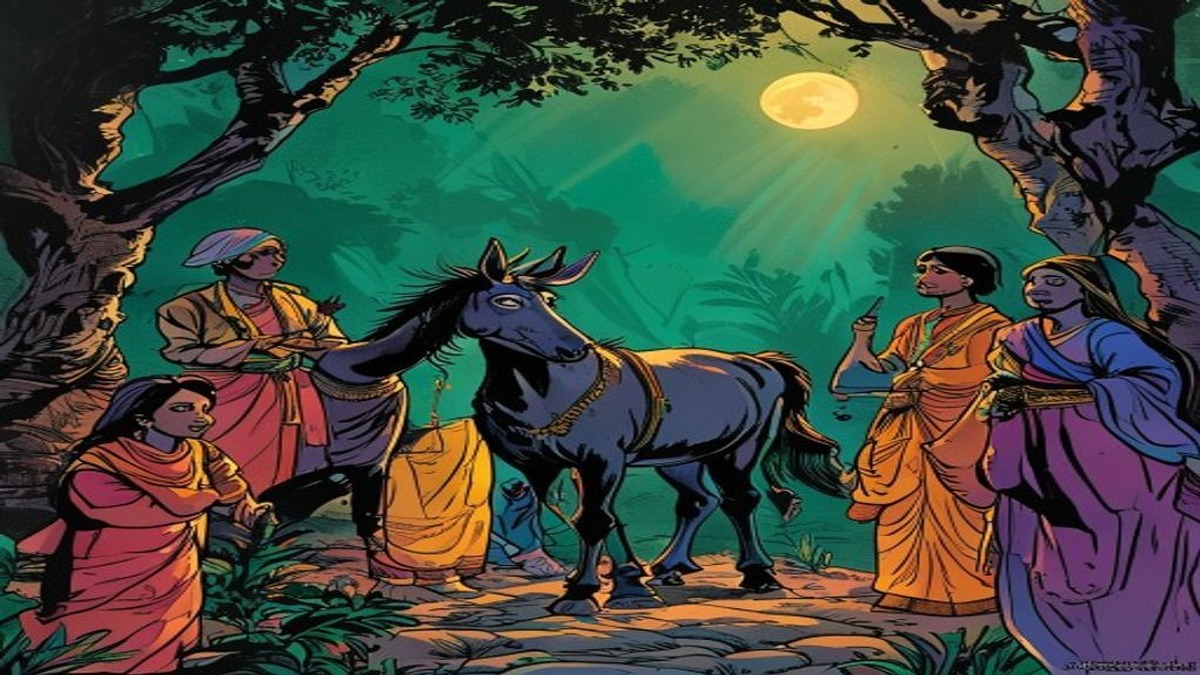
Uddhata brayed. It was, by any honest assessment, a very loud bray. It carried across the field, through the village hedges, into the sleeping farmhouses, under the doors of the dog-pens, and to the ears of every light-sleeping farmer within a considerable radius. It had the pure, carrying quality of a sound designed by evolution to project across long distances — which it had been, for purposes entirely unrelated to musical expression.
The farmhouses lit up in sequence, like a chain of lamps. The dogs began. Voices called to other voices. The specific phrase “donkey in the cucumber field” can move sleeping farmers to their feet with remarkable speed, and it did so now. By the time Uddhata had completed his second bray — for he had barely begun and felt he was just finding his voice — there were lights moving toward the field from three directions and the sound of wooden implements being picked up.
Gomukha had already gone. He had waited as promised, had assessed the situation in the time between the first bray and the first lit lamp, and had made the reasonable calculation that his presence at the field’s edge served no further purpose. He was a fast runner and the night was dark; by the time the farmers arrived he was already in the tree-line.
Uddhata was caught mid-bray. The farmers beat him thoroughly — the text does not dwell on this but does not spare it either — and he was tied to a post for the remainder of the night. By morning his washerman had been summoned, and the donkey returned to his enclosure bruised in several places where the cucumber plants had been and where his singing impulse had been.
Part IV: What the Story Teaches
The story’s moral is delivered not through Uddhata’s suffering but through Gomukha’s analysis the following evening. He found the donkey, treated his injuries with some sympathy, and then said: “The impulse you felt was real. I do not dispute that. The question was never whether you felt it but whether the moment was right to express it. A real feeling expressed at the wrong time, in the wrong place, to the wrong audience, produces exactly the same outcome as a wrong feeling expressed anywhere. The feeling does not protect you; the judgment about when to act on it does.”
Uddhata, who was sore and inclined to listen in a way he had not been the previous night, heard this. The text does not record what he said in response, which is characteristic of Vishnu Sharma’s narrative economy: some lessons do not need to be confirmed by the student. The condition of the student is confirmation enough.
The Sanskrit commentarial tradition places this tale alongside “The Lion that Sprang to Life” as the two defining stories of Book V: both are about the catastrophic consequences of proceeding without examining the situation first. The scholars who restore the lion do so from pride in their expertise; the donkey sings from the conviction that his impulse is automatically valid. Both confuse the existence of a capacity with the wisdom of using it. Both are correct.
Why This Story Has Lasted Three Thousand Years
“The Musical Donkey” has survived because it addresses one of the most persistent and uncomfortable features of human psychology: the tendency to mistake strong desire for good judgment. Uddhata does not bray because he is stupid; he brays because he wants to, and because the wanting is so strong it generates a supporting argument — the impulse is genuine, the night deserves music, the jackal is simply timid — that sounds like reasoning but is actually just desire dressed in the clothes of reason.
The story’s comedy makes this uncomfortable point palatable. Because Uddhata is a donkey and because Gomukha’s warnings are so obviously correct and so obviously ignored, the audience can laugh at the gap between desire and wisdom without feeling personally accused. But the laughter is also recognition: everyone who has ever been warned against doing something they very much wanted to do and done it anyway has been Uddhata in the cucumber field at midnight.
The tale travelled through Arabic Kalila wa Dimna, where it became a fable used by medieval Islamic advisors to counsel rulers against impulsive proclamations. In later European versions it attached to various characters — the peacock who screams at the wrong moment, the rooster who crows before dawn — but the structure remained unchanged. The core mechanism — a creature warned, a warning dismissed with elaborated justification, a consequence that validates the warning exactly — is among the most durable story patterns in world literature, precisely because it never stops being true.
Frequently Asked Questions
What is the moral of The Musical Donkey?
The story teaches that a genuine impulse or feeling does not automatically justify acting on it. The donkey's desire to sing is real, but the time, place, and situation make expressing it disastrous. True judgment means knowing not only what you feel or want, but whether the moment is right to act on that feeling. Strong desire, when mistaken for good judgment, produces the same harm as bad judgment.
Which book of the Panchatantra does this story come from?
The story comes from Book V, Apariksitakarakam (Ill-considered Action), the book of stories about proceeding without examining consequences first. It is often discussed alongside The Lion that Sprang to Life as the two defining examples of Book V's central argument: that capacity without judgment is dangerous.
Who is Gomukha the jackal and what role does he play?
Gomukha is the donkey's companion and the voice of practical wisdom in the story. He gives the correct advice, gives it clearly, gives it multiple times in different forms, and is entirely ignored. His role is to make the warning so obvious that when the consequence arrives, it is unmistakable as a validation of what he said. His survival — he escapes to the tree line — also illustrates that the wise companion of an impulsive creature should maintain an independent exit strategy.
How does the donkey justify singing despite the jackal's warnings?
Uddhata constructs a layered justification: first that the impulse is genuine and genuine impulses should not be suppressed; then that his voice has real depth and beauty; then that the jackal simply lacks the aesthetic education to appreciate it. The Panchatantra presents this as a portrait of motivated reasoning — desire generating arguments that sound like logic but are actually just desire in disguise.
How did this story spread beyond the Panchatantra?
The story entered Arabic Kalila wa Dimna and was used by medieval Islamic advisors as a cautionary fable against rulers who act on impulse without counsel. In European versions the donkey became a peacock, rooster, or other creature prone to conspicuous noise at inconvenient moments, but the structure — warning given, warning ignored with elaborate justification, warning validated by exact consequence — remained unchanged across all adaptations.
You May Also Like
 Panchatantra Stories
Ages 9-12
Panchatantra Stories
Ages 9-12
The Story of the Lion and the Donkey
The Story of the Lion and the Donkey: In a certain jungle, there lived a lion, by the nameof Karalakesara. He had a servant, a jackal named Dhusaraka, who was
 Panchatantra Stories
Ages 9-12
Panchatantra Stories
Ages 9-12
Right-Mind and Wrong-Mind
Right-Mind and Wrong-Mind: Avoid the company of the wicked or you will pay a heavy price for it.” Once upon a time there were two friends in a small village
 Panchatantra Stories
Ages 3-5
Panchatantra Stories
Ages 3-5
The Monkey and The Wedge – For Children
The Monkey and The Wedge – For Children: Once upon a time in a town, a rich merchant decided to build a temple in his courtyard. He assembled many skilled