The Four Treasure-Seekers
Read 'The Four Treasure-Seekers' — a classic Panchatantra story about moral lessons about greed. The Four Treasure-Seekers is a beloved Panchatantra tal...
About This Story
Collection: Panchatantra (Sanskrit: Pancatantra, “five treatises”), Book V — Apariksitakarakam (“Hasty Action”)
Attributed to: Vishnu Sharma, c. 3rd century BCE, composed to instruct three reckless princes in governance and niti-shastra
Theme: The danger of unchecked greed — the one who cannot stop when satisfaction is within reach loses everything
Mythological source: The spinning wheel of Kubera (god of wealth) as a divine deterrent appears in the Mahabharata (Vana Parva) and the Vishnu Purana
Arabic transmission: Related “wheel of punishment” motifs appear in Ibn al-Muqaffa’s Kalila wa-Dimna (8th century CE)
Tale-type: ATU 1645B (Greed Goes Too Far) — variants appear across South Asian, Persian, and Central Asian narrative traditions

I. Four Poor Friends and a Yogi’s Gift
In a prosperous town in ancient India, four Brahmin friends shared everything: their meals, their Sanskrit verses, their long debates about scripture, and their poverty. They had studied hard and prayed faithfully, but the wealth they had hoped learning would bring them had never arrived. Year after year they watched wealthier households prosper around them and felt the quiet shame of men who cannot provide what they believe they deserve.
One evening, as they sat together after a spare dinner of plain rice, they reached a decision. The town had given them nothing. The world was large. They would leave and find their fortune elsewhere. They said their farewells to friends and relatives, packed what little they owned, and set off without any fixed destination in mind — only the conviction that somewhere beyond the horizon, better things awaited.
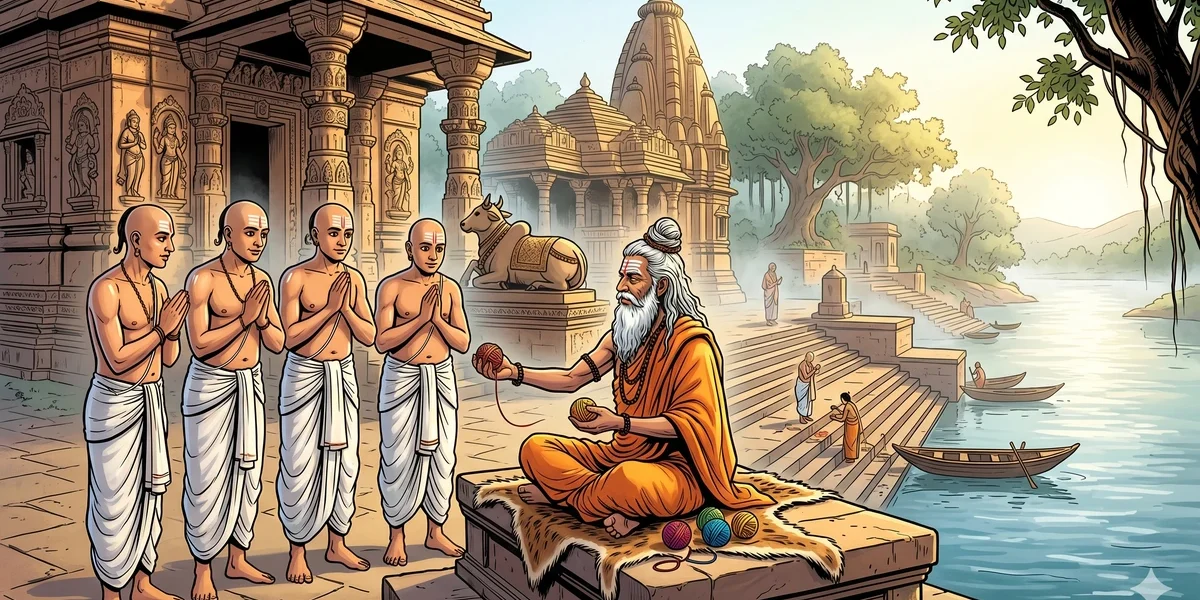
After many days of walking they came to a thriving city they had never visited, with bustling markets and a great Shiva temple on the bank of a clear river. They bathed in the river, made their offerings at the temple, and while resting in the temple courtyard they fell into conversation with an aged Yogi who had made the hermitage nearby his home for decades.
The Yogi saw their gaunt faces and worn sandals and asked gently who they were and what had brought them so far from home. They explained their situation with complete honesty — the poverty, the shame, the desperate hope that somewhere there was treasure waiting for men willing to walk far enough to find it.
The Yogi listened in silence, then went to a small wooden box and returned with four cotton wicks — the kind used to light oil lamps, soft and ordinary in appearance. He placed one in each man’s palm.
“Take these and walk toward the Himalayas,” he said. “Do not look for the direction — simply walk. At some point, one of you will accidentally drop his wick. Wherever the wick falls, dig. You will find treasure buried there. Take it and return home content. That is all you need to do.”
The four Brahmins bowed to the Yogi, tucked the wicks safely in their bundles, and set off north toward the mountains.

II. Copper, Silver, Gold: Three Who Knew When to Stop
They walked for several days through forest and plain, climbing gradually as the air grew cooler and the road thinner. On the third day, the first Brahmin stumbled on a stone and his wick slipped from his fingers to the earth. He stared at the spot for a moment, then remembered the Yogi’s words and knelt to dig.
Within a few inches of topsoil he struck the edge of a large clay pot, and within that pot he found copper coins — more copper than he had ever seen in his life, enough to keep a household comfortable for many years. He looked up at his three companions, his face flushed with joy.
“Come, this is enough for all of us! Four men cannot carry more than this between them. Let us take what we can and go home.”
His three friends considered the copper carefully. One of them put it plainly: “You were destined to copper. Perhaps we are destined to something more. Take your treasure and go home safely. We will continue.” The first Brahmin needed no more persuading. He filled his bag with as many coins as he could carry and headed home a contented man.
The remaining three walked on for several more days. The second man dropped his wick at the edge of a pine forest, dug, and found a sealed bronze urn full of silver. Again he invited his companions to join him in turning back; again they declined gently. The second Brahmin returned home rich in silver and richer still in the knowledge that he had accepted what the universe had offered him.
The third Brahmin’s wick fell in a mountain meadow blanketed with wildflowers. He dug and found a stone-lined pit packed with gold — bars of it, heavy and yellow in the afternoon light. He turned to his one remaining companion, a man whose wick still lay undisturbed in his palm.
“Brother, look at this. We have copper, silver, and gold behind us. Come home with me now. Whatever you find cannot be worth more than sharing gold with a friend.”
But the fourth Brahmin shook his head. He was not angry, not dismissive — only certain. The pattern was too clear to ignore. Copper had given way to silver; silver to gold. What came after gold? Diamonds, surely. Pearls. Jewels beyond imagining. He had been patient this long. Why stop now? The third Brahmin, unable to move his friend’s mind, agreed to stay beside the gold and guard it until his companion returned from whatever lay ahead.

III. The Wheel of Kubera
The fourth Brahmin walked on alone. The mountain path grew steeper and the air thinner. By midday the sun was punishing and there was no stream in sight. By afternoon he was so thirsty that the thought of diamonds had retreated behind the more immediate thought of water. He had completely lost the path and was walking in wide circles without realising it.
Then, in a small clearing at the edge of a rocky outcrop, he found a man standing very still. The man’s face and arms were smeared with dried blood, and above his head, spinning without stopping, was a great iron wheel — turning like a millstone, suspended in air by no visible means, and clearly causing tremendous pain.
The fourth Brahmin, in his thirst, forgot everything else. “Please tell me where I can find water,” he said. “You there, with the wheel on your head — where is the nearest water?”
The instant those words left his mouth, the wheel rose from the standing man’s head and descended onto his own. The pain was immediate and enormous — the weight of iron, the sharp edges, the relentless spinning — and he gasped and cried out.
The man who had been freed stood for a moment in visible relief, rubbing his temples. Then he explained what had just happened.
“This wheel is a device of Kubera, the god of wealth, designed to protect the treasure of this place from greedy men. Only a person carrying one of the Yogi’s magical wicks can reach this spot at all. When such a person speaks to the one carrying the wheel, the wheel transfers. I do not know how long I have been here. It was in the time of King Rama that I came this way, also following a magical wick, also unwilling to stop at gold. I found someone here before me, as you found me. And now you will remain until the next one comes — immune to hunger, thirst, aging, and death — but not to pain.”
He bowed respectfully, picked up his ancient walking staff, and left without looking back.
The fourth Brahmin stood in the clearing with the wheel spinning above his head. The treasure of Kubera glittered on the ground all around him. He was surrounded by diamonds, by gems of every colour, by gold beyond counting — and he could not touch a single piece.

IV. The Friend Who Could Only Watch
Back in the mountain meadow, the third Brahmin grew worried as the hours lengthened and his friend did not return. He decided to follow the path his companion had taken, and after considerable searching he found him: bloodied, in pain, the iron wheel turning above his head in the thin mountain air.
The third Brahmin ran forward. “What has happened? How can I help?”
The fourth Brahmin told him the whole story through his tears — the man he had found, the words he had spoken, the transfer of the wheel. He asked nothing of his friend because there was nothing to ask. No human hand could remove Kubera’s device. Only another wick-carrier’s words could transfer it, and the third Brahmin had no wick.
The third Brahmin stood in the clearing for a long time. Finally he said, with as much kindness as he could manage: “You are learned. You know the Panchatantra and the Mahabharata and all the verses about the nature of desire. You knew that copper led to silver and silver to gold. You knew the pattern. And yet you could not stop. Even being a scholar, you lacked the sense to govern your own greed. There is nothing I can do for you. I must go.”
He walked back through the mountains, collected the gold from the meadow pit, and made his long journey home. The fourth Brahmin remained in the clearing, immortal and in pain, surrounded by the greatest treasure in the world, unable to use any of it.
Moral
Santosham paramam sukham.
“Contentment is the highest happiness.”
— Sanskrit proverbial tradition, also cited in the Mahabharata, Shanti Parva 177.52
The story is mathematically elegant in its structure: three men who stop at the right moment go home wealthy; one man who cannot stop goes home not at all. Vishnu Sharma does not present this as bad luck or divine punishment in the moralistic sense. It is presented as the natural, inevitable consequence of greed’s own logic. The pattern of copper — silver — gold announced unmistakably that each increment brought the next, but also that each increment had a ceiling. The fourth Brahmin understood the pattern but refused to accept that it had a ceiling. He was not punished for greed; he was consumed by it.
Why This Story Has Lasted 2,300 Years
The image at the heart of this tale — a man standing in the middle of immeasurable treasure, unable to touch it, suffering without end — is one of the most powerful in classical Indian narrative. Vishnu Sharma did not need to invent it; images of Kubera’s treasury and the penalties attached to approaching it appear throughout the Mahabharata and the Puranas. What he did was embed this mythological image inside a quiet, realistic story about four ordinary men making ordinary economic decisions. The supernatural ending arrives as the logical conclusion of very human choices.
The story’s threefold structure — copper, silver, gold — is borrowed from the arithmetic of escalation. Each increment convinces the fourth Brahmin that the next must be greater, because each has been. This is the structure of all addictive escalation: the next one will be better; the next one will finally be enough; the next one is the one that justifies all the others. The Panchatantra presents this logic not as stupidity but as a recognisable human experience. The fourth Brahmin is not foolish — he is correct about the pattern. He is wrong only about one thing: that the pattern continues forever.
What makes the tale unusual among classical moral fables is its compassion for the fourth Brahmin. He is not mocked. When his friend finds him at the end, the scene is genuinely sad. The friend acknowledges that the fourth Brahmin is learned — he knows all the right things. His failure is not intellectual but volitional: knowing and stopping are different capacities, and scholarly training develops only the first. This is the same insight that drives the tale of the four learned fools, which appears in the same fifth book of the Panchatantra: knowledge without practical wisdom (viveka) is not enough.
The Kubera device — a spinning wheel of pain that transfers when a wick-carrier speaks — is a remarkable invention. It suggests that greed is not uniquely one person’s failing: it is a kind of wheel that passes from generation to generation, held by each sufferer until the next arrival. The man who finds the fourth Brahmin has been there since the time of King Rama — mythologically, an incalculable age. Greed’s victims have always been there, and always will be. The wheel just keeps transferring.
In the 21st century the tale resonates with particular force in discussions of financial markets, where the logic of “copper — silver — gold” drives leveraged speculation, and where the person who cannot exit at gold reliably reaches the wheel. Versions of the fourth Brahmin populate every economic bubble in recorded history. That is why the story keeps being retold: because the wheel keeps appearing, and it always comes as a surprise to the person who receives it.
Frequently Asked Questions
Is this from the Panchatantra?
Panchatantra Book V (Apariksitakarakam), Vishnu Sharma, c. 3rd century BCE.
Who is Kubera?
The Hindu god of wealth; his spinning wheel punishes mortals who try to steal his treasury.
What Sanskrit concept does the fourth Brahmin illustrate?
Lobha (greed) overwhelming artha (legitimate wealth-seeking) when viveka (wisdom) is absent.
What is the magical wick?
A lamp-wick (varti) charged by the Yogi; its accidental dropping reveals the bearer's destined treasure.
How does this compare to the Midas myth?
Midas receives catastrophe at once; the fourth Brahmin is offered three clear exits (copper, silver, gold) and ignores each one.
You May Also Like
 Panchatantra Stories
Ages 9-12
Panchatantra Stories
Ages 9-12
The Story of the Merchant’s Son
The Story of the Merchant's Son: Do your best but leave it to destiny.” Sagardatta was a merchant who had a handsome young son. One day, he observed that his
 Panchatantra Stories
Ages 9-12
Panchatantra Stories
Ages 9-12
The Story of the Female Mouse
The Story of the Female Mouse: On the bank of the river Ganga, there was a beautifulashrama. The water from the river gushed down onrocks, making a tremendous
 Panchatantra Stories
Ages 6-8
Panchatantra Stories
Ages 6-8
The Price of Indiscretion
Read 'The Price of Indiscretion' — a classic Panchatantra story about moral lessons about greed. The Price of Indiscretion is a beloved Panchatantra tal...