The Story of the Elephant and the Sparrow
The Story of the Elephant and the Sparrow: Somewhere in the jungle, a pair of sparrows hadmade their nest in a Tamal tree. In due course, thefemale sparrow
The Story of the Elephant and the Sparrow
Source: Panchatantra, Book III — Kakolukiyam (Of Crows and Owls), attributed to the sage Vishnu Sharma, composed c. 300 BCE–300 CE; this redaction draws on the Sanskrit critical text and A. N. D. Haksar’s annotated translation (HarperCollins India, 1998), with attention to the full alliance-building sequence recorded in the extended recension.
सही शत्रुं जयति बलिनाम् लূनऀ मित्रैर् सहायितःः
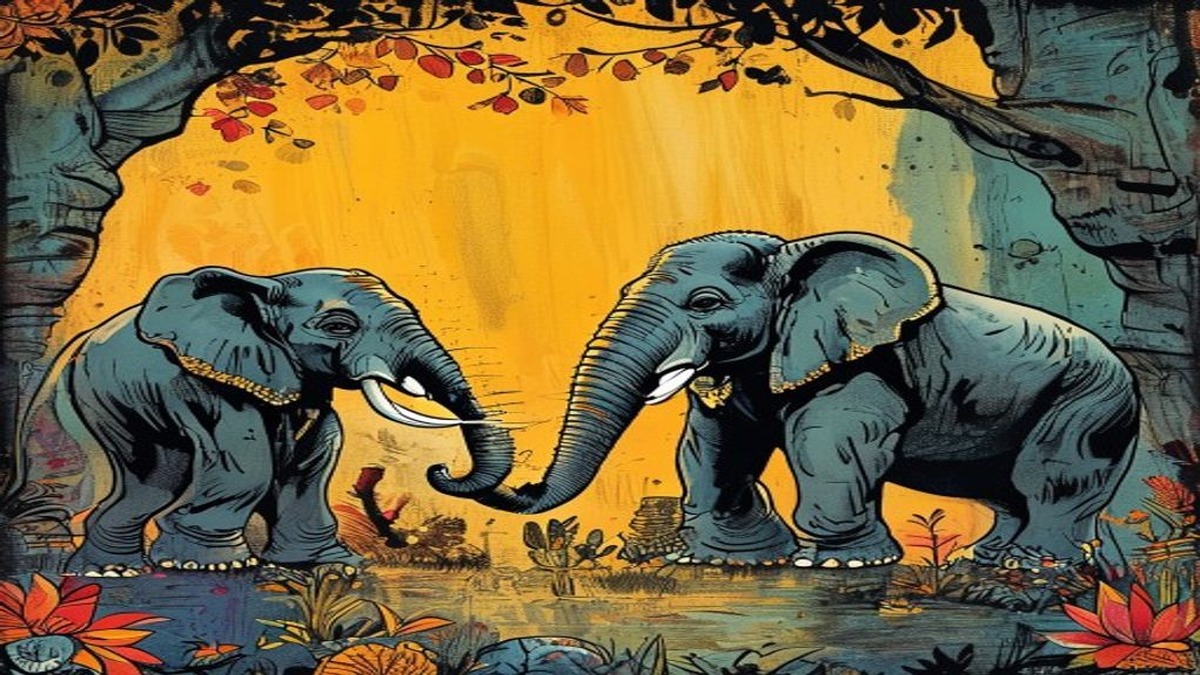
A sparrow’s nest is destroyed by a careless elephant who does not notice what he has crushed. The sparrow, bereaved and furious, builds a coalition: a woodpecker, a fly, and a frog, each contributing a different and essential capability. Together they blind the elephant, lead him to a cliff, and drive him to his death. The tale is the Panchatantra’s most detailed illustration of coalition warfare — the principle that the right alliance of different capabilities, precisely coordinated, can defeat any individual power regardless of its size.
Part I: The Grief and the Plan
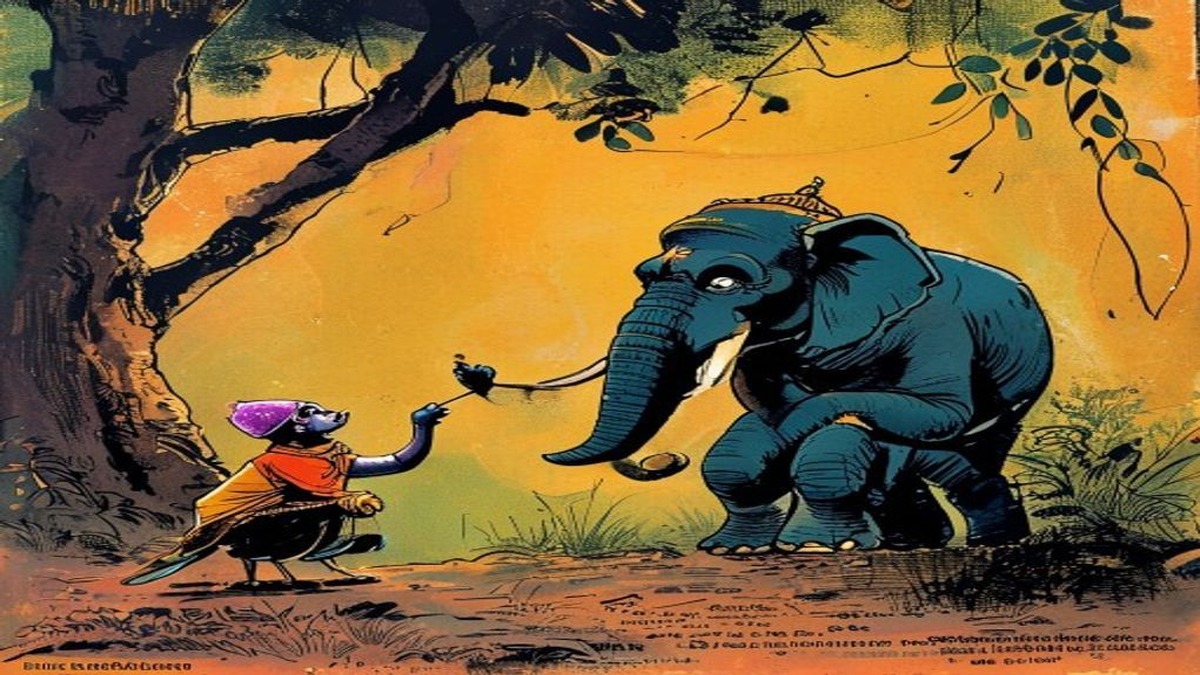
In the eastern forest a sparrow named Vichitrakantha had built her nest in the fork of a low palasha tree and laid four eggs. The nest was well-made and the eggs were close to hatching. An elephant named Madonmatta — the name means “maddened by excitement” — passed through that part of the forest during the heat of the day, seeking shade, and used the palasha tree to scratch his flank. The tree shook; the nest fell; the eggs were crushed underfoot before the elephant noticed there was anything to notice.
Madonmatta walked on. He was not malicious. He had simply not seen what he destroyed, which is the particular cruelty of casual power: it does not need to intend harm to cause it, and it does not need to register the harm it has caused to continue causing it.
Vichitrakantha’s grief was followed by something that grief, in the Panchatantra, almost always produces in its most capable characters: a question. Not “why did this happen?” but “what can I do about it?” The answer to the first question is “because the elephant is large and you are small” — which is true, useless, and uninstructive. The answer to the second question requires the construction of a coalition, and Vichitrakantha began with the member she knew best.
She went to her friend Vinaditaka the woodpecker and told him what had happened. The woodpecker was a practical bird who understood immediately that the sparrow could not address the elephant alone. “We will need a fly,” he said, “and a frog. I know where to find both.”
Part II: The Coalition and Its Capabilities
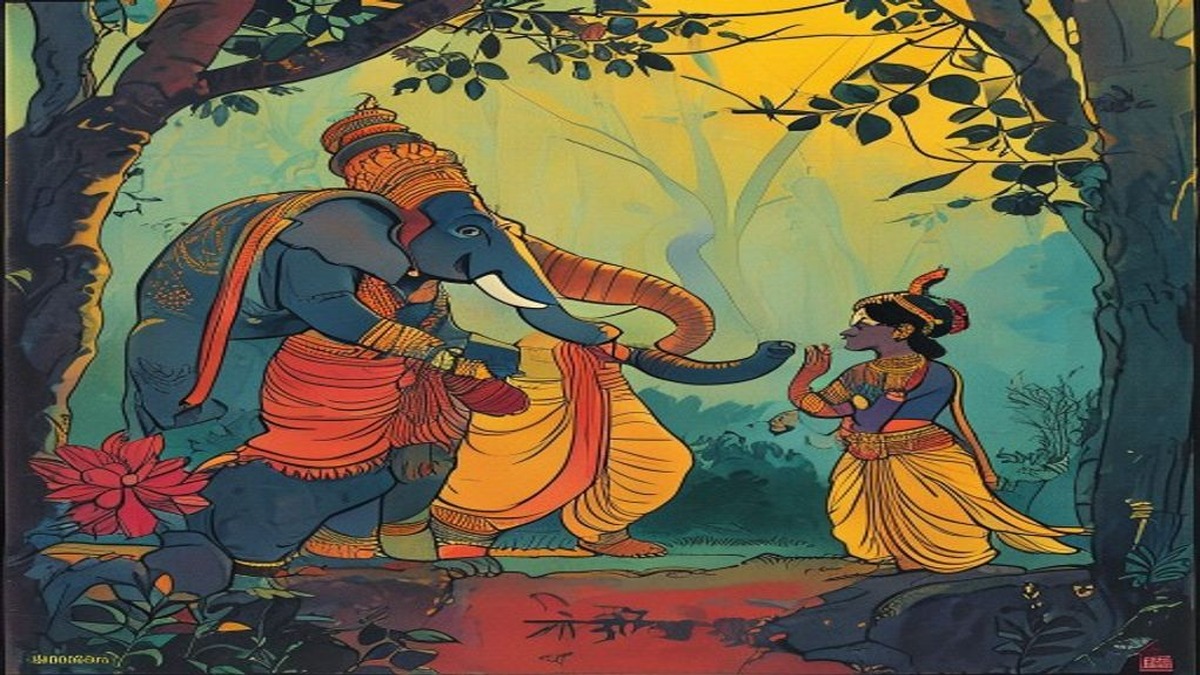
The four creatures met that evening. Each brought a different and essential capability to the coalition’s plan, and Vishnu Sharma records the assembly of these capabilities with the care of a strategist documenting a proven method.
Vinaditaka the woodpecker could strike the elephant’s eyes with precision — his beak was designed for exactly the kind of targeted percussion that could damage a specific small area without close-range contact. He would blind the elephant.
Meghanada the fly could enter the elephant’s ears and produce the kind of disorienting buzz that drives large animals to irrational movement. An elephant whose ears are invaded by a fly loses its reliable sense of spatial orientation — a fact that any creature who has observed elephants during fly season can confirm. Meghanada would disorient him.
Gambhiraghosha the frog could call from a specific location in a specific way. The elephant, blinded and disoriented, would follow the sound of water — which frogs reliably suggest to thirsty animals. Gambhiraghosha would direct him.
Vichitrakantha’s role was coordination: she knew the forest terrain, knew where the cliff was, knew the timing that would be required. She would conduct the operation.
The plan had the elegant coherence of a design where each component is necessary and no component is sufficient alone. The woodpecker alone produces a blinded but still-oriented elephant who can find water. The fly alone produces a disoriented but still-sighted elephant who can navigate. The frog alone produces a direction that a sighted elephant will not follow blindly. Together, in the correct sequence, they produce a blinded, disoriented elephant following a sound toward a cliff in country he cannot see.
Part III: The Execution
They waited for midday — the heat of the day, when the elephant would be thirsty and moving toward water, and when the sun would be at the angle that a blinded animal would not notice the shadow of a cliff until he was at its edge.
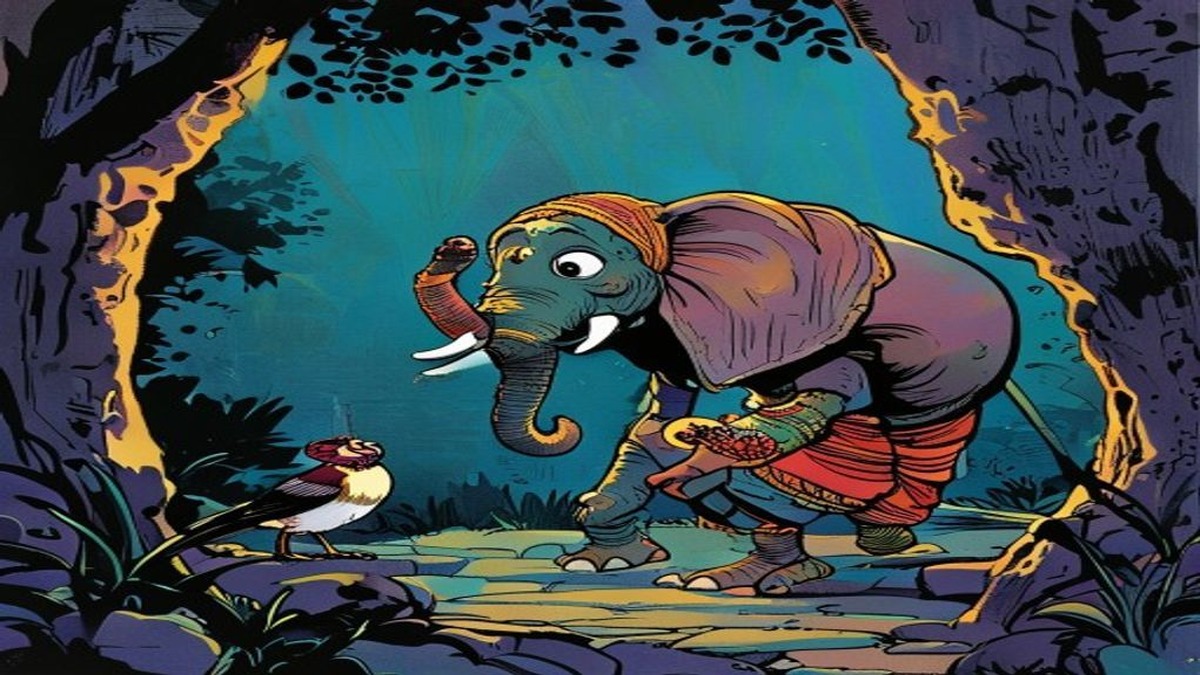
Vinaditaka struck both eyes in rapid succession. The elephant reared and stamped but could not locate his attacker. Meghanada entered his right ear. The buzzing was immediate and overwhelming — the elephant shook his head, walked in circles, lost the cardinal directions he had previously held. Gambhiraghosha called from the direction of the cliff, from the ledge just above its edge, a deep and resonant croak that any thirsty animal would follow as the sound of standing water.
The elephant followed the sound. He moved slowly, carefully — blinded animals are careful — but steadily in the direction Gambhiraghosha indicated. Vichitrakantha watched from above, tracking the progress of each element. The coordination had been discussed in detail; each participant knew exactly when to continue and when to stop.
At the cliff’s edge, the ground changed character under the elephant’s feet — but not enough to warn him before the last step. Madonmatta fell. He was a large elephant and the cliff was not negligibly high. He did not survive the fall.
The four allies separated and returned to their own lives. No one in the forest attributed the elephant’s death to anything other than an unfortunate accident: a blinded animal, disoriented, who had walked off a cliff in unfamiliar terrain. Which was, in a strictly factual sense, exactly what had happened.
Part IV: What the Story Teaches
Vishnu Sharma’s analysis at the close of the tale is one of his most extended treatments of alliance theory. He identifies the two conditions that made the coalition succeed where individual action could not: complementary capabilities and precise sequencing.
Complementary capabilities means that each coalition member contributed something the others could not. A coalition of four woodpeckers would have blinded the elephant more efficiently but could not have directed him. A coalition of four frogs would have produced a direction but nothing to follow it with. The specific combination of different capabilities — sight destruction, orientation destruction, directional deception, and coordinating intelligence — was the source of the coalition’s power, not the number of its members.
Precise sequencing means that the capabilities were deployed in the order that made each subsequent capability more effective. Blindness before disorientation makes the disorientation total; disorientation before direction makes the direction unchallengeable; direction without resistance leads to the cliff. Any other sequence reduces the plan’s effectiveness: disorientation before blindness allows a sighted animal to compensate; direction before disorientation allows a oriented animal to evaluate the sound’s source.
The Panchatantra’s broader argument, stated through the sparrow’s leadership of the coalition, is that the design of a coordinated plan is itself a form of power that does not depend on individual strength. Vichitrakantha could not have killed the elephant; she could design the coalition that did. Design, in this frame, is the weak creature’s highest capability — and the one that the strong most consistently fails to account for.
Why This Story Has Lasted Three Thousand Years
“The Story of the Elephant and the Sparrow” endures because it is the most complete illustration in ancient literature of a principle that modern military theory calls “combined arms”: the coordination of different capability types in precise sequence to produce an effect that no single capability could generate alone. The story’s four-member coalition — each member contributing a different and essential element — is a narrative description of force multiplication through specialisation and coordination.
The tale entered Arabic Kalila wa Dimna and was widely cited in Islamic military and political literature as a model for alliance formation — the argument being that a coalition of the right composition and correct sequencing is more powerful than any individual member of the opposing side, regardless of that individual’s size. In Persian political poetry the story was used to argue that the small and weak have a natural interest in coalition that the large and strong lack, which is why the large consistently underestimate the organizational capacity of the small.
For modern readers the story resonates in every context where organisations or individuals with complementary capabilities can defeat a common opponent that each could not address individually. The coalition’s design — identify the target’s vulnerabilities, find the capabilities that address each vulnerability, sequence the deployment, coordinate the execution — is a template as applicable to modern strategic planning as to a medieval forest. The elephant’s death is the product not of the sparrow’s grief but of her intelligence in asking the right question: not “how do I fight the elephant?” but “who has what I need, and in what order should it be used?”
Frequently Asked Questions
What is the main lesson of the Elephant and the Sparrow story?
Small creatures united by purpose can overcome even the mightiest adversary. The coalition of sparrow, woodpecker, fly, and frog succeeds not through strength but through complementary skills and coordinated action.
Which Panchatantra book contains this story?
The story appears in Panchatantra Book III, the Kakolukiyam section, which focuses on the theme of making and breaking alliances.
What role does each animal play in defeating the elephant?
The woodpecker blinds the elephant; the fly buzzes in its ears causing disorientation; the frog calls from the direction of a pit, luring the elephant to fall in; the sparrow coordinates the entire plan.
Is this story found in other world literature?
Parallel themes appear in Aesop's fables about small animals banding together, and the motif of the powerful brought low by the insignificant is common across Indian, Greek, and Persian storytelling traditions.
What Sanskrit concept does this story illustrate?
The story illustrates the concept of Sandhi (alliance) — one of the six measures of statecraft in ancient Indian political philosophy described in texts like the Arthashastra.
You May Also Like
 Panchatantra Stories
Ages 3-5
Panchatantra Stories
Ages 3-5
The Foolish Crane and The Mongoose
The Foolish Crane and The Mongoose: A big banyan tree was home to a number of cranes in a forest. In the hollow of that tree lived a cobra, which used to feed
 Panchatantra Stories
Ages 3-5
Panchatantra Stories
Ages 3-5
5 Panchatantra Stories About Animals That Kids Love
5 Panchatantra Stories About Animals That Kids Love: Kids love stories with animals in them. Stories of dense forests, strange birds and animals, beautiful
 Panchatantra Stories
Ages 3-5
Panchatantra Stories
Ages 3-5
Suchimukha and The Monkey
A Panchatantra fable about a well-meaning bird named Suchimukha, a troop of cold monkeys, and the danger of giving advice where none is wanted.