The Foolish Crane and The Mongoose
The Foolish Crane and The Mongoose: A big banyan tree was home to a number of cranes in a forest. In the hollow of that tree lived a cobra, which used to feed

The Foolish Crane and the Mongoose
Canonical Attribution and Manuscript Tradition
This tale belongs to Pancatantra Book I, Mitra-bheda, and is one of the collection’s most psychologically precise explorations of how hasty judgment destroys the very thing it seeks to protect. The story is preserved in all major Sanskrit recensions including the Tantrakhyayika (c. 200 BCE, Kashmir) and appears in many later retellings including the Hitopadesha. Its most famous European analogue is the Welsh tale of Llewelyn and his faithful hound Gelert, in which a prince kills his dog upon finding it with blood on its muzzle, only to discover the dog had killed a wolf that was attacking the prince’s infant son. The parallel is structural: an act of protection is misread as an act of harm; the protector is killed or punished; the true situation is discovered too late. The Pancatantra version uses a mongoose and a snake rather than a dog and a wolf, and a crane rather than a prince, but the cognitive mechanism is identical: perception of blood triggers an action — killing — before the situation is assessed. The tale is a companion to The Fighting Goats and the Jackal within the Pancatantra’s sustained teaching on judgment: where the jackal fails by letting appetite override assessment, the crane fails by letting fear and grief override assessment.
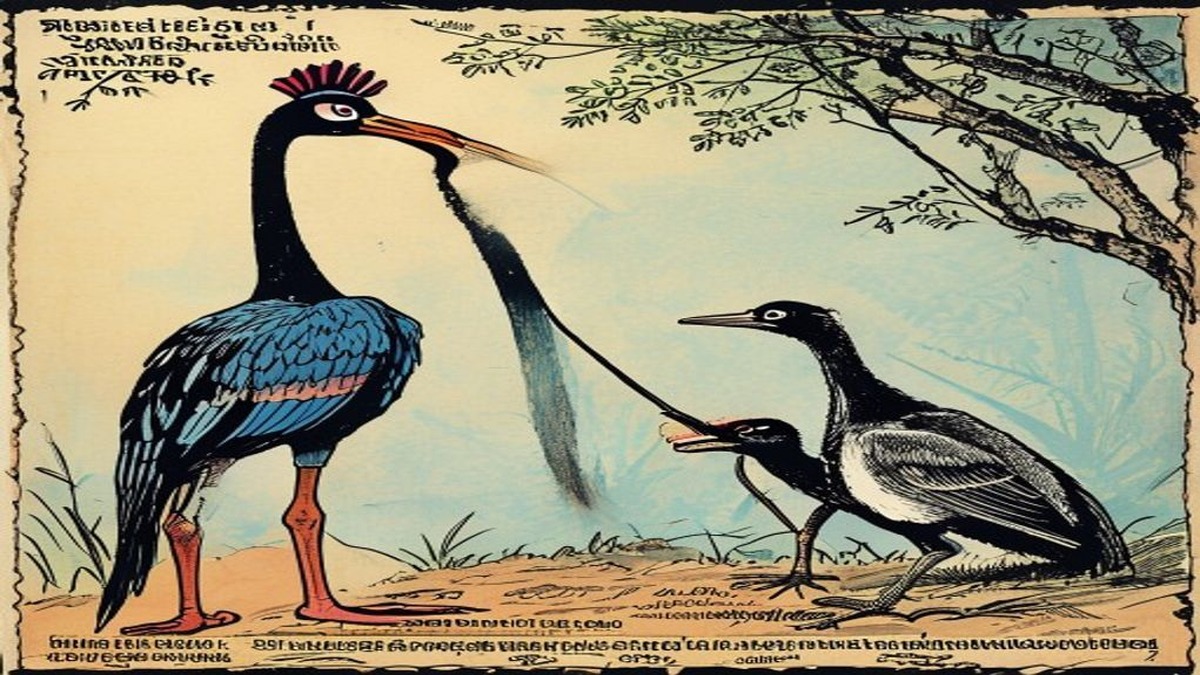
Beat I — The Alliance and the Threat
A crane and a mongoose lived in neighbouring locations. Over time they formed an amicable relationship. The crane had chicks in the nest; the mongoose knew the nest and knew the family. A snake was also in the area — a threat to the crane’s eggs and young that the crane was aware of and worried about. The mongoose, who hunted snakes by nature, was in a position to help.
One day the crane left the nest to find food, as it had to. The mongoose, in the course of its normal movements, came upon the snake approaching the crane’s nest and killed it. This was precisely the protective function the relationship between crane and mongoose had the potential to provide. The mongoose had blood on its muzzle from the kill — this was the physical fact that would determine everything that followed. The crane returned to find its chicks alive, its nest intact, and a mongoose at the entrance with blood on its face.
Beat II — The Misreading and the Act
The crane saw the blood. The blood was on the mongoose. The mongoose was at the entrance to the nest. The crane’s chicks were behind the mongoose. The crane made an immediate inference: the mongoose had attacked the chicks. Grief and protective rage activated simultaneously. The crane struck the mongoose with its beak and killed it.
The Pancatantra’s account of this moment is stark. There is no suggestion that the crane is malicious or even unusually impulsive. The crane made the inference any anxious parent would make: blood, proximity to young, and the creature that must have produced the blood = the creature attacked my young. The inference was wrong. But the action that followed from it was irreversible. The crane then looked further into the nest and found the dead snake. The chicks were unharmed. The mongoose had died defending what the crane most needed defended, and the crane had killed it for doing so.

Beat III — The Discovery
The crane found the dead snake. It examined the snake. It understood the sequence of events: the snake had come for the chicks; the mongoose had killed the snake; the blood was the snake’s blood, not the chicks’ blood; the mongoose had died for a crime it did not commit, doing the exact thing it would have been asked to do if the crane had been present to ask it. The crane’s grief for its chicks transformed into grief for the mongoose.
The Pancatantra notes that the crane could not undo what it had done. This is the tale’s central point, stated without elaboration. Hasty action cannot be recalled. The mongoose was dead. The alliance was destroyed. The threat the mongoose had neutralised was gone, but the mongoose was gone with it. The crane had, in a single unverified action, simultaneously fulfilled its deepest wish (the snake killed) and destroyed its most valuable ally (the mongoose dead). This paradox — getting what you wanted at the cost of the thing that gave you what you wanted — is the Pancatantra’s most compact illustration of the cost of acting before assessing.

Beat IV — What the Crane Teaches About Verification Before Action
Vishnu Sharma’s lesson is not that the crane was foolish in the ordinary sense. The lesson is that a specific cognitive state — acute emotional activation around the protection of something precious — systematically suppresses the verification step that stands between perception and action. The crane’s inference was not irrational given the evidence it processed. It was incomplete: it processed the evidence that was immediately visible (blood, proximity) and acted on it without gathering the evidence that would have changed the inference (the dead snake behind the mongoose, the chicks’ condition).
For Vishnu Sharma’s royal pupils the application is direct. Decisions made in states of acute protective concern, grief, or fear are decisions where the verification step is most likely to be skipped. The minister who receives alarming news about a trusted ally and acts immediately to neutralise that ally — before verifying whether the news is accurate, whether the account is complete, whether there is evidence that would reverse the inference — is the crane. The trusted ally, killed before verification, is the mongoose. And the dead snake found afterward, when nothing can be undone, is the truth that arrived too late. The Pancatantra’s standing instruction is: verify before acting. The Foolish Crane demonstrates the precise mechanism by which that instruction fails to be followed and the precise cost when it does.

Moral and Sanskrit Wisdom Tradition
“One who acts in haste, without verification, destroys what they most wished to protect.”
— Moral of The Foolish Crane and the Mongoose, Pancatantra Book I (Mitra-bheda)
This moral operates in direct dialogue with the Pancatantra’s companion tale of The Fighting Goats and the Jackal. Where the jackal fails by substituting appetite for assessment, the crane fails by substituting emotional urgency for assessment. Both failures share the same structural feature: the verification step — the gathering of sufficient evidence before acting — is bypassed. The Arthashastra addresses both failure modes under its treatment of aparikshitatvam (untested or unverified action): decisions made without adequate investigation of the situation are among Kautilya’s identified sources of political catastrophe. Vishnu Sharma reaches the same conclusion through narrative rather than doctrine: the crane’s story shows, more viscerally than any philosophical argument could, that the cost of skipping verification is paid in the currency you can least afford to spend.
Why This Story Has Lasted 2,300 Years
The Foolish Crane and the Mongoose endures because the failure it describes is not a character defect but a cognitive mechanism that operates on everyone under the right conditions. The crane is not stupid or cruel; it loves its young and acts to protect them. The failure is specifically that love and fear, at sufficient intensity, disable the verification step that would have prevented the irreversible act. The tale’s European analogue in the story of Llewelyn and Gelert, apparently arising independently, suggests how universally this mechanism has been recognised. The lesson — pause, look again, gather all the evidence before acting on the first inference — is among the most ancient and most frequently repeated instructions in the world’s wisdom literature, precisely because it runs against the grain of how emotional activation actually works.
Sanskrit Tradition: Tantrakhyayika (c. 200 BCE, Kashmir); Hitopadesha; European parallel: Llewelyn and Gelert (Wales)
Cognitive Failure: Emotional urgency replacing verification — acting on incomplete evidence under acute protective concern
Author: Vishnu Sharma (attributed, c. 3rd century BCE)
Arthashastra Parallel: Kautilya’s aparikshitatvam (unverified action) as a source of political catastrophe
You May Also Like
 Panchatantra Stories
Ages 9-12
Panchatantra Stories
Ages 9-12
The Story of the Singing Donkey
The Story of the Singing Donkey: In a certain town, there lived a donkey, by the name of Uddhata. He belonged to a washerman. Duringthe daytime, he carried the
 Panchatantra Stories
Ages 9-12
Panchatantra Stories
Ages 9-12
The Story of the Four Learned Fools
The Story of the Four Learned Fools: In a certain town, there lived four Brahmins whohad become great friends. They were all extremely naiveby nature. The
 Panchatantra Stories
Ages 3-5
Panchatantra Stories
Ages 3-5
The Story of the Cobra and the Crow
The Story of the Cobra and the Crow: Somewhere in the country, under a banyan tree, therelived a pair of crows, husband and wife. Now, wheneverthe female