The Elephants and the Hares
The Elephants and the Hares: The weak must make use of all tactics to survive.” Deep in the jungle, there lived a big group of elephants. The elephants lived

Origin & Canonical Placement
“The Elephants and the Hares” is one of the Panchatantra’s most celebrated fables of diplomatic ingenuity, preserved in Vishnu Sharma’s Pancatantra (c. 300 BCE–300 CE) and retold across the Hitopadesha, the Arabic Kalila wa Dimna, and ultimately Bidpai’s European adaptations. It belongs to Book II: Mitra-samprapti (“The Gaining of Friends”), which explores how alliances are forged and how the weak prosper when they act with wit rather than force. The tale encodes a cardinal lesson of niti-shastra — statecraft literature — that the smallest creature commanding superior intelligence may redirect even the mightiest adversary.
“Buddhibalena hi durbalo’pi balavantam jigishati.”
“Even the weak, armed with the power of intelligence, prevails over the mighty.”
— Panchatantra maxim, Book II
Beat I — The Crisis: Elephants and the Moonlit Lake
In a forest near the Chandra-saras — the Moon Lake — there lived a great colony of hares whose warrens had been burrowed over generations beneath the roots of ancient banyan trees surrounding the water. Their life was ordered and peaceful until a prolonged drought drove a vast herd of elephants, led by their king Chaturdanta, to seek out the only permanent water source remaining in the region.
The elephants descended upon the Moon Lake in thunderous columns. Their enormous feet churned the earth, collapsed the hares’ burrows, and crushed dozens of the small creatures who could not flee in time. Every journey to and from the water brought fresh devastation. The hare colony’s elder counsellors gathered in emergency session, acutely aware that direct confrontation was suicidal. One old hare named Lambakarna spoke first: “We cannot meet force with force. We must meet force with a story that force will believe.” The assembly fell silent, recognising that their survival depended entirely on the quality of their collective imagination.
Beat II — The Stratagem: An Ambassador of the Moon
The hares appointed a quick-witted ambassador named Vijaya to approach the elephant king. Vijaya understood that the key to the stratagem lay in choosing his position carefully — he must speak from a height so that Chaturdanta would have to look up at him, subtly reinforcing the impression of authority. He climbed atop a large boulder at the lake’s edge and waited for the herd to arrive.
When Chaturdanta lumbered to the water’s edge, Vijaya spoke with grave composure: “Mighty king, I come as the ambassador of the Moon, whose sacred lake this is. The Moon has observed with deep displeasure how your herd disturbs these consecrated waters night after night. The god of the night sky commands that you cease and withdraw.” Chaturdanta, accustomed to being the largest power in his world, paused. Vijaya pressed the moment: “Look into the water, great king, and you will see the Moon trembling with anger at your presence.” Chaturdanta bent his great head over the lake. The night breeze rippled the surface; the reflected moon shivered and flickered. The elephant king, who had never had cause to question a divine sign, felt a cold certainty settle in his chest. He raised his trunk in a gesture of reverence and withdrew the herd, promising never to disturb the Moon’s lake again.
Beat III — The Analysis: Illusion as a Legitimate Instrument of Statecraft
Vishnu Sharma uses this tale to address one of the most nuanced problems in niti-shastra: when is deception not only permissible but obligatory? The framing is deliberate. The hares have exhausted all legitimate options; they cannot fight, they cannot flee (the lake is their only water source in a drought), and they cannot negotiate on equal terms because the elephants do not perceive them as equals at all. In this zero-sum situation, the text endorses maya — artful illusion — as the morally sound instrument, because it achieves the just outcome (survival of the innocent) while causing no lasting harm to the adversary.
The choice of the Moon as authority is equally instructive. Vijaya does not invent a random god; he invokes the celestial body whose reflection is already present in the lake, a reflection that Chaturdanta can “see” shaking. The illusion succeeds precisely because it is anchored in observable reality. This anticipates the modern principle that the most convincing narrative is one that requires the audience to furnish the final detail themselves from what they can already perceive. Chaturdanta sees the rippling reflection and completes the deception in his own mind — Vijaya merely directed his attention.
The Panchatantra’s political reading is equally sharp: a small state whose army cannot resist a large neighbour should seek leverage through psychology, reputation, and the strategic use of symbols rather than through arms. The Moon Lake fable is thus a miniature treatise on what later political theorists would call “soft power.”
Beat IV — Moral Dimension & Enduring Relevance
The moral the text draws explicitly is that intelligence (“buddhi”) is the supreme resource, outranking physical strength, wealth, and even large numbers. This was a radical claim in an era when most political theory was dominated by discussions of armies and treasuries. Vishnu Sharma’s genius lies in demonstrating the claim through narrative rather than assertion: the reader experiences Vijaya’s triumph and does not need to be told what it means.
The tale also carries a quiet meditation on the relationship between power and perception. Chaturdanta is not a villainous elephant; he is simply large and thoughtless, unaware of the damage his routine causes because the damage happens to creatures too small to register in his field of attention. The hares’ solution does not humiliate him — it gives him a dignified reason to change his behaviour, a “face-saving” exit that allows the stronger party to withdraw without admitting error. This diplomatic sophistication — preserving the adversary’s dignity while achieving one’s objective — is a lesson that recurs throughout Kautilya’s Arthashastra in discussions of how smaller kingdoms should conduct their foreign relations with larger empires.
In contemporary terms, the fable speaks directly to negotiation theory, organisational psychology, and the management of asymmetric conflicts. A smaller party that reframes the terms of a dispute — that changes what the negotiation is “about” — can achieve outcomes that raw bargaining power would never deliver. Vijaya did not argue that the hares deserved the lake; he changed the conversation entirely, making it about divine authority rather than competing claims.
Moral: Intelligence and imagination are the great equalisers; the weakest creature that wields them wisely may redirect the course of the mightiest.
Why This Story Has Lasted 2,000 Years
“The Elephants and the Hares” has persisted because it gives a satisfying answer to a question every generation of readers has faced: what do you do when you are hopelessly outmatched? Its answer — that you reframe the situation, use the adversary’s own assumptions against them, and never fight on terrain that suits only your opponent — is perennially useful. The tale travelled from Sanskrit into Pahlavi, then into Arabic as part of Kalila wa Dimna, then into Persian, Hebrew, Greek, Latin, and eventually every major European language through the Bidpai tradition. In each cultural context it found ready resonance because the experience of being the smaller party confronting overwhelming force is universal. The image of a small hare addressing an elephant king from a rock while pointing to a trembling moon remains one of the most vivid and immediately comprehensible pictures of strategic intelligence that world literature has produced.
About the Panchatantra
The Panchatantra (“Five Treatises”) was composed in Sanskrit by the scholar Vishnu Sharma around 300 BCE–300 CE as a niti-shastra — a guide to wise conduct and statecraft — framed as animal fables for the instruction of young princes. Its five books cover the dissolution of allies, the winning of allies, war and peace, the dangers of naivety, and the hazards of rashness. The text spread westward through Pahlavi and Arabic translations to become the most widely translated secular book of the ancient world after the Bible.
You May Also Like
 Panchatantra Stories
Ages 3-5
Panchatantra Stories
Ages 3-5
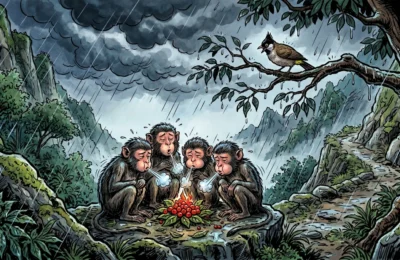
The Bird and the Monkey
The Bird and the Monkey: Never give advice unless you are asked for it.” There lived a group of monkeys in the mountains. During one winter, there were heavy
 Panchatantra Stories
Ages 9-12
Panchatantra Stories
Ages 9-12
The Story of Dharmabuddhi and Papabuddhi
The Story of Dharmabuddhi and Papabuddhi: In a village, there lived two friends, whose nameswere Dharmabuddhi and Papabuddhi. One day Papabuddhi thought to
 Panchatantra Stories
All Ages
Panchatantra Stories
All Ages
The Story of the Lion and the Hare
The Story of the Lion and the Hare: In the jungle, there lived a lion by the name of Bhasuraka. He was very powerful and used to kill the other animals