The Crane and the Crab
The Crane and the Crab: When things go wrong, use your wit to overcome the situation.” A heron lived near a big lake, which was full of fishes and other water

The Crane and the Crab
Canonical Attribution and Manuscript Tradition
This tale belongs to Pancatantra Book I, Mitra-bheda, and circulates as a companion tale to the more elaborate “Crafty Crane and the Craftier Crab.” The two tales are not duplicates: this version foregrounds the crab’s perspective from the outset, with the crab as the first interlocutor of the heron’s false prophecy rather than an afterthought who arrives late to a scheme already in progress. The moral of this version — “when things go wrong, use your wit to overcome the situation” — shifts the lesson from the warning about deception to the celebration of the crab’s positive response. Where the companion tale asks “why did the fish fail to detect the crane’s deception?” this version asks “how did the crab succeed in defeating it?” The tale survives in Sanskrit recensions including the Tantrakhyayika (c. 200 BCE, Kashmir) and is paralleled in the Hitopadesha. It does not carry a specific ATU (Aarne-Thompson-Uther) number. Vishnu Sharma used the two crane-and-crab tales together to teach the same event from complementary perspectives: one illuminating the failure of passive trust, the other celebrating the success of active intelligence.

Beat I — The Crab as the Heron’s First Interlocutor
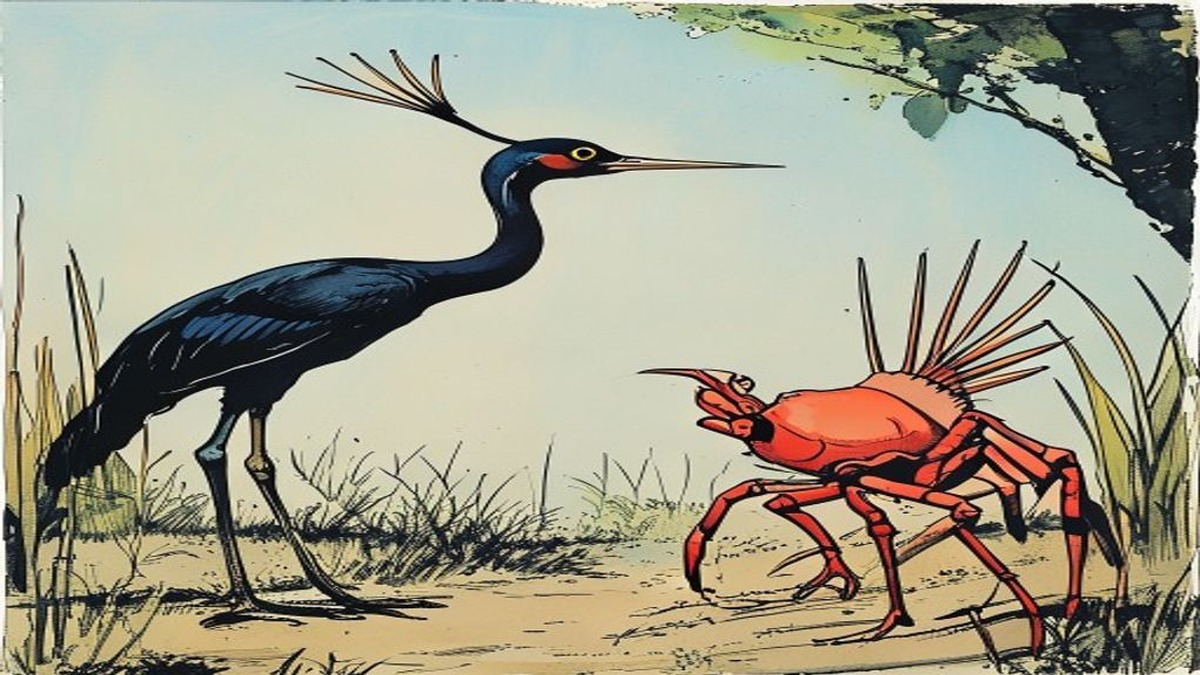
A heron living near a large lake had grown too old to catch fish. Unable to endure hunger, it devised the same stratagem described elsewhere in Mitra-bheda: theatrical grief, a fabricated astrological prophecy of twelve years of drought, and the offer to carry the lake’s creatures to a permanent spring-fed lake some distance away. In this version, however, it is the crab who first approaches the heron and who first asks where the prophecy came from. The crab’s question is precise: “Please tell me if it is true. Please tell me where you have heard such a thing.” This is not the fish’s undifferentiated acceptance; it is an immediate demand for sourcing.
The heron answers with a secondary fabrication: a wise astrologer has told him. The crab observes the lake, notes that the water level does appear to have dropped, and accepts — conditionally — that there may be truth in the report. This conditional acceptance is characteristically different from the fish’s unconditional acceptance. The crab is not convinced; it is provisionally persuaded that the situation warrants investigation. The difference between conviction and provisional persuasion is the difference between the crab’s outcome and the fish’s.
Beat II — The Crab Requests Priority
When the heron begins carrying fish to the supposed new lake, the crab requests to go first. This request is itself a form of intelligence: the crab does not wait for fish to go ahead and not return; it does not gather external evidence of the heron’s honesty; it positions itself as the first verification point. If the new lake exists and is good, the crab arrives there first. If it does not exist, the crab is the first to discover this — while still able to act on the discovery.
The heron agrees to carry the crab first, perhaps because the crab’s size makes it an attractive meal. The crab climbs onto the heron’s neck — a detail this version specifies, rather than the bill: the crab is holding on, not being held. This is a structural detail that the Pancatantra does not overlook. The crab in the bill is entirely at the heron’s mercy; the crab on the neck is in a position to act. The choice of location is the crab’s first active assertion of agency within the journey itself.
Beat III — Verification in Flight and Decisive Action
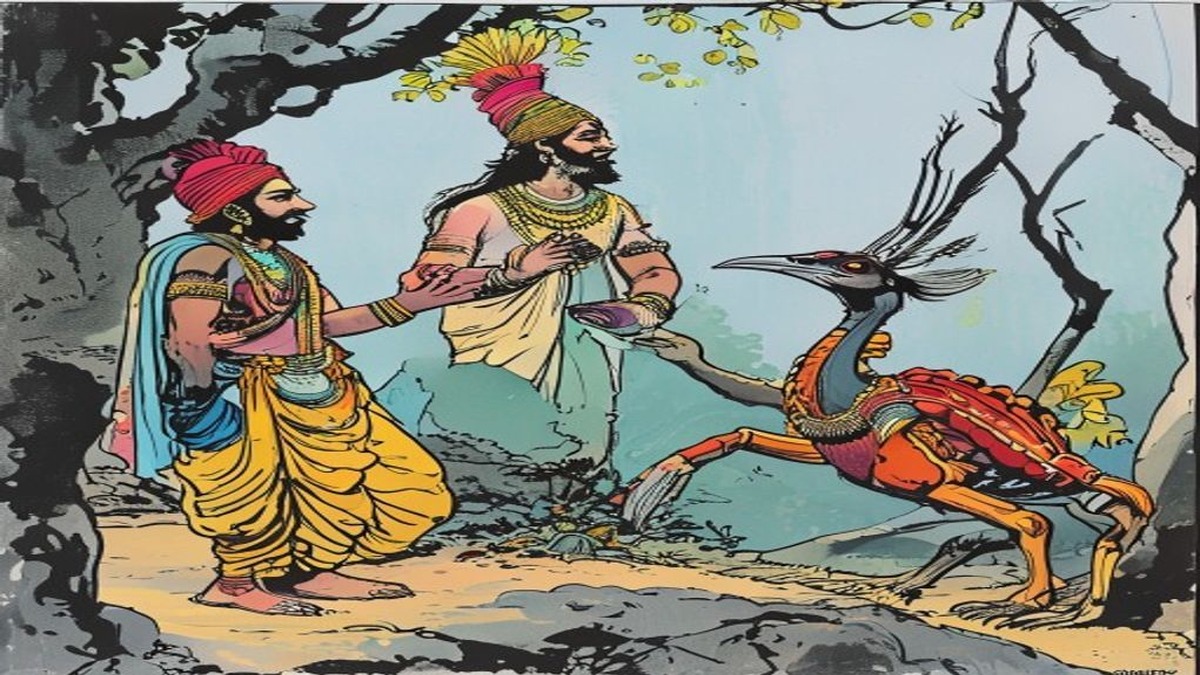
Midway through the flight, the crab asks the heron to show it the lake they are heading toward. The heron, now far from the water and relaxed by the prospect of an easy meal, indicates a large rock covered in fish bones. The crab recognises the bones immediately for what they are: the evidence of everything the heron had done. The prophecy was false. The alternative lake did not exist. The fish had been eaten one by one on this rock. And the crab is about to become the next meal, unless it acts now.
The crab tightens its grip on the heron’s neck with its claws and cuts through. The heron dies in mid-flight. The Pancatantra notes that the crab then returned safely to the lake and informed the other fish of what had happened. The crab is the hero of this version not because it was stronger than the heron — it was not — but because it was alert enough to request the first position, observant enough to ask for verification at the critical moment, and decisive enough to act on what it observed without hesitation or doubt. These three qualities together — alertness, observation, decisive action — are what Vishnu Sharma presents as the complete toolkit of the “craftier” creature.
Beat IV — Wit as an Active, Not Merely Reactive, Faculty
The distinction between this version’s lesson and the companion tale’s lesson is in the framing of intelligence. The companion tale emphasises the fish’s failure: they accepted testimony without demanding verification. This version emphasises the crab’s success: it used its wit not just to detect the deception but to position itself to survive the detection. The crab’s request to go first was not reactive; it preceded the discovery of any deception. The crab used intelligence prospectively — to arrange its position before anything had gone wrong — and then reactively when wrong was confirmed. This double deployment of wit is the fuller lesson.
For Vishnu Sharma’s royal pupils, this version complements the companion story with a positive model rather than a cautionary one. The companion tale says: this is what happens when you do not verify. This version says: this is how verification is done well. The crab’s method — go first, ride on the neck not the bill, demand to see the destination mid-journey, act immediately when you see the bones — is a complete procedure for operating safely within a situation whose premises you have not yet been able to confirm.

Moral and Sanskrit Wisdom Tradition
“When things go wrong, use your wit to overcome the situation.”
— Moral of The Crane and the Crab, Pancatantra Book I (Mitra-bheda)
The Sanskrit tradition’s word for the crab’s quality is prajna — practical wisdom, the intelligence that knows how to act in a specific situation rather than simply how to reason in the abstract. The Kautilya Arthashastra classifies prajna as the highest of the qualities a minister must possess, precisely because it combines knowledge of general principles with the ability to apply them in the particular circumstances of a specific moment. The crab possessed prajna: it knew the general principle (verify before trusting) and it knew how to apply it in the specific circumstances of a flight on a heron’s neck toward an unknown destination. The Pancatantra presents the crab’s victory not as luck but as the predictable outcome of prajna correctly applied. The moral — when things go wrong, use your wit — is Vishnu Sharma’s assertion that prajna, not strength, not luck, not external assistance, is the faculty that most reliably produces survival in adverse conditions.
Why This Story Has Lasted 2,300 Years
The Crane and the Crab endures alongside its companion tale because together they constitute a complete curriculum on the same subject: how to survive a situation where a more powerful party is lying to you. The companion tale teaches recognition — what deception looks like and why it works. This tale teaches response — what effective counter-action looks like and why it works. Together they form the Pancatantra at its pedagogical best: a problem stated from one angle, then restated from another until the full architecture of the threat and the appropriate response has been examined from every direction. Vishnu Sharma wrote not simple fables but a curriculum disguised as entertainment, designed for a young prince who would navigate exactly these situations — powerful parties pursuing their own interests while presenting themselves as protectors — in the courts and alliances of the ancient world.
Sanskrit Tradition: Tantrakhyayika recension (c. 200 BCE, Kashmir); Hitopadesha parallel
Key Faculty: Prajna (practical wisdom) — the ability to apply general principles in specific situations
Companion Tale: “The Crafty Crane and the Craftier Crab” (the cautionary counterpart)
Author: Vishnu Sharma (attributed, c. 3rd century BCE)
You May Also Like
 Panchatantra Stories
Ages 9-12
Panchatantra Stories
Ages 9-12
The Story of Chakradhara.
The Story of Chakradhara.: In a certain town, there lived four young fellows, who were the sons of Brahmins They were very friendlywith each other. But they
 Panchatantra Stories
Ages 9-12
Panchatantra Stories
Ages 9-12
The Unforgiving Monkey
The Unforgiving Monkey: Chandra was a king, whose sons kept a group of monkeys as pets. These monkeys were treated as royal pets, and were provided with the
 Panchatantra Stories
Ages 3-5
Panchatantra Stories
Ages 3-5
The Blue Jackal
A Panchatantra tale about a jackal accidentally dyed blue who briefly rules the jungle until his true nature gives him away. A classic story about honesty.