Frogs That Rode a Snake
The framing tale of pride and slow-motion ruin from Book III of the Panchatantra — an old cobra named Mandavishya pretends weakness, and the proud frog king Gangadatta rides him to the doom of his entire kingdom. A two-thousand-year-old story about flattery, deception, and the most dangerous kind of enemy: the one who appears to surrender first.
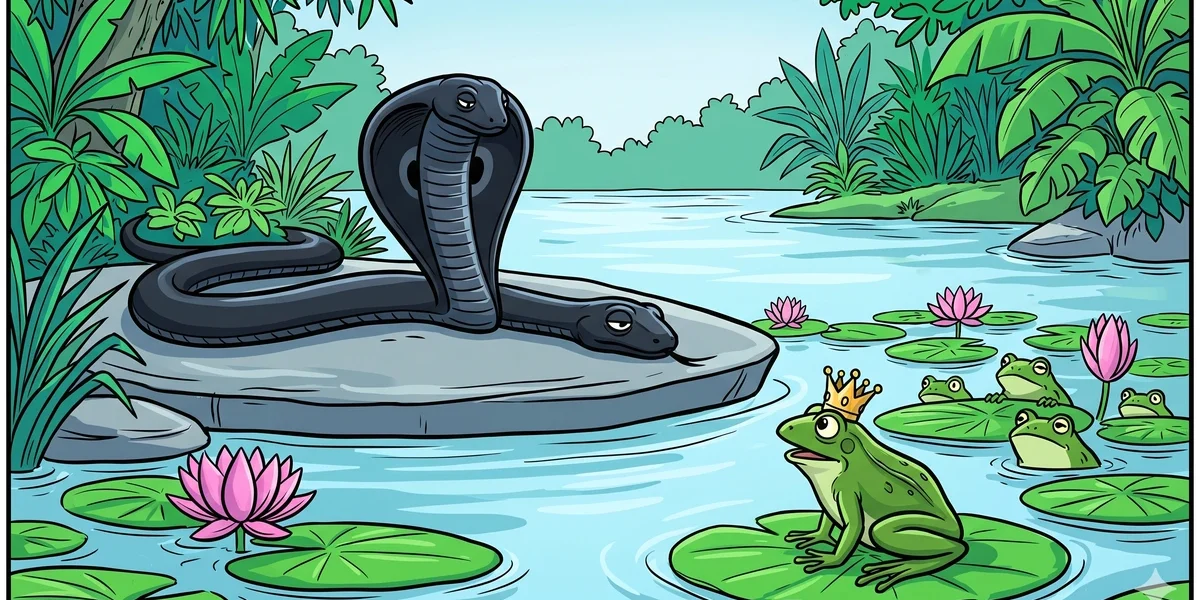
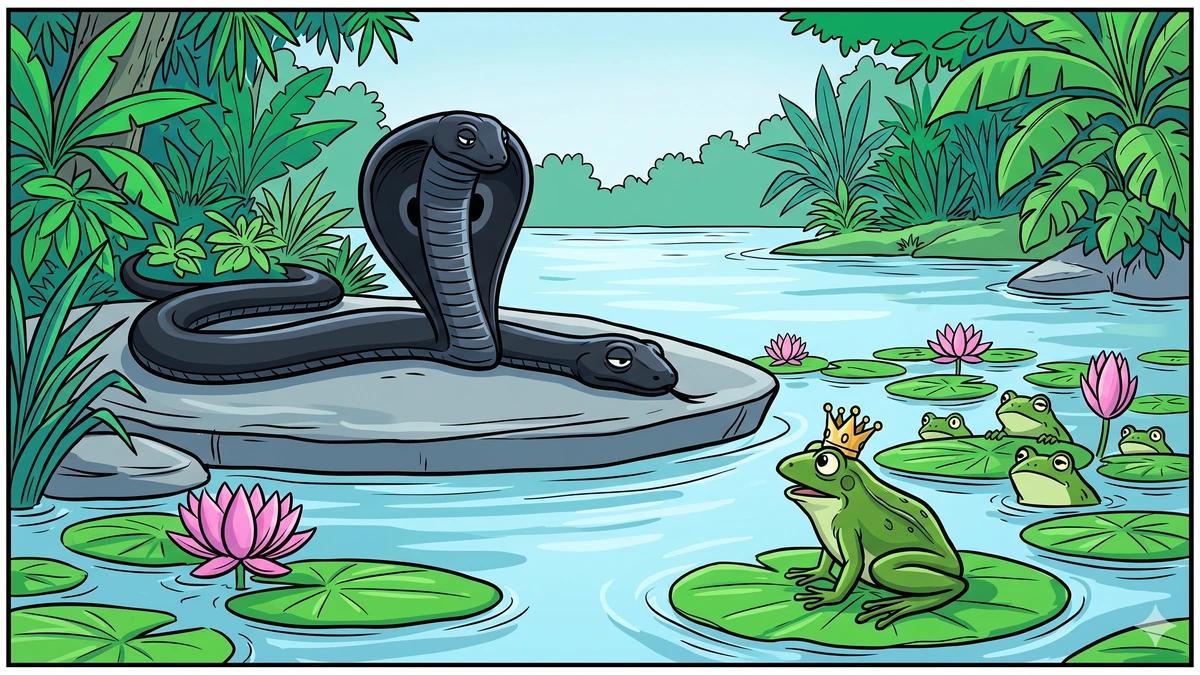
An old black snake. A pond full of trusting frogs. And a piece of advice in the Panchatantra so unsettling that it has been quoted, paraphrased, and refused by readers for two thousand years: that a clever enemy who has just laid down his weapons is more dangerous than one who is still fighting, because he has only laid them down in order to pick up yours.
This is the story of Mandavishya the snake and Gangadatta the king of frogs — and of the elegant, terrible, very slow trap that one of them set for the other across the pond at the foot of the Varuna hills.
Where this story comes from
“The Frogs That Rode a Snake” is one of the central fables of Book III of the Panchatantra — Kakolukiyam, which translates as “Of Crows and Owls.” Of the five books traditionally attributed to the sage Vishnu Sharma around 200 BCE, Book III is the most political. Its subject is open conflict — how to make peace, how to make war, when to retreat, when to strike, and how to recognise the moves of an enemy who is more patient than you are.
This particular tale is told inside Book III as a warning, by one of the wise crow ministers, about a very specific kind of strategic mistake: trusting a defeated enemy who offers you his service. In the original Sanskrit, the snake is Mandavishya — a name that means roughly “slow-poisoned,” with the deliberate double meaning of a snake whose venom has weakened with age, and a snake whose plan is poison delivered slowly, drop by drop. The frog king is Gangadatta — “given by the Ganges” — though many later retellings call him Jalapada, “water-foot.” The names have shifted across centuries; the warning has not.
It is a story that survives, almost unchanged, in the Pahlavi version of the Panchatantra, in the Arabic Kalila wa Dimna, in the Persian Anvar-i Suhayli, and in dozens of oral traditions from the Deccan to Central Asia. Wherever it has travelled, it has carried the same uncomfortable observation about power — that a hunter need not be stronger than his prey if he is willing to be more patient.
The story
Act I — The snake who grew tired of hunting
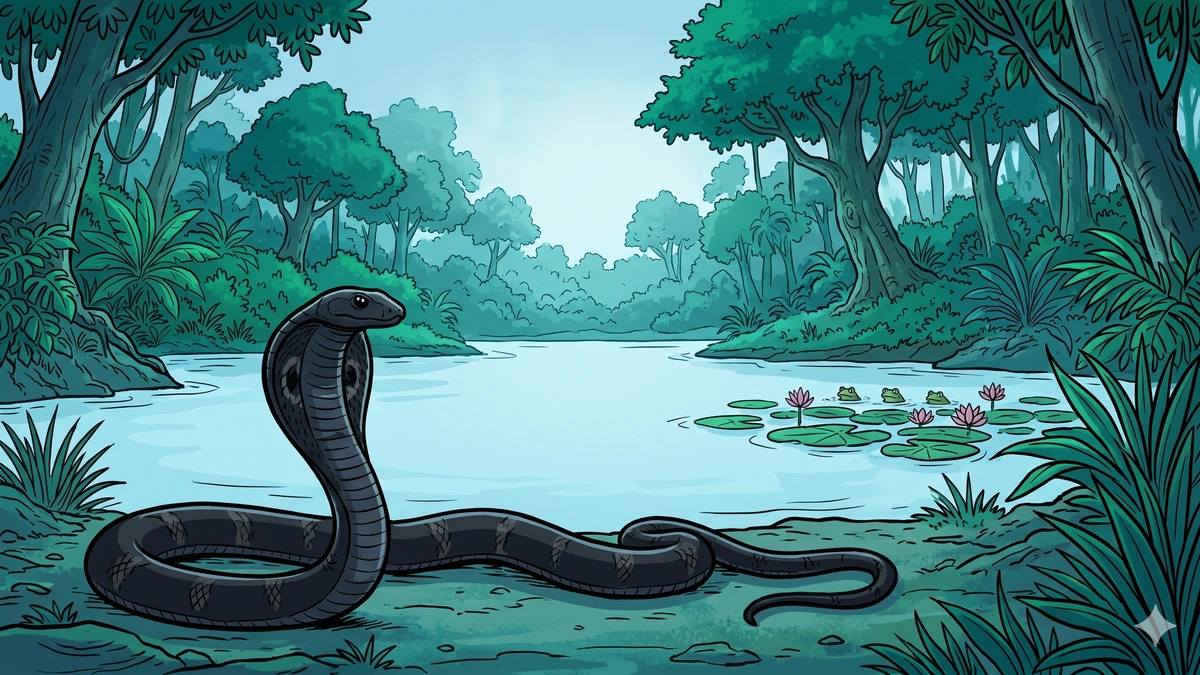
Long ago, in a forest at the foot of the Varuna hills, there lived an old black snake named Mandavishya. Once he had been a magnificent hunter — sleek, dark, fast as falling water — and the frogs in the pond on the edge of the forest had spent their whole lives learning to fear his shadow. But the years had passed, as years do, and Mandavishya had grown old. His coils were stiff. His strike was no longer fast enough. The young frogs leapt away from him before he could close his jaws, and the older frogs — who knew him by sight — had stopped coming anywhere near the lake’s edge altogether.
Mandavishya was hungry. He was also, very importantly for what happens next, intelligent. He was the kind of creature who, when his body fails him, simply uses his mind harder.
One afternoon he lay on a flat stone beside the water and thought for a long time. By evening he had a plan.
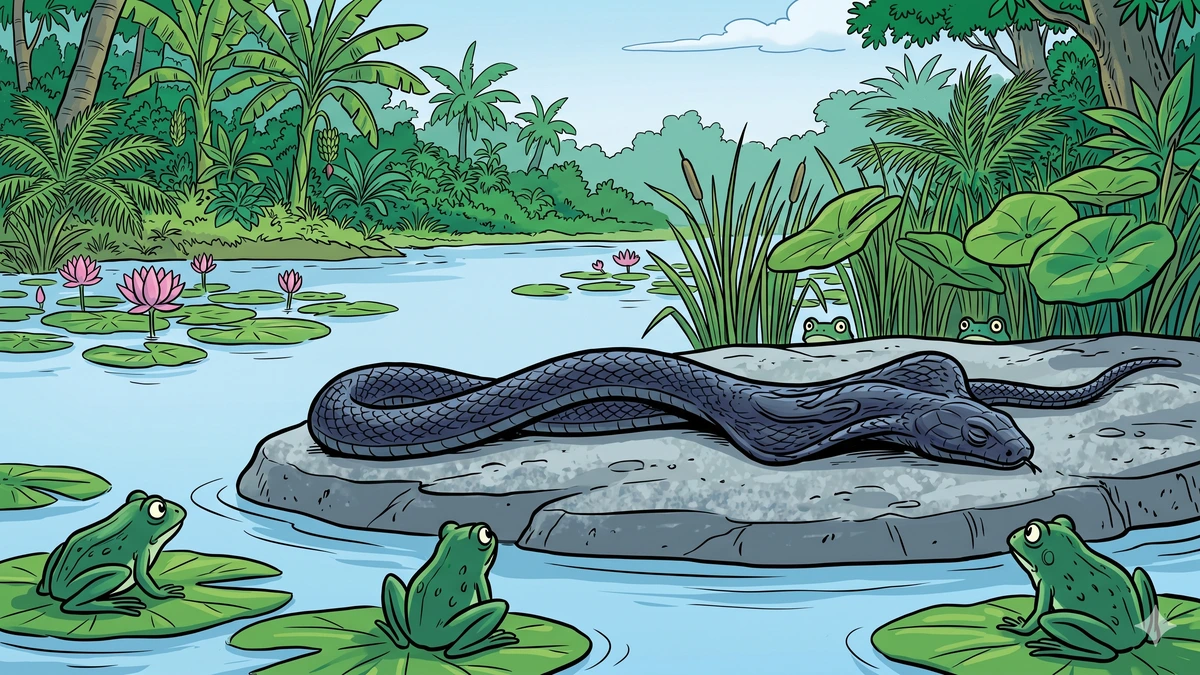
The next morning, he uncoiled himself slowly, dragged himself out into plain sight at the edge of the pond, and lay there in the open. He did not strike at any frog that passed. He did not even raise his head. He sighed, in the long, theatrical way snakes can sigh, and let his body slacken as if he were dying.
Act II — The frog who came to ask
The frogs noticed, of course. A snake lying out in the open and refusing to hunt is the kind of thing frogs notice. They watched him from a careful distance. They watched him for a whole day. He did not move. They watched him for a second day. He did not move.
By the third day, one bold young frog could not bear it any longer. He hopped — cautiously, ready to leap back into the water at the first twitch — to the edge of the stone where Mandavishya lay.
“Uncle,” said the young frog, “forgive my asking. But why are you not hunting? Why are you lying here? You used to be the terror of this lake. What has happened to you?”
Mandavishya did not even open his eyes. In a slow, sorrowful voice he said, “Ah, my son. I am the most unlucky snake in the world. Listen to my misfortune.”
And he told the frog a long, sad, completely invented story. He had been hunting one night, he said. He had seen a frog leap into a circle of holy Brahmin priests reciting the Vedas. In his eagerness, he said, he had struck — but he had struck the wrong target. He had bitten not the frog but the thumb of a Brahmin’s young son. The boy had died. The grieving father had cursed him.
“From this day onward,” Mandavishya quoted, with great theatrical sorrow, “you shall not eat as a hunter eats. You shall serve the frogs you wronged. You shall be their vehicle, their carriage. You shall carry them upon your back, and your hunger shall be at their mercy.”
Mandavishya opened his eyes for the first time and looked, with what he hoped was an expression of great penitence, at the small frog. “And so,” he said, “here I am. I have come to live out my curse. I am at the service of any frog who will have me.”
The young frog stared. Then, having said nothing, he turned and hopped, very fast, back into the lake.
Act III — The frog king who liked the idea of a vehicle
The story of the cursed snake who wanted to be ridden travelled through the lake faster than ripples. It reached the king of frogs himself, an old and well-fed monarch named Gangadatta — sometimes also called Jalapada in later retellings — who ruled over the entire pond and over a court of ministers and a flotilla of attendants.
Gangadatta thought for a long moment. Then, slowly, the corners of his wide mouth turned upward.
“A snake,” he said to his advisors, “as a vehicle. Imagine. We could move from the deep end of the pond to the shallows in a single ride. We could attend the lily flats without exhausting ourselves. We could be carried — carried! — like the kings of men. Has any frog king in history ever ridden a snake?”
The wisest of his ministers cleared her throat. “My king,” she said carefully, “I would advise extreme caution. There are very few stories I know of in which a hungry snake, lying still, was lying still for honest reasons.”
“Nonsense,” said Gangadatta, who had already, in his head, chosen the colour of his saddle. “He is cursed. He has confessed. He cannot harm us. And besides — what a sight it will be.”
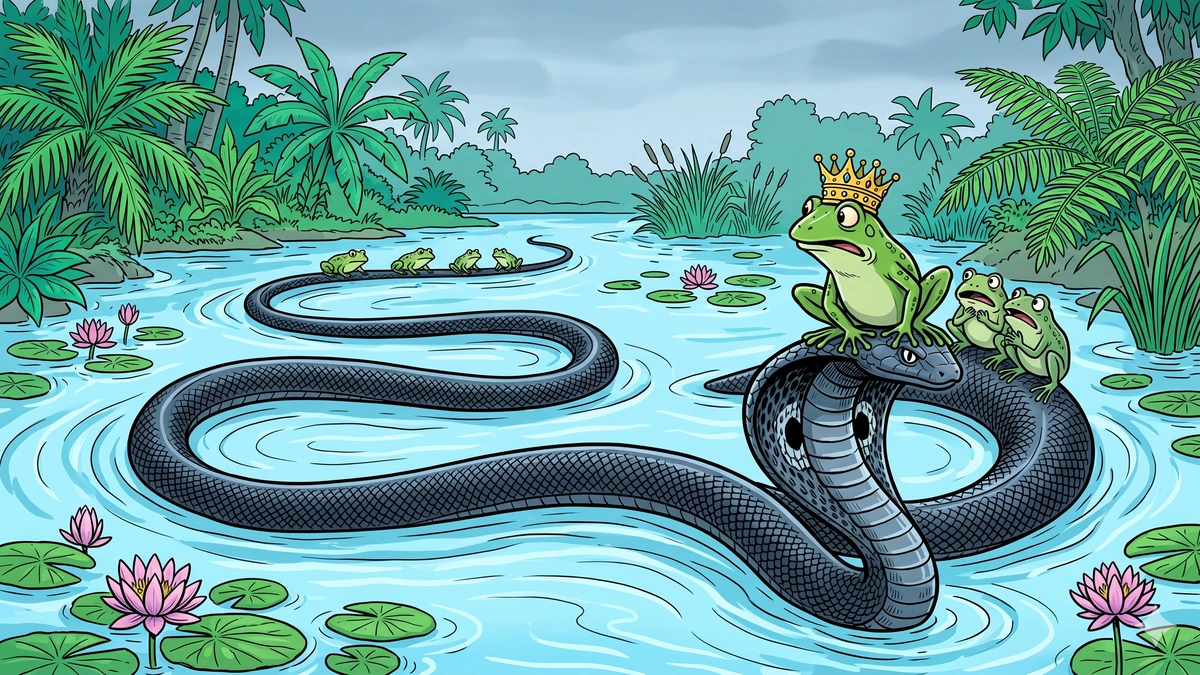
The next morning, the king of frogs hopped solemnly out to the edge of the pond. He climbed up onto the broad, dark hood of Mandavishya. His ministers followed and arranged themselves along the snake’s body. The senior frogs came next, in order of rank. Younger frogs filled in behind them. The remaining frogs of the pond — who could not find space on the great long back of the snake — followed in a happy splashing procession on either side, like crowds beside a royal carriage.
Mandavishya, with great dignity, glided forward.
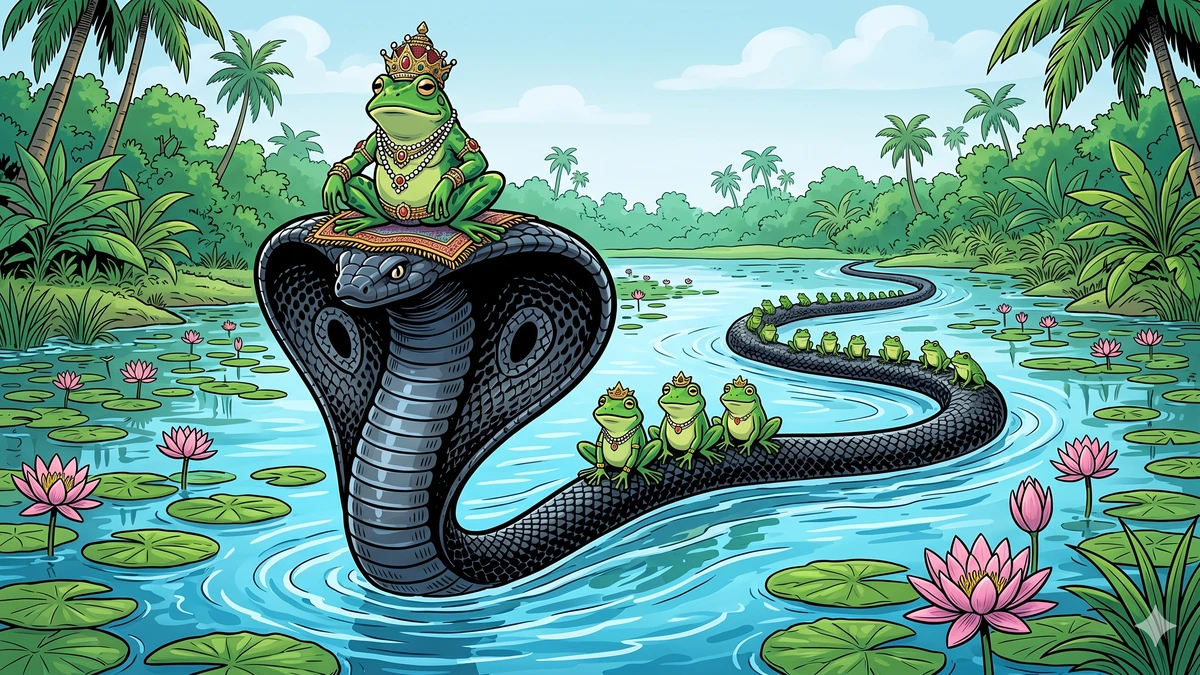
For the first day, it was wonderful. The snake performed small theatrical flourishes — gentle dips, graceful curves, the slow elegant turns of a creature who has thought a great deal about how to look obedient. The frogs cheered. The king laughed delightedly. By evening, the entire frog kingdom believed itself to be ruling the lake more grandly than any frog kingdom in history.
Act IV — The slow tightening
On the second morning, Mandavishya was a little slower. By the afternoon, he was distinctly slow. By the evening, he was crawling — barely.
King Gangadatta, perched on the snake’s hood, leaned forward with concern. “My friend,” he said, “what is the matter with you today? You move as though you carry a mountain.”
“My king,” Mandavishya said, in the same sorrowful voice he had used three days earlier, “forgive me. I have not eaten. The curse forbids me to hunt. I am very weak. I will try to do better tomorrow.” And he sighed a long, slow sigh.
Gangadatta thought about this. He thought about the long beautiful procession behind him. He thought about how very nice it had been, the day before, to be carried.
“Well,” he said, “we cannot have our vehicle starve. That would be a poor reward for your loyalty.” He paused, and then said, almost casually, “Eat the smaller frogs, the very young ones at the back. There are too many of them anyway. They are barely missed.”
A small silence fell along the snake’s body. The wise minister-frog closed her eyes.
Mandavishya, with infinite tact, said, “Only if my king commands it.”
“I command it,” said the king.
And so, very politely, very carefully, Mandavishya ate his first frog.
Act V — How a kingdom disappears
It is not necessary to describe what happened next at length. Anyone who has ever watched a small steady leak empty a great basin already knows.
One frog a day. Sometimes two. Always from the back of the procession. Always the youngest, the smallest, the ones the king was happiest to spare. The procession grew shorter. The cheers grew quieter. The lake grew emptier.
Mandavishya grew sleeker. His coils thickened. His skin, which had been dull and grey at the edges from age, turned a deep glossy black again. He moved a little faster each week. He did not, however, ask his king for any new permissions. He simply waited, patiently, for permission to be repeated.
Gangadatta, perched on the hood, noticed at first only that the procession behind him was a little smaller than yesterday. Then he noticed that his ministers were missing. Then he noticed that he was the only frog left riding.
And then, on a quiet afternoon by the empty edge of the pond, Mandavishya — strong now, fast now, fully restored — turned his great triangular head and looked at the king of frogs sitting alone on his hood.
The king understood. There was a single moment of understanding. There was nothing to say.
The pond was quiet for a long time afterwards.
Who’s who in the story
Mandavishya — An old black snake whose body has weakened but whose mind has not. The Panchatantra is unusually careful with him: he is never described as evil. He is described as patient. The story is, in part, an argument that patience is the most dangerous quality an enemy can possess, because it survives every other failure.
Gangadatta (sometimes Jalapada) — The king of frogs. Not a foolish king, exactly, but a vain one. The flaw the Panchatantra is interested in is not stupidity. It is the particular blindness that comes when a ruler is offered a flattering arrangement and refuses to ask, even once, what the other side gets out of it.
The wise minister-frog — She has only a handful of lines, and she is right in every one of them, and she is overruled. The story keeps her on screen as a quiet rebuke to every leader who has ever silenced the one advisor who saw what was happening.
The young frogs at the back of the procession — Nameless. Numerous. Eaten first. Their absence is the entire shape of the story. The Panchatantra wants us to feel them.
The lesson
The most uncomfortable Panchatantra lesson of all is that some defeats look exactly like victories at the start. Gangadatta did not lose his kingdom in a battle he could see. He lost it because he accepted a gift that was too good to question. By the time the cost of the gift became visible, more than half the cost had already been paid.
The Panchatantra’s point is not that frogs should distrust snakes — that would be too easy. The point is that any time a former enemy offers you something you have always wanted, in exactly the form you have always wanted it, you should ask, very specifically, what the other side will get out of the arrangement. If you cannot answer that question clearly, you are about to be ridden.
śatroḥ śaraṇam āgatya yāti vināśam eva hi /
vyatyastam āha bhūyiṣṭham, gaṅgādatto yathā tathā //“He who takes shelter with an enemy goes to his own destruction. Most often, as the tale of Gaṅgādatta shows, the inversion is complete: the protector becomes the predator, and the kingdom that was given as a gift is the kingdom that is eaten.”
— Pañcatantra Book III, the Sanskrit verse spoken by Sthirajīvin to the crow-king as he prepares to infiltrate the owls.
Why this story still matters today
Two thousand years after Vishnu Sharma wrote it, Mandavishya is still everywhere. He is the suspiciously generous deal. He is the rival who has “given up the fight.” He is the predatory loan offered with a smile. He is the platform that gives you everything you want for free, until your data has thickened its coils. Anywhere a powerful actor stops fighting and starts offering, the Panchatantra would like a moment of your attention.
It is also a story about the cost of vanity in leaders. Gangadatta does not lose his frogs because he is cruel. He loses them because he is flattered. He likes the picture of himself riding a snake. He likes it so much that when the cost of the picture begins to be paid in young lives at the back of the procession, he tells himself the cost is small. The Panchatantra, watching from a distance of two thousand years, would like every reader to ask themselves: what am I currently agreeing to lose, in small increments, in exchange for being carried?
Frequently asked questions
What is the moral of “The Frogs That Rode a Snake”?
The moral is that a defeated or seemingly weakened enemy who offers you his service is more dangerous, not less. Mandavishya wins by appearing to surrender; Gangadatta loses because he believes the surrender is real. The story warns rulers, leaders, and ordinary readers alike to look very carefully at what is being asked of them in exchange for any unusually generous gift, especially from a former adversary.
Which book of the Panchatantra is this story from?
It is from Book III — Kakolukiyam (“Of Crows and Owls”) of the Panchatantra, traditionally attributed to Vishnu Sharma around 200 BCE. Book III is the political book of the Panchatantra; its subject is conflict between rival kingdoms, and “The Frogs That Rode a Snake” appears within it as a warning fable told by one of the wise crow ministers.
What are the Sanskrit names of the snake and the frog king?
In the original Sanskrit, the snake is Mandavishya, which means roughly “slow-poisoned” — a deliberate double meaning, suggesting both an old snake whose venom has weakened and an enemy whose strategy is poison delivered slowly. The frog king is Gangadatta, meaning “given by the Ganges,” though in many later retellings he is called Jalapada, “water-foot.”
How did the snake trick the frogs?
Mandavishya pretended to be cursed by a Brahmin to serve as a vehicle for the frogs. He lay still and weak by the lake’s edge for several days until the curious frogs approached him. He told them his elaborate tale of guilt, persuaded the frog king Gangadatta to ride him, and then, by complaining of weakness, secured permission from the king himself to eat the smaller frogs in the procession. He then ate the kingdom one frog at a time, beginning with the youngest at the back.
What can children learn from this story today?
Children can learn that not every kind offer is what it appears to be, and that the right question to ask of a generous stranger is always: “What does this person get out of it?” The story is also a lesson in not allowing flattery — the pleasure of being treated specially — to silence the small voice of caution. In every version of this tale across two thousand years, the wise minister who warns the king is always right and is always overruled.
Related folk tales
If you enjoyed this story, you may also like these other tales from the Panchatantra and beyond, all on this site:
- The Foolish Lion and the Clever Rabbit — a Book I tale about cleverness defeating brute strength.
- The Four Friends and the Hunter — the framing tale of Book II, on friendship across difference.
- The Monkey and the Crocodile — Book IV, friendship and betrayal at the riverbank.
- Elephants and Hares — a hare uses the moon’s reflection to outwit an elephant king.
- The Three Fish — a Book I fable about foresight and procrastination.
Did you know?
The story of Mandavishya and Gangadatta is one of the most quoted Panchatantra fables in the long political tradition of South Asia. Medieval Sanskrit treatises on statecraft refer to it by name as a warning to kings about accepting tribute or offers of vassalage from defeated rivals. The Persian Anvar-i Suhayli, the Arabic Kalila wa Dimna, and several Mughal court manuscripts all preserve illustrated versions of the snake carrying the frog king, and the image of a crowned amphibian riding the hood of a serpent appears in the margins of imperial documents as a kind of visual proverb. When you read this story today, you are reading what was, for two thousand years, the standard cautionary tale told to any king or merchant who was about to accept an offer that seemed too generous to be true.
Frequently Asked Questions
What is the moral of The Frogs That Rode a Snake?
Which Panchatantra book contains Frogs That Rode a Snake?
How did the frogs trick the snake?
Who wrote the Frogs That Rode a Snake story?
What lesson does Frogs That Rode a Snake teach children?
You May Also Like
 Panchatantra Stories
Ages 3-5
Panchatantra Stories
Ages 3-5
The Fighting Goats and the Jackal
The Fighting Goats and the Jackal: One day while a sage was going through a jungle, he saw two golden rams (billy goats) fighting each other. Even though both
 Panchatantra Stories
Ages 6-8
Panchatantra Stories
Ages 6-8
The Crafty Crane And The Craftier Crab
The Crafty Crane And The Craftier Crab: Once upon a time an old crane lived on the rim of a large lake in the middle of a jungle. Because of age, it was not
 Panchatantra Stories
Ages 6-8
Panchatantra Stories
Ages 6-8
The Price of Indiscretion
Read 'The Price of Indiscretion' — a classic Panchatantra story about moral lessons about greed. The Price of Indiscretion is a beloved Panchatantra tal...