Union Is Strength
Union Is Strength: Long ago, there lived a flock of pigeons in a dense forest. In the flock, there was an old pigeon who was very wise. All the pigeons
Union Is Strength — Panchatantra, Book I: Mitra-bheda (The Loss of Friends)
This tale belongs to the first book of the Panchatantra, compiled by Vishnu Sharma around 300 BCE as a text of nītiśāstra — the science of wise conduct in statecraft and personal life. Book I — Mitra-bheda, “The Loss of Friends” — concerns the mechanisms through which alliances are built, maintained, and destroyed. Among its teaching stories, the tale of unity in the face of predation is one of the oldest and most widely distributed: weaker creatures who act together can defeat stronger ones who act alone. The version most commonly called “Union Is Strength” in the Indian tradition focuses on a flock of doves who escape a hunter’s net through coordinated flight, and survive afterward through the friendship of a mouse who cuts their bonds.
Beat I — The Net and the Doves
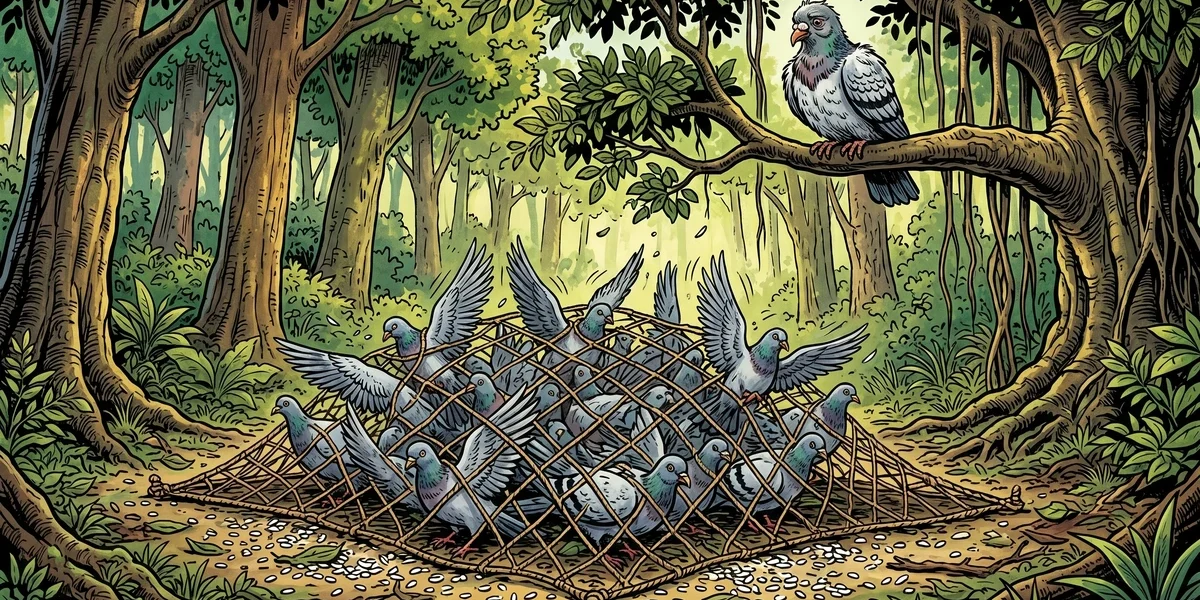
A hunter spread his net in a forest clearing, scattered grain across it as bait, and retreated to wait in the trees. A flock of doves, led by their king Chitragriva, spotted the grain from above. One old dove among them was cautious — grain scattered so abundantly in an open clearing without obvious source was worth examining before landing. But the flock was hungry and the grain was plentiful, and the younger birds’ enthusiasm overrode the elder’s hesitation. They landed.
The net snapped up instantly, entangling every dove. The birds panicked — beating their wings against the mesh, pulling in different directions, exhausting themselves in individual struggle that accomplished nothing except to tangle the net more tightly around each of them. The hunter heard the commotion and began walking toward the clearing.
Chitragriva the dove-king made a rapid assessment. Individual struggle was useless; the net was too strong and too well-made for any single dove to break free. But the net as a whole might be lifted if every dove flew in the same direction at the same moment. He called out to his flock with the authority of a leader who has seen what others have not yet seen: stop struggling individually. Together, on my signal, fly upward.
The flock stilled. Chitragriva gave the signal. Every dove beat its wings simultaneously, pulling upward in the same direction with all its strength. The net rose — slowly, then all at once — and the entire flock, net and all, lifted into the air and flew away, leaving the hunter standing in an empty clearing watching his livelihood disappear over the treeline.
Beat II — The Mouse and the Bonds
The flock could fly with the net, but not indefinitely and not to safety. Chitragriva knew a mouse named Hiranyaka — a friend of his in a distant part of the forest, a creature with sharp teeth and a reliable character. He steered the flock toward Hiranyaka’s home.
When they landed, Hiranyaka emerged from his burrow and found a dove-king draped in a net with a hundred companions in the same predicament. The friendship between a mouse and a dove is not an obvious one; the Panchatantra does not explain how it had developed. It simply records that it existed, and that Hiranyaka responded to his friend’s situation without hesitation.
He began cutting the net immediately — starting with Chitragriva’s bonds, as the dove-king requested, and working outward through the flock until every dove was free. Chitragriva had suggested Hiranyaka start with him because, as leader, his freedom would restore the morale and organization of the flock. Hiranyaka had agreed but insisted on beginning with the others, not the king — the logic being that if his teeth failed midway through the work, it was better that the many were freed than the one.
In the end there was no failure of teeth, and all were freed. The flock rose and departed. Hiranyaka returned to his burrow. The Panchatantra notes the exchange without sentiment: two different creatures, a friendship that crossed species boundaries, and a practical act of help freely given when needed.
Beat III — On Unity as a Practical Technology
The Panchatantra does not present unity as a moral good in the abstract — as a value to be aspired to because solidarity is intrinsically admirable. It presents unity as a technology with specific operating requirements and specific performance characteristics. When the doves struggle individually, the technology fails: each dove’s effort cancels the others, the net holds, and the hunter approaches. When they fly together, the technology works: the combined force exceeds the net’s resistance, and all survive.
The operating requirement is crucial: unity requires a moment of genuine collective stillness before coordinated action. Chitragriva must get the panicking birds to stop struggling individually — which is itself a leadership achievement, since panic and individual struggle are the natural responses to entrapment. The hardest part of coordinated escape is not the escape itself; it is producing the shared stillness that allows coordination to begin.
The Arthashastra of Kautilya addresses this in military and political terms: a smaller force acting with complete coordination can defeat a larger force acting with divided purpose. Kautilya’s analysis of campaigns consistently emphasises that the decisive variable is not raw strength but the quality of coordination — the degree to which individual energies are directed toward a single point at a single moment. The doves against the net are a miniature demonstration of this principle.
Beat IV — The Friendship That Completes the Escape
The story’s second movement — Hiranyaka cutting the bonds — adds a dimension the coordinated flight alone cannot provide. The doves escaped the clearing through unity. They escaped the net through friendship. The two mechanisms are different in kind: unity is the coordination of those who are already allied; friendship is the extension of help across the boundary of alliance, from an unexpected quarter, because a relationship of genuine mutual regard has been established in advance of the crisis.
Hiranyaka the mouse was not a dove and had no stake in the doves’ survival beyond the friendship itself. His help was not strategic — he gained nothing from freeing the flock except the satisfaction of having helped his friend. The Panchatantra values this kind of friendship specifically because it is not reducible to alliance or mutual interest. It is the kind of friendship that exists before the crisis and can be relied upon during it precisely because it was not formed in response to the crisis.
“What one cannot do alone, many can do together; and what many cannot sustain, a single friend in the right place can complete.”
Why This Story Has Lasted 2,300 Years
Union Is Strength endures because it demonstrates its principle rather than merely stating it. The net rising into the air — carried by a hundred small birds working in perfect coordination — is an image so vivid and so physically satisfying that it requires no explanatory gloss. Coordination works; the story shows it working. Friendship across difference matters; the story shows it mattering. The Panchatantra at its best does not argue for values; it makes values visible in action, and trusts the image to carry the argument further than any abstract statement could.
About the Panchatantra
The Panchatantra (“Five Treatises”) was composed by Vishnu Sharma circa 300 BCE as a compendium of nītiśāstra — statecraft, ethics, and worldly wisdom — expressed through interlocking animal fables. Book I, Mitra-bheda (“The Loss of Friends”), explores the full spectrum of alliance: how friendships are built, how they are deployed in crisis, and how they are destroyed by scheming. The doves-and-mouse story appears in multiple recensions of the Panchatantra and in derivative traditions including the Hitopadesha. It has been translated into Pahlavi, Arabic, Hebrew, Latin, and every major European vernacular, and remains in active circulation in children’s and adult literature worldwide.
Frequently Asked Questions
**Q: Why is this story important?**
You May Also Like
 Panchatantra Stories
Ages 9-12
Panchatantra Stories
Ages 9-12
The Musical Donkey: A Panchatantra Fable
The Panchatantra's hard-edged little fable of Uddhata — the "haughty" washerman's donkey — who feasts on stolen cucumbers under the moon, mistakes his longing for talent, and brays the song that brings the farmers running with sticks. The story is found in Book V of the Panchatantra (Aparīkṣitakāraka, "Ill-Considered Action"), and it is one of Vishnu Sharma's quietest and most devastating lessons: a donkey called Raised On High is going to be brought low, and the only question is how.
 Panchatantra Stories
Ages 3-5
Panchatantra Stories
Ages 3-5
The Monkey and The Wedge – For Children
The Monkey and The Wedge – For Children: Once upon a time in a town, a rich merchant decided to build a temple in his courtyard. He assembled many skilled
 Panchatantra Stories
Ages 6-8
Panchatantra Stories
Ages 6-8
Shandili and the Sesame Seeds
A Panchatantra tale about a poor Brahmin's wife Shandili, a suspicious trader, and why something too good to be true usually isn't. A classic lesson in caution.