The Croc and The Monkey
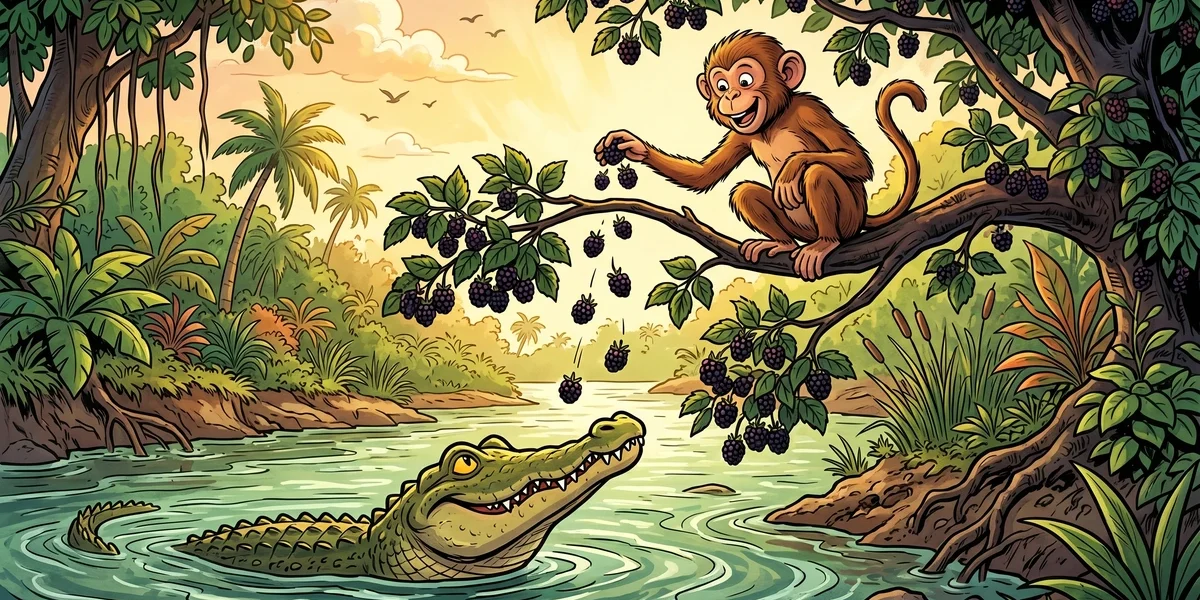
The Croc and The Monkey: Raktamukha was a monkey living on a blackberry tree near the coast. That tree was always full of fruits. One day a crocodile named
Origin & Canonical Placement
“The Crocodile and the Monkey” is among the most celebrated and widely distributed tales in the entire Panchatantra corpus, appearing not only in Vishnu Sharma’s original text (c. 300 BCE–300 CE) but also in Buddhist Jataka literature, the Hitopadesha, the Arabic Kalila wa Dimna, and folk traditions across South and Southeast Asia. It belongs to Book II: Mitra-samprapti (“The Gaining of Friends”) and encodes a fundamental lesson of statecraft: that intelligence under pressure — specifically, the capacity to remain calm, think clearly, and construct a convincing counter-narrative in the moment of greatest danger — is the supreme survival skill.
“Apade kah kramah prapnoti dharanam; buddhimatam tu na kah samkato nasti.”
“The wise find no crisis from which there is no exit; for the intelligent, no calamity is without a remedy.”
— Panchatantra maxim, Book II
Beat I — The Friendship: A Monkey, a Crocodile, and a Rose Apple Tree
A monkey named Raktamukha (Red-face) lived in a great rose apple tree on the bank of a wide river. The tree bore sweet fruit in abundance, and the monkey was generous: each day he would shake fruit down to the crocodile named Karalamukha (Fierce-face) who rested below in the shallows. Over time the two became genuine companions — the monkey sharing his fruit; the crocodile offering the protection of his fearsome presence and the companionship of his slow, reflective conversation. It was an unlikely friendship between air and water, between quick and ponderous, and it endured for many seasons.
The crocodile brought rose apples home to his wife, who ate them with pleasure but grew increasingly uneasy about her husband’s daily absences at the riverbank. She asked him about the monkey. When he described the friendship warmly, she made a calculation: a creature who ate these sweet fruits every day for years would have a heart suffused with their sweetness. Such a heart, she told her husband, would be a delicacy beyond comparison — and she was not well, and craved it, and would not recover without it. The crocodile, caught between his wife’s apparent illness and his long friendship, hesitated. She pressed him. He yielded.
Beat II — The Trap and the Escape: Intelligence Under the Most Extreme Pressure
The crocodile returned to the riverbank and invited the monkey to visit his home beneath the water — his wife wished to meet his friend, he said, and had prepared a feast. The monkey, delighted, agreed and climbed onto the crocodile’s back. Midway across the river, the crocodile felt the weight of what he was doing and, rather than sustain the deception, told the monkey the truth: his wife craved the monkey’s heart; that was the destination of this journey; the monkey had no hope of escape.
The monkey absorbed this information without visible panic. He thought for precisely as long as he could afford to think, then spoke: “My friend, I wish you had told me this before we left the bank. I would gladly have given you my heart — but I left it at home in the tree. I always do, when I go visiting. We must return so I can collect it.” The crocodile, whose literal-mindedness was one of his defining qualities, turned back. The moment they reached the bank, the monkey leaped into his tree and from its upper branches addressed the crocodile with a mixture of sadness and finality: “There is no heart outside this chest. A creature who betrays a friend has no claim on anything from that friend. Farewell.”
Beat III — The Analysis: The Components of Survival Intelligence
The Panchatantra’s analysis of this episode focuses on what the monkey actually does in the moment of crisis, because it is a precise and teachable sequence. First: he does not panic. Panic would have led him to jump — into the river, where the crocodile would have caught him instantly. Second: he assesses his assets. His only asset is words — the crocodile’s credulity and the physical fact that they are still in the water, not yet at the destination. Third: he constructs a narrative that exploits the crocodile’s most salient characteristic — his literal-mindedness. The claim that a monkey leaves his heart in a tree is anatomically absurd; but the crocodile believes it, because he has no framework for disbelieving it and every motive to believe that the solution to his problem is still accessible.
The monkey’s strategy belongs to what classical Indian rhetoric calls vak-chaturya — verbal dexterity, the capacity to produce the right words at the right moment under pressure. This is distinguished from ordinary eloquence (which requires preparation and leisure) by its improvisational quality. The Panchatantra presents it as a learnable skill, not an innate gift — one that can be developed through the study of niti (wisdom literature) and the practice of anticipating adversarial scenarios before they occur.
Kautilya’s Arthashastra identifies the capacity to respond intelligently under pressure as among the most essential qualities of a minister or general, devoting a separate chapter to the training of diplomatic envoys in precisely the skills the monkey demonstrates: reading the adversary’s psychology, identifying their key assumption, and constructing a response that exploits it.
Beat IV — Moral Dimension & Enduring Relevance
The tale’s moral encompasses both parties. For the monkey, it is an affirmation that calm intelligence in extremis can overcome even the most desperate physical disadvantage — that the mind, kept clear under pressure, is a survival tool of the first order. For the crocodile, it is a lesson about the cost of betraying genuine friendship: he lost both the monkey’s heart and the monkey’s company, gained nothing for his wife, and returned home with nothing but the knowledge of what he had destroyed. His wife’s stratagem — the feigned illness, the manufactured craving — produced only loss.
The story also raises a question about the crocodile’s disclosure. Why did he tell the monkey the truth midway across the river, rather than simply delivering him to his fate? The text implies that genuine friendship had not been entirely extinguished by the wife’s pressure — that some residual loyalty compelled the crocodile to give his friend at least the information, if not a real chance. This half-measure of conscience, paradoxically, was the monkey’s salvation: the disclosure gave him the information he needed to construct his escape. A fully corrupt crocodile would have said nothing, and the monkey would have had no opportunity to think. The lesson for the powerful is striking: even incomplete betrayal, accompanied by disclosure, may give the person betrayed exactly the opening they need.
Moral: A calm mind in crisis is worth more than physical strength; when all seems lost, the intelligent seek the one assumption the adversary has made that can be turned against them.
Why This Story Has Lasted 2,000 Years
The monkey and the crocodile have remained one of world literature’s most beloved narrative pairs because their encounter distils a permanent human experience — the betrayal of trust by someone close, discovered at the worst possible moment — and gives it a resolution that is both satisfying and instructive. The monkey’s escape is not luck; it is the direct product of qualities that the reader can identify, admire, and aspire to. The crocodile’s failure is not stupidity but something more interesting: a mind divided against itself, unable to commit fully to either loyalty or treachery, and defeated by the residual conscience that made him disclose what he should have concealed. The story has been retold in Jataka tales, Aesop-influenced European collections, and hundreds of regional South Asian variants, each culture finding in it a different nuance — but all finding the core image of a monkey thinking clearly on the back of a crocodile in the middle of a river to be one of the most vivid pictures of composed intelligence under pressure that narrative art has produced.
About the Panchatantra
The Panchatantra (“Five Treatises”) was composed in Sanskrit by the scholar Vishnu Sharma around 300 BCE–300 CE as a niti-shastra — a guide to wise conduct and statecraft — framed as animal fables for the instruction of young princes. Its five books cover the dissolution of allies, the winning of allies, war and peace, the dangers of naivety, and the hazards of rashness. The text spread westward through Pahlavi and Arabic translations to become the most widely translated secular book of the ancient world after the Bible.
You May Also Like
 Panchatantra Stories
Ages 6-8
Panchatantra Stories
Ages 6-8
The Jackal’s Strategy
The Jackal's Strategy: A jackal's clever scheme to divide his companions unravels under pressure A classic Indian folk tale retold for young readers.
 Panchatantra Stories
Ages 3-5
Panchatantra Stories
Ages 3-5
A Baker’s Dozen – An American Folktale
Why do American bakers give thirteen instead of twelve? A Dutch baker, a strange old woman, and Saint Nicholas made it so.
 Panchatantra Stories
Ages 6-8
Panchatantra Stories
Ages 6-8
The Musical Donkey
Read 'The Musical Donkey' — a classic Panchatantra story about nature and animals. The Musical Donkey is a beloved Panchatantra tale featuring a donkey ...