The Tale of Two Fishes and a Frog
The Tale of Two Fishes and a Frog: A Panchatantra Lesson in Wisdom In ancient India, there lived a wise king named Vikarma who loved to hear stories. One day

The Tale of Two Fishes and a Frog
Source: Panchatantra, Book V — Apariksitakarakam (Ill-considered Action), attributed to the sage Vishnu Sharma, composed c. 300 BCE–300 CE; this redaction follows the Sanskrit Tantrakhyayika recension and Patrick Olivelle’s critical translation (Oxford University Press, 2006). The story has a parallel in the Buddhist Jataka corpus (no. 114, Apannaka-jataka context).
एकबुद्धिर् जीवति, शतबुद्धिर् मरिष्यतिःः
Three creatures share a pond: two fish and a frog. The fish — Shathabuddhi (Hundred-Wits) and Sahasrabuddhi (Thousand-Wits) — are celebrated for their elaborate intelligence. The frog, Ekabuddhi (Single-Wit), possesses only one plan for any emergency: dive to the bottom and wait. When fishermen arrive and the crisis is real, the two fish exhaust themselves cycling through their repertoire of clever strategies while the fishermen’s net closes. Ekabuddhi dives. The story is the Panchatantra’s most precise argument that a single effective response, reliably executed, defeats a thousand theoretical alternatives that are never quite deployed.
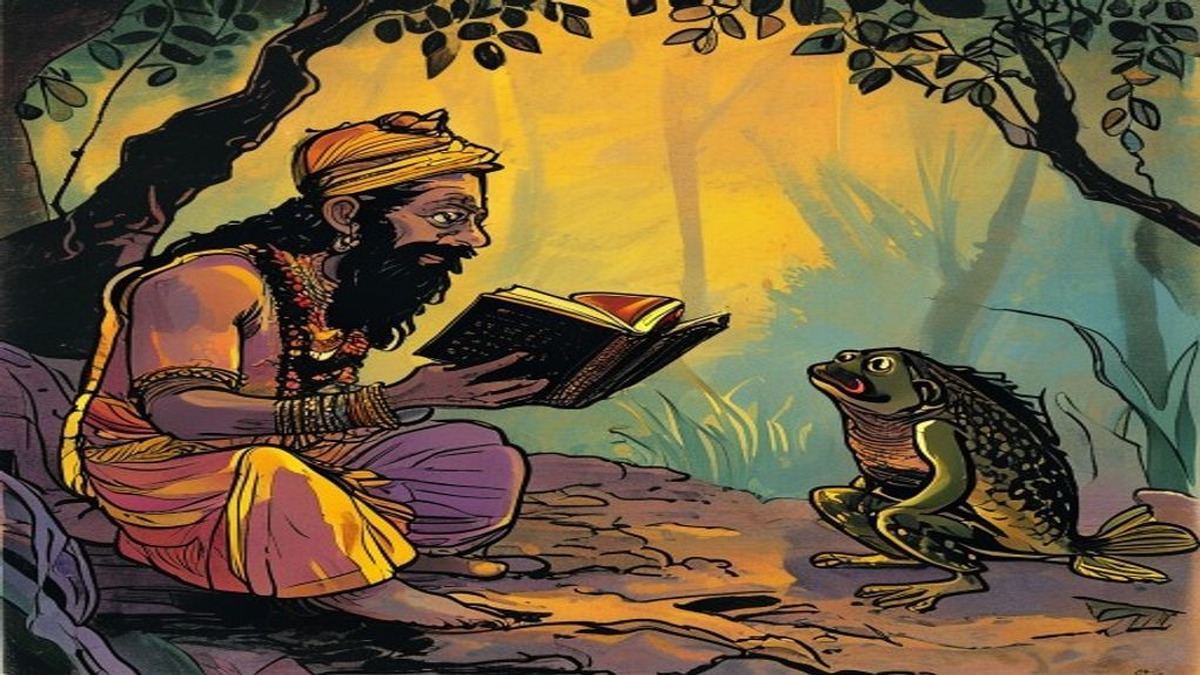
Part I: The Pond and Its Philosophers
The pond at the forest’s edge was small but rich, fed by an underground spring that kept it clear through the dry season when the larger lakes went brackish. In this pond lived three prominent residents whose reputations extended well beyond the water’s edge.
Shathabuddhi was a large rohu whose intelligence was the local standard of comparison: “as clever as Shathabuddhi” was the pond’s highest compliment. He was known for having escaped three nets, two herons, and a bear in his long life, each time through a different stratagem. He collected escape plans the way other fish collect territory — obsessively, in depth, with annotations.
Sahasrabuddhi was larger and more impressive still: a massive catla whose memory for tactics was said to be essentially infinite. He had, over many years, catalogued the behaviours of every fisherman who had worked the region, every type of net and trap in local use, and the theoretical responses appropriate to each. When he discoursed on evasion strategy, the smaller fish gathered to listen in the way that students gather near a great teacher.
Ekabuddhi was a frog. He was not unintelligent; he simply had a different relationship to the concept of preparation. He had, as his name announced, one plan for any threat: dive to the deepest part of the pond and wedge himself under the root-mass of the oldest lotus plant, where the water was coldest and darkest and where no net had ever reached. He had used this plan on eleven separate occasions. It had worked eleven times.
When the two fish held their evening discussions of escape theory, they sometimes included Ekabuddhi as a courtesy. He listened politely. When asked for his contribution, he always gave the same answer. “Dive to the bottom,” he said. The fish found this charming in a limited sort of way, the way sophisticated people find simple things charming: with an underlying condescension they are careful not to display too openly.
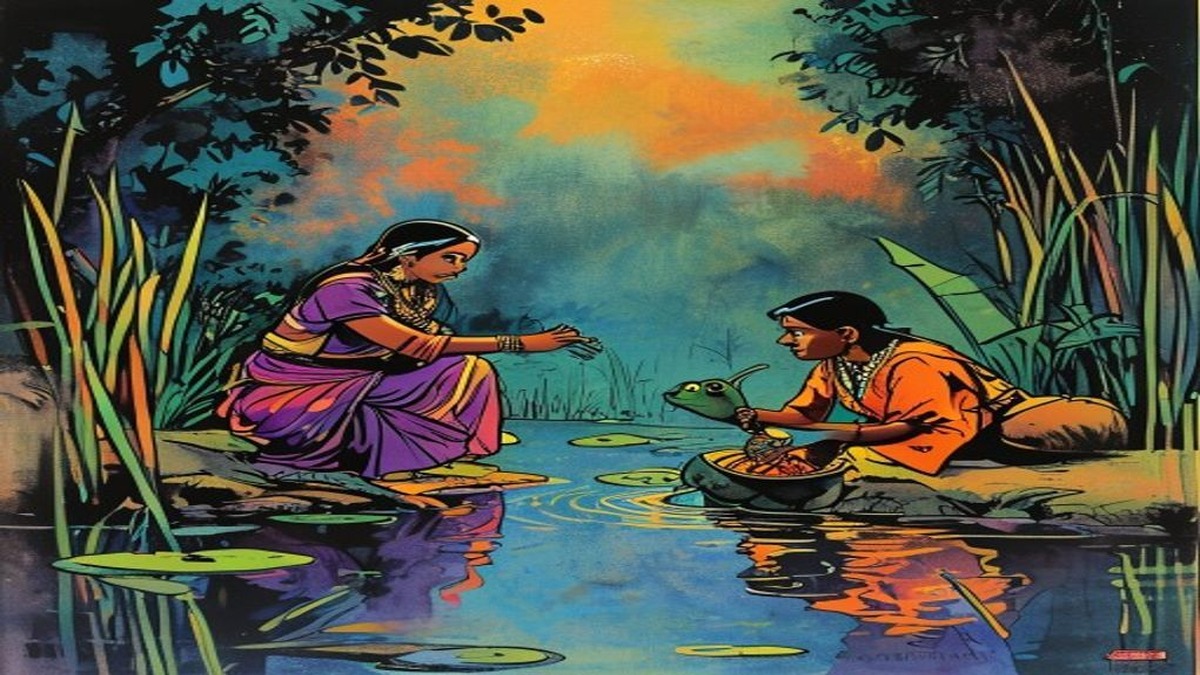
Part II: The Fishermen Arrive
On the morning in question, two fishermen came to the pond. They were not the regular fishermen of the region; they were from a village three days’ walk to the east and had heard that the small spring-fed pond held exceptional fish. They carried a net of the type known locally as a sweep-net: wide, weighted at the bottom, designed to be drawn across the full width of a small body of water.
All three residents of the pond detected the fishermen’s approach simultaneously — the vibration of steps on the bank, the smell of old net, the quality of the shadow that fell across the water. The frog’s response was immediate: he moved toward the deepest part of the pond and positioned himself near the lotus root-mass, ready to wedge in at the first indication of the net entering the water.
The two fish held a rapid conference.
Sahasrabuddhi reviewed his catalogue. This type of net, these fishermen’s probable technique, the pond’s dimensions — he identified seventeen possible responses. The first was to crowd against the bank where the net could not fully deploy. The second was to find the net’s weighted edge and push beneath it. The third was to time a surface breach for the moment the net was at its most extended. The fourth…
Shathabuddhi interrupted to argue for a different initial approach: stay in the deeper water, confuse the deployment by moving in the opposite direction to the net’s apparent sweep. He had used this approach with a different net type three years earlier. He explained the principle.
The fishermen finished positioning themselves and threw the net.

Part III: The Net and Its Work
Ekabuddhi was under the lotus root-mass before the net had fully extended. The water above him was cold and dark. He could feel the net’s vibration through the water but not its presence directly. He waited. This was the whole of his plan and he executed it completely and immediately. He did not reconsider it. He did not wonder if a different position might have been better. He had done this eleven times. He waited.
Above him, the two fish were executing the first of their responses. Shathabuddhi had broken toward the bank; the net’s deployment had already covered that approach. He reversed, chose the second strategy, drove toward the net’s weighted edge. The fishermen, experienced, felt the pressure and adjusted. Shathabuddhi chose the third strategy, then the fourth. Each was technically correct — each was the right response to a net deployed in a specific way — but the fishermen adjusted faster than the strategy could be completed, and each new adjustment required a new assessment.
Sahasrabuddhi was cataloguing simultaneously, cross-referencing what he was observing against his theoretical database, selecting the optimal response to the current configuration while the configuration changed faster than the selection process ran. He was never wrong, exactly. He was always slightly behind.
The net completed its sweep.
Both fish were in it. Shathabuddhi had nearly reached the underweighted corner during the third attempt; a small adjustment by the fisherman on the right had closed that gap a quarter-second before his escape. Sahasrabuddhi had identified the optimal moment for a surface breach and had not quite reached the breach position when the net closed.
The fishermen pulled the net to shore. It contained two very large, very intelligent fish who would make excellent eating.
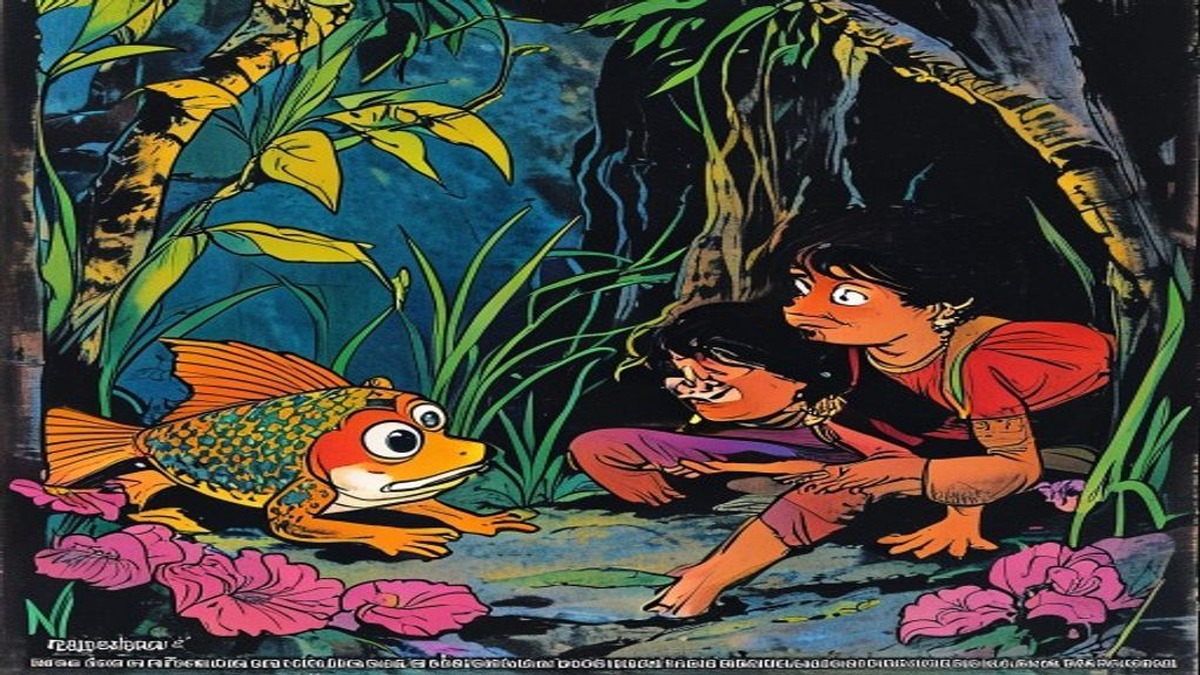
Part IV: The Lesson of the Root-Mass
Ekabuddhi emerged from beneath the lotus root-mass when the vibrations in the water told him the fishermen had gone. He surfaced, looked at the empty bank, and assessed the situation with the calm of a creature who had survived the same crisis twelve times now using the same method and saw no reason to change his approach.
Vishnu Sharma’s commentary is among his most compressed: “The fish with a thousand plans had no plan ready when the plan was needed. The frog with one plan had it ready at all times. In a crisis, the question is not which strategy is theoretically superior but which one the practitioner can actually execute under pressure.”
The Sanskrit commentarial tradition reads this story as a critique not of intelligence but of a particular kind of intelligence: the kind that accumulates theories faster than it develops the capacity to act on them. Shathabuddhi and Sahasrabuddhi were genuinely more intelligent than Ekabuddhi in the sense that they possessed more knowledge and could formulate more sophisticated responses. Their failure was not a failure of intelligence but of implementation: their response system could not convert knowledge into action fast enough under the specific time constraints of the crisis.
Ekabuddhi’s advantage was not the quality of his single plan — it was not theoretically optimal — but its speed of deployment. He had practiced it eleven times. It required no deliberation. When the crisis came, the gap between recognition and action was essentially zero. The fish spent that interval deliberating. The net spent it closing.
Why This Story Has Lasted Three Thousand Years
“The Tale of Two Fishes and a Frog” endures because it describes a failure mode that is paradoxically more common among the intelligent than the simple: paralysis by analysis, the inability to act when the action required is less sophisticated than the analytical apparatus available. The story is not an argument against intelligence or preparation; it is an argument that intelligence and preparation are only valuable if they can be converted into action within the time available for action.
The Sanskrit pedagogical tradition uses this story specifically in the training of ministers and military commanders: the argument being that a decision made at 70% of optimal quality and executed immediately is almost always superior to an optimal decision that arrives after the window has closed. This insight was not rediscovered by Western military theory until Carl von Clausewitz formulated it in the nineteenth century as the relationship between decision-making speed and the “fog of war.”
The story entered Arabic Kalila wa Dimna and was cited in medieval Islamic discussions of the relationship between scholarship and practical action — a recurring theme in Islamic political thought about whether theoretical excellence translates into effective governance. In modern management literature, the story’s mechanism has been independently rediscovered under various names: analysis paralysis, the planning fallacy, over-optimisation. In each case the diagnosis is the same as Vishnu Sharma’s: a repertoire of excellent plans, no executed plan.
Ekabuddhi’s root-mass is not a sophisticated refuge. It is a practised one. The story’s deepest lesson is that the practised simple response, deployed without hesitation, will almost always defeat the theoretically superior response that is still being selected when the net closes.
Frequently Asked Questions
What is the moral of The Tale of Two Fishes and a Frog?
The story teaches that a single plan reliably executed defeats a thousand theoretically superior plans that cannot be deployed in time. The frog survives not because his plan is better but because it requires no deliberation — practiced eleven times, it deploys instantly. The fish's superior knowledge cannot compensate for their slower response time when the net closes.
Who are Shathabuddhi, Sahasrabuddhi, and Ekabuddhi?
Their names are the story's thesis: Shathabuddhi (Hundred-Wits), Sahasrabuddhi (Thousand-Wits), and Ekabuddhi (Single-Wit). Vishnu Sharma chose these names to signal that the story is about the structural relationship between the quantity of available strategies and the ability to execute any one of them under time pressure.
Which book of the Panchatantra does this story come from?
The story comes from Book V, Apariksitakarakam (Ill-considered Action). The ill-considered action here is the fish's decision to keep deliberating rather than acting — in a crisis, the deliberation itself becomes the fatal error.
Is there a Buddhist version of this story?
Yes. A closely related story appears in the Jataka corpus. The Panchatantra and Jataka traditions drew on overlapping pools of Indian folk narrative, and this story's pattern — the single-wit survivor, the multi-wit victims — appears in multiple South Asian narrative traditions from roughly the same era.
How does this story relate to analysis paralysis?
The story describes exactly the mechanism modern decision theorists call analysis paralysis: the failure to act because selecting the optimal response takes longer than the situation allows. The Panchatantra's diagnosis anticipates by two thousand years the military science observation that a good-enough decision made immediately beats an optimal decision made too late.
You May Also Like
 Panchatantra Stories
Ages 3-5
Panchatantra Stories
Ages 3-5
The Story of the Lion, the Camel, the Jackal and the Crow
The Story of the Lion, the Camel, the Jackal and the Crow: In a ertain part of the jungle, there lived a lionking, by the name of Madotkata. His retinue
 Panchatantra Stories
Ages 6-8
Panchatantra Stories
Ages 6-8
The Tale of Three Fishes
Three fishes face danger differently: one dies unprepared, one escapes through wisdom, one through swift action.
 Panchatantra Stories
Ages 6-8
Panchatantra Stories
Ages 6-8
The Story of the Old Merchant, His Young Wife and the Thief
The Story of the Old Merchant, His Young Wife and the Thief: In a certain town, there -lived an old merchant by the name of Kamatura. After the death of his