The Elephants and the King of Mice
A thirsty elephant herd hurts a mouse kingdom, and later a tiny army of mice repays their kindness.
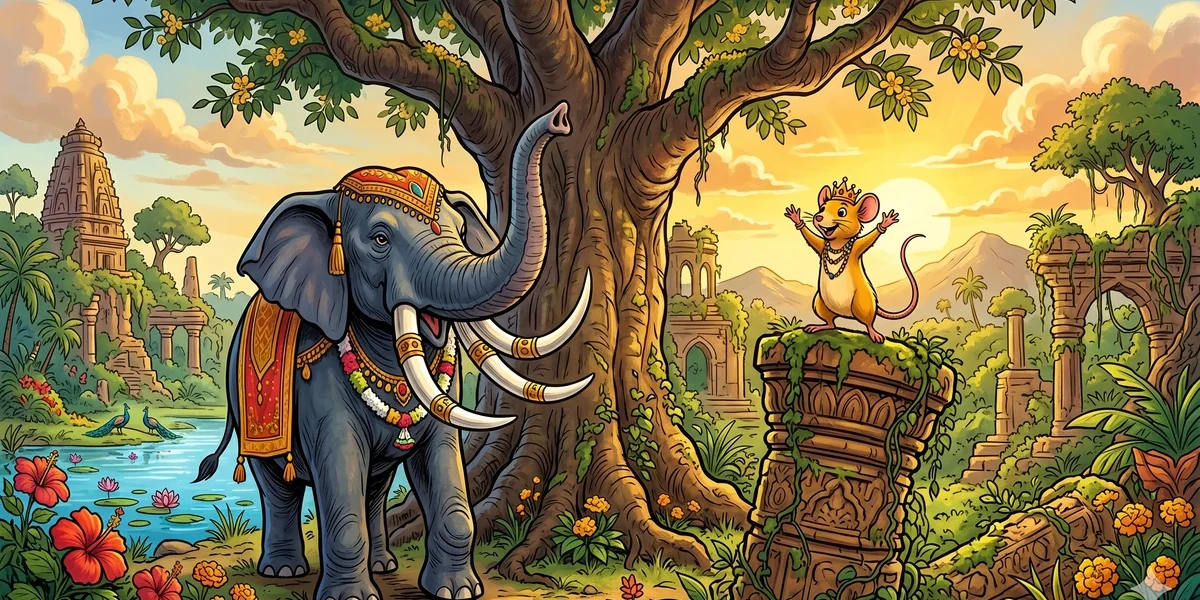

Long ago, in the days when forests still spoke and animals still kept treaties with one another, there was a great elephant-king whose name was Chaturdanta — “the Four-Tusked.” His four ivory tusks had grown long and curved as the years had passed, and they shone like polished moonstone when he walked beneath the sun. He was lord of a vast herd that drank from the cool rivers, ate the sweet bamboo, and rested under the shade of the great sal trees of an ancient Indian forest at the edge of a long-fallen city.
And in that fallen city, hidden beneath the broken stones and overgrown courtyards, lived another king. He was so small that an elephant might pass over him and never see him. He was Mūṣikarāja, the King of the Mice. His coat was the colour of warm honey, his eyes were dark and bright, and beneath his ruined kingdom there ran a vast network of tunnels — chambers, granaries, council halls, all carved out of the soft earth between the old stone foundations. Hundreds of mice lived under his rule, and they had grown bold in their old kingdom because no creature ever troubled them there.
The story of how these two kings met, and how the smallest creature in the forest one day saved the largest, is one of the oldest and most precious lessons of the Pañcatantra. It is a tale told for more than two thousand years, in Sanskrit and in Persian, in Arabic and in Latin, in Spanish and in English. And the lesson it teaches is this: no one knows whose moment of need will come; therefore the wise make friends everywhere.
Where the Tale Comes From
This story belongs to Book III of the Pañcatantra (c. 200 BCE), the book called Kākolūkīyam — “Of Crows and Owls.” The book is the longest of the Pañcatantra's five and is itself a frame for many inset stories that illustrate the principles of statecraft and the choosing of allies. The Tale of the Elephants and the Mice is one of these inset stories, told to demonstrate a single piece of royal wisdom: that an ally is worth cultivating regardless of size, because no one can foresee the day on which the smallest creature will become the only friend who can help.
The same tale is preserved with great elaboration in Nārāyaṇa's Hitopadeśa (c. 12th century CE), Book II — Mitralābha (“The Acquisition of Friends”) — where it stands as one of the canonical exemplars of the principle that gives the book its name. From the Sanskrit it travelled westward in the 6th century CE through the Persian physician Borzūya's Pahlavi translation, and from there into Arabic as Ibn al-Muqaffaʿ's Kalīla wa Dimna, into Persian again as the Anvār-i Suhaylī, into Latin as John of Capua's Directorium Humanae Vitae, and into Spanish as the Calila e Dimna of 1251. In every one of those languages the elephants and the mice still meet at the ruined city, and the lesson is unchanged.
The Buddhist canon preserves a parallel tale in the Latukikā-Jātaka (Jātaka 357), the “Quail's Revenge,” in which a tiny quail repays a great elephant. Folklorists list the motif under ATU 75 (“The Help of the Weak”) and ATU 554 (“The Grateful Animals”). And the most famous Western descendant of the Indian original is Aesop's “The Lion and the Mouse” (Perry 150) — the same tale, with a Greek lion substituted for the Indian elephant. The Indian version, with the herd of elephants and the kingdom of mice and the ruined city above their tunnels, is older than the Greek; it is one of the gifts the Pañcatantra gave to the world.
The Drought and the Long March
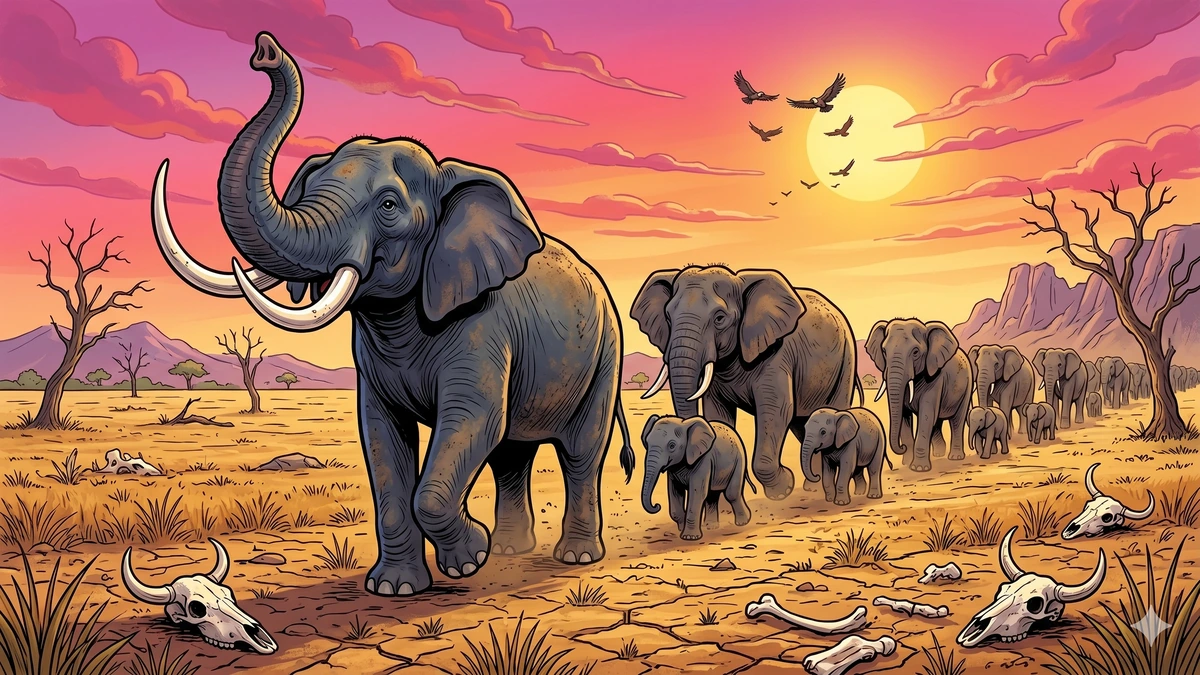
One year, the rain did not come.
The first month of the monsoon passed and the sky stayed clear and white. The second month passed, and the third, and still no rain. The streams of the great forest grew thin, then thinner, and at last there was nothing left of them but cracked beds of grey clay. The leaves on the sal trees curled brown at the edges. The bamboo dried until it rattled like bone in the hot wind. Even the deer began to grow weak.
Chaturdanta gathered his herd around him under the largest of the old sal trees. The calves stood close to their mothers; the great bulls stood with their ears half-spread, listening; the elders dipped their long trunks in salutation. The four-tusked king spoke quietly, as elephant-kings do, in the deep voice that travels along the earth as much as through the air.
“My family,” he said, “there is no water left in our forest. If we stay here, the calves will die first, and the rest of us soon after. We must walk. Somewhere far from here there will still be a lake. We will find it together, or we will die together. But we will not sit and wait.”
And so the long march began.
For days and nights they walked. The sun beat on their grey backs. The youngest calves grew so tired that the older cows had to twine their trunks with the calves' trunks and gently tug them along. Chaturdanta walked at the head of the column, his great tusks held high, his trunk testing the wind for any scent of water. Behind him stretched the herd: more than a hundred elephants, walking single-file across plains where dry grass scratched at their feet and where vultures circled the distant horizon, watching to see if any of them would fall.
On the seventh day, when even Chaturdanta had begun to wonder if there was any water left in the world, the youngest of his nephews lifted his trunk suddenly and trumpeted.
“Uncle! I smell it! Water — to the east!”
The herd stopped. The wind shifted. And there, faint but unmistakable, came the cool green smell of a great body of water, somewhere just beyond the next ridge of low hills. A ripple of joy went through the herd. The calves trumpeted. The mothers laughed in their soft, deep elephant way. Chaturdanta turned, raised his four tusks, and led them at a gentle run over the ridge.
Below them, in the bowl of a wide green valley, lay a lake. It was vast and still and the colour of polished sapphire, fringed with lotus and reeds, with white herons and blue kingfishers wheeling above it. And beside the lake, half buried in vines and tall grass, lay the broken walls and tumbled towers of an ancient ruined city.
The herd descended to the water and drank.
The Kingdom Beneath the Stones

What the elephants did not know — what no one in the forest knew — was that the ruined city was not empty.
Beneath the broken paving-stones and under the fallen pillars and through the dark spaces under sunken floors, an entire kingdom of mice had lived for many generations. Their king was Mūṣikarāja, who was old enough to remember three droughts and four floods, whose coat was the warm gold of summer wheat, whose eyes were quick and wise. Under his rule the mice had built a vast hidden city — long tunnels braced with twigs, granaries piled with seeds and grain, council chambers where the elders met, nurseries where the pups grew. Above ground there were only the silent ruins of the old human city; below ground there was a living kingdom of thousands.
The mice were peaceful. They had no enemies in the ruins. The owls had moved away long ago; the snakes preferred the rivers; even the foxes did not bother to dig where the soil was full of stones. The mouse-kingdom had grown rich and content beneath the broken city, year after year, generation after generation, undisturbed.
And then the elephants came down to drink.
Chaturdanta's herd, weary from seven days of marching, walked across the meadows toward the lake. Their feet were enormous. Each footstep weighed more than ten of the largest forest deer. They did not know they were treading on the roof of a great hidden city. They did not know that beneath each footfall a tunnel was caving in, a chamber was collapsing, a granary was burying itself in dust. They did not know that little mice were running for their lives through pitch-dark tunnels that suddenly snapped shut over their heads.
By the time the herd reached the lake and began to drink and to spray themselves with water in their joy, the mouse-kingdom lay in ruins. Hundreds of tunnels had collapsed. Many of Mūṣikarāja's subjects had been killed or injured. Mothers ran searching for their pups; soldiers tried to dig out elders who had been buried alive. The dust rose from the broken tunnels in a slow grey cloud.
And in the centre of his ruined kingdom, Mūṣikarāja the mouse-king stood with the dust on his fur and tears on his small face, and watched the elephants drinking peacefully at the lake.
The Smallest King Speaks to the Greatest
Now, the mice could have done many things. They could have hidden in their broken tunnels and wept and waited for the elephants to leave. They could have cursed the great creatures who had not even noticed them. They could have plotted some small revenge — a bite on the trunk while the elephants slept, perhaps, or stones rolled into the lake to muddy the water. None of these would have changed anything. None of these would have helped.
But Mūṣikarāja was wise. He had read the stars and the seasons; he had watched the world for many summers; and he understood something that small creatures often forget. He understood that the great are not always the enemy, and that the small are not always helpless. He understood that one good speech, made at the right moment, can do more than a thousand bites or a thousand stones.
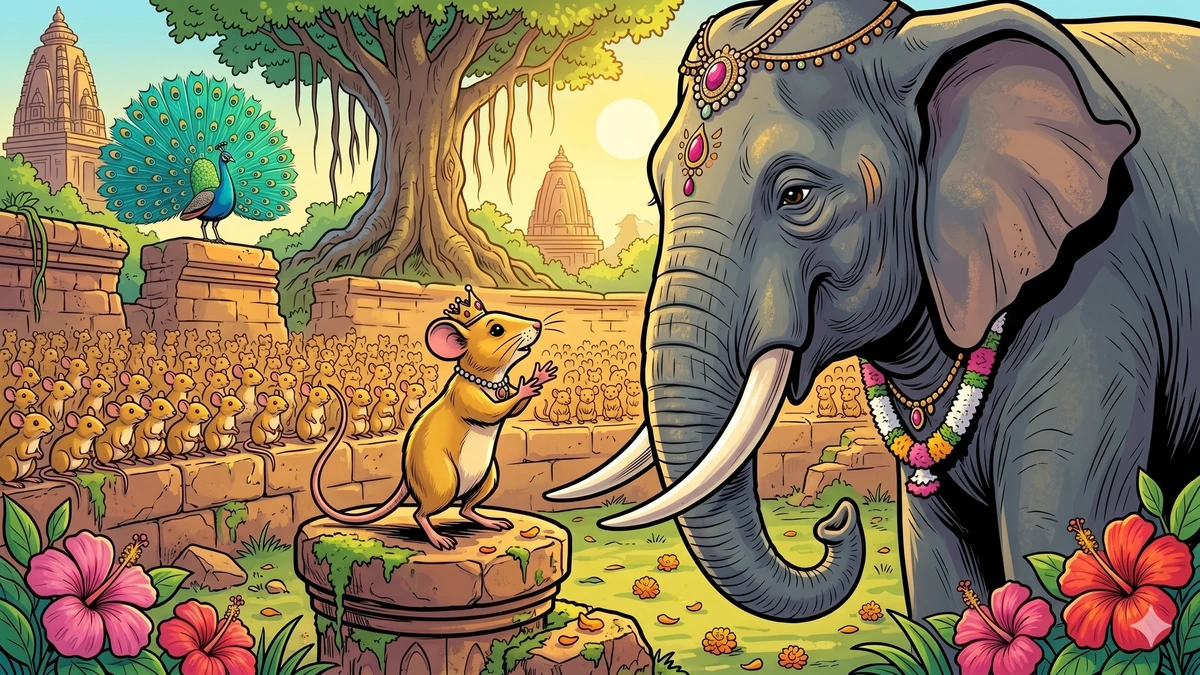
He cleaned the dust from his honey-coloured coat. He smoothed his whiskers. He climbed up onto the highest piece of broken pillar he could find — a moss-covered stone that lay near the path the elephants would take when they walked back toward their forest. He stood up on his hind paws. And when Chaturdanta passed by, the mouse-king cleared his small throat and spoke as loud as he could.
“Great King of the Elephants! I beg you — hear a small voice that speaks for many.”
Chaturdanta stopped. The whole herd stopped behind him. The four-tusked king turned his enormous head and looked down with mild surprise. There, on the broken pillar, no taller than a tuft of grass, stood a tiny golden mouse on his hind paws.
“Speak, little brother,” said Chaturdanta gently. “What is your need?”
And Mūṣikarāja told him. He told him of the kingdom beneath the stones, and of the long tunnels that had been built over many lifetimes, and of the pups and the elders and the granaries. He told him how the herd's great feet had crushed through the roofs of his city, how many of his people lay dead, and how more would die if the elephants returned by the same path. He spoke without anger, and without pleading. He spoke as one king speaks to another.
And then he said the words that all the wise teachers of India have remembered for two thousand years.
“Great King — every creature, however small, may one day stand upon the threshold of your need. None of us, neither the small nor the great, knows whose moment of friendship will come. The wise king makes friends everywhere, because the wise king does not know who, in some unknown hour, will save him. Spare what is left of my people. Promise that when you come to the lake again you will choose another path. And in return, my people and I will be your friends forever — and if ever a day comes when the great king of elephants needs the help of small creatures, we shall come.”
Chaturdanta was silent for a long time. The herd behind him stood silent too. The wind moved softly across the ruined city. At last the four-tusked king lowered his great head until his trunk almost touched the moss-covered pillar, and he spoke very gently.
“King of the Mice — I did not see your kingdom. I did not know my feet were breaking it. I am ashamed. We will choose another path; we will never walk this way again. And I accept your friendship — though I cannot imagine a day when so great a herd as ours could need so small a king as you. But I will keep your friendship in my heart, and I will not forget.”
He raised his head, gave a slow trumpet of farewell, and led the herd back to the forest by a long way that did not pass over any tunnel of the mice.
The Years that Passed
The rains returned. The forest grew green again. The streams ran cool and full, and the bamboo grew thick and sweet, and the elephants rested in their old places. Chaturdanta sometimes thought of the small king on the moss-covered pillar, and smiled, and shook his great head as if at a dream.
Years passed. The calves of that long-march year grew into tall young bulls and sleek young cows. The herd thrived.
And then, one season, the hunters came.
The Trap

They were hunters from a faraway king who wanted elephants for his army. They brought with them long ropes braided of strong fibre, and great nets woven of those ropes — nets so wide that an entire herd could be caught in one of them at once. They studied the forest for many weeks, learning where Chaturdanta's herd drank and rested. They dug pits and concealed them with leaves. They strung the great nets between the trees on the path the elephants used most often.
And one twilight, when the herd was returning from the watering-place to its sleeping ground, the trap closed. The hidden ropes pulled tight. The nets dropped from the trees. The pits opened beneath their feet. The forest filled with the cries of trapped elephants — calves and mothers and great bulls all caught at once. The hunters came running with torches and with shouts of triumph. They bound every elephant's legs with cords and tied each one to a tree. They tied the trunks of the bulls so they could not trumpet a warning. They tied even Chaturdanta — the four-tusked king — and they tied him most carefully, with the strongest of the ropes, and they laughed at the size of him.
By midnight the whole herd was bound. The hunters slept around their campfire, planning to begin the long march to the king's capital at dawn. There was no chance of escape. The ropes were too thick to break; the elephants' trunks were too tightly tied to be of any use; the calves were terrified into silence. There was nothing the herd could do.
Chaturdanta stood with his four tusks bound down to his knees by ropes thicker than a man's arm. He thought of the calves. He thought of the cows. He thought of the dawn coming. And then he remembered the moss-covered pillar, and the small voice that had spoken to him beside the ruined city long ago, and the promise that he had not believed he would ever need.
He closed his eyes. He concentrated all the strength of his old wise mind into a single thought, and he sent it across the great forest — across the rivers and the bamboo and the broken hills — toward the kingdom of the mice. Mūṣikarāja, my friend. The day has come.
In the ruined city beneath the stones, Mūṣikarāja the mouse-king woke from his sleep with the message in his mind, and he understood at once. He woke the council of elders. He woke the soldiers, the runners, the gnawing-teams. He gathered every single mouse of his kingdom — every grandmother and every pup, every guard and every grain-keeper — and he led them out under the moonlight of that long night, in a great silent flowing river of small honey-coloured bodies, toward the clearing where Chaturdanta's herd lay bound.
They came as silently as moonlight. The hunters slept on. The campfire crackled and the smoke went up unbroken. And the mice swarmed up the legs of the bound elephants, up the trunks, along the bodies, and they began to gnaw. Each mouse gnawed at one rope. The little teeth — sharper than any blade — cut through the great fibre cords as cleanly as a knife cuts butter. Before the moon had set, the ropes that bound Chaturdanta were chewed away. Before the morning star had risen, every elephant in the herd was free.
The herd rose silently. They lifted their freed trunks, embraced their freed calves, and Chaturdanta knelt his great head on the forest floor before the small king who had come to save him. Mūṣikarāja stood on his hind paws on the four-tusked king's broad forehead, and he smiled.
“Did I not say,” said the mouse-king softly, “that no one knows whose moment of need will come? You did not despise me when you were great. I have not forgotten when you are bound. Walk now, brother. Walk before the hunters wake.”
The herd melted into the forest. By the time the hunters opened their eyes at dawn, the clearing was empty — only the gnawed ends of a thousand ropes lay scattered on the ground, and the mice were already long gone home through the moonlit grass.
The Moral
The Sanskrit verse that seals this story is one of the most-quoted in all the literature of India:
na kaścid api jānāti kasya kālo bhaviṣyati /
yasmād akāraṇaṁ mitraṁ kuryāt sarvatra paṇḍitaḥ //“No one knows whose hour of need will come.
Therefore the wise man makes friends everywhere — even without cause.”
This is not a children's sentiment about being kind to small animals — though it is also that. The Pañcatantra is a treatise on statecraft, written for princes who would one day rule, and the verse is a precise piece of political philosophy. It is the doctrine of mitralābha, “the winning of friends.” Its claim is hard and clear: no one can foresee the future; no one knows from which corner the moment of need will come; therefore the rational policy is to make alliances widely, generously, and without immediate calculation, especially with those who seem to have nothing to give. Because the day will come — it always comes — when the only friend who can help is the friend you made when you did not need one.
The companion verse, told everywhere alongside this story, is even more pointed:
alpa-śaktiṁ na manyeta ko ‘pi prājño hi mātrayā /
raśmi-baddho gajo yena mūṣikenaiva mocitaḥ //“Let no wise man despise the small by mere measure of size —
the elephant bound by ropes was freed by the mouse.”
Why This Story Endures
For more than two thousand years this tale has been told in India, in Persia, in Arabia, in Spain, in England, in every classroom and at every grandmother's knee. It has been retold in picture books and in policy manuals. It has crossed languages, religions, and continents. It has even crossed species — for Aesop's “The Lion and the Mouse” is the same tale, one elephant and one drought-march removed.
It endures because its lesson is impossible to outgrow. The young child hears it as a story about being kind to animals. The student of statecraft reads it as a treatise on alliance-making. The Hindu philosopher reads it as a meditation on karma and on the unknowability of the future. The Buddhist reads it as a teaching on the interdependence of all beings. The grown adult, who has lived long enough to need the help of someone they once thought small, reads it as a reminder of every kindness they showed when they did not need to, and every kindness they failed to show.
And every generation of Indian children, when they ask why their grandmothers tell them this tale, hears the same answer: because no one knows whose moment of need will come. Make friends everywhere. The smallest creature in the world may one day be the only one who can save you.
Frequently Asked Questions
What is the moral of The Elephants and the King of Mice?
Which book of the Panchatantra contains The Elephants and the King of Mice?
What is the story of The Elephants and the King of Mice about?
Why do the mice help the elephants in the Panchatantra story?
Is The Elephants and the King of Mice suitable for children?
You May Also Like
 Panchatantra Stories
Ages 9-12
Panchatantra Stories
Ages 9-12
The Monkey and the Crocodile
Read 'The Monkey and the Crocodile' — a classic Panchatantra story about nature and animals. The Monkey and the Crocodile is a beloved Panchatantra tale...
 Panchatantra Stories
Ages 9-12
Panchatantra Stories
Ages 9-12
The Wedding of The Mouse
The Wedding of The Mouse: There was a hermitage belonging to the sage Salankayana. He went one morning to river Ganga to bathe. As he was reciting stanzas in
 Panchatantra Stories
Ages 6-8
Panchatantra Stories
Ages 6-8
The Carpenter’s Wife
The Carpenter's Wife: Once upon a time, a carpenter lived in a village with his wife. He had heard bad stories about her and wanted to know the truth about