The Four Learned Fools
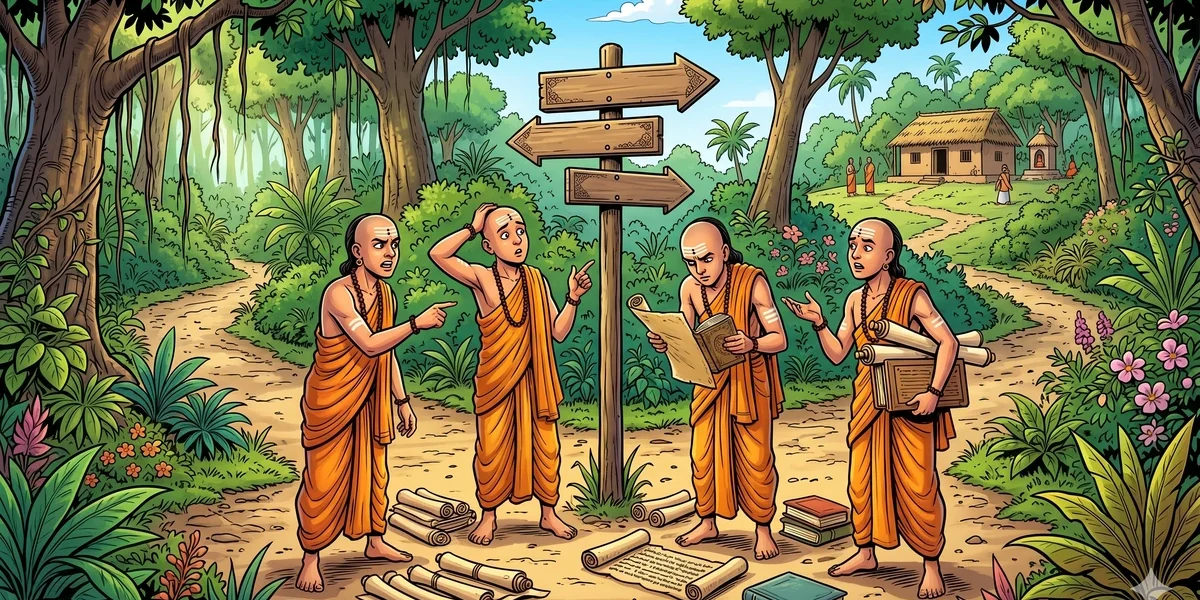
The Four Learned Fools: Four learned men resurrect a dead lion, forgetting the danger they've unleashed A classic Indian folk tale retold for young readers.
About This Story
Sanskrit title: Caturmūrkha-kathā (“The Tale of the Four Fools”)
Collection: Pañcatantra (पञ्चतन्त्र), Book V — Apariksitakarakam (अपरीक्षितकारकम्, “Hasty Action”)
Attributed to: Viṣṇuśarman (Vishnu Sharma), c. 3rd century BCE, composed to instruct three reckless princes in the arts of governance (nīti-śāstra)
Arabic transmission: Preserved in Ibn al-Muqaffaʿ’s Kalīla wa-Dimna (كليلة ودمنة), 8th century CE
Tale-type: ATU 1696 + ATU 1685 composite — “Scholars Who Lack Common Sense” / “The Fool on the Book”
Sanskrit verse tradition: Related verses appear in Hitopadeśa I.1 and Somadeva’s Kathāsaritsāgara, both of which draw on the Pañcatantra’s fifth tantra
I. The Decision to Seek Wisdom in the World
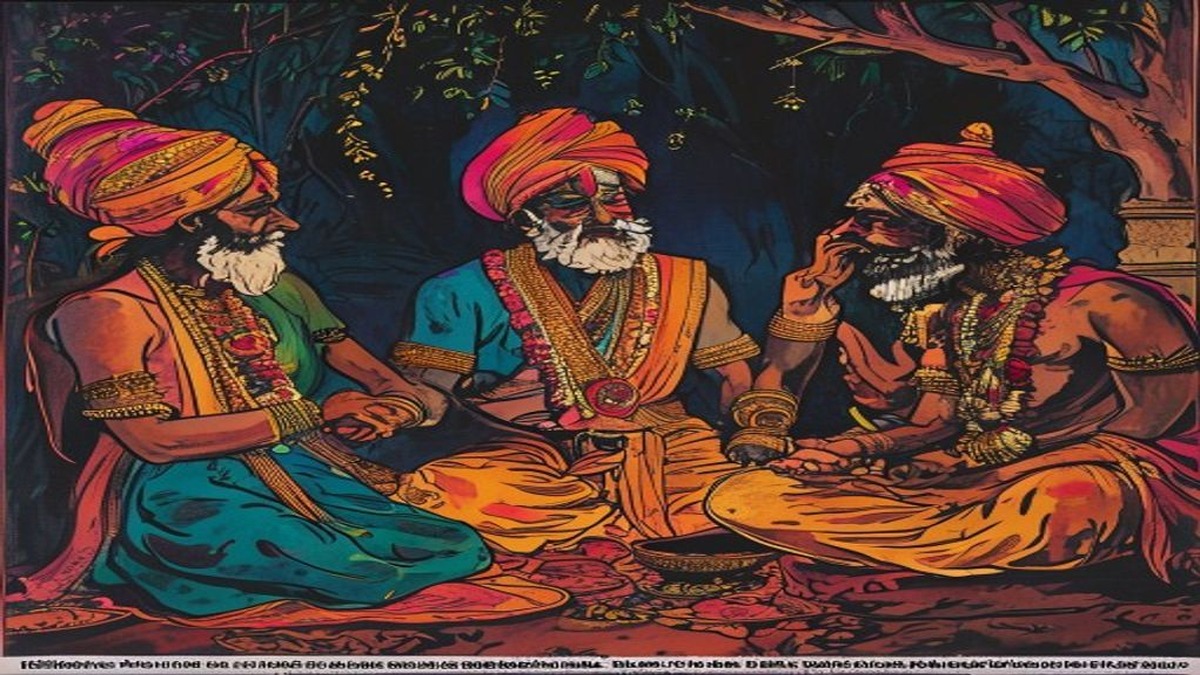
In a prosperous town somewhere in the great subcontinent, four young Brahmins grew up together as the closest of friends. They were clever boys, devoted to study, and each felt in his heart that the life of a scholar was the highest life a man could live. Yet scholarship brought no income — their families were comfortable but not wealthy, and the four friends knew that sooner or later they would have to venture beyond their familiar lanes and earn their place in the world.
One evening they sat together beneath a pipal tree and reached a decision. They would travel to a distant centre of learning, place themselves under a renowned guru, and immerse themselves in the śāstras — the sacred treatises of grammar, logic, astronomy, law, medicine, and metaphysics that formed the backbone of classical Indian education. They would study until no text held a mystery for them. Then they would return, learned and wealthy.
Their guru’s hermitage was far away. The four friends walked through forest and plain, crossed rivers on rope-ferries, and arrived at last at the āśrama. The guru accepted them without hesitation: he could see they were earnest. For twelve unbroken years the four men studied. They memorised thousands of verses, debated commentaries deep into the night by the light of clay lamps, and mastered the subtle distinctions between one school of thought and another. When finally their guru pronounced them fit to go into the world, they were repositories of the entire classical tradition. Each carried his texts rolled into bundles on his shoulder. Their heads were full of quotations. Their hearts were full of pride.
What they had never been taught — because the hermitage had no way to teach it — was the art of reading the living world around them.
II. The Funeral Procession, the Donkey, and the Camel
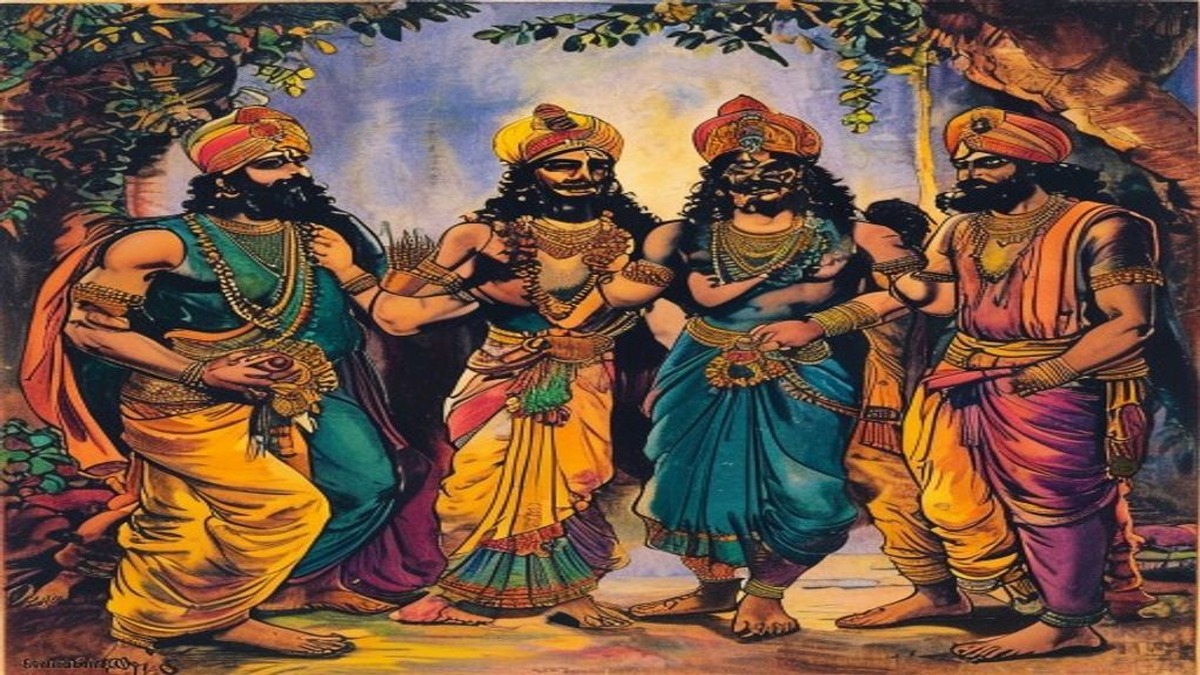
The road home brought the four Brahmins to a crossroads. They stood debating which fork to take when a sound rose from one of the lanes: the slow beat of a drum, the trembling note of a conch, the low voices of men reciting funeral hymns. A great procession was advancing — the body of a merchant’s son, draped in white, borne on a bamboo bier, followed by the whole town in mourning.
One of the Brahmins immediately unrolled his bundle and consulted his texts. He found a verse: mahājano yena gataḥ sa panthāḥ — “The path great men travel is the correct path.” The funeral procession was clearly composed of great men: merchants, elders, priests. Logic was irrefutable. “We must follow them,” he announced. His three companions nodded. They fell in behind the cortège and walked to the cremation ground.
At the cremation ground they found themselves surrounded by ash-pits, broken clay pots, and the residue of old fires. The funeral rites concluded and the crowd dispersed. The four Brahmins were left alone — except for a thin donkey tethered to a post, waiting patiently for its washerman master to return.
Another Brahmin opened his texts and located a second verse: āpadi sthāyi bandhuḥ — “A true friend is one who stands by you in misfortune.” The donkey had stayed. It had not run. Clearly, the donkey was a true friend. With great solemnity the four scholars garlanded the animal, washed its hoofs, and pressed their foreheads to its flank in respectful greeting.
While they were occupied in this ceremony, they saw a camel cantering across the plain toward them. Its gait was swift and purposeful. A third Brahmin consulted his texts and produced a verse: dharmo vegena gacchati — “Righteousness moves quickly.” The fast-moving camel, therefore, must be Righteousness personified. A fourth verse confirmed the conclusion: a good man should always lead his friend toward Righteousness. Since the donkey was their friend and the camel was Righteousness, the duty was clear. They tied the donkey to the camel.
The camel, indifferent to all philosophy, continued at its usual trot. The donkey, straining against the rope, was dragged lurching across the cremation ground. At this precise moment the washerman arrived, saw his donkey being abused, and snatched up a stick. The four scholars, having consulted no text on the subject of angry washermen, did the only natural thing: they ran.
III. The River, the Sacred Leaf, and the Sword
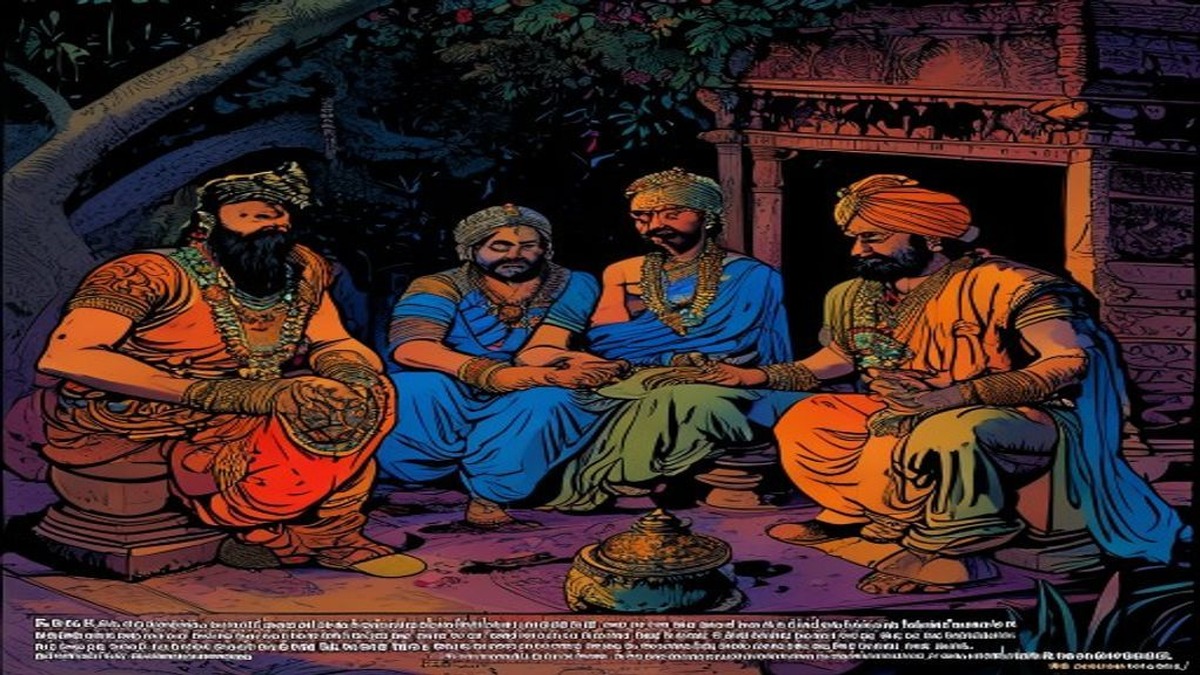
The four Brahmins fled until they reached a wide river. They were breathing hard, their text-bundles clutched against their chests, when they noticed a single broad leaf drifting on the current — a leaf of the holy pīpal, the sacred fig, the tree under which the Buddha would one day find enlightenment.
One of the scholars recalled a verse: pāvanam tārayati — “The holy carries one across.” The pīpal leaf was incontestably holy. Therefore it would carry him across the river. Without testing the logic further, the Brahmin leaped onto the leaf. He sank instantly. He could not swim. The current caught him and began pulling him downstream.
His companion plunged in to save him, seizing his arm. But the river was in full spate and far stronger than the rescuer. He could not haul his drowning friend to shore. In his texts there was a verse for this situation too: āpadi ardham tyajet — “When total destruction threatens, a wise man sacrifices half to save the rest.” The meaning was clear. He drew his sword and cut his friend across the middle. He dragged what remained to the bank. His friend was dead.
Three Brahmins now stood dripping on the riverbank, one fewer than before. They mourned for a moment — the texts had something for grief, too — and then continued their journey, because the texts also said that the wise man does not delay unnecessarily.
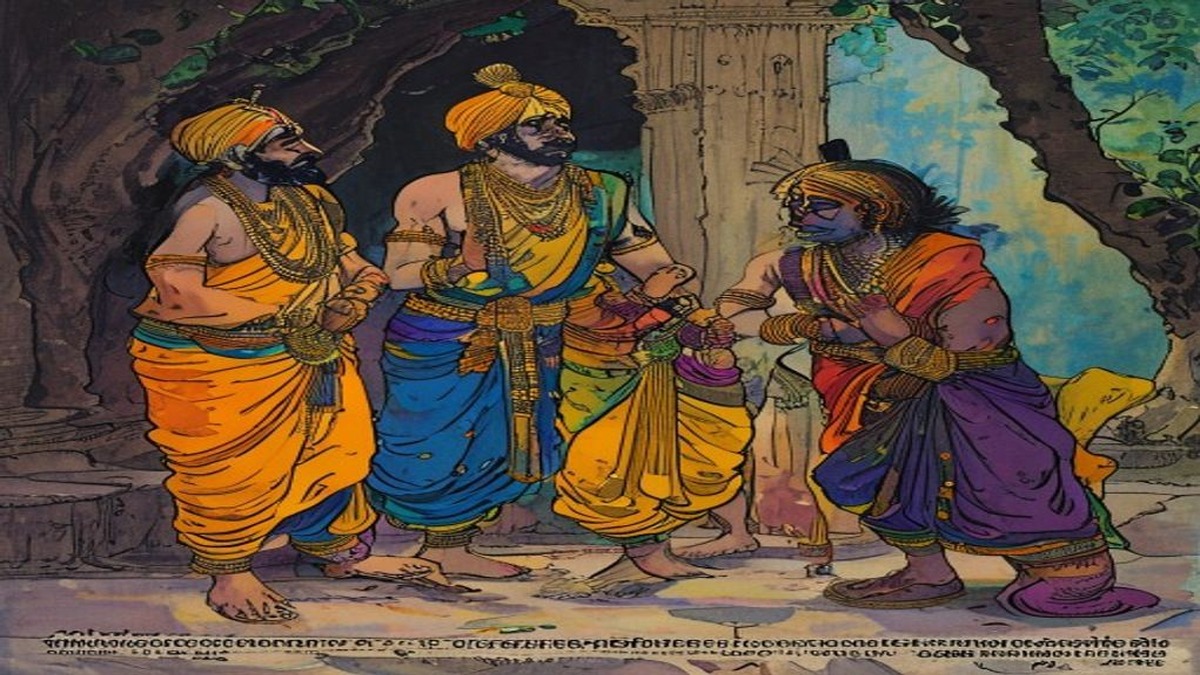
IV. The Village of the Three Foods
The remaining three scholars reached a village at dusk. The villagers, knowing that Brahmin scholars were guests of honour, welcomed them with genuine warmth. Three different households volunteered to feed the three wanderers. Each scholar was shown to a separate courtyard and settled on a clean mat.
The first householder brought seviyan — sweet vermicelli noodles, long and delicate. The Brahmin unrolled his texts and found a verse: dīrghāyojananiti naśyati — “Long scheming leads inevitably to destruction.” Noodles were long. He refused to eat. He sat hungry all night.
The second householder brought a bowl of frothy sweet kheer, milk-rice pudding, its surface airy with foam. The Brahmin found his verse: phenilam sthira na bhavati — “Whatever is frothy and distended does not last.” Foam was a sign of impermanence. He refused to eat. He sat hungry all night.
The third householder brought puranpoli — a flat bread stuffed with sweetened lentil, with a depression pressed into its centre by the cook’s thumb. The Brahmin found his verse: chidram vinaśanam sūcayati — “A defect foretells approaching ruin.” There was a hole in the bread. He refused to eat. He sat hungry all night.
In the morning the three households compared notes. Within the hour the whole village was laughing. News of the learned men who had refused to eat because of the shapes of their food spread from house to house, each retelling adding a new detail. When the three Brahmins finally rose and set off, the villagers followed them to the edge of the fields, laughing all the way.
Moral
śāstraṃ cet nāsti kiṃ tena, arthaṃ bhrāntaḥ prapedire
“What use are scriptures if their reader cannot understand the purpose they were written for? The learned who have lost their way are as blind as those who never read at all.”
— Pañcatantra, Book V (Apariksitakarakam), adapted
The tale does not argue against learning. The Brahmins had memorised real texts containing genuine wisdom. Their error lay in applying those texts mechanically, as a look-up table, without asking what the authors had actually meant. Mahājano yena gataḥ sa panthāḥ counsels the traveller to follow wise guides — not to join any procession that happens to be moving. Āpadi sthāyi bandhuḥ praises loyal friendship — not the company of whatever creature stays longest in a field. The wisdom was sound. The application was absurd. And that, Vishnu Sharma suggests, is the whole tragedy of scholarship without judgment.
Why This Story Has Lasted 2,300 Years
The Pañcatantra was composed at a moment when the Indian subcontinent’s philosophical traditions were at their most self-aware. The schools of Nyāya (logic), Mīmāṃsā (ritual interpretation), and Vedānta (metaphysics) were generating vast bodies of technical commentary. A certain type of scholar — brilliant, exhaustively trained, completely impractical — was a recognisable social figure. Vishnu Sharma’s genius was to take that figure and push him to grotesque extremes that illuminate the underlying problem without moralising.
The story’s power comes partly from its escalating absurdity. The four Brahmins begin by making a slightly eccentric decision — following a funeral procession to navigate by a memorised proverb — and end with one of them dead, cut in half by his own rescuer, who was also acting on a memorised proverb. Each step follows logically from the previous one if you grant the initial premise: that texts are to be applied literally, not interpreted. The comedy is philosophical before it is slapstick.
When the Arab translator Ibn al-Muqaffaʿ brought the Pañcatantra to Baghdad in the 8th century under the title Kalīla wa-Dimna, the tale found a new context in a civilisation deeply invested in the relationship between textual learning (ʿilm) and practical wisdom (ḥikma). The tension the story dramatises — between book-knowledge and lived experience — is not specific to ancient India. It appears in Greek comedies about pedantic philosophers, in medieval European tales of impractical clerks, in modern satire of credentialed incompetence. The story migrates so easily between cultures because the type it mocks is universal.
What makes the tale endure rather than merely amuse is its underlying compassion. The four Brahmins are not villains. They genuinely believe they are doing the right thing. The Brahmin who cuts his friend in half is trying to save him — the verse about sacrificing half to save the rest is real advice, applicable in certain real situations. He applies it wrongly, catastrophically, and the story allows us to feel the horror of that failure rather than simply laughing at it. This is the Pañcatantra’s recurring sophistication: it teaches by allowing us to feel, not just to judge.
Today the story lives on in classroom discussions of the difference between procedural knowledge and tacit knowledge — what you can read in a manual versus what you absorb through experience. It is cited in discussions of engineering, medicine, and law: any field where the gap between theory and practice can be lethal. The four Brahmins are, in this reading, a warning about any system of training that rewards memorisation over judgment. Two thousand three hundred years have not changed the lesson’s urgency.
Frequently Asked Questions
Which Panchatantra book contains The Four Learned Fools?
Book V, Apariksitakarakam (Hasty Action), composed by Vishnu Sharma c. 3rd century BCE.
What is a pandita-murkha?
Sanskrit: a learned fool with scholarly credentials who lacks practical wisdom to apply knowledge correctly.
How did the Panchatantra reach Europe?
Via Persian Kalilah-Damnag (6th c.), Arabic Kalila wa-Dimna (Ibn al-Muqaffa, 8th c.), Latin Directorium Humanae Vitae (c.1270).
Which verse is misapplied at the crossroads?
mahajano yena gatah sa panthah: The path great men travel is the right path.
What modern theory does this tale illustrate?
Michael Polanyi's distinction between explicit knowledge (memorised rules) and tacit knowledge (experiential judgment).
You May Also Like
 Panchatantra Stories
Ages 3-5
Panchatantra Stories
Ages 3-5
The Story Of Cat A Mouse A Lizard And An Owl
The Story Of Cat A Mouse A Lizard And An Owl: This is the story of four creatures, none of whom loved each other, who lived in the same banyan tree in a forest
 Panchatantra Stories
Ages 6-8
Panchatantra Stories
Ages 6-8
The Lioness and the Young Jackal
A warm Indian folk tale about a lioness who raises an orphan jackal alongside her own cubs — and the gentle lesson about who we really are.
 Panchatantra Stories
Ages 9-12
Panchatantra Stories
Ages 9-12
The Story of the Monkey and the Log
The Story of the Monkey and the Log: A merchant had started building a temple beneaththe trees on the outskirts of a town. Every day thecarpenters and the