The Cobra and the Crows
The Cobra and the Crows: Even a very powerful enemy can be destroyed through deceit.” There was a big banyan tree, where two crows husband and wife, had

The Cobra and the Crows
Canonical Attribution and Manuscript Tradition
This tale belongs to Pancatantra Book I, Mitra-bheda, and is one of the collection’s most admired examples of upaya — strategic means — specifically the use of third-party power to accomplish what direct confrontation cannot. The tale survives in all major Sanskrit recensions including the Tantrakhyayika (c. 200 BCE, Kashmir) and is paralleled in the Hitopadesha, where it illustrates the principle that every powerful adversary has a structural vulnerability that intelligence can locate and exploit. The tale is not assigned a standard ATU number. Vishnu Sharma distinguishes this tale’s lesson from mere cunning: the crows do not deceive the cobra directly but use its own nature and habits to arrange a situation where a third party does the work — a technique Kautilya would classify as the highest form of upaya.
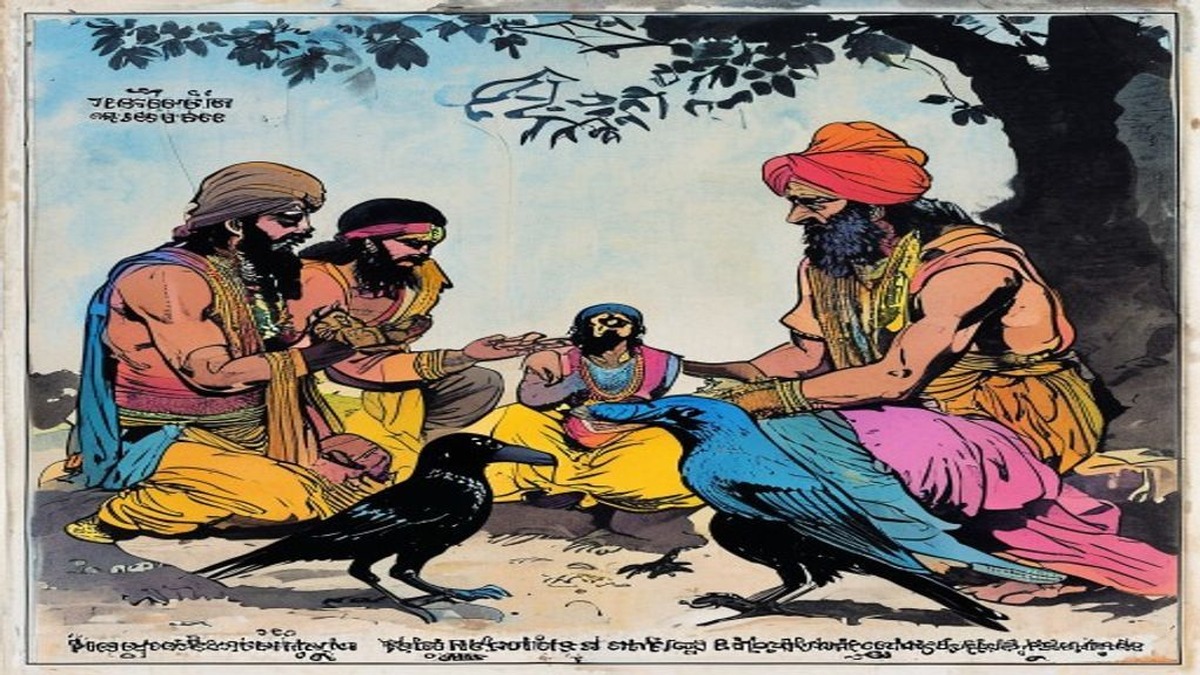
Beat I — The Problem Without a Direct Solution
A pair of crows had built their nest in a large banyan tree. In the hollow of the same tree lived a black cobra. Each season, when the female crow hatched her eggs, the cobra would climb up and eat the newborns. The crows were helpless against the cobra in direct confrontation: it was larger, faster, and venomous. Every attempt at direct defence ended in failure. The problem was structural — they could not move their nest without abandoning the tree, and they could not kill the cobra themselves. Every solution available to them in isolation was inadequate.
The crows sought the counsel of a jackal, who lived in a nearby tree. They described the situation in full: powerful enemy, repeated losses, no direct remedy available. The jackal’s response articulates the Pancatantra’s core principle for this category of problem: strength is not the only instrument of destruction, and a powerful enemy encountered in the open is not the same problem as a powerful enemy who can be caused to encounter his own destruction in a situation you have designed. The means must be matched to the specific vulnerability of the specific enemy, not to the general category of “powerful adversary.” The jackal had a plan.
Beat II — The Jackal’s Strategy: Using Third-Party Power
The jackal instructed the crows to fly to the capital city and observe the houses of wealthy, careless people. When they found a house where valuable ornaments were left unattended — in a garden, by a bathing pool, or in an open courtyard — the crow should steal the most conspicuous item, fly back to the tree, and drop it deliberately into the cobra’s hollow, making sure to do so where the king’s servants and guards could see the action clearly. The logic of the plan rested on several interlocking elements: wealthy people employ guards; guards report missing valuables; guards investigate where valuables are found; no guard finding a valuable inside a cobra’s hollow will retrieve it without first killing the cobra.
The plan did not require the crows to fight the cobra at all. It required them to arrange for the cobra to be in a place where someone else — someone armed, motivated, and capable — would have both the need and the means to kill it. The crows were not strong enough to defeat the cobra; the king’s guards were. The crows could not create a reason for the guards to come to the tree; the stolen ornament would. The cobra’s own choice of home — the hollow in the tree — made it findable. Every element the plan required already existed in the situation; the jackal had simply assembled them into a sequence that produced the desired outcome.
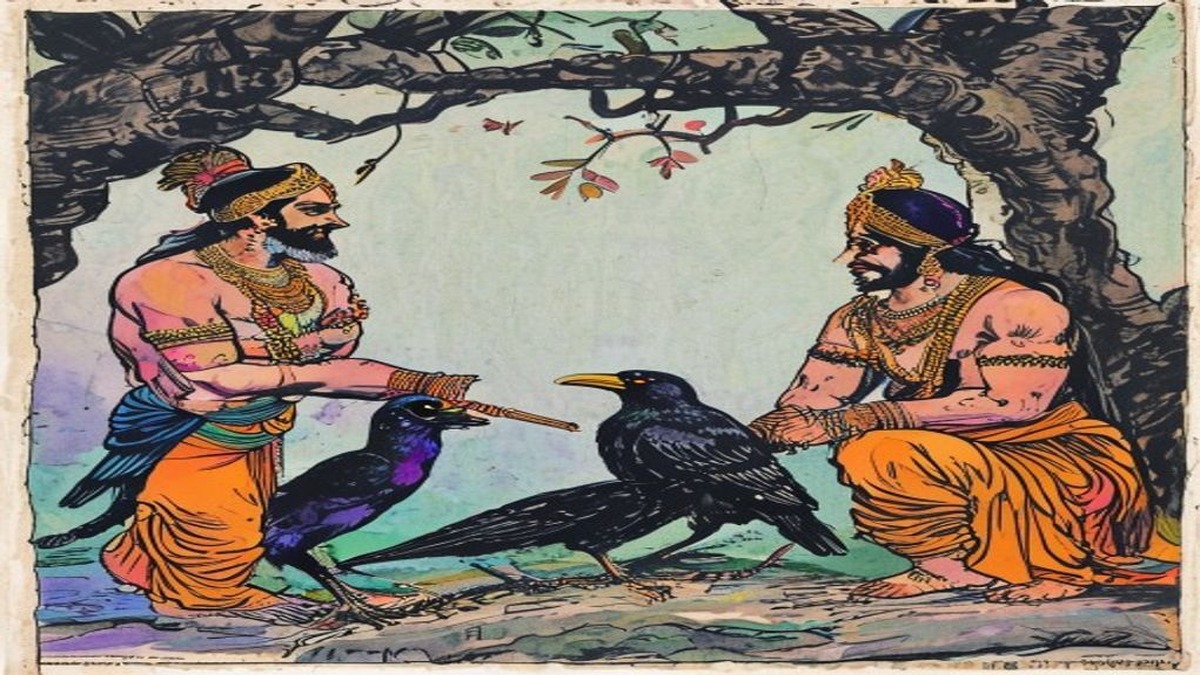
Beat III — Execution and Outcome
The crows did as instructed. They found a wealthy household where a golden necklace had been left beside a bathing pool while its owner bathed. The crow seized it and flew back toward the tree at a height where it was clearly visible from below. The servants of the household saw the theft and followed, shouting. The crow descended to the cobra’s tree and dropped the necklace into the hollow. The servants arrived, found the hollow, saw the necklace inside, and also saw the cobra. They killed the cobra with sticks, retrieved the necklace, and returned to their master’s house.
The crows were unhurt. They had not engaged the cobra at any point. The cobra was dead. The nest was safe. The necklace was returned to its owner. From the perspective of every party in the story except the cobra, the outcome was at worst neutral and for most parties satisfactory. The cobra was killed not because anyone set out to kill it but because the conditions of its death had been systematically arranged by parties it had been ignoring as beneath its attention. The crows the cobra had been casually predating were the architects of its destruction.
Beat IV — What the Strategy Teaches About Power
The Pancatantra’s analysis of this tale’s method is embedded in the jackal’s framing of the problem. The crows came to the jackal with a problem of direct confrontation: how can we defeat the cobra? The jackal reframed it as a problem of indirect arrangement: how can we cause the cobra to be in a situation where someone else defeats it? The first framing has no good answer when the direct parties are mismatched in power. The second framing almost always has an answer, because every powerful entity exists within a network of relationships, rules, and interests that can potentially be engaged to produce its removal.
Vishnu Sharma’s lesson extends to statecraft: a ruler facing a more powerful adversary has not exhausted his options when direct force fails. The question becomes: what does this adversary’s power depend on? What interests, if engaged, would produce its removal? The crows found the cobra’s power depended on its presence in the tree, that the tree was near the capital, that the capital had armed servants motivated by property recovery, and that the cobra’s hollow made it findable. The method — locate the dependency, engage the relevant third-party force, arrange the conditions — is universal across different adversaries and different situations.
Moral and Sanskrit Wisdom Tradition
“Even a very powerful enemy can be destroyed through deceit.”
— Moral of The Cobra and the Crows, Pancatantra Book I (Mitra-bheda)
The Pancatantra’s word for the crows’ method — upaya — encompasses a range of strategic means that includes but is not limited to deception. In this tale the crows do not deceive the cobra; they do not deceive the servants; they deceive no one. They arrange a situation in which each party acts according to their own interests and nature, and the arrangement of those interests produces the cobra’s death. The Kautilya Arthashastra, roughly contemporary with the Pancatantra, classifies this as the highest form of upaya: the achievement of one’s objective by structuring the situation so that it resolves itself without requiring the weaker party to engage the stronger party directly. Vishnu Sharma and Kautilya both considered this faculty — the ability to read a situation well enough to arrange it rather than simply respond to it — the most valuable of all political capabilities.
Why This Story Has Lasted 2,300 Years
The Cobra and the Crows endures because the strategic principle it illustrates — using third-party power rather than direct confrontation to resolve a power imbalance — remains one of the most durable ideas in political philosophy. Every tradition facing the problem of the weak against the strong has arrived at the same insight: structure the situation so the confrontation is never direct. Sun Tzu calls it winning without fighting; Kautilya’s four means place direct force as a last resort. The Pancatantra illustrates the principle with a crow, a stolen necklace, and a cobra in a hollow: simple enough for a child to follow, deep enough to take a lifetime of political experience to fully apply.
Sanskrit Tradition: Tantrakhyayika recension (c. 200 BCE, Kashmir); Hitopadesha parallel
Strategic Principle: Upaya (strategic means) — using third-party power to resolve a power imbalance
Author: Vishnu Sharma (attributed, c. 3rd century BCE)
Core Lesson: A powerful enemy’s structural dependencies, not direct confrontation, are the proper object of analysis
You May Also Like
 Panchatantra Stories
Ages 3-5
Panchatantra Stories
Ages 3-5
The Monkey and The Wedge – For Children
The Monkey and The Wedge – For Children: Once upon a time in a town, a rich merchant decided to build a temple in his courtyard. He assembled many skilled
 Panchatantra Stories
Ages 6-8
Panchatantra Stories
Ages 6-8
The Story of Soma Sharma’s Father
The Story of Soma Sharma’s Father: In a certain village, there lived a Brahmin, by the name of Swabhavakripana He used to live by begging. Whenever he got
 Panchatantra Stories
Ages 3-5
Panchatantra Stories
Ages 3-5
The Donkey in the Tiger’s Skin
The Donkey in the Tiger's Skin: The Donkey in the Tiger’s Skin: A Panchatantra Tale of Deception Undone In the heart of a bustling kingdom, where cotton fields