The Bowman And The Lion | Aesop’s Fables
The Bowman And The Lion | Aesop’s Fables: A skilled bowman once decided to go hunting deep in the forest. He was known for his accurate aim and all the animals
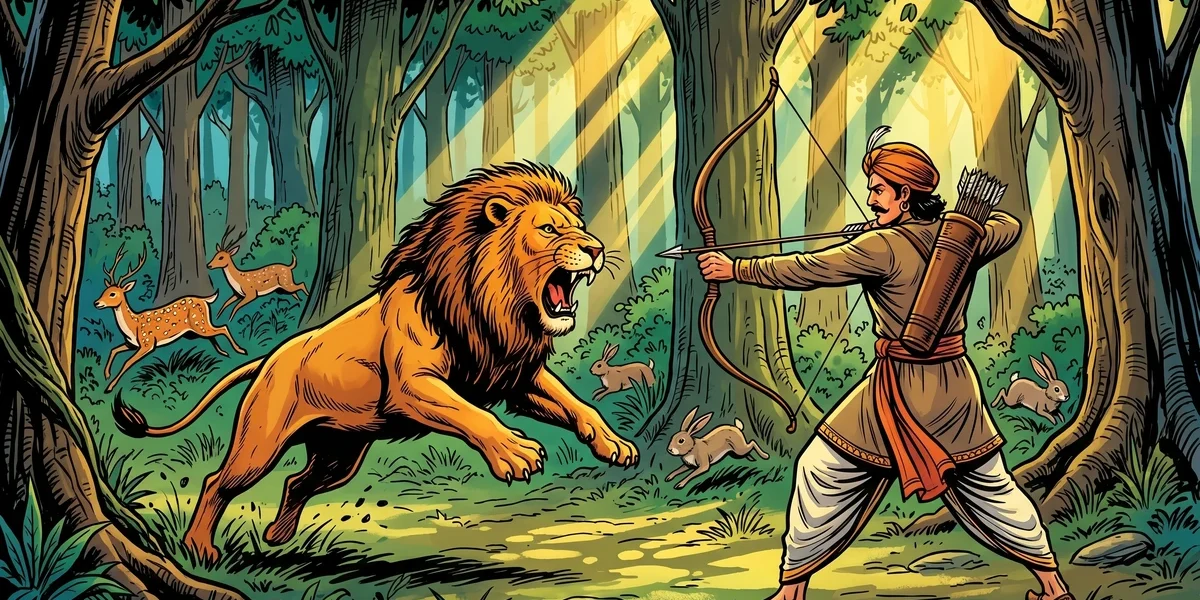
The Bowman and the Lion: The Arrow That Arrives Before the Warning
Aesop’s Method: The Moral in the Moment of Death
Aesopic fables are characterised by an economy so ruthless that every element of the story is load-bearing. There is no atmospheric description for its own sake, no character development beyond what the moral requires, no scene that does not directly serve the point. This economy is a form of respect for the reader’s intelligence: the fable trusts that the situation, rendered with sufficient precision, will produce the moral without needing to announce it.
The Bowman and the Lion is one of Aesop’s most structurally precise fables. A bowman enters a forest. The animals flee from him — all except the lion, who stands his ground, challenging the newcomer. The bowman sends an arrow into the lion without approaching, wounding him severely. As the lion flees in pain, the bowman calls after him: “Beware of me, for I am a messenger who comes before my master. My master is far worse than I am.” The lion, wounded and fleeing, hears this warning too late to act on it.
The fable ends there. No resolution, no further action — just the arrow in the lion’s side and the bowman’s voice calling after him through the trees. The moral is left to the reader, which is Aesop’s characteristic method: the story generates the insight; the teller does not need to extract it.
The Asymmetry of the Ranged Weapon: Power That Operates at Distance
The philosophical point of the fable turns on the nature of the ranged weapon — specifically, the arrow’s capacity to deliver harm before the source of harm has arrived. The lion’s error is to evaluate the threat by the ordinary measure of proximity: this man is not close enough to be dangerous; I will stand my ground and assert my dominance. This is entirely reasonable reasoning for a creature whose experience of danger is limited to threats that arrive in physical proximity — teeth, claws, the clash of bodies.
The arrow violates this reasoning by operating at a range that the lion’s framework of danger does not include. The arrow arrives before the bowman; the harm is done before the threat is visibly proximate. By the time the lion understands that the small distant figure with the bent stick represents a genuine threat, the arrow is already in his side. The warning is delivered — but it comes after the damage.
This asymmetry is not merely tactical but epistemological: the lion’s framework for evaluating danger was internally coherent and based on real experience, but it was incomplete. It did not include the category of the ranged weapon, the threat that operates across distances its source cannot physically traverse in the moment of attack. The fable is a parable about the limitations of any framework that is based entirely on past experience: when genuinely novel dangers appear, the old frameworks for evaluating danger may not only fail to protect but may actively mislead.
“I am a messenger,” said the arrow. “My master is worse than I am. But you are already bleeding — and now you know what you did not know before. The knowledge comes at a price.”
The Warning Delivered Too Late: What the Fable Says About Timing and Knowledge
The bowman’s call — “Beware of me; I am a messenger before my master” — is a warning, but it is a warning delivered after the harm it warns against has already occurred. This paradox of the belated warning is the fable’s central philosophical contribution: there are situations in which understanding arrives only after the damage that would have motivated the understanding in advance.
The Greek tradition has a specific word for this experience: pathei mathos — “learning through suffering,” wisdom purchased through painful experience. The phrase comes from Aeschylus’s Agamemnon: “Zeus has led us on the road to understanding, has established as a fixed ordinance that wisdom comes by suffering.” The lion, wounded and fleeing, has learned something he did not know before. But the price of the learning is the wound. And the tragedy is that the knowledge, had it been available in advance, would have prevented the very experience through which it was acquired.
This is the particular form of tragedy that the bowman fable dramatises: not the tragedy of ignorance per se, but the tragedy of the knowledge that arrives only through its own negation — the lesson learned only by making the mistake the lesson would have prevented. Every person who has experienced this form of learning — the understanding that comes with “if only I had known” — recognises it immediately in the lion’s situation.
The Arthashastra, Kautilya’s treatise on statecraft, addresses the related problem from the ruler’s perspective: the good ruler must build intelligence networks and warning systems precisely because by the time a threat is visible, it may already be too late to prepare against it. The arrow that arrives before the bowman is the paradigmatic statecraft problem — the danger that presents itself in its consequences before it presents itself as a danger. Kautilya’s answer is systematic intelligence-gathering; Aesop’s answer is the fable that teaches the lesson before experience has to teach it at greater cost.
Pride and the Overestimation of Proximity: The Lion’s Error
At the heart of the lion’s mistake is pride — specifically the pride of the apex predator who has never encountered a threat from distance. The lion’s challenge to the bowman is not irrational; it is the expression of a self-concept built on genuine experience: I am the most dangerous creature in this forest, and nothing that walks in on two legs represents a threat to me that I need to respect. This self-concept was accurate for every encounter the lion had previously had. It failed at the first encounter with a bowman.
The Panchatantra, which shares many fable types with the Aesopic tradition through historical channels of transmission, would classify this as the error of darpavasha — acting under the influence of pride rather than accurate assessment. Pride distorts perception: it causes the proud creature to see threats as manageable before assessing them, to dismiss new information because it conflicts with the existing self-image. The lion does not carefully assess the bowman; it asserts dominance because assertion of dominance has always worked before.
The moral lesson the fable delivers is therefore not merely about ranged weapons or physical danger but about the epistemology of pride: the creature (or person, or institution) that has never met its match is the one most vulnerable to the genuinely novel threat, because its self-confidence precludes the careful assessment that might reveal the danger before the arrow arrives. The bowman’s lesson is the lesson of any opponent who understands that the proud adversary will stand firm rather than assess — and uses that standing firm as the opportunity to wound from a distance.
Why This Story Lasted
The Bowman and the Lion has lasted for more than two millennia because it encapsulates two durable insights in a form of striking economy: first, that the genuinely novel threat operates outside the framework that past experience has built for evaluating danger; and second, that the pride of the unchallenged is the most reliable vulnerability for the challenger to exploit. These insights are as relevant to political and corporate strategy as they are to the Aesopic lion in his forest. The fable persists because the pattern it describes — the apex creature undone by the weapon it had never imagined — keeps finding new instances in every era.
Frequently Asked Questions
What is the moral of the Bowman and the Lion fable?
The fable carries several interlocking moral lessons. Most immediately: do not judge a threat by its visible proximity alone; some dangers operate at a distance and arrive before their source can be perceived as dangerous. More broadly: pride in past invulnerability is the most reliable vulnerability to a genuinely novel threat; the creature who has never met its match is precisely the one least prepared to assess the new kind of challenge accurately. And finally: some knowledge is only available through experience of its own negation — the lesson that would have prevented the wound is only fully understood after the wounding. This last is the most philosophically rich and most tragic dimension of the fable.
Who was Aesop and how did his fables come to be?
Aesop is a semi-legendary figure, traditionally identified as a slave in ancient Greece (c. 620–564 BCE) who composed moral fables using animal characters. Ancient sources describe him as from Thrace, Phrygia, or Africa, and as a man of distinctive appearance who compensated for his social position through the indirectness and wisdom of his stories. Most modern scholars believe “Aesop” is a name that accumulated around a pre-existing oral tradition of fables rather than a single historical author — the fables attributed to him were collected and written down by later writers, most influentially by Phaedrus (1st century CE) and Babrius (2nd century CE). The Aesopic tradition deeply influenced Indian, Arabic, and European fable traditions.
What is “pathei mathos” and how does it apply here?
Pathei mathos (παθεῖ μάθος) is a phrase from Aeschylus’s Agamemnon meaning “learning through suffering” or “wisdom purchased by pain.” It describes the specifically tragic form of knowledge that is acquired through painful experience rather than through reflection in advance — the understanding that comes too late to prevent the experience from which it was learned. The Bowman and the Lion fable is a parable of pathei mathos: the lion’s understanding of the bowman’s danger is complete only after the arrow has struck. The knowledge is real; the timing is tragic. The Aesopic fable tradition exists partly to offer a substitute for this form of learning — a way of acquiring the lesson without having to sustain the wound.
Are there similar fables in Indian tradition about distant or invisible threats?
Yes. The Panchatantra includes several tales about the danger of threats that are not immediately visible or that operate through intermediaries rather than direct confrontation — the crow that drops a serpent onto an enemy from the air, the mouse that cuts the net trapping a lion (demonstrating that even small allies can address dangers the strong cannot reach). Kautilya’s Arthashastra devotes considerable attention to the danger of invisible or indirect threats in statecraft — spies, assassination by poison, destabilization through seemingly unrelated events — and prescribes systematic intelligence to guard against threats that present their consequences before presenting their source. The specific image of the arrow preceding the bowman is distinctly Aesopic, but the underlying insight is shared across traditions.
What can children learn from this fable about pride and caution?
Children can take several accessible lessons from the Bowman and the Lion: that confidence based on past experience is valuable but not complete protection against genuinely new situations; that the habit of pausing to assess before acting — rather than immediately responding based on prior pattern — is a form of wisdom rather than weakness; and that the new or unfamiliar should be approached with curiosity and care rather than dismissed because it does not fit one’s existing categories of threat or challenge. The lion’s mistake was not stupidity but the over-application of a framework that had been adequate to all previous situations. Learning to notice when one is in a genuinely new situation is a skill that the fable teaches through the lion’s memorable, painful mistake.
Frequently Asked Questions
What is the moral of The Bowman and the Lion?
Who wrote The Bowman and the Lion?
What happens in The Bowman and the Lion story?
What lesson does The Bowman and the Lion teach children?
Why does the lion flee in The Bowman and the Lion?
You May Also Like
 Aesop's Fables
Ages 3-5
Aesop's Fables
Ages 3-5
The Tale of Two Frogs
Two Japanese frogs climb a mountain to see the world — and discover that a pair of eyes set the wrong way can change everything.
 Aesop's Fables
Ages 3-5
Aesop's Fables
Ages 3-5
How Did Stories Begin – A Zulu Folktale
How Did Stories Begin – A Zulu Folktale: Zulus live in Africa. Like you, the children who live there also like to listen to stories. But what would happen if
 Aesop's Fables
Ages 3-5
Aesop's Fables
Ages 3-5
A Story Weaver By Chance Meet Vani Balaraman Of Cuddles And Reads
A Story Weaver By Chance Meet Vani Balaraman Of Cuddles And Reads: Somethings happen by chance. For Vani Balaraman, it was storytelling. Founder of Cuddles and