Jonah and The Whale – Bedtime Bible Stories for Children
Jonah and The Whale. A man runs from his duty but learns a lesson. This bedtime story teaches about second chances and doing what is right.
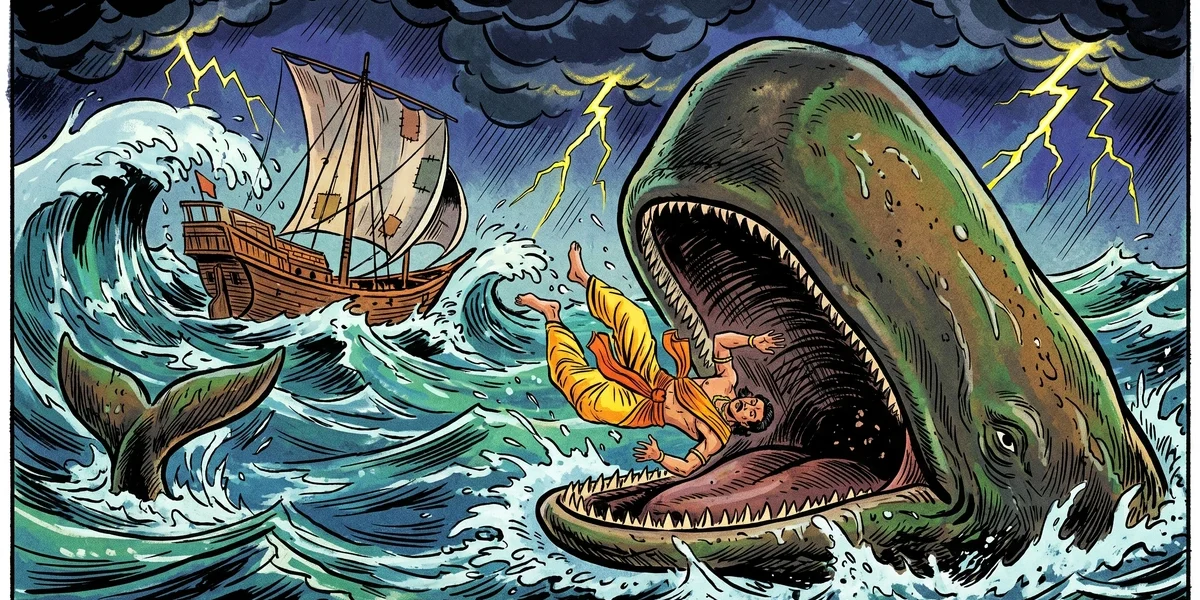
Jonah and the Whale: Anastrophē and the Prophet Who Ran
The Prophet and the Commission He Refused
In the prophetic literature of the Hebrew Bible, the call narrative is a fixed form: God speaks, the prophet protests, God insists, and the prophet goes. Moses protests his speech impediment; Isaiah protests his unclean lips; Jeremiah protests his youth. What makes the Book of Jonah singular in this entire tradition is that Jonah neither protests nor negotiates — he simply runs. “Arise, go to Nineveh, that great city, and call out against it” (Jonah 1:2). And Jonah rose — not to go to Nineveh, but to flee to Tarshish, the opposite direction, the far western edge of the known world.
Nineveh was the capital of Assyria, the empire that had destroyed the northern kingdom of Israel in 722 BCE and deported its people. To ask an Israelite prophet to preach repentance to Ninevites was not merely an inconvenient assignment — it was a theological scandal. Jonah’s flight is not cowardice in the ordinary sense; it is a refusal rooted in a profound theological objection he will only articulate much later, in chapter four: he knew God was gracious and merciful, slow to anger and abounding in steadfast love, and he did not want Nineveh to be forgiven.
This opening beat establishes the story’s central tension — not between Jonah and the whale, but between Jonah and the character of God. The whale is, in this reading, a secondary instrument. The primary drama is a dispute about the scope of divine mercy: Does it extend even to one’s enemies? Can the wicked repent and be received? The story of Jonah is less a tale of miraculous survival and more a sustained interrogation of prophetic vocation and the limits of moral imagination.
The Ketos as Divine Container: Sea, Storm, and Swallowing
Jonah boards a ship at Joppa. A great storm arises — and the sailors, seasoned professionals who would not panic at ordinary squalls, are terrified. They cast lots to determine who has brought divine wrath upon them, and the lot falls on Jonah. He confesses: “I am a Hebrew, and I fear the LORD, the God of heaven, who made the sea and the dry land” (Jonah 1:9). The irony is dense — this man who fears the God of the sea has fled by sea from that very God.
The sailors are reluctant to throw him overboard. They try to row back to land. Only when no other option remains do they cast him into the sea, praying that innocent blood not be charged to them. The storm immediately ceases. The sailors, Gentile sailors, offer sacrifices and make vows to the LORD — a foreshadowing of the story’s wider argument about non-Israelites and divine encounter.
Then comes the great fish — dag gadol in Hebrew, a great fish (not specifically a whale, though the Greek Septuagint uses ketos, a sea monster). The fish swallows Jonah, and he remains in its belly for three days and three nights. Within the fish, Jonah prays — a psalm of thanksgiving that reads as if composed after deliverance, suggesting the prayer is retrospective, placed on his lips in the belly to dramatise the moment of turning. He speaks of crying from the belly of Sheol, of the deep closing over him, of weeds wrapping around his head — and of the LORD hearing from his temple.
The ketos here functions not as predator but as providential container. In ancient Near Eastern mythology, sea monsters (Tiamat, Leviathan, Yam) represent the forces of chaos that the deity must overcome. But in Jonah, the great fish is God’s instrument — appointed, directed, obedient. The sea itself obeys the divine will. It is Jonah alone who has trouble with obedience.
“When my life was fainting away, I remembered the LORD, and my prayer came to you, into your holy temple. Those who pay regard to vain idols forsake their hope of steadfast love.”
Anastrophē: The Turning of the Prophet and the City
The Hebrew concept at the heart of this story is teshuvah — usually translated as repentance, but more precisely meaning “turning” or “return.” The root is shuv, to turn back. The narrative structure of Jonah is built entirely on turnings: the sailors turn to the LORD; the great fish turns Jonah back toward land; Jonah turns and goes to Nineveh; and most remarkably, Nineveh turns — the entire city, from its king to its cattle, fasts and wears sackcloth.
The Ninevite repentance is presented as immediate, total, and dramatic: “The people of Nineveh believed God. They called for a fast and put on sackcloth, from the greatest of them to the least of them. The word reached the king of Nineveh, and he arose from his throne, removed his robe, covered himself with sackcloth, and sat in ashes” (Jonah 3:5–6). The king issues a royal decree: let man and beast be covered with sackcloth, let them cry mightily to God, and let everyone turn from his evil way. The decree explicitly includes the animals, a detail that reads as both humorous hyperbole and theological statement — all of creation participates in the turning.
God sees their turning and relents of the disaster he had planned. This is the moment Jonah had dreaded. He is furious — “exceedingly displeased” in most translations, though the Hebrew suggests something closer to a burning rage. He prays his theological complaint: “Is not this what I said when I was yet in my country? That is why I made haste to flee to Tarshish; for I knew that you are a gracious God and merciful, slow to anger and abounding in steadfast love, and relenting from disaster” (Jonah 4:2). Jonah’s anger is theologically sophisticated: he is not wrong about God’s character. He simply cannot accept that this character extends to his enemies.
The story’s final scene involves a plant — a qiqayon, perhaps a castor oil plant — that God causes to grow over Jonah to shade him. Jonah is glad about the plant. Then a worm attacks the plant and it withers. Jonah is angry again, angry enough to die. And God delivers the closing argument: “You pity the plant, for which you did not labor, nor did you make it grow… And should not I pity Nineveh, that great city, in which there are more than 120,000 persons who do not know their right hand from their left, and also much cattle?” (Jonah 4:10–11). The book ends here, with God’s question hanging unanswered — inviting the reader to complete the argument.
The Unfinished Prophet: Moral Imagination and the Scope of Mercy
The Book of Jonah is unique among prophetic texts in that its protagonist is never vindicated. He is not a model of faith but a case study in the failure of moral imagination. His theology is correct — God is indeed gracious and merciful — but his ethics cannot accommodate the logical implications of his own theology. He wants a mercy that stops at his own tribal boundary.
This is what makes Jonah enduringly resonant across cultures and millennia. The failure it depicts is not exotic or primitive; it is the ordinary human failure of caring about those close to us while being unable to extend genuine concern to those we regard as enemies or outsiders. The prophetic literature of the Hebrew Bible is filled with oracles against foreign nations — Moab, Edom, Babylon, Assyria — but in Jonah alone, a prophet is sent to preach repentance to a foreign nation and is angry when they listen. The irony is the point.
In later reception history, the story gained further layers. In the New Testament, Jesus references “the sign of Jonah” — three days and nights in the belly of the fish — as a prefiguration of the resurrection. The early church read the story typologically, Jonah as a “type” of Christ who descends into death and rises. Islamic tradition includes Jonah (Yunus) as a prophet, and the Quranic account (Surah 37:139–148) emphasises his call for help from the darkness and God’s rescue as a mercy. Each receiving tradition refracts the story through its own theological optic, but the core structure — flight, confinement, turning, mission, grudging obedience — remains remarkably stable.
For children encountering this story, what persists is the image of the man inside the whale: the impossible survival, the darkness, the prayer, the emergence onto dry land. This image belongs to the deep grammar of human narrative — the descent into the underworld, the ordeal in the belly of the beast, the return to life transformed. What the adult re-reading discovers is that Jonah does not quite complete his transformation. He emerges from the fish; he does not yet emerge from himself. The story’s open ending is its greatest honesty.
Why This Story Lasted
The story of Jonah has survived for approximately 2,500 years across Jewish, Christian, and Islamic traditions for reasons that have little to do with the miraculous fish and everything to do with its psychological and moral precision. It is one of the oldest — and most honest — portraits of what might be called selective compassion: the human tendency to ration mercy according to prior relationship and perceived desert. Jonah wants justice for his people and cannot extend it to Nineveh. The story refuses to let him off the hook.
Its structure — flight, descent, emergence, reluctant mission, anger at success — maps onto patterns recognisable across cultures: the reluctant hero, the underground ordeal, the unexpected conversion of the adversary. Its concluding question is formally unresolved, which means every reader is implicated. The story does not tell us what Jonah decided; it asks us what we would decide. Three millennia of readers have found the question worth sitting with.
Frequently Asked Questions
Is Jonah and the Whale meant to be taken literally or allegorically?
Scholarly opinion is divided, and the debate is longstanding. Many biblical scholars classify the Book of Jonah as a didactic novella or parable — a genre meant to convey theological truth rather than historical reportage. Its hyperbolic elements (the instantaneous conversion of an entire Assyrian city, animals wearing sackcloth, a plant that grows overnight) suggest a literary rather than strictly historical mode. Other interpreters, particularly within conservative religious traditions, read it as historical narrative. The theological content — about the scope of divine mercy and the failure of prophetic self-righteousness — remains equally powerful under either reading.
What kind of fish swallowed Jonah?
The Hebrew text says dag gadol, “a great fish” — unspecified. The Greek Septuagint translates this as ketos, a large sea creature or sea monster. The word “whale” entered the tradition largely through Jerome’s Latin Vulgate and subsequent translations. Biologists have debated whether a sperm whale’s throat could accommodate a human; there have also been historical accounts, possibly apocryphal, of sailors surviving inside the stomachs of large fish for brief periods. The text’s interest is theological, not biological — the species is beside the point.
Why was Jonah angry that Nineveh was forgiven?
Jonah explicitly states his reason in chapter four: he knew God was gracious and merciful, and he did not want that mercy extended to Nineveh. Nineveh was the capital of Assyria, the empire responsible for the destruction and deportation of the northern Israelite kingdom in 722 BCE. For an Israelite, Nineveh represented oppression and cultural annihilation. Jonah’s anger was thus politically and historically grounded — he wanted justice for his people’s suffering, not mercy for their destroyers. The book’s argument is that God’s mercy is not bounded by these grievances, which is what makes it a difficult and still-relevant story.
How does Jonah appear in Islamic tradition?
In Islam, Jonah is known as Yunus (or Dhul-Nun, “the one of the whale”) and is recognised as a prophet. He appears in the Quran in several places, most notably Surah 37:139–148 and Surah 10 (which is named Surah Yunus). The Islamic account preserves the core narrative — Yunus flees his mission, is swallowed by a great fish, calls out to God from the darkness (“There is no deity except You; exalted are You. Indeed, I have been of the wrongdoers”), and is released to preach successfully. A chapter of the Quran bearing his name emphasises divine mercy and the value of sincere repentance.
What is the “sign of Jonah” that Jesus references in the New Testament?
In Matthew 12:38–41 and Luke 11:29–32, Jesus is asked by scribes and Pharisees for a sign. He says that no sign will be given except the sign of Jonah: “For just as Jonah was three days and three nights in the belly of the great fish, so will the Son of Man be three days and three nights in the heart of the earth.” Early Christian interpretation took this as a typological prefiguration — Jonah’s descent into the fish and return to land as a foreshadowing of the death and resurrection of Jesus. Jesus also references the Ninevites who repented at Jonah’s preaching, holding them up as a counterexample to those who refused to repent despite witnessing greater signs.
Frequently Asked Questions
**Q: Why is this story important?**
You May Also Like
 Aesop's Fables
Ages 3-5
Aesop's Fables
Ages 3-5
Story Camp – A Creative Journey For Budding Wordsmiths
Discover how the Story Camp of 2017 transformed children into active storytellers and writers through the power of narrative.
 Aesop's Fables
Ages 3-5
Aesop's Fables
Ages 3-5
The Hermits Daughter
The Hermits Daughter: Near a town in India called Ikshumati, on a beautiful wide river, with trees belonging to a great forest near its banks, there dwelt a
 Aesop's Fables
Ages 9-12
Aesop's Fables
Ages 9-12
The Goose That Laid Golden Eggs
The Goose That Laid Golden Eggs: In a modest farmstead nestled in a valley where green fields stretched to the horizon and wildflowers bloomed in abundance