Timid Hare Flight Beasts
Timid Hare Flight Beasts: Once upon a time when Brahmadatta reigned in Benares, the Bodhisatta came to life as a young lion. And when fully grown he lived in a
The Hare Who Started a Stampede: Fear as Contagion
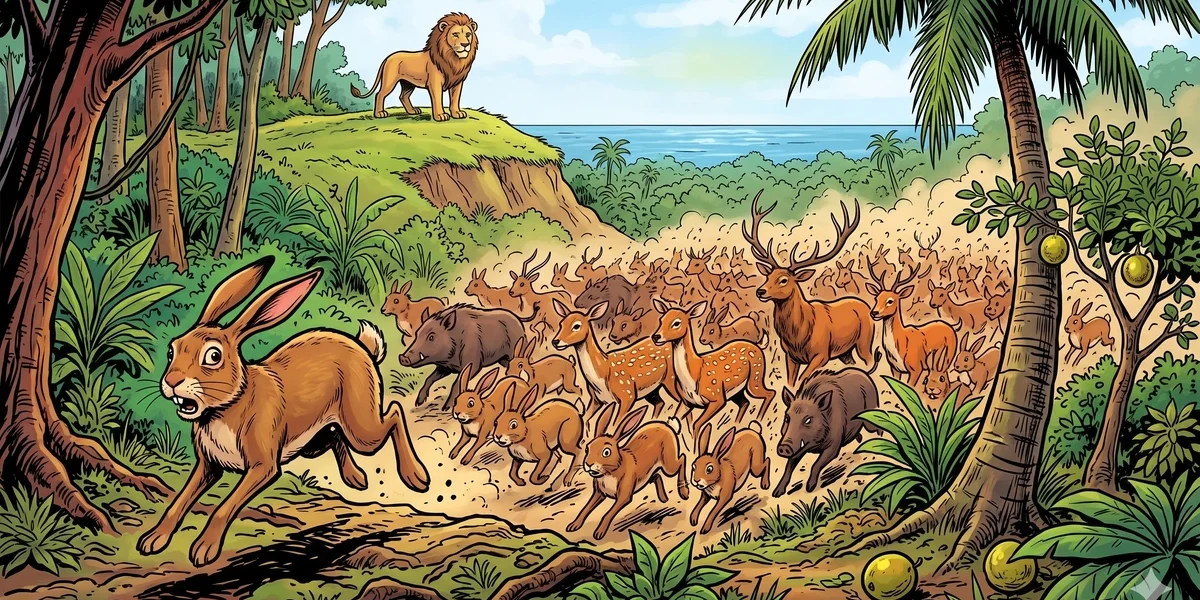
In the forest near Benares, a hare resting beneath a fruit tree heard the crash of a falling fruit — and, interpreting the sound as evidence of the earth’s collapse, fled in pure terror. Other animals, seeing the hare run, ran also. Within moments, hundreds of deer, elephants, and creatures of every kind were in full flight, driven not by any actual danger but by the cascading terror of observed panic. This tale — Jataka No. 322, “Daddabha Jataka” (The Timid Hare) — is one of the most psychologically acute stories in the entire Pali Canon’s Jataka collection, and its insight into the mechanics of mass panic is as fresh today as it was when the tale was first compiled around the 3rd century BCE.
The Bodhisattva in this tale takes the form of a lion (in some versions a wise elephant or the future Buddha as a forest deity) who observes the stampede, diagnoses its absurdity, and uses both speed and voice to halt it. He does not compel the animals to stop; he races ahead of the stampede, places himself in its path, and roars — a single act that interrupts the panic feedback loop long enough for the animals to pause and regain their capacity for rational assessment. He then takes the hare back to the fallen fruit, demonstrates that the earth is still intact, and explains what actually happened. The stampede dissolves. The animals disperse calmly. The disaster that was never real has been averted.
Daddabha and the Psychology of Collective Fear
The tale’s psychological sophistication lies in its precise anatomy of how panic propagates. The hare does not spread deliberate misinformation; it experiences genuine terror and acts on it. But the social transmission of fear operates independently of the fear’s validity — the other animals do not investigate the hare’s claim; they read the hare’s behavior (running) as evidence of danger. This is what behavioral psychologists call “social contagion of affect”: the emotional state of one organism is transmitted to others through behavioral signals, bypassing the cognitive processing that might evaluate the fear’s basis.
The Buddhist analysis of this process connects it to the concept of moha (delusion) — the third member of the “three poisons” alongside greed and hatred. The hare’s fear is delusional in the technical sense: it arises from a misinterpretation of a sensory event (sound of falling fruit → “the earth is collapsing”), and this delusion propagates through the community with the speed and force of genuine information. The Bodhisattva’s intervention is simultaneously practical (stopping the stampede) and spiritual (correcting the delusion): he addresses both the immediate crisis and its cognitive root.
The Bodhisattva as Crisis Leader: Speed, Position, and Voice
What enables the Bodhisattva to stop the stampede? Not superior force — he cannot overpower hundreds of panicking animals. Instead, he uses three instruments: speed (he races faster than the stampede to get ahead of it), position (he places himself in the path of the fleeing animals, creating an obstacle that forces a choice between following him or continuing), and voice (his roar is loud enough to interrupt the panic feedback loop). These three instruments correspond to classical Indian leadership theory: shakti (power/capacity), sthana (position/authority), and vak (speech/communication). The Bodhisattva deploys all three simultaneously, and the combination is sufficient where any single instrument would have failed.
The political theorists of ancient India — Kautilya foremost among them — identified these same three elements in effective statecraft. A ruler who has capacity but no authority is ineffective; authority without capacity is hollow; both without clear communication cannot coordinate collective action. The Bodhisattva-as-leader in the Jataka demonstrates the integrated deployment of all three: he can run faster than the stampede (shakti), his presence in their path creates de facto authority (sthana), and his roar arrests their attention long enough for communication to occur (vak). Crisis leadership, the tale suggests, is a matter of integration rather than any single heroic quality.
Empirical Correction: The Return to the Fallen Fruit
Perhaps the tale’s most underappreciated detail is the Bodhisattva’s insistence on returning the hare to the site of the original event and demonstrating, empirically, that the earth has not collapsed. He does not merely assert that the animals were wrong; he provides evidence. This empirical corrective — show, don’t just tell — reflects the Buddhist epistemological tradition’s emphasis on pratyaksha (direct perception) as the most authoritative form of knowledge. A claim without evidence, however authoritative the speaker, is not genuine knowledge; genuine knowledge requires grounding in verifiable experience.
This epistemological care distinguishes the Bodhisattva’s leadership from mere authoritarian command: he does not tell the animals to stop being afraid and trust him, but demonstrates the actual state of affairs so they can form their own correct judgment. This is leadership through samyak-drshti (right view) — not the imposition of the leader’s view but the provision of conditions under which correct view can arise in each individual. The tale thus embeds a complete pedagogy of non-coercive leadership within what appears to be a simple animal fable.
“He did not shout that they were fools. He simply ran faster, stood in their path, and showed them the fruit that had fallen — just a fruit, just the earth, still whole.”
Why This Story Lasted
Timid Hare Flight Beasts endures because mass panic has never ceased to be a feature of human communities. The stampede driven by a misheard sound is the template for stock market crashes, political panics, and social media rumor cascades — any situation in which the emotional state of a visible minority propagates faster than the information needed to evaluate it. The Bodhisattva’s response — get ahead of the cascade, interrupt its momentum, provide verifiable evidence of the actual situation — remains the most effective available intervention in such crises. The tale is both a psychological description and an operational manual, compressed into a story short enough for a child to remember and deep enough for a crisis leader to study.
Frequently Asked Questions
Which Jataka tale is Timid Hare Flight Beasts?
This is Jataka No. 322, “Daddabha Jataka” (The Timid Hare), from the Pali Canon’s Jataka collection (c. 3rd century BCE). It is one of the Bodhisattva tales in which the future Buddha takes animal form — here as a lion or forest deity — to prevent a disaster caused by mass panic triggered by a hare’s mistaken interpretation of a falling fruit.
What is “social contagion of affect” and how does it appear in this tale?
Social contagion of affect is the transmission of emotional states through behavioral signals, bypassing cognitive evaluation. The stampede animals do not investigate the hare’s claim — they read the hare’s running as evidence of danger. In Buddhist terms this is moha (delusion) propagating through community: the hare’s misinterpretation becomes the community’s collective reality through observed behavior rather than actual information.
How does the Bodhisattva stop the stampede and what leadership principles does this demonstrate?
The Bodhisattva uses three instruments: shakti (speed — he races ahead of the stampede), sthana (position — he places himself in the animals’ path), and vak (voice — his roar interrupts the panic loop). These correspond to Kautilya’s analysis of effective leadership as the integration of capacity, authority, and communication — any single element alone would have failed.
Why does the Bodhisattva return the hare to the fallen fruit rather than just asserting the truth?
This reflects Buddhist epistemology’s emphasis on pratyaksha (direct perception) as the most authoritative knowledge. The Bodhisattva provides verifiable evidence rather than asserting authority — embodying samyak-drshti (right view) leadership: not imposing the leader’s view but creating conditions for correct view to arise independently in each individual. Show, don’t just tell.
What modern situations does the Timid Hare tale illuminate?
The tale maps onto stock market crashes, political panics, and social media rumor cascades — any situation where emotional states propagate faster than verifiable information. The Bodhisattva’s response (get ahead of the cascade, interrupt momentum, provide evidence) remains the most effective available intervention in information cascades and mass panic situations, making this 2,500-year-old fable operationally relevant today.
Frequently Asked Questions
**Q: Why is this story important?**
You May Also Like
 Aesop's Fables
Ages 3-5
Aesop's Fables
Ages 3-5
The Mother In Law Became An Ass
The Mother In Law Became An Ass: Little by little the mother-in-law became an ass - vara vara mâmi kaludai pôl ânâl̤, is a proverb among the Tamil̤s, applied
 Aesop's Fables
Ages 3-5
Aesop's Fables
Ages 3-5
The Ruby Prince
<p>Read ‘The Ruby Prince’ — a classic Aesop’s Fables story about honesty. In this classic Aesop’s fable, a ant, a king, and a prince take center stage in a…</p>
 Aesop's Fables
Ages 9-12
Aesop's Fables
Ages 9-12
The Talkative Tortoise
The dual-rooted Indian fable of Kambugrīva — "Conch-Necked," the tortoise of Phullotpala pond — and his two wild-goose friends Saṅkaṭa and Vikaṭa, who try to lift him out of a drought by carrying him on a stick. The story comes to us through two ancient traditions at once: the Buddhist Pali Canon as Kacchapa Jātaka No. 215, and the Hindu Panchatantra as Book I, Mitrabheda. It is not, as is often claimed, a tale of Aesop. T.W. Rhys Davids' 1880 translation is preserved in full alongside the Sanskrit retelling, with Sanskrit names restored, the dual-tradition origin explained, and the story's two-thousand-year journey through Pahlavi, Arabic, Persian, Hebrew, Latin, and finally La Fontaine's French traced.