Black Arts
Black Arts: The wild people who dwell in the South-West are masters of many black arts. They often lure men of the Middle Kingdom to their country by promising

Origin and Narrative Tradition
“Black Arts” belongs to the Chinese popular narrative tradition of supernatural contest—tales in which practitioners of heterodox or dark magical arts (hei-shu, literally “black arts”; also wushu, yao-shu, or sorcery) encounter adversaries whose power derives from moral virtue, Daoist cultivation, or Buddhist merit, and are defeated not by superior force but by the structural weakness that all deception-based power shares: its dependence on concealment. This narrative tradition runs through Chinese popular literature from the Han-period ghost tales (zhiguai) through the great Ming-dynasty novels (Xiyouji—Journey to the West—is organised almost entirely around this pattern: demons who practice dark arts are defeated by the morally grounded power of the Buddhist pilgrim party) to the Qing-dynasty court-case fiction and the village story-cycles that circulated through teahouse storytelling. The “black arts” tale in Chinese folk tradition is not simply a story about magic; it is a sustained moral argument about the relationship between power and its source, and about why power derived from deception is inherently less stable than power derived from authentic cultivation.
Beat I — The Dark Practitioner and His Power
The practitioner of black arts enters the narrative trailing an aura of genuine menace. His power is real—the folk tradition does not present dark magic as mere illusion—and his victims are real victims, not people deceived by something that does not exist. He can cause illness, manipulate weather, see through walls, compel the spirits of the dead, and bend the will of the living. The village or town that hosts him lives in genuine fear, because his power over natural causality—his ability to make things happen at a distance, without visible mechanism—gives him the kind of leverage that no ordinary wealth or military force can match. In the Chinese moral universe, the dark arts practitioner’s power is real but its source is wrong: he has obtained his abilities by shortcutting the cultivation (xiuyang) and moral development (de) that legitimate supernatural power requires, typically through transactions with demons, the consumption of forbidden substances, or the violation of ritual prohibitions that exist specifically to prevent this kind of asymmetric power accumulation.
Beat II — The Adversary of Genuine Cultivation
The practitioner of black arts meets his match in an adversary whose power is grounded in legitimate cultivation: a Daoist immortal, a Buddhist monk of genuine attainment, a village shaman whose authority derives from community service rather than personal power accumulation, or occasionally a morally upright ordinary person whose virtue creates a kind of natural immunity to deception-based influence. The structural asymmetry between the two types of power is the tale’s central argument: the dark practitioner’s techniques depend on concealment (the victim must not know what is being done to him), on the victim’s fear (which amplifies the technique’s effect), and on the absence of a counter-framework within which the technique can be named and thereby defused. The legitimate practitioner’s first move is almost always to name what is happening—to identify the technique, explain its mechanism, and thereby remove its power over those who now understand what they are facing. In Chinese folk tradition, naming the demon’s technique is already half the battle: the known thing is manageable; only the unknown thing is truly terrifying.
Beat III — The Daoist and Buddhist Frameworks for Supernatural Contest
Chinese popular religious tradition provides two distinct but complementary frameworks for understanding the defeat of dark arts. The Daoist framework understands dark arts as the misuse of the same qi (vital force) and spiritual power that legitimate cultivation develops: the dark practitioner has tapped into genuine natural forces but has oriented them toward selfish ends, and this selfish orientation creates a structural instability—qi that flows against the Dao eventually reverses on its source. The Buddhist framework understands dark arts as fundamentally dependent on the victim’s own karmic susceptibility: a person of genuine moral purity carries no hook for the dark practitioner’s technique to attach to, because the technique requires the exploitation of some existing fear, greed, or delusion in the victim. Both frameworks arrive at the same practical conclusion: the surest protection against dark arts is the cultivation of virtue, and the surest defeat of the dark practitioner is the removal of the conditions his techniques require. The great Ming novel Xiyouji dramatises this Daoist-Buddhist synthesis on an epic scale; the village “black arts” folk tale does it in miniature.
Beat IV — The Exposure and Its Aftermath
The exposure of the black arts practitioner is typically public—performed before the community he has terrorised—and has a quality of revelation rather than mere defeat. What the community sees is not just the practitioner being overcome but the mechanism of his power being made visible for the first time: the manipulation of appearances that made his power seem larger than it was, the exploitation of fear that amplified his actual capability, the social isolation of his victims that prevented them from comparing notes and discovering the pattern. The exposure is therefore not simply a narrative resolution but a social education: the community that witnesses the unmasking of black arts acquires a framework for recognising and resisting such arts in the future. Chinese folk tales in this tradition carry a strongly didactic function alongside their entertainment value, and their circulation through teahouse storytelling and temple-fair performances served as practical instruction in the community’s accumulated knowledge about how manipulation and fear operate.
Ming dao fei chang dao—The Dao that can be clearly named is not the eternal Dao. (Tao Te Ching 1.1) But the dark arts that cannot survive being named are the weakest arts; genuine power needs no concealment, for it has nothing to hide and nothing to lose by being seen.
Why This Story Has Lasted
“Black Arts” endures because it addresses a social anxiety that is permanent and universal: the fear of power that operates by invisible mechanism, that can harm without being seen or identified. Every community develops forms of explanation for misfortune that attribute it to human malice operating through obscure channels—witchcraft, the evil eye, poisoning, manipulation—and the folk tale that explains how such power works and how it can be defeated provides genuine social utility. The Chinese tradition’s particular contribution is the insistence that the best defence against dark arts is not a counter-technique of equal darkness but the cultivation of the moral transparency that makes dark-arts targeting impossible: the person with nothing to hide gives the practitioner nothing to work with.
Tradition & Collection Notes
Narrative tradition: Chinese zhiguai (accounts of the strange) tradition; Tang-dynasty chuanqi supernatural tales; Ming-dynasty popular fiction. Classical parallel: Xiyouji (Journey to the West) by Wu Cheng’en (sixteenth century)—the paradigm text for Daoist-Buddhist defeat of demonic dark arts. Religious frameworks: Daoist qi-cultivation and de (virtue); Buddhist karmic immunity to demonic attack; Confucian zhengqi (upright spirit) as natural protection. Motif index: G200 (Witches), D1810 (Magic knowledge), G271 (Witch overcome or disenchanted), K1810 (Deception by disguise). Popular religious context: Chinese village wu (shaman/healer) tradition; Daoist exorcism ritual (jiao); Buddhist guohu (merit-protection) practice. Scholarly reference: Wolfram Eberhard, A Dictionary of Chinese Symbols (1986); Kenneth DeWoskin and J. I. Crump, In Search of the Supernatural (1996).
You May Also Like
 Chinese Folk Tales
All Ages
Chinese Folk Tales
All Ages
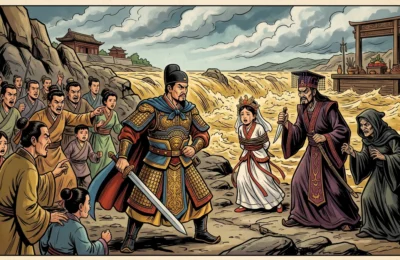
The Spirits Of The Yellow River
The Spirits Of The Yellow River: are called Dai Wang Great King. For many hundreds of years past the river inspectors had continued to report that all sorts of
 Chinese Folk Tales
Ages 6-8
Chinese Folk Tales
Ages 6-8
How The River-God’s Wedding Was Broken Off
How The River-God's Wedding Was Broken Off - a folk tale retold for young readers with a clear moral, simple words, and the warmth of a bedtime story from...
 Chinese Folk Tales
Ages 9-12
Chinese Folk Tales
Ages 9-12
Yang Gui Fe
Yang Gui Fe: The favorite wife of the emperor Ming Huang of the Tang dynasty was the celebrated Yang Gui Fe. She so enchanted him by her beauty that he did