Judge Bao and the Missing Gold
Judge Bao and the Missing Gold: During a time when justice was not merely an ideal but a practice guarded fiercely by those few with the wisdom and courage to
Origin & Tradition
Judge Bao (包拯, Bāo Zhěng, 999-1062 CE) — revered as Bao Gong (包公, Lord Bao) or Bao Qingtian (包青天, Bao the Blue Sky, a metaphor for unclouded justice) — began as a real historical official of the Northern Song Dynasty who rose from a Anhui province family to become Prefect of Kaifeng, the imperial capital, and a member of the Supreme Court. His reputation for absolute impartiality — documented in the Song Shi (official Song history) — made him a legend within his own lifetime: he prosecuted imperial relatives and powerful eunuchs with the same rigour he applied to commoners, refused gifts from colleagues, simplified proceedings to benefit the poor, and reportedly opened the court gates directly to petitioners so they could address him without intermediary. After his death, this historical reputation accumulated an enormous fictional literature: Yuan Dynasty opera, Ming-Qing novels (San Xia Wu Yi — Three Heroes and Five Gallants), and, in the twentieth and twenty-first centuries, the most enduring television drama franchise in Chinese-speaking media. The case of the missing gold is one of thousands of narratives attributed to him.
Beat I — The Case and Its Apparent Insolubility
A merchant comes before Judge Bao’s court in Kaifeng with a complaint: he has lost a substantial sum of gold. He had been travelling with another merchant — they had shared lodging for several nights, and on the morning of their parting, the gold was gone. The accused merchant denies theft. There are no witnesses. There is no physical evidence. The gold does not appear in the accused’s possession. The local magistrate had dismissed the case as unprovable; the plaintiff has come to Kaifeng as a last resort, believing that if any official can find truth where others have found only opacity, it is Bao Gong.
Judge Bao hears the complaint with the characteristic attention his legend records: he asks specific questions about the timing, the lodging arrangements, the merchant’s behaviour in the days before and after. He asks about the gold itself — its weight, its form, whether it was wrapped or loose, where it had been stored during the journey. He asks each party separately and notes the points at which their accounts align and the points at which they diverge. The divergences are small but specific: the accused merchant hesitates slightly on one question; the plaintiff is certain of one detail that the accused claims not to remember.
In the folk tradition, Judge Bao resolves this kind of case through a combination of methods that his legend associates with him: psychological acuity, staged procedures designed to reveal concealed knowledge, and — in the most legendary versions — a kind of supernatural insight that the tradition attributes to his divine mandate (symbolised by the crescent moon on his forehead). In this particular case, a creative sting operation is central.
Beat II — The Judge’s Method: Seeing What Others Cannot
Judge Bao announces that he will examine the gold itself — and then, to general bewilderment, orders that the donkeys the two merchants had used to transport their goods be brought to the courthouse and fed hay in the courtyard. He instructs that all manure produced by the donkeys be collected and brought to him. His clerks and the assembled petitioners regard this with puzzlement bordering on alarm.
The manure yields the gold. The accused merchant, knowing that the bags of goods on his donkey would be searched at the next checkpoint, had hidden the stolen gold inside the hay he purchased for his animal. The hay was eaten; the gold, indigestible, passed through. Judge Bao’s reasoning was precise: the gold could not have been carried on the merchant’s person (they had been searched) or concealed in his goods (the bags had been examined). The only other thing the merchant controlled was what his animals consumed. The procedure was not magic; it was systematic elimination of alternatives and creative attention to what had been overlooked.
The accused confesses. The gold is returned. The case that had seemed insoluble at the local level — where the magistrate lacked the patience for systematic reasoning and the authority to compel creative procedures — yields to the combination of intelligence, authority, and methodical attention that Judge Bao brings to every matter before him. The plaintiff, who had expected either dismissal or a conventional interrogation, leaves with his gold and the story that will be told about this resolution for centuries.
Beat III — Qing Li Fa: The Three-Part Framework of Chinese Justice
The intellectual achievement that Judge Bao embodies — and that his legendary status celebrates — is not merely clever detection. It is the mastery of the tripartite framework that Chinese traditional jurisprudence called qing li fa (情理法): the weighing of qing (human feeling and circumstance), li (moral principle and ethical reason), and fa (legal statute and institutional rule) in arriving at judgment.
Fa (法) alone — the application of written law without attention to circumstance — produces mechanical justice that may be technically correct but morally unsatisfying. The Han Feizi tradition of strict legalism, which dominated the Qin Dynasty, was understood by subsequent Chinese political thought to have produced exactly this: a state that applied rules with perfect consistency and produced widespread suffering, because rules are abstractions and human situations are specific. Qing (情) alone — pure sympathy for the parties — produces sentiment masquerading as justice, where whoever tells the more affecting story wins regardless of the truth. Li (理, moral principle) alone — the application of abstract ethical reasoning without attention to legal structure or human feeling — produces philosophical pronouncements that may be wise but lack the institutional force to be enacted.
The ideal magistrate — the figure that Judge Bao represents in Chinese cultural imagination — weighs all three simultaneously. In the missing gold case, he deploys fa: he has the authority to compel the examination of the donkeys’ manure; no ordinary citizen could do this. He deploys li: his moral reasoning eliminates the implausible explanations and points toward the one that fits the facts. He deploys qing: he attends to the specific circumstance — the particular arrangement of the journey, the timing of the discovery, the small hesitation in the accused’s testimony — that a purely abstract procedure would have ignored.
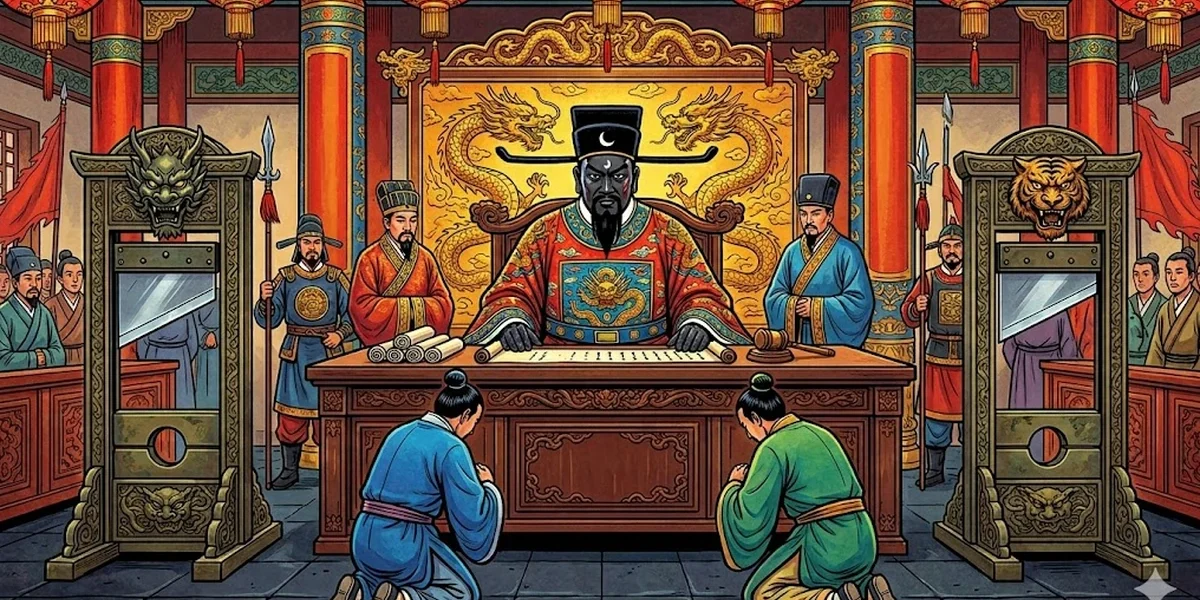
Judge Bao’s black face in opera — the standard makeup that distinguishes him — is the theatrical encoding of gang (刚, unyielding integrity, hardness). He cannot be softened by bribery, moved by rank, or impressed by social connection. The crescent moon mark on his forehead connects him to celestial mandate — he judges under heaven’s authority, which supersedes all earthly hierarchies. Together these theatrical conventions communicate the two qualities that qing li fa requires above all: the intelligence to perceive what actually happened, and the courage to act on that perception regardless of who is implicated.
Beat IV — Bao Zheng the Historical Official and Bao Gong the Cultural Archetype
The historical Bao Zheng was a formidable but human official. The Song Shi records specific cases: he overturned a miscarriage of justice involving a false confession; he prosecuted a relative of the empress for illegal land seizure; he reformed the Kaifeng court’s accessibility to commoners. He was known for his austerity — he refused to accept gifts and lived at a standard significantly below his official rank. He was also known for being difficult: his colleagues found his uncompromising standard uncomfortable; his refusal to participate in the gift-exchange economy that oiled Song officialdom made him an isolated figure.
What the literary tradition did with this historical raw material was to transform specific documented acts of integrity into a mythological archetype: the incorruptible judge who has supernatural assistance, who can prosecute the dead as well as the living, who travels between the human world and the underworld to apply justice impartially across both. The literary Bao Gong acquired three divine execution devices — the guillotine shaped like a dog’s head (for commoners), the tiger’s head (for officials), and the dragon’s head (for royalty) — which could execute anyone without the imperial pardon that protected powerful wrongdoers in the historical world. These devices are the fictional solution to a real problem: the legal system of any dynasty protects its powerful members from the full application of its own statutes.
The gap between the historical Bao Zheng and the legendary Bao Gong is itself a cultural document: it records what Chinese people wished their legal system could be, as opposed to what it demonstrably was. The supernatural execution devices are the fantasy of a justice system powerful enough to reach those whom the real system protected. The incorruptible judge is the longing for an official who genuinely serves the people rather than the powerful. In every generation that has retold the Bao Gong stories, this longing has remained current — because the problem the legends solve has remained current.
“The just magistrate is called Qingtian — the blue sky — because justice should be clear and unclouded, reaching everywhere equally, without the shadows cast by rank or wealth.”
— Chinese popular tradition on Bao Zheng / Bao Gong
Why This Story Has Lasted
Judge Bao has remained culturally vital for a millennium because he answers a need that no actual legal system fully satisfies: the need for a figure who sees the truth and acts on it without fear of consequence. Every society that has struggled with the selective application of law — with the protection that wealth and rank confer against the rules that govern everyone else — has needed a Judge Bao. The specific case of the missing gold demonstrates the qualities his legend celebrates: patient systematic reasoning, creative procedure, and the authority to compel whatever examination the truth requires. The donkeys’ manure is unglamorous but conclusive; justice, the story suggests, does not require drama, only rigour and the courage to follow the evidence wherever it leads.
Frequently Asked Questions
Who was Judge Bao and was he a real person?
Bao Zheng (包拯, 999-1062 CE) was a real official of the Northern Song Dynasty, rising to become Prefect of Kaifeng (the imperial capital) and a member of the Supreme Court. The Song Shi (official Song history) documents his reputation for impartiality: he prosecuted imperial relatives and powerful eunuchs with the same vigour applied to commoners, refused gifts, and reformed court procedures to benefit the poor. After his death, his historical reputation accumulated an enormous fictional tradition — Yuan opera, Ming-Qing novels, and modern television — transforming a formidable but human official into a supernatural archetype of incorruptible justice.
How did Judge Bao solve the missing gold case?
Through systematic elimination and creative procedure. Having determined that the gold could not have been hidden on the accused merchant’s person or in his goods (both had been searched), Judge Bao identified the one thing the merchant controlled that had not been examined: what his donkey had consumed. He ordered the donkeys’ manure collected and found the gold — hidden in hay the merchant had purchased, which his donkey ate and then passed. The procedure was not magical; it was the application of rigorous reasoning to eliminate the impossible and examine the overlooked.
What is qing li fa in Chinese traditional jurisprudence?
Qing li fa (情理法) is the tripartite framework for judgment in Chinese traditional legal philosophy: qing (human feeling, circumstance, and empathy), li (moral principle and ethical reason), and fa (legal statute and institutional rule). The ideal magistrate weighs all three simultaneously; mechanical application of fa alone produces technically correct but morally unsatisfying outcomes; pure qing without fa produces sentiment masquerading as justice; li without institutional force produces wisdom without effect. Judge Bao is the cultural archetype of the official who wields all three correctly.
What does Judge Bao’s black face mean in Chinese opera?
In Chinese traditional opera makeup, the black face (hei lian) encodes gang (刚, unyielding integrity, hardness) — the quality of a person who cannot be softened by bribes, moved by rank, or impressed by social connection. Black face characters are morally upright, stern, and impartial. Judge Bao’s iconic black face is his most recognisable theatrical feature, communicating before he speaks a word that this is an official who will not bend. The crescent moon mark on his forehead adds a celestial dimension: he judges under heaven’s authority, which supersedes all earthly hierarchies.
Why is Judge Bao called Bao Qingtian (Blue Sky Bao)?
Qingtian (青天, Blue Sky) is a traditional Chinese metaphor for justice that is clear, unclouded, and reaches everywhere equally — like the sky at its clearest, which does not give more light to the wealthy neighbourhood than the poor one. The title Bao Qingtian encodes the ideal of impartial justice: a judgment system as transparent and undistorting as a cloudless sky. The common people of the Song Dynasty (and of every subsequent dynasty that retold his stories) applied the term to Bao Zheng because he represented, in their experience, the closest any official had come to that standard. The gap between the blue sky ideal and the clouded reality of most legal systems is part of what makes the title so resonant.
You May Also Like
 Chinese Folk Tales
Ages 9-12
Chinese Folk Tales
Ages 9-12
The Queen Of Heaven
The Queen Of Heaven: who is also known as the Holy Mother, was in mortal life a maiden of Fukien, named Lin. She was pure, reverential and pious in her ways
 Chinese Folk Tales
All Ages
Chinese Folk Tales
All Ages
The Golden Canister
The Golden Canister: In the days of the Tang dynasty there lived a certain count in the camp at Ludschou. He had a slave who could play the lute admirably, and
 Chinese Folk Tales
Ages 6-8
Chinese Folk Tales
Ages 6-8
A Legend Of Confucius
A Legend Of Confucius: When Confucius came to the earth, the Kilin, that strange beast which is the prince of all four-footed animals, and only appears when