A Legend Of Confucius
A Legend Of Confucius: When Confucius came to the earth, the Kilin, that strange beast which is the prince of all four-footed animals, and only appears when
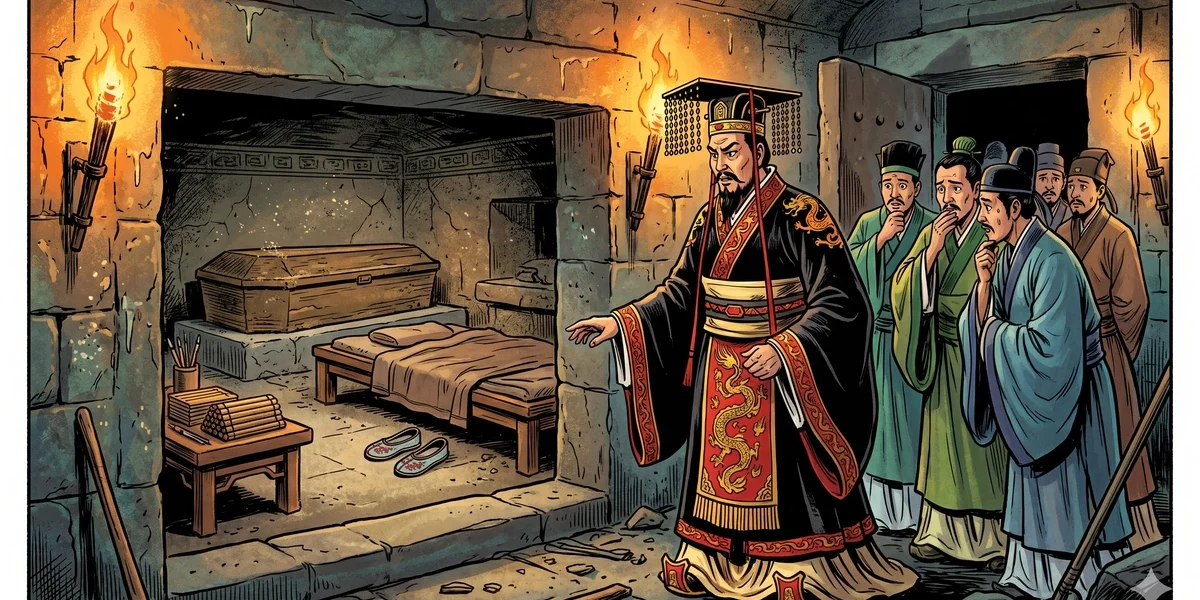
Origin and Narrative Tradition
Legends of Confucius (Kong Qiu, 551–479 BCE) form one of East Asian civilisation’s richest and most layered bodies of folk narrative—a tradition that accumulated over two and a half millennia, overlaying the historical teacher of the Analects with a legendary figure whose encounters with wise children, Daoist masters, and divine tests served successive generations as vehicles for thinking through the nature of wisdom, learning, and the limits of received authority. The historical Confucius was a scholar-official who failed to achieve lasting political influence during his lifetime, spent years travelling through the states of Zhou-era China seeking a ruler willing to implement his vision of virtuous governance, and eventually returned to his home state of Lu to teach a circle of disciples whose conversations with him were recorded in the Lunyu (Analects). The legendary Confucius, by contrast, is an omnipresent figure whose encounters with every challenge—the impudent child, the mysterious ferryman, the Daoist sage who appears to contradict everything the Confucian tradition values—serve as occasions for demonstrating or deepening wisdom rather than for political action. The folk legend tradition thus performs a function complementary to the classical text: it gives the sage a biography of trial and encounter that the Analects’ question-and-answer format cannot provide.
Beat I — The Sage on the Road
The most numerous and beloved Confucius legends are road stories: Confucius and his disciples travelling between states, encountering the China of the late Zhou period in all its diversity and turbulence. These encounters typically follow one of two structural patterns. In the first, Confucius meets someone—a farmer, a child, a hermit—who asks a question or makes an observation that reveals a gap in the sage’s knowledge, prompting him to acknowledge that the world contains wisdom beyond what formal learning can contain. In the second, Confucius meets someone who tests him—poses a riddle, challenges a precept, disputes a claim—and the encounter reveals either the scope of the Confucian framework or, in the Daoist counter-tradition, its limits. Both structural patterns carry the same fundamental teaching: genuine wisdom is always in process, never complete, and the sage who cannot be surprised has stopped learning.
Beat II — The Wise Child and the Eclipse of the Teacher
Among the most celebrated categories of Confucius legend is the encounter with the wise child—typically a child of five or seven who asks the great sage a question he cannot immediately answer, thereby demonstrating that wisdom is not the exclusive possession of the formally educated. In the most famous version, Confucius and his disciples encounter a child blocking the road with a small city built from stones. When asked to move aside, the child asks: “Is it the cart that should go around the city, or the city that should go around the cart?” Confucius, recognising the child’s intelligence, stops and converses with him—the child eventually stumps the sage with astronomical questions, and Confucius openly acknowledges the child’s superiority in that domain. The legend’s teaching is explicit: San ren xing bi you wo shi—“Among any three walkers, I am sure to find a teacher.” The child-encounter legend dramatises this principle with maximum impact by making the teacher the youngest person in the scene.
Beat III — Confucius and the Daoist Counter-Tradition
A significant strand of Confucius legend situates him in encounters with Daoist figures—most prominently the legendary Laozi, but also various anonymous hermits, fishermen, and recluses—who challenge the Confucian project from the perspective of a wisdom that values spontaneous naturalness (ziran) over cultivated virtue (de). In the Zhuangzi, Laozi famously dismisses Confucius’s project of ceremonial reform with the observation that fish need water and people need dao—elaborate ceremonies are the bucket when the river has dried up. The folk legend tradition adapted these philosophical dialogues into story form, presenting the encounters as genuinely productive: Confucius does not win these debates, but he learns from them. The sage who travels to see Laozi returns humbled and transformed: “I know birds can fly, fish can swim, animals can run. But there is the dragon—I cannot comprehend how it rides wind and cloud and mounts to heaven. Today I have seen Laozi. He is like the dragon!” The folk legend’s Confucius is a learner before he is a teacher, and his willingness to acknowledge what exceeds his understanding is the quality that makes him trustworthy as a guide.
Beat IV — The Legend’s Lasting Moral
What distinguishes the Confucius of folk legend from the authoritarian Confucianism that later imperial orthodoxy constructed from his texts is precisely this quality of openness—the willingness to be surprised, corrected, and taught by sources that conventional hierarchy would not recognise as teachers. The historical Confucius of the Analects says: “At fifteen, I had my mind bent on learning. At thirty, I stood firm. At forty, I had no doubts. At fifty, I knew the decrees of Heaven. At sixty, my ear was an obedient organ. At seventy, I could follow what my heart desired, without transgressing what was right.” The folk legend tradition takes the fifteen-year-old learning and the seventy-year-old freedom and gives them narrative flesh: the sage who was always learning because the world always had more to teach than any curriculum could contain.
San ren xing bi you wo shi yan, ze qi shan zhe er cong zhi, qi bu shan zhe er gai zhi—When I walk along with two others, they may serve me as my teachers. I will select their good qualities and follow them; their bad qualities and avoid them. (Analects 7.22, the Confucian principle of universal teachability that the legends dramatise in encounter after encounter)
Why This Story Has Lasted
Confucius legends have circulated for two and a half millennia because they embody a paradox that any teaching tradition must eventually confront: the greatest teachers are those who remain genuinely students. The sage whose encounter with a child or a hermit produces not dismissal but genuine curiosity is a different figure from the institutional authority who knows all the answers in advance. Chinese folk culture preserved this image of the learning Confucius—the one who could be stumped, who could acknowledge a superior understanding when he encountered it, who described himself not as a saint but as someone who loved learning so much that he forgot to eat when absorbed in it—as a counter-weight to the court Confucianism that used his name to enforce orthodoxy. The legend’s Confucius is democracy’s Confucius: the sage who finds teachers everywhere because he looks for them everywhere.
Tradition & Collection Notes
Historical figure: Kong Qiu (Confucius), 551–479 BCE, native of the state of Lu; teacher, scholar-official, and the Ru (Confucian) tradition’s founding figure. Primary classical text: Lunyu (Analects), compiled by his disciples; particularly relevant: 7.22 (universal teachability), 2.4 (stages of the sage’s learning). Daoist counter-tradition: Zhuangzi, chapters on Confucius’s encounters with Laozi; Laozi’s description of Confucius as seeing only the surface of dao. Wise-child tradition: “Xiang Tuo” legend (child who stumps Confucius on astronomical questions); preserved in Warring States Anecdotes and later folk collections. Motif index: J80 (Wisdom acquired from observation), J1111 (Clever person), H509 (Tests of cleverness or ability). Scholarly reference: Michael Nylan, The Five Confucian Classics (2001); Anne Birrell, Chinese Mythology: An Introduction (1993).
You May Also Like
 Chinese Folk Tales
Ages 9-12
Chinese Folk Tales
Ages 9-12
The Bird With Nine Heads
The Bird With Nine Heads: Long, long ago, there once lived a king and a queen who had a daughter. One day, when the daughter went walking in the garden, a
 Chinese Folk Tales
All Ages
Chinese Folk Tales
All Ages
Help In Need
Help In Need: Some twenty miles east of Gingdschou lies the Lake of the Maidens. It is several miles square and surrounded on all sides by thick green thickets
 Chinese Folk Tales
Ages 9-12
Chinese Folk Tales
Ages 9-12
Yang Oerlang
Yang Oerlang: The second daughter of the Ruler of Heaven once came down upon the earth and secretly became the wife of a mortal man named Yang. And when she