The Queen Of Heaven
The Queen Of Heaven: who is also known as the Holy Mother, was in mortal life a maiden of Fukien, named Lin. She was pure, reverential and pious in her ways
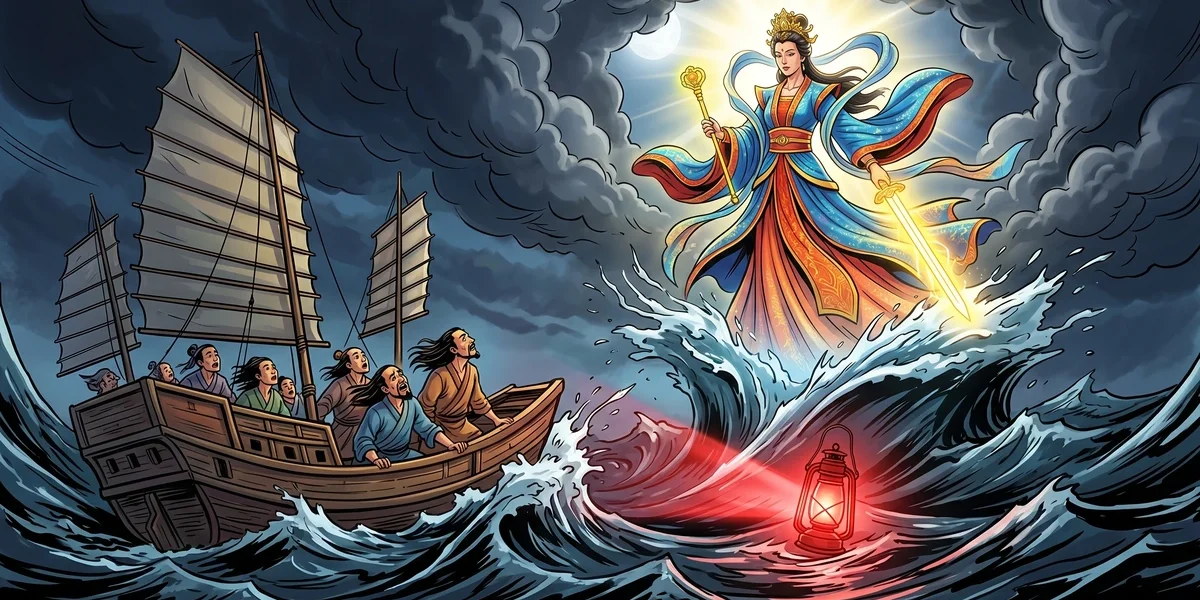
Mazu: From Fujian Fishing Girl to Empress of Heaven
The Queen Of Heaven tells the origin story of Mazu (媽祖) — arguably the most widely venerated female deity in the Chinese religious tradition, worshipped by hundreds of millions of people across coastal China, Taiwan, Southeast Asia, and Chinese diaspora communities worldwide. Her formal title is Tian Hou (天后, Queen of Heaven) or Tian Shang Sheng Mu (天上聖母, Holy Mother in Heaven), and her temples — of which there are thousands — serve simultaneously as religious sites, community centers, and maritime safety institutions.
The historical core of the Mazu tradition holds that she was born Lin Mo (林默) around 960 CE in Meizhou, Fujian province, the seventh child of a fishing family. From childhood she was said to possess unusual spiritual gifts: she learned to read without instruction, understood medicinal herbs, and entered spontaneous meditation states in which she could perceive events happening at a distance. She is believed to have died young — some accounts say at age 28, others at 16 — either in a failed attempt to rescue family members lost at sea or in a state of voluntary transition to a higher mode of existence. What followed her death was centuries of growing veneration, official imperial recognition (the Song, Yuan, Ming, and Qing dynasties all conferred increasingly exalted titles upon her), and the emergence of a fully articulated theological figure who remains a living presence in contemporary Chinese religious life.
Beat I — The Girl Who Dreamed in the Bodies of Others
Lin Mo was born, according to the accounts that form the core legend, under unusual circumstances: her mother dreamed of the bodhisattva Guanyin offering her a lotus flower before the birth. The child did not cry at birth — an auspicious sign — and the family began to call her Mo (默, “silent” or “quiet”), a name that would later acquire deeper resonance.
From her early years she displayed what the tradition calls shen tong (神通, divine capacities) — not supernatural powers in the Western fantasy sense, but heightened perceptual and empathic abilities that allowed her to sense conditions beyond normal human range. She could feel when weather was about to turn dangerous. She entered meditative states in which she seemed to leave her physical body and travel to distant locations. She learned the medicinal and weather-reading knowledge of the coastal fishing community with unnatural speed, and she freely shared this knowledge with neighboring families who came to her for counsel.
The central episode of the legend’s first movement concerns her brothers. While Lin Mo sat at her loom one afternoon in a deep meditative state, she apparently lost consciousness — or, in the tradition’s framing, entered a state of active spiritual projection. In her interior vision she saw her brothers’ fishing boats caught in a sudden storm far offshore; she reached out in her vision and grasped their boats, guiding them toward safety. Her mother, frightened by her daughter’s unresponsive state, shook her awake. In that moment of interrupted consciousness, one brother’s boat — the one she had momentarily released — sank. He survived but barely; the others came home safely. Lin Mo wept for her failure to hold on through the full passage.
This episode is treated by the tradition not as a supernatural intervention but as the first demonstration of a love so complete that it could, at its fullest extension, reach beyond ordinary physical limitation. The grief at the interruption becomes the defining emotional note: not triumph at having saved most of her brothers, but grief at the one she could not hold long enough.
Beat II — The Ascension and the Living Presence
The accounts of Lin Mo’s death differ in significant ways across regional traditions. The oldest Fujian accounts suggest she climbed a mountain near her home village and ascended peacefully into heaven, her body dissolving into light. Maritime traditions from later centuries describe her dying at sea while searching for her missing father during a storm — the very kind of death she had spent her life helping fishermen avoid. Some texts suggest she chose the moment of her own transition, understanding that her capacity to help would be greater from a spiritual station than from an embodied one.
What followed was not a gradual memorial process but an immediate and apparently spontaneous recognition by the fishing communities of Fujian that something of Lin Mo’s protective presence remained available to them. Fishermen reported seeing a woman in red robes standing on cliffs or walking on the water during storms, directing boats away from rocks. Those who were pulled from the water in near-drowning experiences described a calm female voice or a pair of hands that guided them toward surface and shore.
The Song dynasty imperial court, receiving reports of these phenomena from the Fujian provincial administration — reports attached to petitions for her official recognition — granted her the title Ling Hui Fei (靈惠妃, Numinous and Beneficent Consort) in 1156 CE. Over the following seven centuries, successive dynasties elevated her title repeatedly, each elevation reflecting both the growth of her popular following and the pragmatic recognition by imperial administrators that she was performing, in the spiritual register, the genuinely important public function of maritime safety assurance in a pre-modern coastal economy dependent on the sea.
Beat III — Mazu and the Theology of Protective Compassion
The theological structure of the Mazu tradition illuminates something distinctive about Chinese popular religious thought: the belief that exceptional human beings do not merely enter a separate divine realm at death but rather achieve a mode of being in which their most essential quality — in Mazu’s case, the protective love she directed toward fishermen and sailors — becomes universalized and perpetually available.
This differs significantly from both the Buddhist model of the bodhisattva (who postpones final enlightenment to assist all beings) and the Daoist model of the immortal (xian, 仙, who achieves escape from the cycle of transformation). Mazu in popular practice is understood as a shen (神, spirit/deity) who remains specifically connected to the concerns and dangers of maritime life — not transcendent of them but deeply embedded in them. Her power is not general omnipotence but specialized, experienced compassion: she knows what it is to fear for family members at sea because she lived that fear completely.
This theological particularity makes her more effective, not less, in popular religious estimation. Fishermen’s families pray to Mazu not because she is omnipotent but because she has personally experienced the specific terror they are facing. Her empathic authority is grounded in biographical reality — she is not a divine figure who condescends to understand human maritime fear but a human being who understood it so completely that the understanding became her defining spiritual attribute.
The ling (靈, numinous efficacy) that her title emphasizes — the quality that makes a deity effective rather than merely real — is consistently understood in Mazu veneration as arising from this empathic foundation. She helps because she has felt what her petitioners feel. This makes the theological relationship reciprocal in an interesting way: the fishermen’s fear validates her compassion; her compassion addresses their fear. The relationship is not between a superior being and dependent humans but between humans who have found, in one of their own, a concentrated expression of the protective love that holds communities together in the face of an indifferent sea.
Beat IV — The Living Goddess and the Global Diaspora
Mazu’s significance in contemporary Chinese cultural life cannot be overstated. Her worship spread from Fujian throughout the Chinese world as Fujianese maritime traders, fishermen, and eventually emigrants carried their religious practice with them. Taiwan’s more than five hundred Mazu temples constitute one of the densest concentrations of veneration for a single deity anywhere in the world. The annual Dajia Mazu pilgrimage — in which her statue is carried by hundreds of thousands of devotees across Taiwan over nine days — is one of the largest religious processions on earth.
In Southeast Asia, Mazu temples serve as community anchors for Chinese diaspora populations in Malaysia, Singapore, Indonesia, Vietnam, and the Philippines, providing not only religious services but social support networks, charitable functions, and a material connection to ancestral homeland that has persisted through generations of migration. In 2009, UNESCO recognized Mazu worship and its associated cultural practices as an Intangible Cultural Heritage of Humanity — one of the first Chinese folk religious traditions to receive this designation.
The legend of her origin — the silent girl at the loom, the brothers in the storm, the grief at the one she could not hold — remains at the center of this living tradition because it provides the emotional foundation that makes her divinity comprehensible. She is not worshipped as an abstract power but as a specific kind of love: the love that reaches beyond its own capacity and is transformed by the reaching.
“She did not become divine by leaving humanity behind. She became divine by carrying humanity’s deepest love to its ultimate expression.”
— Principle of the Mazu veneration tradition, Fujian province
Why This Legend Has Lasted
The origin story of Mazu has lasted not because it involves spectacular miracles but because it begins with something entirely ordinary and recognizable: a daughter’s anxiety for her family on the water. The legend takes that anxiety — which every coastal family in China has experienced — and traces it to its ultimate conclusion. If you loved your family at sea with complete, unbroken attention, what might that love become capable of?
The answer the tradition offers is not theological abstraction but lived experience: the community of maritime China, over a thousand years, has found that something of protective love remains available in the world — that the accumulated prayers, the red temple banners, the incense smoke rising from ten thousand coastal shrines, point toward something that has not disappeared from the human record. Whether one frames this theologically or anthropologically, the reality of the tradition itself — its longevity, its global spread, its continuing vitality — is a historical fact that demands explanation. The legend of Lin Mo, the silent girl who loved too much to stop at death, is the tradition’s own answer.
Mazu in Historical and Contemporary Practice
The historical Lin Mo (林默) is believed to have lived approximately 960–987 CE in Meizhou Island, Putian Prefecture, Fujian Province. The first official imperial recognition came in 1156 under the Song dynasty; subsequent dynasties granted progressively elevated titles — from Consort to Princess to Concubine of Heaven to Empress of Heaven (Tian Hou). The Qing dynasty’s recognition was particularly significant given the dynasty’s Manchu origins, as it demonstrated the extent to which Mazu veneration had penetrated beyond its Fujianese homeland to become a pan-Chinese institution. Today the Mazu Ancestral Temple on Meizhou Island, rebuilt and expanded over centuries, receives millions of pilgrims annually. The Taiwan Dajia Jenn Lann Temple pilgrimage — one of the world’s largest religious events — traverses approximately 330 kilometers over nine days. UNESCO’s 2009 Intangible Cultural Heritage designation applied specifically to Mazu belief and customs as practiced across Fujian and Taiwan, acknowledging the tradition’s unique status as both living religious practice and significant intangible cultural heritage.
You May Also Like
 Chinese Folk Tales
All Ages
Chinese Folk Tales
All Ages
The Spirits Of The Yellow River
The Spirits Of The Yellow River: are called Dai Wang Great King. For many hundreds of years past the river inspectors had continued to report that all sorts of
 Chinese Folk Tales
All Ages
Chinese Folk Tales
All Ages
Old Dschang
Old Dschang: Once upon a time there was a man who went by the name of Old Dschang. He lived in the country, near Yangdschou, as a gardener. His neighbor, named
 Chinese Folk Tales
Ages 9-12
Chinese Folk Tales
Ages 9-12
The Bird With Nine Heads
The Bird With Nine Heads: Long, long ago, there once lived a king and a queen who had a daughter. One day, when the daughter went walking in the garden, a