The Golden Goose: Kindness Rewarded, Greed Punished
The Golden Goose: Kindness Rewarded, Greed Punished: The Foolish Youngest Son In a time when the world still held magic in its forests and mountains, there

A youngest son nicknamed Dummling — “the simpleton” — who shares his dry crust and sour beer with a little gray man in the forest; a goose with feathers of pure gold; an innkeeper’s three daughters who reach out to pluck a single feather and find their fingers will not let go; a parson, a sexton, two field-labourers, and a chain of strangers all trailing helplessly after the golden bird; a princess who has never laughed in her life and who, at the sight of the absurd parade, breaks at last into open joy. The Golden Goose (Die goldene Gans) is one of the most photographed images in all of European fairy tale, and one of the few in the Brothers Grimm collection in which the moral verdict is delivered not by sword or curse but by laughter. Published in 1812 in the first edition of the Kinder- und Hausmärchen as tale number 64 (KHM 64), the story belongs to the international tale type Aarne–Thompson–Uther 571, “All Stick Together”, and stands as the Brothers Grimm’s most thoroughly comic statement of a moral they returned to many times: that humble kindness, which the world calls foolishness, is in the end the only kindness that holds.
1. The Three Brothers and the Little Gray Man
The story opens, as so many of the Brothers Grimm’s tales do, in the household of an ordinary forester. There is a man with three sons. The two elder are clever and well thought of in the village; the youngest is called Dummling, the diminutive of der Dumme — “the simpleton”, “the foolish little one” — and is mocked, scorned, and pushed aside on all occasions. The Brothers Grimm name him by his nickname only; the simpleton has, in the moral grammar of the tale, no other name, because the world has not yet seen fit to give him one. One day the eldest son announces that he will go into the forest to chop wood. His mother packs him a fine flour-cake (einen schönen Eierkuchen) and a bottle of wine, and he sets off with the certainty of a young man who has been told all his life that the world is his.
In the forest, an old gray-haired man (ein altes graues Männchen) meets him on the path, wishes him a friendly good morning, and asks for a small piece of cake and a swallow of wine. The eldest son, in the Grimms’ brisk country-German, refuses with a smug little speech: “Wenn ich dir meinen Kuchen und meinen Wein gebe, so hab’ ich selber nichts.” “If I were to give you my cake and my wine, I would have nothing for myself.” He shoves the little man aside and walks on. He sets to work on a fine tree; on his very first stroke the axe glances off, gashes his arm, and he must hobble home wounded. The middle son, sent next, behaves no better: same refusal, same little injury, same humiliated return. The Brothers Grimm tell these two failures with the brevity of a folk-teller who knows the audience is waiting for the third.
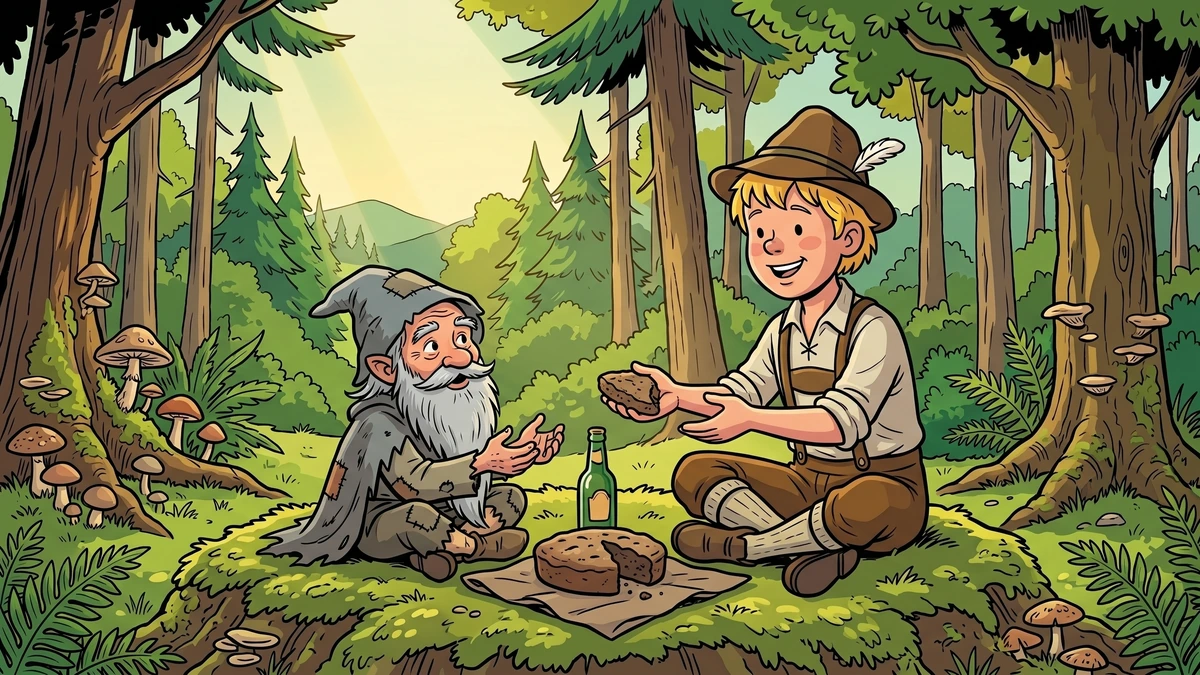
At last Dummling asks his father if he too may go. The father resists — “Du verstehst es ja gar nicht”, “you don’t know the first thing about it” — but Dummling persists, and is sent off at last with a poor man’s lunch: a cake of ash-baked bread (Aschenkuchen) made with water, and a bottle of sour beer. He goes whistling into the forest. The same old gray man meets him on the same path. He asks for a piece of cake and a swallow of beer. Dummling sits down at once, opens his bundle, and answers with the open-handedness of a child who has never been taught to count his loaves: “Ich habe aber nur Aschenkuchen und saures Bier; wenn dir das recht ist, so wollen wir uns setzen und essen.” “I have only ash-cake and sour beer; if that suits you, let us sit down and eat.” When he opens the cloth, the ash-cake has become a fine flour-cake, and the sour beer has become good wine. They eat together. The little gray man, who has never been a beggar at all but is in fact one of the forest’s old guardian spirits in disguise, looks at Dummling with grave kindness, and says: “Because you have a good heart and have shared what you had, I will give you luck. Yonder stands an old tree; cut it down, and at its roots you will find something.” With that he vanishes among the trees, the way the gray men in the Grimms always vanish — without movement, between two breaths, the way a thought leaves a mind.
2. The Golden Goose and the Innkeeper’s Three Daughters
Dummling cuts down the old tree the gray man pointed out, and at its roots, sitting quietly among the broken earth, there is a goose — not an ordinary white goose, but a goose whose feathers are von purem Gold, of pure gold. He picks her up, tucks her under his arm, and walks on through the forest until he reaches an inn where he means to spend the night. The Brothers Grimm describe what happens next with the dry comedy of a teller who has been waiting two thousand words to deliver the joke. The innkeeper has three daughters. They see the golden goose and are seized at once by the small, dishonest hunger that the goose, all through the rest of the tale, will exist to expose. Each thinks privately that a single golden feather, plucked when the boy is asleep, would surely never be missed.
“Es wird sich schon eine Gelegenheit finden, wo ich mir eine Feder ausziehe.”
“There will surely come a chance for me to pluck out a feather for myself.” — the eldest daughter’s thought, KHM 64
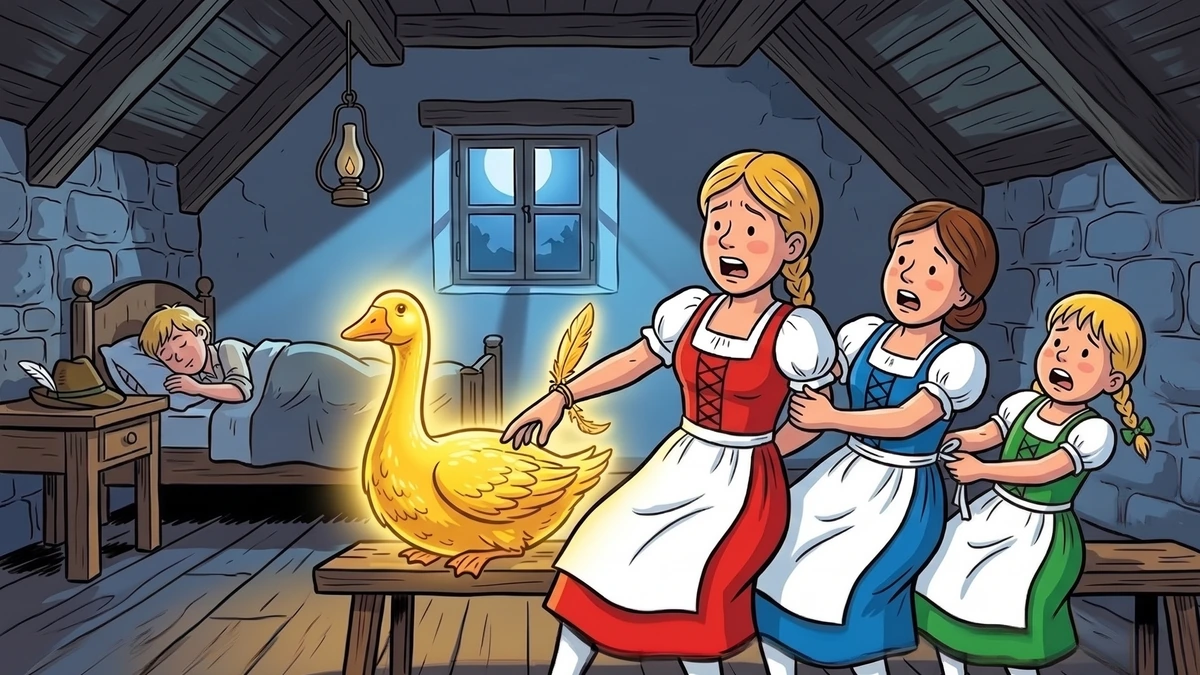
The eldest daughter is the first to try. She waits until Dummling has gone to bed, slips into the room where the goose has been left, and reaches out her hand. The instant her fingers close on a feather, her hand is stuck fast to the wing and she cannot pull it free. The middle sister comes in to scold her and tug her loose; the moment she touches her sister’s sleeve, her hand sticks too. The youngest comes in to help — the same; she sticks to the middle one. And there the three daughters of the innkeeper stand all night, in the order of their greed, fastened in a small humiliated row to the back of a sleeping golden goose.
It is worth pausing on the small genius of the Grimms’ staging. The goose punishes nothing. The goose makes no sound, lays no curse, performs no judgement of any kind. The goose is simply a golden goose; the punishment is supplied entirely by the hand that reaches out to take what is not its own. Folklorists from Stith Thompson to Maria Tatar have noted that this is one of the cleanest moral mechanisms in the entire ATU index: tale type 571, “All Stick Together”, in which the magical object exposes greed not by judging it but by holding it visible for everyone to see. The hand that grasps cannot let go; the hand that gives freely — like Dummling’s opening of his bundle to the gray man — is the only hand the tale lets stay clean.
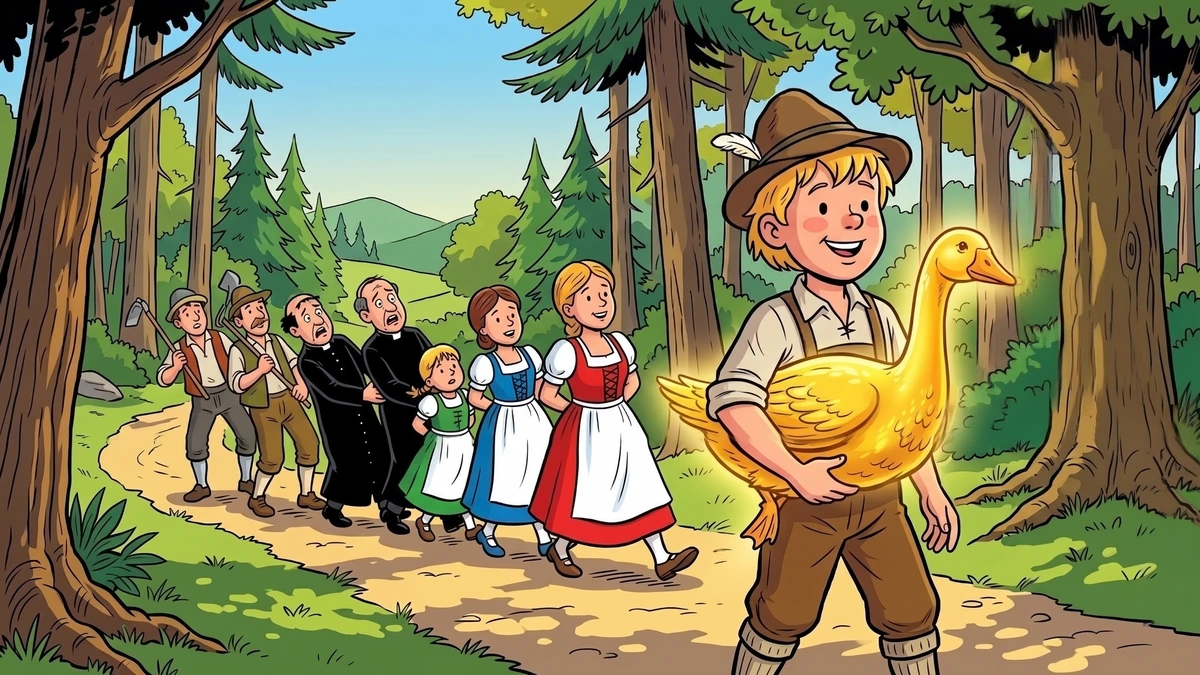
In the morning, Dummling, who has slept the long sleep of the kind, picks up his goose under his arm and sets off down the road, never noticing that three young women are dragging behind him in a stuck-together line. They run because they must; he walks because he wants to. They cross fields. A parson, on his way to early service, sees the indecent procession and shouts at the girls to be ashamed of themselves, running after a young man like that. He grabs the youngest by the sleeve to pull her back. He sticks. The sexton comes round the corner, sees the parson held fast by the seat of a girl’s coat, and scolds him; he tries to pull him loose; he sticks. Two field-labourers, hailed by the sexton, lay their hoes down to help; they stick. The line behind Dummling grows: seven, eight, the better part of a parish, all hopping and stumbling along behind a young man who has not yet looked back. The Brothers Grimm write the sequence with the patience of a teller who knows the ridiculous picture is doing all the work.
3. The Princess Who Had Never Laughed
The kingdom into which Dummling now wanders has its own grief. The king of the country has a daughter who is so serious, so sealed inside herself, that she has never been seen to smile in all her life, much less to laugh. The Brothers Grimm describe her in a single grave sentence: she is so sad that nothing in the world has ever moved her to mirth. The king, in despair, has issued an open proclamation, the kind of proclamation that always sets the action of a fairy tale in motion: whoever can make the princess laugh shall have her in marriage. Many young men have tried; many have failed; the princess has watched dancers and jugglers and mocking fools without so much as a softening of her mouth. She sits by her high window, day after day, and looks out at a world that has not yet given her a reason to be glad.
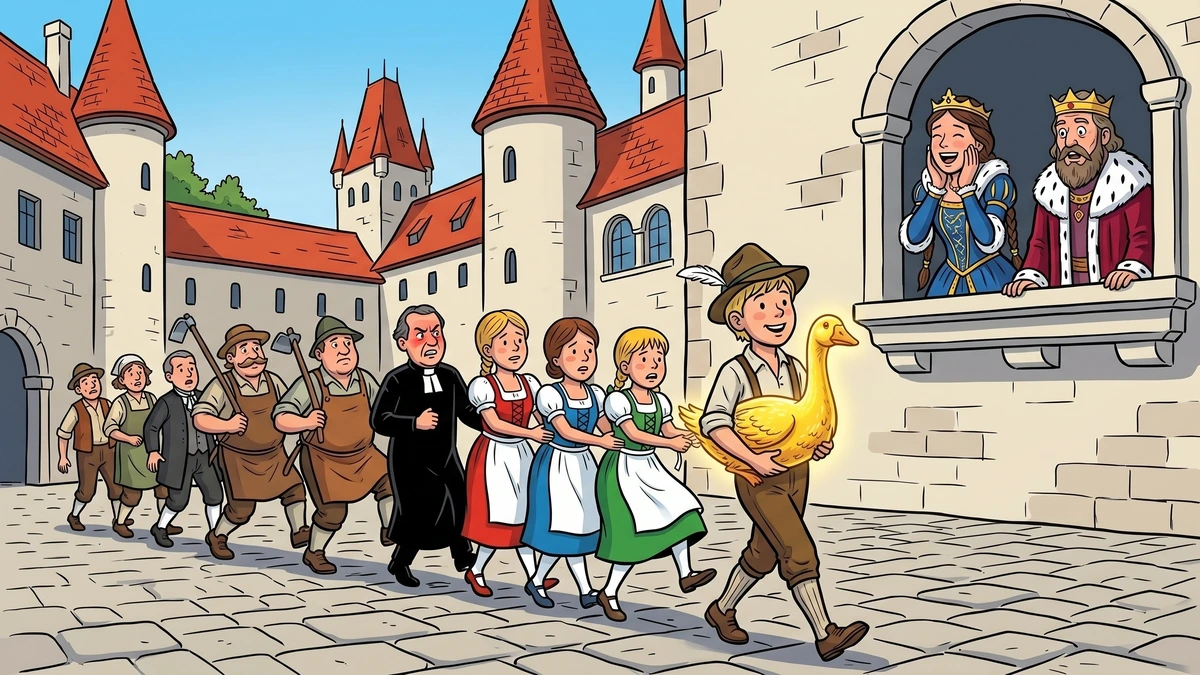
It is into the courtyard below this window that Dummling now wanders, his golden goose under his arm, his unwilling parade still trailing behind. The Brothers Grimm let the moment land without commentary. The princess looks down. She sees a young man who does not know he is leading a procession; she sees, behind him, three girls and a parson and a sexton and two labourers all stuck shoulder to shoulder and elbow to back of the coat, hopping ridiculously over the cobblestones; she sees the absurd small chain of human greed dragged in helpless single file behind a single golden bird; and at last, for the first time in her life, the princess of the silent face throws back her head and laughs. The Brothers Grimm record her laughter in the plainest words their nineteenth-century German has: sie fing an zu lachen, und wollte gar nicht wieder aufhören, “she began to laugh, and would not stop again.”
The king, watching from beside his daughter, recognises at once that the boy in the courtyard has done what no court entertainer was able to do, and that the proclamation must now be honoured. But the king is not a generous man either, and the second half of the tale — in the appended episode that folklorists classify as ATU 513B, “The Land-and-Water Ship” — turns on his attempts to slip out of his own promise. He sets impossible conditions. Dummling must first find a man who can drink down a whole cellar full of wine. Then he must find a man who can eat a mountain of bread. Then he must build a ship that will sail on dry land as well as on water. Each task seems to the king to be a polite refusal, the kind of impossible favour that the boy will never be able to perform. But each time Dummling goes back into the forest, the little gray man is waiting under the same trees, and the gray man — who is, the Brothers Grimm now allow us to understand, the same forest spirit Dummling fed at the beginning — sends him to a thirsty man drinking up the entire cellar at one sitting, to a hungry man eating up a whole bakery, and at last to a quiet old craftsman who carves a ship that goes on land and water both. Kindness, having been planted once in the open hand of a simpleton, is paid back across the rest of the tale in the small honest currency the Grimms always preferred: every favour Dummling has need of, the gray man arranges, because Dummling once gave the gray man what little he had.
4. The Wedding and the Quiet Inheritance
The king, in the end, runs out of impossible conditions. Dummling has done every task that was set him; the cellar is dry, the bread is gone, the strange ship has sailed up out of the river onto the courtyard stones in front of the throne; the princess is laughing still, and laughing now with the open delight of a young woman who has at last seen the man she means to spend her life with. The Brothers Grimm bring the story to its close in a single short sentence so plain that it has the weight of an old village blessing: da musste der König ihm seine Tochter geben, und sie hielten Hochzeit, “then the king had to give him his daughter, and they held the wedding.” Dummling marries the princess. After the king’s death he becomes ruler in his place. He does not become a different person. He does not, the Grimms quietly note, change his name; he is still Dummling. But the village that mocked him, the brothers who shoved him, the innkeeper’s daughters whose fingers had stuck themselves to a goose — all of them now live in a kingdom whose ruler is the boy who shared his ash-cake with a beggar on a forest path.
The Brothers Grimm leave the chain of stuck strangers off-stage at the end of the tale, and many readers, even in nineteenth-century Germany, asked Wilhelm Grimm what became of them. In the 1812 first edition the question is not answered. In later editions the brothers added, in a single passing remark, that once the goose had served her purpose she gave back what she had taken, and the parson and the sexton and the labourers and the innkeeper’s three daughters were quietly released, each of them sent home with a small cold lesson and no public penance. The Brothers Grimm understood, very precisely, that the moral force of the tale was not in punishment. It was in the picture. The picture of a parade of grown people stuck to a goose was the punishment. After the laughter of the princess, no further reprimand was needed.
The Moral: The Open Hand Is the Only Hand the Goose Will Not Hold
“Ich habe aber nur Aschenkuchen und saures Bier; wenn dir das recht ist, so wollen wir uns setzen und essen.”
“I have only ash-cake and sour beer; if that suits you, let us sit down and eat.” — Dummling to the little gray man, KHM 64, Brüder Grimm, Kinder- und Hausmärchen (1812)
The moral of The Golden Goose is not, despite many illustrated retellings, that the simpleton is rewarded because he is simple. It is that the simpleton is rewarded because his hand opens. The two clever brothers fail in the forest not because they are clever but because they keep their cake closed inside their own ownership. The innkeeper’s three daughters fail in the bedroom not because they are unkind but because their fingers reach. The parson and the sexton and the two labourers fail in the field not because they are unworthy but because they grab. The Brothers Grimm have given us, in the small repeated motion of a hand that closes around what is not its own, the tightest possible illustration of the central old-Lutheran moral they had absorbed from the country households they collected in: der Geizige ergreift sich selbst — “the greedy man seizes himself”. Greed is its own punishment because it is the same gesture as being trapped. Generosity is its own reward because it is the same gesture as being free.
There is a second, gentler moral that the Brothers Grimm allow to live in the small architecture of the tale rather than in any one line: laughter is also a form of recognition. The princess does not laugh at Dummling. She laughs at the absurd parade behind him, which is to say she laughs at the ridiculous picture of a world that has spent its whole life reaching for things it cannot let go of. Her laughter is the first honest feeling she has ever had in a court that has been protecting her from honest feelings since she was a child. It is also, in the moral grammar of the tale, the first kindness anyone in the kingdom has shown her. The Brothers Grimm, who knew very well that a sealed face is the face of a person who has not yet been allowed to see anything funny, gave the princess a husband who did not know he was being funny — and in that small surprise, the seal of her face is broken. Dummling does not deserve the princess because he has performed any cleverness; he deserves her because he is the first thing in her life that she has been able to look at without flinching.
Why It Lasted
Of the more than two hundred tales the Brothers Grimm published between 1812 and 1857, The Golden Goose is one of perhaps two dozen that have travelled outside the German-speaking world without losing their distinctive shape. The tale is classified as Aarne–Thompson–Uther type ATU 571, “All Stick Together”, with an appended episode of type ATU 513B, “The Land-and-Water Ship”. International variants of the sticky-chain motif exist across Germanic, Slavic, and Nordic Europe: a Norwegian cousin tells of a magical golden bird whose feathers fasten the hands of every greedy neighbour in the parish; a Russian cousin substitutes a golden duck and a fishmonger’s wife; a Finnish cousin keeps the goose but moves the laughter from a princess to a dying queen. In all of them, the magical object does not judge. It simply holds. The shape of the tale — greed exposed as adhesion, kindness rewarded as freedom of movement — is one of the oldest moral pictures in northern European storytelling.
The textual history of the Grimm version is itself a small lesson in nineteenth-century editorial conscience. In their Annotations volume the Brothers Grimm record that they received the tale from two sources: a Hesse household that scholars have since identified as the Hassenpflug family of Kassel, who supplied the brothers with so many of the courtly tales of the early collection, and a Paderborn household identified as the von Haxthausen family, who supplied the rougher countryside variants. Wilhelm Grimm braided the two oral versions together for the 1812 first edition and revised the prose lightly across the seven editions of his lifetime, removing in 1819 a few of the coarsest village turns of phrase and softening, in 1857, the description of the parson’s indignity. The skeleton of the tale, however — the three brothers, the gray man on the path, the goose under the old tree, the chain of stuck strangers, the princess who has never laughed — is essentially unaltered from the version Wilhelm took down in his small black notebook in the autumn of 1810.
The tale has lasted, finally, because every one of its central images has the quality of something a child can carry whole into adulthood. The little gray man on the forest path, who is and is not a beggar. The ash-cake that turns into wedding-bread the moment it is shared. The golden goose at the roots of the old tree, who weighs no more under one arm than an ordinary goose would. The hand that closes around a feather and will not open again. The parson and the sexton and the two labourers in their helpless human chain. The high window in the king’s castle where a young woman has been waiting all her short life for a reason to be glad. And, above all, the simplest moral picture in the whole Grimm collection: a young man whom the village called a fool walking quietly down a road with a golden bird under his arm, not yet knowing that everything he has refused to grasp is already on its way to him. The Brothers Grimm, who knew that the best fairy tales are the ones that turn a moral into a picture and let the picture do the teaching, gave The Golden Goose a shape that two centuries of European childhoods have not been able to set down.
You May Also Like
 Grimm's Fairy Tales
Ages 9-12
Grimm's Fairy Tales
Ages 9-12
Cat and Mouse in Partnership
A cat and a mouse hide a pot of fat for winter, but not every friend keeps a promise.
 Grimm's Fairy Tales
Ages 9-12
Grimm's Fairy Tales
Ages 9-12
The Juniper-Tree
The Juniper-Tree: Long, long ago, some two thousand years or so, there lived a rich man with a good and beautiful wife. They loved each other dearly, but
 Grimm's Fairy Tales
Ages 9-12
Grimm's Fairy Tales
Ages 9-12
The Water Of Life
The Water Of Life: Long before you or I were born, there reigned, in a country a great way off, a king who had three sons. This king once fell very ill so ill