The Girl With The Horse’s Head Or The Silkworm Goddess
The Girl With The Horse's Head Or The Silkworm Goddess: In the dim ages of the past there once was an old man who went on a journey. No one remained at home
Origin & Tradition
“The Girl with the Horse’s Head” — also known as the myth of Can Nü (蚕女, Silkworm Girl) — is one of the most important etiological myths in the entire Chinese tradition: an origin story for silk itself, the material that for more than four thousand years defined Chinese civilisation, connected China to the world through the Silk Road, and remained a closely guarded technological secret whose theft was, at various points in Chinese history, punishable by death. The story appears in early texts including Gan Bao’s Sou Shen Ji (搜神記, c. 348 CE) and is reflected in the iconography of the Silkworm Goddess (Can Shen, 蚕神) worshipped at dedicated altars throughout imperial China. The myth exists in a complex relationship with the better-known legend of Empress Leizu (宀祖), the wife of the Yellow Emperor Huangdi, traditionally credited with discovering silk when a silkworm cocoon fell into her tea. Together, Can Nü and Leizu represent the two faces of Chinese silk mythology: the sacrificial origin and the civilizational gift.
Part I — The Promise and the Betrayal
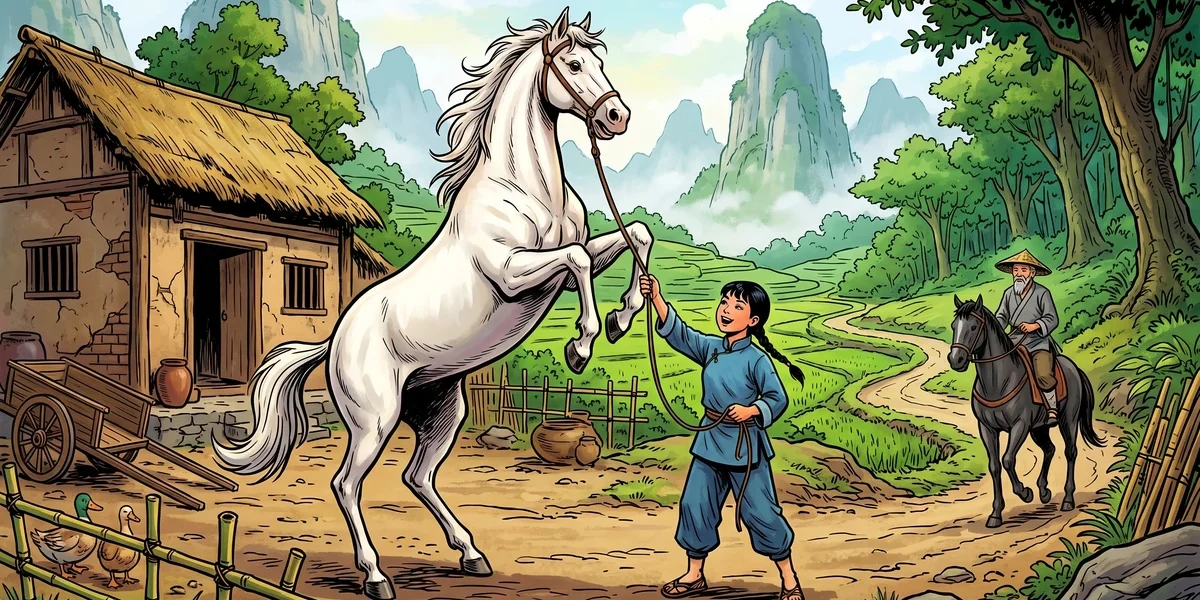
In a household somewhere in ancient China, a father has gone missing. His daughter, alone and anxious, addresses the family’s horse — a magnificent animal who has been her father’s constant companion — with a desperate promise: if the horse can find her father and bring him home, she will marry it. The promise is extravagant, impossible by any human social standard, and the girl utters it not as a serious contractual commitment but as the overflow of grief and desperation finding expression in the only direction available.
The horse takes her seriously. It sets out, tracks the father through whatever obstacle or distance separates them, and brings him home safely. The daughter is overjoyed — and immediately confronted with the full weight of what she said. The horse, she now understands, understood perfectly. It performed the service; it expects the payment.
The father, learning of the promise, is horrified. He kills the horse. In his understanding, the promise was never legitimate — no human daughter can be promised to an animal, and the animal’s performance of the task does not create a binding obligation. He acts swiftly and definitively, removing what he sees as a preposterous claim before it can go further. The horse’s hide is spread out in the courtyard to dry.
But the universe, in this story, operates on different premises. Promises matter, even rash ones. The horse’s service was real; the girl’s word was given; the father’s destruction of the horse was not a resolution but a rupture. The hide, inexplicably animated, rises, wraps itself around the girl, and carries her away.
Part II — Transformation and the Silkworm
When the father searches for his daughter, he finds her eventually — transformed. She is no longer a girl in any recognisable sense; she has become a silkworm, spinning from her body an extraordinary thread of lustrous silk, the horse’s head now merged with her own in a chimeric form that combines the equine and the feminine, the animal and the human, the sacrificed and the transformed. She lives in a mulberry tree, consuming its leaves, producing from her body something the world has never seen before.
The transformation is simultaneously punishment and apotheosis. The girl is punished — she loses her human form, her ordinary life, her future as a daughter and wife — but she is also elevated. Her new existence produces silk, the most precious textile in human history, and her suffering becomes the foundation of a civilizational gift. The Silkworm Goddess is not a comfortable deity — she is a figure of pathos and sacrifice, a reminder that the things that clothe and adorn human civilisation are purchased at costs that are easily forgotten once the product has been separated from its origin.
In the iconographic tradition, Can Nü is depicted with a horse’s head — the merged identity of girl and animal made permanent in divine form. This image, which might seem grotesque outside its cultural context, carries within the tradition a specific theological charge: it insists on the continuity between the sacrifice and the gift, between the broken promise and the extraordinary consequence, between the killed horse and the goddess who wears its identity forever.
Part III — The Silk Cult and the Imperial Sericulture Ritual
Silk was not merely a commodity in imperial China. It was a civilizational substance — a material that encoded Chinese cultural identity so completely that the route along which it traveled to the West became, retroactively, the defining geographical metaphor of Chinese engagement with the world. The discovery of silk is traditionally dated to the reign of the Yellow Emperor Huangdi (c. 2700 BCE), and his wife Empress Leizu is credited with the agricultural development of sericulture: cultivating mulberry trees, domesticating silkworms, and developing the reeling and weaving techniques that converted raw cocoons into usable fabric.
The state cult of sericulture was among the most elaborately institutionalised of imperial ritual obligations. Each spring, the Empress of China performed the qin can (親蚕, “personally tending the silkworms”) ritual at the Altar of the Silkworm Ancestors (Xian Can Tan, 先蚕壇) — a ceremony in which she symbolically inaugurated the silk season by feeding mulberry leaves to silkworms in the imperial silk garden. This was not ceremonial window-dressing but a theologically charged enactment of the imperial family’s obligation to maintain the agricultural-ritual order that sustained the empire. Just as the Emperor performed the spring ploughing ritual to inaugurate the farming season, the Empress performed the silkworm ritual to inaugurate silk production — both acts positioning the imperial family as the intermediary between Heaven’s cosmological mandate and the practical sustenance of the population.
Can Nü, the Silkworm Goddess of this myth, stands behind this ritual tradition as its founding sacrifice. The mulberry trees in which she lives and the silk she produces from her transformed body are the mythological originals of which every subsequent silkworm, every mulberry grove, every bolt of imperial silk is a copy. When the Empress fed mulberry leaves to silkworms at the Xian Can Tan, she was re-enacting the original gift — honouring the girl who became a goddess by losing everything that made her human.
Part IV — The Moral of Broken Promises and Unintended Consequences
The myth of Can Nü encodes a moral structure more complex than simple cautionary tale. Three parties bear responsibility for what happens: the girl who made the promise, the horse who took it seriously, and the father who destroyed the horse rather than honour what his daughter had said. None of these actions is entirely without justification — the girl’s promise was desperate and well-intentioned; the horse’s expectation was technically legitimate; the father’s revulsion at the proposed marriage was culturally reasonable — but the combination of these three partially justified actions produces an outcome that none of them intended and none of them can undo.
This moral structure — in which disaster emerges not from simple villainy but from the compounding of individually comprehensible choices — is characteristic of the most sophisticated Chinese mythological thinking. The cosmos in this story is not indifferent, but it is not punishing anyone for wickedness. It is simply enforcing the principle that words have weight, that promises made in extremity are still promises, that the horse’s service was real and required acknowledgment. The transformation of the girl is the universe’s way of resolving an impossible situation — a resolution that is simultaneously terrible and magnificent, as the most important resolutions often are.
The civilizational gift at the story’s end — silk — does not cancel the tragedy; it transforms it. The girl’s suffering is not made retroactively acceptable by the importance of what it produces. But it is given meaning — not wasted, not pointless, not merely pathetic. The Silkworm Goddess who wears the horse’s head for eternity is a figure of genuine tragedy who is also genuinely venerated, and both aspects of that paradox must be held simultaneously to understand what Chinese culture has said, through her, about the relationship between sacrifice and civilisation.
“She made a promise when she did not know what it meant. The horse understood what she could not. Her father tried to cancel what could not be cancelled. And the world gained its most beautiful cloth from the tangle of what none of them had intended.”
Why This Story Lasted
The myth of Can Nü lasted because silk itself lasted — because for four thousand years, the act of unwinding a silkworm cocoon was an encounter with the mystery of how a tiny creature produces something so impossibly fine and lustrous. The myth answers the implied question behind that encounter: this came from somewhere extraordinary; this cost something; this is not merely a material convenience but the product of a cosmic event. Etiological myths survive as long as the phenomenon they explain retains its capacity for wonder, and silk has never stopped being wonderful.
The story also lasted because it refuses the comfortable resolution. Can Nü is not restored to human form; the father is not punished; the horse is not resurrected. The transformation is permanent, the loss is real, and the silk is simultaneously a gift and an enduring testament to what was broken. This refusal of comfortable resolution is what makes the myth feel true in the way that only myths can: not factually accurate, but emotionally exact about the way that the most important things in civilised life — the textiles that clothe us, the foods that sustain us, the technologies that connect us — are always, if we trace them back far enough, founded on some form of sacrifice that the beneficiaries have mostly forgotten.
You May Also Like
 Chinese Folk Tales
All Ages
Chinese Folk Tales
All Ages
The Tragedy Of The Yin Family
The Tragedy Of The Yin Family: In a certain district in one of the central provinces of China, there lived a man of the name of Yin. He was possessed of
 Chinese Folk Tales
All Ages
Chinese Folk Tales
All Ages
Rose Of Evening
Rose Of Evening: On the fifth day of the fifth month the festival of the Dragon Junk is held along the Yangtze-kiang. A dragon is hollowed out of wood, painted
 Chinese Folk Tales
All Ages
Chinese Folk Tales
All Ages
The Monk Of The Yangtze-Kiang
The Monk Of The Yangtze-Kiang: Buddhism took its rise in southern India, on the island of Ceylon. It was there that the son of a Brahminic king lived, who had